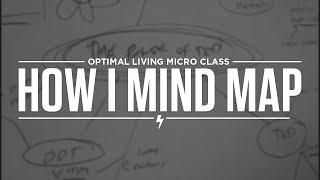
Brian Johnson shows how to mind map like your brain actually works, not in straight lines. He uses David Emerald's DDT and Empowerment Dynamic as an example, then walks through the practical moves: single keywords, the rubber-band metaphor for tension, baby steps to release it.
Chapters
Hey guys, what's up? Trust, you're doing great. This morning was flipping through my journal and found this mind map of this note. The Power of Ted by my friend David Emerald. Really good book, highly recommend it. So anyway, I taught a class led of philosopher's notes live on the book. And of course I used my notes as my guide for the 90 minute class that we have here in Ubid. And so I go through my note and kind of identify how I want to flow through it. And then I also often create a mind map of it. I'm not sure if you're familiar with mind maps, so I thought I would give you a very quick overview. The basic idea is that your brain does not work in a linear fashion. So your brain doesn't go, you know, a and then 1 and 2 and then B and 1 and 2. I always hated outlining stuff when I was a kid, you know, and you had to do the chapter outlines and stuff. The idea is here, this is very linear, right? Your brain doesn't work linearly, though. Your brain works much more like most things in nature work, which is imagine a flower, right? So you get a flower with a petal and a petal and a petal and a petal and a petal and a petal. Or imagine a neuron. So you got a neuron in your brain and it's got all these dendrites. Oops, helps if I get it over there. All these dendrites, right, that are coming off of it. And you've got another neuron with all of its little connections that are going on. They're all connecting in all these different amazing ways. Here's another one. An infinite number of different connections can be created through the way that nature has architected itself in our brain and in every other facet. So, so the idea of mind mapping is to mirror nature, right? And to map your mind and to map, in this case, the power of ted. So what you do in the mind mapping concept, and you can learn more about this from a guy named Tony Buzan. If you google Tony Buzan mind mapping, you'll learn more. But the idea is this most simple way to describe the idea is start with the major idea that you want to discuss or you want to map out. So for me, it was the power of ted, right? Now, in the power of ted, there's a couple of different things that we need to know. First, there's ddt, right? So ddt, that's the dreaded drama triangle, okay? This is what Ted talks about in his Great book David Emerald talks about. So in the ddt, what do we have? We have three different facets. We have a victim, we have a persecutor, and we have a rescuer. And I'm not going to go into the detail of the book, although that would be fun. I'll do that in another video. But those are the three facets that I need to be able to understand and communicate for the class to be effective. Now, the victim looks at problems, right? That's what I wrote down here. Looks at problems. And then the persecutor needs to dominate, needs to be right. Right. Then the rescuer needs to rescue the victim. So they need a victim, right? So anyway, these are just the ideas that I put down in order to remember it. And the idea of mind mapping is you start with a central theme and then you have ideas that kind of spring out of it and you want to keep it as simple as you can. So you have one words, right? So ddt. And then within that I've got this little triangle. I've got victim, persecutor, rescuer. Then I've got a, you know, a keyword or two that comes out of that, another one that comes out of here, and then I'll see that, you know, the DDT is juxtaposed to with the power of Ted, which is the empowerment dynamic, right? So I wrote that up here, the empowerment dynamic. And within that we have a triangle that's different than the triangle in ddt. We have creator, we have challenger, and we have coach. So then we can write over here, we can write over here, we can write over here. And then going further into the note, and again, using this as my guide and my understanding of the book as a guide, what I want to understand and teach today is how to shift, how to shift from DDT to the empowerment dynamic, right? So the shift occurs between a victim and a creator, between a persecutor and a challenger, and between a rescuer and a coach. And the question that you ask in order to shift is, what do I want? What's my intention? And is this person whole? So again, I keep on flowing. And then I have rubber bands up here, which is an idea that I pursued. Then I've got holding the tension, you know, between your current reality and your ideal. That's called dynamic tension. And I used rubber bands as an example in the class. I gave them to everybody and had them stretch them out, etc. Etc. Etc. And then you hold the tension and then you release that tension through baby steps. Right. Most people want to reduce their ideal. You want to hold it and then move forward with baby steps. So basically I have the book mapped out in, in a single page. And maybe eight years ago when I first learned this, I was doing triathlon and met a woman who had a 10 year old daughter who was struggling in school and I helped her out for a little bit and one of the first things I taught her was this. I taught her how to mind map and you can take a chapter. I remember working with her on a history chapter in her class and what we did was we looked at the major parts of the book or the chapter rather and then pulled out the elements and made it fun so she wasn't overwhelmed. You know, we looked at the, the pictures and the graphs and the charts and found the major things that were going on in that chapter and then we mapped them out in a really fun way with the mind map. And her C's went to A's and weeks and I went to the class and visited. She invited me to special Friends and Grandparents day and vividly remember the teacher coming up to me and saying to me what did you do? But I taught her to believe in herself and gave her a couple of ideas. This was a big one. So mind mapping is huge. I use it all the time. I use it for my business ideas. If I have a creative challenge, marketing ideas, all kinds of different things. So I highly recommend it. So if you have something that's going on in your life, maybe start with get out of this linear thinking mode, right? If everything's A, then this, then this and this. And let your brand, your brain kind of expand and just kind of doodle around and just see how different ideas extend themselves and connect to other places and all that good stuff. And again you can learn more about it. There's a lot more sophisticated stuff you can do with it. But this is how I use it in a really simple fashion and I thought I would share. So there you go. Power of Ted Mind map. Now today I'm going to do the science of being Great. It's the class I'm teaching this afternoon so I am going to go through this note and get clear on how I'm going to lead this discussion and then mind map it as well. Alright, Trust you're doing great. Sharing more soon later. Can't forget the potato wedges that just arrived. Yeah. From cafe. If you're ever in Ubud, Bali, go to cafe. Organic delicious food. Alright, have a great day. Bye.