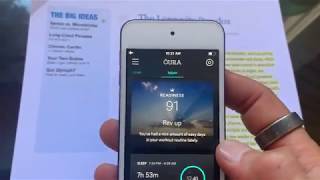
Brian Johnson (vlog) describes a personal experiment using an Oura ring to improve sleep-readiness metrics. After reading The Longevity Paradox (Stephen Gundry), he shifted his last meal to ~4 hours before bedtime (often eating as early as 3:33pm for an ~7:45–8:00pm bedtime) and observed substantial improvements in Oura-measured resting heart rate and heart rate variability within weeks.
Questions this video answers
Stop eating ~4 hours before bedtime (last meal often at ~3:33pm for a ~7:45–8:00pm bedtime).
March (year not specified in the clip).
Average lowest nighttime resting heart rate dropped from ~45–47 bpm to ~42 bpm (≈10% decrease).
Average HRV increased from ~47–50 to ~66–68 (reported as roughly a 30% increase).
Chapters
Hey guys, what's up? This is Brad. It's been way too long before I've done a behind the camera video. Here we go. Today I want to talk about my oura ring. There it is. Here's the app and a little hack I made after reading that book, the Longevity Paradox. Marie Forleo's new book is awesome, by the way. Of course, I created a note on it and in the note I said, hey, look, this might be one of the ideas that's most changed my life. Obviously I've done like 550 notes. They each have five to 10 big ideas, it's thousands of big ideas that I've experimented with, etc. This might be literally the number one lever I've pulled. That's saying a lot. So maybe it's just tied for first, but it's crazy. So long story a little shorter. Stephen Gundry tells us that glymph is super important. Glymph is like your lymph, only in your brain. In order for your brain to get properly cleaned, it basically needs space to operate. And that space is created where you wash your brain by not eating right before you go to sleep. Right. So he makes some really compelling case for why that matters. And I've known this for a long time, but I've, you know, I'd eat two hours before I go to bed, etc. But he said, four hours before you go to bed, four hours before you go to bed, you eat your last meal. I said, okay, well, I get paid to experiment with this stuff. I'll try it out. And the results that I saw as measured by my oura ring are literally just astonishing to me, specifically my resting heart rate and my heart rate variability. So I want to walk you through that right now and hopefully add some value. We're really pushing this idea with our coaches. We're training a thousand optimized coaches right now and also encouraging them to use whatever data they have, whether it's their watch or Fitbit or whatever. I happen to use the Oura ring. Michael, my right hand guy with the coach program is all into that. So we've been kind of advocating for the oura ring. Check out the link below. We've got a discount. You can get something like 50 bucks off, etc. I love it. But whatever you're going to use, see if you can connect decisions you're making like this to data. So very long prelude. Here's what I learned. Where do we want to begin? Well, I'll just show you the graphs, the curves are what get me here. So Aura, for those who don't know, it, records different variables via your ring, and it's basically trying to help you optimize your sleep. And, you know, I forgot to mention one thing, so I'm going to take a quick aside and I'm going to come right back. I use an ipod to track my Aura data. I rarely use my smartphone these days. I'm turning it on more, but I never used to turn it on. And I didn't want to have the app for Aura on my phone because that's connected to a ton of stuff that I don't want to activate when I wake up in the morning. So I bought this ipod, and we're actually thinking about creating ipods preloaded with the optimized Coach content. So this one's engraved optimize Coach, let's change the world. But I bought the ipod on this. The only thing I use it for is Oura, basically. So when I wake up, I plug in my Oura ring and then, boom, open the app. Here we are. I do not. I bypass my smartphone because I don't want all the things that get triggered with that. As we talk about a lot in our work together, Digital sunset, turn off your phone and then don't turn it on again until you've been creative before, reactive, et cetera, et cetera. And again, longer conversation there. Let's get back on focus. So Oura rings track your resting heart rate, your heart rate variability, and then other variables like body temperature, respiratory rate that influence Timex Watch, telling me to get up every thousand seconds. Usually I'll move, do whatever. We'll just make it a very quick up and down today. So Oura rings track data like your resting heart rate, heart rate variability, body temperature, et cetera. Each of these is going to be indicative of and predictive of your readiness for the day. So they go through their little algorithms and say, hey, look, your heart rate's higher than normal, your heart rate variability is down, so your readiness is going to be lower. Take it easy today. Or whatever. Today I've been kind of oscillating my training. So today it says, hey, you've had some nice, easy recovery days. Turn it up. So that's precisely what I did this morning in my. In my workout. Back to these graphs. So my resting heart rate last night was 40. All right. Heart rate variability was 72, which is awesome. I'm excited about that. And it shows you the daily, the Weekly, the Monthly, etc. But what I'm more excited about is how I pulled a lever and changed it. So look at this. This is my resting heart rate. I got the Oura ring in March, right? So what does that say? 46 was my average lowest resting heart rate. That's not, not my average. That's the average lowest during the night resting heart rate. And then it went down to 45, went up to 47. And then I started running this experiment based on the longevity paradox, glymph, et cetera, where I ate four hours before I went to bed. One change, one change took me from. And I go to bed at like 8, you know, so I'm 7, 45, 8. So I'm eating my last meal by 4, even 333 last meal crazy early. But then look what happened. My resting heart rate went down from 4547 to 42. That's a roughly 10% drop. And then it stayed there. Since I've made this shift. 42, 42, 42 is my average lower resting heart rate. And I've been really good with the experiment. There's been maybe one or two days over that period of time where I haven't done it. So interesting. Resting heart rate has just dropped. Exciting. Now let's look at heart rate variability and what we'll see is the same thing in the inverse curve. Heart rate variability is predictive of your recovery, your well being, et cetera, correlated to and predictive of, you know, how ready you are to go for the day. So you want that high, you obviously want a lower resting heart rate and you want this high. So then let's look at our little monthly dealio here. Same exact thing but the opposite direction. So my resting heart average, I'm sorry, my heart rate variability average in March was 4750. Frankly, I didn't know is that good or bad? I don't know. And then I did the seemed decent, right? I did the experiment, same exact time, right in here and boom, it went up to 60. What is that? 9, 68, 66. I was fighting something a little bit earlier this month with brought that down a little bit. 53 to 68 for the non math majors. That's like 30% increase. My heart rate variability improved that much. One thing that I did eating four hours earlier. So I just find that absolutely astonishing. That is what I wanted to share how I'm optimizing my aura ring data. Resting heart rate, heart rate variability. Hope that was helpful. Excited to do some more of these. Let's get our glimp going? Wash your brain. Obviously. More in the note. Awesome book. That's all for today. Make it awesome. See ya.