Journaling 101: Behind the Scenes
Brian Johnson walks through his upcoming Journaling 101 class, which teaches pen-and-paper journaling for clarity and confidence. He covers a five-minute daily practice, the Big Three priorities, and why handwriting beats typing. The course splits theory and live demonstrations of his actual journaling routine.
Chapters
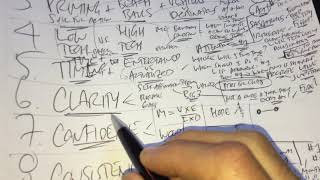
Hey, this is Brian. Good morning. At least for me. It is 7:30. I am 45 minutes into my second deep work time block this morning. After a nice little oscillation with the family. Super sweet. I'm Preparing for Journaling 101 by Candlelight no less. The sun is now up, but it was not when I started this party and I thought I would flip it on and give you a behind the scenes. I'm really excited about this class. It's going to be really fun and really the most kind of personal class I've done. I'm going to show you exactly what I do to journal and use my life as the example. And we're going to have two different parts to the class. So it's going to be how to use a pen and paper to create clarity, confidence and consistency. So we're going to have a theory section which will be like my normal way that I teach a class, Top 10 Big Ideas Theory. Then we're going to change the studio around and bring my desk out in front of the lights and set up and all that stuff and then shoot me journaling and show you how I actually journal. So I'm really, really excited about that. And the process that I use to create this class will be one of the main things that I talk about in terms of creative thinking and how I use journaling as a means to clarify my thoughts, etc. And I'm going to save, for example, all of my notes that I go through in the process. Usually I throw them away, which will be one of the ideas we cover. Should you archive or should you trash? I trash. I don't keep my journaling. But we'll have a fun discussion about that. Anyway, this is how this class has already evolved. It started with this really, really bad suck to unsuck, etc. Now it's getting a little tighter. Pretty exciting, but it's still going to go through a number of iterations. This is what it looked like as I was capturing ideas. Oh, that might be a good idea. Maybe not. Et cetera, et cetera, et cetera. And then what we've stumbled upon is our 10 big ideas. We're going to start with the why why journal. Well, let's get some clarity, let's get some confidence and let's get some consistency in our lives. Then we're going to talk about the Keystone Initiative. I just did a note on Atul Gawande's great book, the Checklisted Manifesto. We talked about it a little bit in Productivity 101, we're going to unpack this in this class. Both theory and then practice. I'm going to help you get clarity on your keystone, the three things that you do when you have great days. It's important. Then we're going to talk about the fact that journaling is really. It's about priming our soul for action. But we don't want to get caught up in over journaling. We want to use it just enough as a vehicle to our destination, not thinking that the journaling itself is actually going to get us anywhere beyond just kind of activating our energy. We're going to talk about beach balls, which I did a plus one on recently. We'll get into that in the class and how that relates to thinking versus doing. We're going to talk about low tech versus high tech. I do all of my journaling as low tech as possible and I'm going nuts right now. This candle is here because we're having fun playing at the extremes as professional optimizers in finding ways to reduce technology as much as possible. I'm seeing if I can step back into 1860s Ralph Wato Emerson style without burning my house down. So we'll see how that goes. But anyway, we'll talk about the fact that I think when you. When I arrive at a choice point, I use Drucker's methodology for decision making. Boundary conditions, he calls them. My boundary conditions are if I can do it without tech, I don't use tech. I always go low tech. And finding ways to systematically build it into our lives, I think is huge. If you need to use your smartphone to do your journaling, we're going to defeat the purpose of getting offline and going deep. I didn't turn my phone on for 10 days until Monday. This is the end of the week. But until the beginning of this week and got some trash guys outside. I'm going to shut my door or my window rather. So we need to pay attention to all the ways that we're connected to technology that we don't need to be. I think journaling is one of the most important ways to step back, get a nice pen and a piece of paper and get to work writing on your thoughts. We'll talk about the research behind how that deepens focus and clarity, etc. We're going to talk about time. How do you find the time? And then timing. When do you do it? We're going to talk about need to make a choice. Do you want to be entertained or do you want to be actualized It's a big decision that we want to get clear on. If you want to elevate your standards to world class levels, at least for your own personal actualization, you got to trade out some of your entertainment time for actualization time. That's when you can journal. We'll talk about getting clarity, getting confidence, getting consistency in detail in the practical side of things. And then we're going to have what I call a five minute foundation. A super simple process you can engage in for five minutes every day that will give you a foundation that you can rock. And then again, we'll talk about archiving versus trashing and then developing an idiosyncratic style. I have my style, you're going to have your style. You just need to test things, evolve, etc, etc etc. So that's the theory side of it. Again, this class is going to have two parts, the theory and then the practice. So the practice is going to include how to journal in this five minute foundation. And I'm going to show you literally in depth in the class. There's my thousand second get up and move. So I will move my body. There you go. Five minute foundation. We'll do an overview of it. I think there are three components to good journaling. This is literally my journaling from this morning. Right? So I'm imagining myself at 70 years old. My kids are older. I can imagine that right now I want to be their best friends when they're 30 and 25 years old. Well, I better be that now. Right? Then we've got the eulogy, virtues, the classic virtues, etc. What I'm going to do to create the things I need to do in order to hit the goals that I want to hit, etc. And then we're going to focus on what I think are the three essential things to capture in our journaling. Creating hope, the science of hope, the science of grit, and the science of self affirmation theory. Unpacking that in five minutes, Boom. Get in, get out, get back to work. But you primed your subconscious. You can do this in two minutes. And research shows unequivocally that this is one of the most powerful ways to boost your well being. So we want to do that consistently. Then we're going to look at our Keystone 3. These are my Keystone 3 habits. Digital Sunset AM1, deep work and then my rituals for movement. What are the three things you do that keep you most plugged in and that make you have awesome days? What are you doing when you're super on I call that your Keystone three. If that's the only thing you get out of this class is clarity on that and then journaling and tracking it, you're going to be doing really, really well. Then we're going to talk about our big three, the energy, family, service, etc. I'm going to walk through how I do this and help you get clarity on how to do it. Then we're going to talk about masterpiece days. Journaling to figure out how you create a masterpiece day. At the end of the day, that's all that matters. Can we consistently show up and have great days? Well, let's look at our AM one time block. Let's look at our PM one time block, or PM rather AM and PM bookends, and then fill it in. I'll show you how I do that and give you an idea of how to map that out and start getting more clarity on what your masterpiece day will look like, which will include, by the way, your big three and your Keystone three. We'll talk about that. And then we're actually going to move to the wall calendar, which lives right there. I'm going to pull that down, shine some light on it, and we're going to film how I walk through it. You can notice even from this view how messy it is, which I love, and how many smiley faces are on it. Well, maybe I'll count them to see how many are there. Then we're going to talk about whoop. And some of the things that I do most frequently when I'm journaling. This is like my number one thing, whooping. And I'm actually going to walk you through my number one goal right now of getting 100,000 members in our membership platform and what that means for me and how I break that down, wish outcome, obstacles, plan and be super just transparent and personal on this is how I do it. What's most important to you? Fill it in. Then we'll talk about another thing I journal often. It's abstract, but I love it. It's abstract on first blush, motivation equals value times expectancy over impulsivity times delay. If you know my work, you know I talk about this a lot. But we need to activate our energy. Do you really want it? Do you really think you can have it? Are you getting thrown off by distractions and delay? Obviously, I'll unpack that in detail. Then we'll talk about notes and how to use journaling to prep for conversations and then to capture notes during conversations. So this is my stack of notes from my conversations with Phil Stutts. So I'm going to walk you through this. This is day one of my first coaching session with Phil Stutts. These are the notes I took. This is a way to use journaling to capture our thoughts. We'll talk about the research that shows that using a pen and paper is actually much more effective than using technology, whether you're a student, in a classroom or anywhere else. And then again, we have my notes that I've been polishing. Oh, and then a couple other things we'll talk about. Fun stuff. So I don't have a to do list. I have fun stuff that I make a note of. And then I also capture things that come up. This is David Allen, GTD101. You got to get things out of your head and capture them. I do it in a bunch of ways from post it notes. This is literally things that I just came up with this morning. I'm curious, did Emerson use a candle or did he use a gas lamp? I don't know. I want to figure that out. So that's a little research thing. So I captured it. It's out of my head. Boom. Somewhat trusted system. Mine's a little rough, but we'll talk about that. And then finally, the tenth thing that we'll do in the practice side of journaling is purpose. So journaling for purpose. The thing that I've done the most is Jim Collins's hedgehog concept. Those three circles that intersect at what you love, what you can be great at, and what the world needs. That's how I arrive at my one thing. And then I focus. What do I absolutely love to do? So much I pay to do it? What can I be truly great at? World class standard. And then what does the world need? And how do I truly serve? Profoundly. I obsess about that. I've done that dozens and dozens of times. I'll walk you through how I do it, hopefully give you some insight on how you can do it. And that's a quick, somewhat quick, meandering look at what we're going to talk about. Can't wait. We'll be sharing the class in November and I'm fired up. All right, have an awesome day. And members, obviously you'll get it. If you're not a member yet, join us at Optimize me. It's only 10 bucks a month. We're told that's an astonishing deal. And you'll get access to 25 classes like this, hundreds of philosopher's notes, etc. If that fires you up awesome. If not, hope you enjoy all the free stuff and have an awesome day. See ya.






