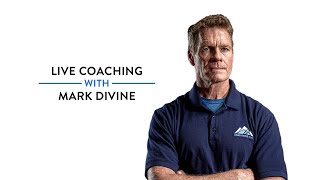
Mark Divine describes a three-part approach to leadership: wake up through spiritual practice, grow up through psychological development, and clear up emotional baggage. He combines Western psychology with Eastern meditation to argue that fear and other negative qualities can be eradicated through disciplined practice.
Chapters
Is it possible to, like, just get rid of the fear?
It is. It is at the highest levels of human development, you can eradicate all those negative qualities, which then allows your positive qualities, which are innate, to flourish. This is true in the spiritual traditions. It's, you know, it's talked about in the yoga tradition and Tibetan mental practices of Tibetan Buddhism and Zajin and Mahamudra and stuff like that. The idea is that the negative qualities are essentially programmed into us both epigenetically into early childhood and also through our social kind of languaging. But it's not natural. The only quality of fear that is natural is a primordial fear of loss of your actual physical existence. And even that can be overcome through practice. Naturally. We're born with, you know, these all. All these incredible innate positive qualities, such as the capacity for compassion. That's a really powerful one. Generosity of spirit, calmness, patience, peace, equanimity. These are really profound positive qualities, but they're obscured by the negative qualities. So this is actually a problem with positive psychology because if you just pretend to be positive by saying happy, glad type things, you're not doing anything to eradicate the negative qualities. So when you're not saying the happy, glad things, the negative qualities still are kind of stewing inside of you, right? So you've got to literally starve the fear by eradicating the negative qualities, by working on exposing them, understanding their root, and then re. You know, reacquainting yourself with the aspects of yourself that got wounded when that happened. And then, you know, basically recontextualizing that and adding a different energetic quality to the experience of the emotional energy that, you know, that is tied to that story. You know, that. Yeah, shadow story. So that's. That's the work of Western psychology. One of the, you know, greatest contributions to humanity is Western psychology. The other one is Eastern mysticism and spiritual or meditation traditions. You put those two together and you've got a one, two punch for developing mental, you know, highest stages of mental development, as well as emotional awareness and control. And that's really what we're looking for. You know, one of my mentors and friends is Ken Wilber. And I love how Ken even, you know, had to come to this conclusion through a long process of his own discovery. For a long time he was working on, you know, what we'll call waking up, growing up and showing up. Waking up is the process of waking, awakening to the bigger story of your life, which is that you're a spiritual being having this human existence that you're capable so much more than you're taught that you can awaken to this reality through, you know, through mental practices like meditation, concentration, and mindfulness. And then you can. Through that process, you can also trigger growth. But growth is growing up through the developmental stages, transpersonal developmental stages, that have been mapped in Western psychology. And most people get kind of stuck at the stage that their parents or their dominant culture. But we can grow beyond that once we have the map. Even just examining the map and recognizing where we are in the map, it can become a psychoactive process. So the combination of waking up and growing up are really powerful. But even if you're well on your way in those different practices of waking up and growing up, you can still get stuck if you haven't done or if you don't do the emotional work of clearing up your past shadow. So these three aspects work together. Wake up, grow up, and clear up your emotional shadow so that you can show up fully, authentically. Right. Excuse me. In your leadership roles and with your family and whatnot sitting tight. Thank you.
That was so good. And I just. I just so love and appreciate the way you integrate all these different wisdom traditions. Ken Wilber's brilliant is, you know, stages of development, Right. Talking about transcending and including a lot. But it's clear in your books. It's clear just in your response. And it's so important, you know, that we. That we not shy away from these different pieces of ourselves and do that emotional work along with the mental work on the spiritual work. It all kind of comes together. I love the way that you articulate that both in your books and here with us today. So.
Thank you. Unbeatable mind, Michael, is, I mean, essentially a program of reintegration. Right. So we look at the human as a whole, you know, the whole being. Right. And we look at the mind as occupying every aspect of the body, mind system. So, you know, but. But that's contrary to the way we're taught in Western civilization, Western academia, we're taught to look at these things as, like, separate compartments. We have the physical being, which is dissectable or examinable, like through neuroscience and brain waves and whatnot. And then we have, you know, then we have the mental piece, which is kind of like psychological processing. Right. And even that gets conflated down often to its physical correlate, which are like neuroscience, you know, the neuropeptides and the neurochemicals and, you know, neuroplasticity, for instance.
Yeah.
You know, the emotional piece. That's kind of something that, you know, is way off to the. The left. And, you know, you do it if you get, you know, if you have a problem or if your wife drags you by the ear to the therapist. Right. And then that may open up some emotional development. So it's also considered somewhat separate, like other. I have my emotional life, but I'll tuck that away and not have to worry too much about it. Hopefully it doesn't, you know, get in the way. Yeah, same thing with spiritual. Like, spiritual is more of a concept for a lot of people. Like, it has to do with a belief in a higher power. And we're going to, like, connect with that on Sundays when I go to church. So I look at all that and say, you know, what the reality is from my perspective is these are all integrated into one experience that we call life. You can't separate them. So you've got to address the physical, the mental, the emotional, the intuitional, and the spiritual, you know, all together. And so we'd like to train them all together so that we can access all of them, integrate them, and then operate from that whole mind, whole person perspective. And when you do that, then, man, life just takes on a much more rarefied, you know, form. And you have great care and concern and compassion starts to open up because you're really connecting to that courage vault that resides in your heart. And acting from that perspective and you're able to be much more present and, you know, bring more of yourself into your relationships.
Hi, this is Michael, the head coach at Optymyze, and I hope that you enjoyed that wisdom from one of our brilliant luminary guest faculty members. For more on Optimize Coach, head to www.Optimize.me. coach, it is time. Let's master ourselves, serve heroically, and empower others to do the same. Closing the gap between who are capable of being and who are actually being more and more consistently expressing the best versions of ourself. That is how we change the world, one person at a time, together, starting with you and with us today. And that, of course, is what Optimize Coach is all about. Head to this site for more information and to join us. Class three starts soon.