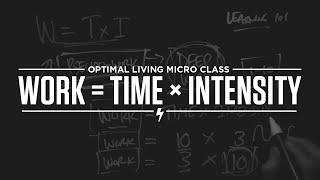
Brian Johnson breaks down the formula Work = Time × Intensity, showing how deep focus cuts hours needed. Intensity 3 takes 10 hours; intensity 10 takes 3 hours for the same output. The trick is maximizing focus in short bursts, then actually resting between them.
Questions this video answers
Work = Time × Intensity.
10 hours.
3 hours.
Chapters
Hi, this is Brian. Welcome back to another micro class. This one's on W equals T times I work equals time times intensity. It's inspired by how to become a straight A student. Cal Newport. Awesome book. Read it in Preparation for Learning 101 coming soon. Check that out. So the first idea in this book, how to become a straight A student while not grinding. Right? Not working all the time, is to master this equation. And he says the number one problem that students who aren't performing at a high level and or are working just grinding, is that they haven't come to realize that there's work and then there's pseudo work. Too often, too many people, whether they're students or professionals or are engaged in pseudo work. Ten years after Cal wrote this book, he wrote another book called Deep Work. In that book, he juxtaposes shallow work vis a vis deep work. So 10 years prior to writing this book, as he was talking to these elite students, he learned that they mastered real work rather than pseudo work. And here's the equation we want to have in mind to bring this point home. Work, like what you actually produce in your work equals time times intensity. So let's say that a student wants to prepare for an exam. That's the work they want to achieve. Proper preparation. Okay, cool. And let's say that's the same in both the examples we're going to use here. Now, if your intensity is low, let's say on a scale of 1 to 10, your intensity is a 3. You're doing pseudo work. You're distracted by your friends. Let's say you're in a dorm and people keep on coming in and out, or you're in the cafeteria and same thing, having different conversations. You're kind of sort of working at an intensity level of 3. And let's say it takes you 10 hours at this 3 intensity to do this work to prepare for that exam. Okay, now let's go through that equation again, and let's do it with someone who's actually deeply engaged in their work. And they show up with an intensity of 10, and they go find a place where they're isolated, where they're not doing pseudo work. They're doing deep work. They're not distracted. Their smartphones are shut off, and they're just in the zone getting work done. Now, with an intensity of 10, to produce this same amount of work, they only need to work for three hours. Three hours versus 10 hours. Because they showed up with a high level of intensity, they actually worked rather than doing pseudo work. This is the first chapter. It's a really big idea. You, you need to check in whether you're studying or working as a professional. Are you doing pseudo work? Are you doing deep work? And the whole point of the book was let's create more time to do the other things in our lives. Let's have a full, well rounded life. I love showing up with an intensity of 10 at work so I can shut down 10th hour Roman style at 4pm and be there, check out, just kind of enjoy an hour and then be fully engaged with my family, be completely offline on the weekends and yet do more than I've ever done in my life because I'm showing up with a 10 intensity and oscillating throughout my day. So check out where you're at consistently in your life one to ten. And when you sit down to study or to work next time, ask yourself, am I going to show up at a 1 or 2 or a 3 or 4 or 5 or a 10? And then remember the funny line, you may think you're at an 8 but you're really at a 2. Find ways to get to this 10. And then again, of course, remember, you've got to oscillate. You can't play at a 10 all day long. Cal says in another Big Idea, we cover max 10 for one hour and you need to take at least a five to 10 minute break before you can hit it again. But there you go. Work equals time times intensity. Let's get out of pseudo work, do some real deep work.
Isn't it a bit odd we went from math to science to history but somehow missed the class on how to. For some wacky reason, optimal living 101 never made the schedule. Of course, it's too late to go back and change that and you're too busy to read full time to catch up.
Yet.
If you're like us, you're all about optimizing your life and actualizing your potential. So imagine this. Imagine having someone read the best books on optimal living and pulling out the big ideas that can truly change your life. You know those sections you asterisk and underline and mark all up. Then imagine that guy me connecting those ideas to other great books and helping you apply them to your life today. Well, that's what I do with something we call Philosopher's Notes, where I break down each great book into a simple 6 page PDF, 20 minute MP3 and 10 minute Philosopher's Notes TV episode. Then imagine me taking the absolute best big ideas from those great books and sharing them with you in fun, inspiring, super practical, optimal living 101, classes on stuff like purpose 101, confidence 101, business 101, meditation 101, that sort of thing. You've got a personal trainer? I'm kind of like your personal philosopher. Ancient wisdom plus modern science plus common sense plus virtue plus mastery plus fun. That's what our optimized membership program is all about. We'd love to have you join us.