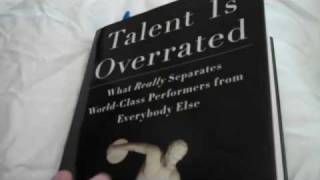
Brian Johnson breaks down why Mozart wasn't born a genius. His father Leopold trained him relentlessly for 18 years before his first major work, a pattern that matches what "Talent Is Overrated" argues: world-class performance comes from prolonged, diligent practice, not innate gift.
Chapters
How are you? It is Sunday morning. My love and I are reading in bed. Something we love to do. Today is a tech free day and we're actually going to fast today as well. Maybe have some juice and stuff, but pretty excited about that. So I'm reading Talent is overrated. What really separates world class performers from everybody else? I did a big idea on the last chapter last time, which was fun falling on your butt 20,000 times. You can see that video too. Now I am reading a chapter on talent, right? And the fact that talent is overrated. So the basic idea here is that a Mozart or a Tiger woods or any of these people are born with talent, right? They were born with a special gift to just do great things in the world. And he makes the case that if that's true, we need to look at the evidence. And if you look at the evidence of talent and musicians, chess players, things like that, hundreds of studies done, none of them point to an innate particular talent that was just manifested like that. In fact, if you look at a Mozart, which is why I turned on the flip cam here, it's pretty fascinating stuff. So you got Wolfgang Mozart, right? You think, my God, the guy was composing music at age five. That's just absolutely stunning. How does someone do that unless they were born a genius? Well, how someone does it is they're born the son of Leopold Mozart and who happens to be one of the greatest teachers of music of the era, who published a book on how to teach children music the same year that his son Mozart, Wolfgang Mozart was born. And then if you look at Leopold, his father's history, he stopped composing when he started teaching wolfgang at age 3 or something like that. And just fascinating stuff. So you look at it, and if you look at what Mozart did in his first, you know, X years, 18 years from the time he started training at 3 until the time that he wrote his first masterpiece at 21, that's 18 years of diligent training. That's amazing to consider because we have this idea that, oh, I'm just not good at it, so I'm not going to try. That's just nonsensical. The fact is it takes an incredible amount of practice and work to become a genius at anything. So there you go. And then the primary question for me and my exploration today and for you, I believe, and for all of us is what is it that we want to truly become great at? And it doesn't need to be something that we want to do to impress other people. It shouldn't be something for that. What is it that we're truly inspired to create, whether it's our own life that's a piece of art or mastery in a specific subject, whether it's music or parenting or business or art or whatever. But this idea that it's all about how much effort we put in is what this book is all about. And it's not always easy. In fact, it's usually pretty hard work, like falling on your butt 20,000 times that we did last time. But the question remains in what are you going to be great? What are you dedicating your life to? And just embracing that idea that it takes diligent, patient and persistent effort. I got that phrase from S.N. gwanka, who led a 10 day Vipassana retreat I did a couple years ago, teaching meditation. He said the practice of meditation can only be mastered if you work diligently, patiently and persistently. He'd say this phrase again and again and again and again. In a Burmese accent he'd say, work diligently, diligently. That how it went. Work patiently and persistently. Patiently and persistently and you're bound to be successful. Bound to be successful. He'd say that dozens and dozens and dozens of times. So it works in our meditation practice, it works in our relationship practice, it works in everything that we want to become exceptional at. We've got to put in the effort, we've got to put in the practice. So there you go. I could talk about this for another hour, but I'm going to wrap it up, get back to reading. What are you reading over there, darling? The New Energy Body by Natalia Rose. Oh, fascinating. All right, there we go. Nice lazy Sunday over here. Trust you're having a great day. Bye.