Optimize = Optimus = Best = Eudaimon = Hero = YOU!
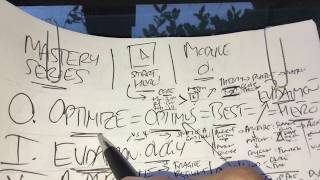
Brian Johnson introduces the Mastery Series: a 250-day program to move from theory to practice to mastery by cultivating virtues and practical habits. The program centers on optimizing three domains—energy, work, and love—supported by foundational practices (sleep, nutrition, movement, breathing, gratitude, hope) and modules on algorithms/habits, heroic quests, and daily bookends to build emotional stamina, antifragility, and sustained flourishing (eudaimonia).
Chapters
Hey guys, what's up? This is Bry. Tomorrow we kick off our Mastery Series. I'm pretty fired up. Of course, this morning's AM1 deep work time block was dedicated to preparing for this session tomorrow. Can't wait to see those of you who will be there if you can't make it. Obviously we're archiving and all that good stuff, but before I jumped into that, did the carpe diem journaling big three times too. Energy, work and love identities I'm committed to embodying the virtues I'm committed to embodying and what I'm going to do today to make that happen. Moving from theory to practice to mastery. And then we've got the new one that we talked about in the last video. Energy, work and love. And then gratitude, hope and zest. These are the three virtues science say are most highly correlated with our well being. Therefore, let's cultivate them, which is a big part, of course, of our Mastery Series. So as many of you know, I've spent half of the last 20 years as a founder, CEO, raised some money, built and sold a couple of businesses, and the other half as a philosopher, a lover of wisdom, reading, writing, teaching, repeating, and in the process created a thousand plus ones. 500 philosopher's notes, 50, 101 classes. But this Mastery Series is where we bring all of that together to help us truly move from theory to practice to mastery. Which is why we call it Mastery Series to get us to do all the things we know we can do. Why? So we can close the gap between who we're capable of being and who we're actually being. Because as we discuss all the time, it's in that gap where our regret, anxiety, disillusionment, ick, et cetera exists. Close the gap. There's no room for it. New experience with the ancient Greek philosophers called Eudaimonia, which is why our sequences optimize, which is from the Latin optimus, which literally means the best. And of course, in our case, we're talking about the best version of you. Optimize equals optimus equals best equals eudaimon equals hero. We don't stop at Yudaimon. We're going to talk about that in our next first module next week. But it's not enough to be the best version of you. We need you to give your gifts to the world to become a modern, everyday hero. The etymology, Greek for. Greek etymology for that word is protector. It's not killer of bad guys or tough guys. It's protector. So again, we become the Best version of ourselves. So we can give ourselves most fully to our families, communities and world. Optimize equals. Optimize equals best equals hudaimon equals hero. Now that all sounds nice. How do we actually do that and truly close the gap consistently? Well, this is the program. We start by stepping back and realizing the game we're playing. Eudaimonology is the word we use. That word literally means the study of a good soul. Eudaimon is good soul. Eudaimon. Right. Eudaimonology is the study of a good soul. Well, do you know what psychology means? Psychology is the study of a soul. We playfully say, look, that's nice, but we want to study a good soul. Right. A lot of positive psychologists been focused on kind of the negative aspects of human behavior. But let's focus on the positive. How do we create the best version of ourselves? We'll look at ancient wisdom, modern science, from Aristotle, who told us the summum bonum is to play this game well by living with virtue, arete, which is our philosophy distilled into one word to express the best version of you. Moment to moment to moment, you experience joy, a sense of deep flourishing. Maslow said the same thing. Ancient wisdom, modern science. He said what one can be, one must be. Then he told us, in any given moment, you're either stepping forward or you're stepping back. Choose wisely. Right. Realize I'm showing you the dinky dinky top level. I've got a page for each of those. Why don't we look at that real quick? So there we go. And then you got Martin Seligman. So his most recent book is called Flourish, Founder of positive psychology, of course. Well, that's a direct translation of Eudaimonia. You want to flourish, you want to express the best version of yourself. Well, how do you do that? He says the same thing. The underpinnings of the entire positive psychology movement is virtue, which is what arete directly translates into virtue or excellence. Expressing the best version of yourself when moment to moment to moment. That's the ultimate game. That's the essence of your demonology. We're going to talk a lot about virtue, the top virtues that are most associated with, well, being in the program and how to operationalize that. Then we're actually going to go from Module 1 to Module X. I'll tell a fun story about what happened last year when we taught breaking my arm. In between the first session and the second session, I had to get some screws installed into my arm, which provided me a wonderful opportunity to practice Our philosophy, we want to be antifragile, have antifragile responsibility, responsibility to be able to step in between stimulus and response. This is Stephen Covey's number one thing. Number one habit of seven habits of highly effective people. You got to be proactive. You need to be response able to. Viktor Frankl says, our freedom exists in that gap. So we need to get really good at choosing the best response moment to moment to moment to moment. And I'm going to suggest we want to be antifragile in those responses. We don't want to be fragile where we break, life happens and hard things happen and we break. Nor do we want to be resilient where we hold up longer and we bounce back faster. We want to be what Nassim Taleb calls antifragile. When we get knocked around, we want to get stronger. He says, imagine the wind. It extinguishes a candle, but it fuels a fire. That's the attitude we want to have. We capture that in a mantra. Oh, obstacles make me stronger. That's the essence of antifragile responsibility. That's going to be fun. Then we're going to get back to the regular programming and talk about the big three. Times two, times two. We'll walk through the origin story, how we came up with the big three of energy, work and love. Talk about Stephen Covey's roles and goals. Tony Robbins categories of improvement, awesome, but could be overwhelming. Then we have Freud, who says, look, a good life is about work and love. I agree. Only I would say you need the energy to show up powerfully in your work and in your love. Which is why we structure our entire program around you, optimizing across these three domains. Your energy, your work and your love. And you want to know too, that positive psychology says that the number one virtue most highly associated with well being is what they call zest. We would call it energy. So we want to get our zest, our energy, dialed in. That's our big three. Then times two, we have a carpe diem journaling process that I've alluded to a number of times that will walk you through and coach you on how to do it and encourage you to start doing it and then hold our coaches accountable to doing it on a daily basis. It's one of the main things we hold our coaches accountable to. You got to move from theory to practice to mastery today, which happens to be the next module. But anyway, we identify who we are at our best. Energy wise, work wise and love wise. Then we identify the Virtues. That version of us embodies energy, work and love wise. Then we look at what we're going to do today. What's the number one behavior we're going to engage in today? Again to move out of the abstract to the concrete. And then we've got some more fun on those top three virtues. Then eudaimonology module X and we got the big three times two. Then what? Then we need to know that today's the day. We need to move from abstract to concrete. We're going to spend two months, two months on how to seize the day. We have six different modules, we've got a big picture. We're going to talk about the fact that today is the day, right? And if you want emotional stamina, you want your highs to be higher, you want your lows to be higher so you can sustain a high level of well being and functioning and performance, etc. Well, then you need to know that the worse you feel, the more committed you need to be to your protocol. The worse you feel, the more committed you are to your protocol. That's how you cultivate what my coach calls emotional stamina, which I love. And then your highs get higher and your lows get higher. You're not going to be perfectly happy all the time, but your highs go up and your lows go up. You don't have bad days when you know what a good day looks like and you're committed to operationalizing that. Yeah, you'll have some off days, but you're not going to have the circus days of the past. And I speak as an expert in having many of those in the past. So six different sessions. We're going to have big picture. Then we're going to go to the PM and then we're going to go to the am. We're going to talk about bookends, AM and PM bookends. We're also going to make the point that your day starts the night before and this might be the most life changing idea. And the feedback we've gotten that people, oh my gosh, wow. I was just blowing up my night and then of course I woke up tired in the morning. So we talk about some very simple things here. Practices like digital sunset, turning off your electronics so you can get a good night of sleep. Prioritizing your actualizing over your entertainment. We need to make some fundamental decisions to create the energy to show up powerfully. Anyway, we'll talk more about it, but PM bookend, then AM bookend, you create some pre input wins. Then we optimize our energy, our work and our love. Again, systematically architecting that masterpiece day so you have more energized tranquility, less enervated anxiety. You get really productive when you know how to bring a high intensity focus to what's most important. And then we'll also talk about how to deepen your love. We talk about not only love 1.0 and 2.0, but 0.0, 3.0 and infinity. Taking care of yourself, your family, your community, encouraging others and loving life and all of it and seeing it as a gift. As you can tell, I get kind of fired up about that. Again. Two months, you're gonna be pretty good at creating masterpiece days to the extent you engage in the practices, et cetera. Then we step back in. Module four is Heroic Quests, the science of. We offer the fact that you have, for the idea that you have two different quests, a universal one that we all share, then a unique quest that's unique to you. As Maslow said, what one can be, one must be. Who must you be is the question. But we all share that universal quest. As David Brooks says in the subtitle to his new book, the Second Mountain, the quest for a moral life. That's what we're talking about here. To really tap into the best within ourselves, living with virtue, etc. So Quest, we'll talk about that then. We're going to talk about the science of grit, of hope, and of making your dreams a reality. A whoop process. And then getting into the nuts and bolts of motivation. We'll skip this now, but that's. These are themes we're going to come back to again and again and again and again and again and again and again and again and again. Then we move forward into algorithms, where we basically integrate three of our classes, Willpower101, Habits101 and Algorithms101, into four sessions to help you become an expert at using your willpower wisely to install habits that run on autopilot. This is the key to sustainable change in your life. What scientists would call durable change, right? Where you tap into your basal ganglia, your ancient intelligence, right? And you again use your willpower wisely to install habits that you don't need to think about. They run on autopilot. So we'll talk big picture. Bring Ray Dalio to the party. You all know a Harari to the party. They talk about algorithms, how this is the number one language of the 21st century and that we can 100,000x our performance via what Dalio describes as artificial intelligence. I'm going to say you can do the same thing with ancient intelligence. Use your basal ganglia hundreds of millions of years old. It just wants to know what you want it to do. And it will do it again and again and again without you having to think about it. So we're going to talk about big picture, then sessions on installing keystone habits and deleting kryptonite habits. What are the good things you want to install that you haven't been able to. We're going to go hit that hard. What are the bad habits you've been wanting to get rid of forever? Let's go get rid of them. What's this done? Let's go do it. And let's get good at the process of doing this so you can do it again. And if you want to become a coach with us, you can teach others how to do this. Then our head coach, Michael, will walk us through the power algorithms. We're going to challenge you to take an inventory of your top 100 current algorithms. If this then that how is your life currently being run? Then we're going to whittle it down to the top 10. What are the most important algorithms in your life? We'll share what we would propose as our most important algorithms and then challenge you to create your own version of that. Boom. That one's fun. Then we move on to the fundies. Right? This is two and a half months that we're going to spend on the fundamentals. Eating, moving, sleeping, po breathing, being present. This year we're adding be grateful and prospering. These are our seven fundamentals. Each one's going to get a session. After an introductory session, we're going to make the point. Look, I draw this little Maslow's hierarchy with a circle at the top to represent you at your absolute best. But you know what? It all starts with a really solid foundation. John Wooden and his socks we're going to talk about. You want to see how tall a building is going to be? Look at how deeply they're digging the foundation. You want a one story building, no big deal. Don't need a deep foundation. You want a high skyscraper. You want to reach your potential, you better dig deep and be into your foundation, your fundamentals and harness the power that's always there. All the power we need is always there. We just need to get out of our way, plug the leaks and start doing the things that help us really express that. Whatever you want to call it, divine power, infinite power, etc. But it's there. We're also going to talk about states and stages. It's really easy to do a program of whatever length, weekend, week long, month long, year long, and have a state experience, particularly over the shorter programs, which is why ours is 250 days. We don't want you to get shot out of a cannon, feel this unbelievable empowerment and then come back home and sometimes refilling even worse than you did before you went because you tasted it and you don't know how to install it. Well, we want to lock in the games. You do it by mastery of the algorithms, by mastery of your days and by mastery of your fundamentals. Again, we want emotional stamina via a very clear protocol. We're going to playfully say you want to head start on eating, moving, sleeping, breathing. We're going to go off on each of them, but stop eating sugar, stop eating ultra processed foods. We're going to challenge our coaches to reach their ideal waist to height ratio. One of the more challenging things, we have people in our program who have lost a ton of weight who for the first time, you know, saying they're at their weight when they were in high school or whatever and they didn't think they can get there. But we're going to implement these simple fundamentals and do some amazing things that are super, super inspiring to hear the stories from our optimized community, etc. Anyway, eating, moving. We're going to talk about moving, getting up every thousand seconds, which is why my little stopwatch goes off. Taking 10,000 steps a day. The science on on movement. Kelly McGonagall's new book, the Joy of Movement. Scientists actually know the number of steps you need to have to be depressed. You know, if you don't hit a certain threshold, the likelihood that you're depressed is like unbelievably high. It's like 4800 steps a day or something like that. And most Americans get less than that. Well, we're going to step up, literally and figuratively sleep. Leading researchers on sleep tell us, you know what? This isn't a pillar of health. This is the foundation. This is actually the number one most important thing, why we sleep. Unbelievably good book. We're going to prioritize that. And if you're like a different human, if you haven't been sleeping well and you start sleeping, great, then we're going to talk about breathing and being present. Breathing properly, in through your nose, down into your belly, exhaling longer than your, than your inhale. Great way to calm yourself. Energize, tranquility, etc. Being present, we're going to encourage meditation and teach that one minute floor again. Use your algorithms to install that practice. Science is unequivocal there too. And then being grateful, seeing life as a gift. Happy people are grateful people. They're not entitled. They don't think that the world owes them anything. They're grateful for the gift of life and everything in it. We want to cultivate that deeply. Then we cultivate our ability to go forward with hope, which is what the word prosper literally means. Prosperity in its etymological sense. Get up. We'd usually do some burpees now, but we'll pause on that for now. Prosperity literally means to go forward with hope, to prosper. We're going to talk about that in turning toward your challenges so you can experience higher levels of well being, etc. And notice here our fundamentals correlate with those three virtues. You want better zest, eat, move, sleep, breathe, be present and then be grateful and then be hopeful again. Operationalizing virtue, ancient Wisdom, Modern Science, etc. Then we wrap it up with Module 7, Optimus U. We started with optimize equals optimus equals best equals udemon equals hero. We end with Optimus U. Virtue embodied. We'll talk in depth about some of the virtues that we see as fundamental that are kind of lean into ancient wisdom, modern science. But at the end of the day, we want you to imagine the version of you that has energized tranquility, Energized Euthymia. Yes, you have a deep sense of purpose. You're not comparing yourself to everyone all day, every day, and you're feeling a deep sense of connection and energy as you move through your day. You also have a sense of calm confidence, that antifragility we talked about before. Confidence literally means intense trust in yourself that you can handle what life's going to throw at you. Then we want to extend that to others and be loving and offer heroic encouragement to ourselves and to those in our lives and our family, our communities, our world, etc. And then ultimately all this leads to that hero, which is via enthusiastic service. Enthusiasm. Another etymology lesson comes from two little Greek words. Entheos, God within. Want to tap into that life force within us, that soul force within us, and give ourselves most fully to the world. Optimize equals optimus equals best equals eudaimon equals hero. Moving from theory to practice to mastery is what we're going to do. Then we're going to challenge you to make a Decision. So all that's, again, really nice. And I was thinking about, what is it about the people who change their lives, like, fundamentally changed their lives in our program last year. And ultimately it came down to a decision. We all need to make a decision in life. We playfully call it the dojo decision. And when you walk into a dojo for the first time, you got a white belt on. Everybody's got a white belt on. But there's two versions of you that can walk into that studio. There's the version of you that's just going through the motions. You're happy to be there. You got a white belt and you know, that's fine, you can do that. But then there's a different version of you that's going for mastery. From day one. You know you want a black belt and you tell me which one of these versions of you is going to show up with a higher degree of intensity. He's going to get more out of those sessions. Right? There's obviously no question. If you're going for mastery, you've made the decision, I'm going for mastery. I'm going to do my best. I'm going all in on this. To go from, in our case theory to practice to mastery, you're going to achieve a heck of a lot more. So I just realized that it's that decision and also commitment, one of the big themes of the books I've been studying lately. Two out of the last three talked about commitment. The second mountain talked about the four commitments of life. And then Mark Devine's new book, the Seven Commitments, to Stare down the Wolf. But it takes commitment for us to realize that this isn't a dress rehearsal. It's time to wake up. It's time to get to that activation energy point. We'll talk about that. You get nothing at 450 degrees trying to make fire in nature. You need to be at 451. You want to boil water, you need to be at 212 degrees. Something happens. You reach a transformative state when you're willing to turn up the heat that high. Which is why Socrates says, you need to approach this like a man whose head is underwater wants oxygen. And why? Campbell quotes Ramakrishna, who says, you need to approach enlightenment like a man whose hair is on fire. A woman whose hair is on fire approaches a pond. You need a level of intensity to move from being a librarian of these ideas to being a true warrior of the mind, as the ancient Stoic philosophers talked about it, which is how Socrates framed it, which is how Gandhi framed it. The Bhagavad Gita, Gandhi's sacred text, is set on a battlefield. It's a warrior being counseled by a God to basically embrace his daimon, his inner soul, rather than his demon, his little small version of himself, and close the gap between who he's capable of being and who he's actually being. That's what it's all about. And then we've got some exercises we'll save for another time. Quick trip to hell and then to heaven, and some practices that we'll be walking through tomorrow. That's a long overview. Optimize equals optimist equals best equals udemy equals hero equals you. Let's do this.






