Pilar Gerasimo interviews Brian Johnson about Areté: Activate Your Heroic Potential
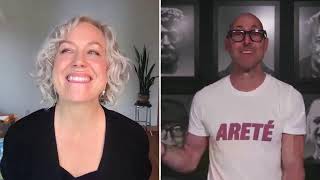
Brian Johnson discusses his new book Areté, which distills ancient Greek wisdom and modern science into 451 short chapters on expressing your best self. The book includes a QR code linking to the Heroic platform for guided social training, and Johnson emphasizes how community multiplies behavior change through small, moment-to-moment practices.
Questions this video answers
451 = degrees Fahrenheit required to ignite paper (metaphor: activation energy for change).
451 micro-ideas (short/pithy micro-chapters).
Know the ultimate game; Forge antifragile confidence; Optimize your big three priorities; Make today a masterpiece; Master yourself; Dominate the fundamentals; Activate your superpower.
Page 5 (the interview states the QR code appears on page 5).
November 14 (mentioned near the end of the interview).
Chapters
It says something. Oh, I'm so proud of you for putting this baby out into the world. And I know it's been a work in progress for quite some time today. I want to talk about the book. I also want to talk a little bit about the journey that brought you to the finish line here, because I know there were a few moments where you were like, you know what? I think this wants to be a different book than we were expecting. I actually realized I have to zoom out so that people can see the book. But now they can see it on your shirt, which is pretty fantastic. Wearing it loud and proud. And I believe you are always.
They can see it on my forearm. They can see it on the COVID of the book. We got the T shirt. I'm not wearing Arte underwear, but otherwise, I'm all in.
I was asking if you have, like, an Arte onesie that you can, like, wear for naps or something.
Sweatshirt over there. Let's go.
Oh, well, let me start back just a little bit, because some folks who follow my world and your world have seen us in each other's worlds for a long, long time. Decades now. You were on our podcast when we were doing the regular podcast. I'll experiment a couple times. You've been in Experience Life magazine, I think. You were a guest on my radio show. We've done interesting and cool collaborations together. But more recently, the work you've been doing with Heroic has been pretty all consuming. And let's just talk people back from when you moved into Heroic mode. Like hardcore from previous work with Optimize and Philosopher's Notes. And at what point in the middle of all of that creation of an app and a new personal developed platform, you. You decided to give this book a major chunk of your energy and time, because that's a pretty significant departure from where you were, what you were doing. Anyway, in my mind, it's a lot of additional work, so catch us up a little.
Yeah, well, I think that everything you said, you know, there's been a lot of iterations for me since, you know, we met one another, I think, two decades ago, literally, which is hard to even believe. Time flies and you're having fun and the gray's coming in. Let's go.
A lot of gray. In my case, it's so good.
So good. Every time I see it, I'm just struck by the beauty of the owned silver there. So for me, it's not so much a departure per se, as an extension and an important kind of encapsulation of my life's work. So as you know, I've spent half of the last 25 years as a founder CEO, built and sold the two social platforms before Facebook. And then when I wasn't doing that, I was reading and writing and thinking and teaching and became a philosopher, a lover of wisdom. Did the heroic coach stuff, the philosopher's notes, et cetera. And then heroic brought it all together. So on election night 2020, politics aside, woke up and said, look, I've waited for 17, 18 years for someone to create an answer to the social dilemma. Tristan Harris's great documentary on Netflix about the unintended catastrophic consequences of attention, economics and in social platforms. And again, we had you interviewed me when I was running ZODs, which had a quarter of a million people in it before Facebook 18 years ago. So had that platform endured. It died a sad death, as many startups do after we sold it to a publicly traded company. But anyway, heroic was born. That night, election night 2020, we did the crowdfunding where we were blessed to have the support to make history as the first company to ever raise 5 million. People were hungry for heroes. They want to see a different, a better world, you know, and they believe that we can help by creating this social training platform. But the vision was always to bring the book to life and I've waited for a long time to do it and it's really the distillation of my life's work. So it was a big lift. But Patrick, who's behind the scenes here, and Michael and Jana and our team and of course our publishing partners did a lot of the lifting with me. And essentially it's a best off. It's 451 of the absolute best ideas I've ever studied over the last 10, 15, 20 years. Micro chapters, these little ideas, hopefully any one of which can help improve your life and in aggregate can help you, as per the subtitle, activate your heroic potential. But I've waited a long time and we're really excited about it. I'm proud of it. And now we're all in on we hope that it will help catalyze our movement as a concrete thing. Like people, they pick up and they read books. It's easier to describe and to understand than an app, which is kind of abstract, you know. So that's now a long answer to your short question, but some of what led us to where we are today with the book.
Oh, well, I'm really glad you mentioned the thing about the physical book, because I agree with you that while apps and interactive tools can Be really helpful. Like, you know, Fitbits and Oura rings and all of that can be really helpful. There is something about having a tangible object in your hand, and particularly you talked about the attention economy. There's something personal that happens when you are on a page and you can turn a page and get to the next thing, but it doesn't suck you in in a kind of abusive way that I think electronics do. So there's a purity to my attention when I'm dealing with a physical object. The other thing about it, which I really like, as you mentioned, the format, it's these very short. It's like a devotional, really. You can have these individual pages that you could read one a day or. Or one when you have a moment, like with your morning minutes or whatever. But I described with my book, like, I want people to feel that just by having it in the room with them, there's a transmission, there's a talisman kind of quality to it of, like, remembering. And the title, rha. We have to talk about that, like, what that really means for people who have not yet dived into the whole thing. It's a call really to, like. With my book, Healthy Deviant is a call to an identity of, like, remember, I can deviate from unhealthy norms. Arete is a call to action in and of itself. Just the title, just the T shirt. Would you talk a little bit about what it means for folks who are unfamiliar with the rallying?
Yeah, there's so much in what you just said, but, yeah, so we'll go straight into arte and then kind of dance around, I imagine. But the way I'm framing it up, I was just at the Conscious Capitalism event last week where we spent so many, you know, great moments of conversation over the years. And, you know, we brought the books and I literally personally handed it to, if not 100 people, a lot of people, you know. And so the way I described it was that arete is the one word answer that the ancient Greek philosophers like Aristotle and Plato and Socrates and the ancient Roman Stoics like Aurelius and, you know, Epictetus and Seneca would give to the question of how to live a good life. So arete is literally their single word answer. We translate it as virtue or excellence, but it means something closer to expressing the best version of yourself. Moment, moment to moment to moment. And the way that I like to describe it is if you're capable of being this, you know, version of yourself and you're actually being this, and there will always be those moments, but it's in those moments in which we're not expressing the best version of ourselves because of, to your point, oftentimes, the habituation to the unhealthy cultural norms that it takes heroic courage to deviate from them and to be that healthy deviant. But when there's a gap, that's where regret, anxiety, disillusionment, you know, all the other things exist. And again, it's more nuanced than that. But in those moments, and if you aggregate enough of those moments, you want to give up, you want to numb yourself, and life becomes really, really hard and it loses a lot of the joy. Now, if you close the gap in any given moment, again, never perfectly, but more and more consistently express the best version of yourself, there's no room for all that negativity. You feel a deep sense of what the Greeks would call eudaimonia, which means good soul, a deep sense of joy and meaning and purpose. And you do that by living with Arete. So that's my life's work. It's why I tattooed my body with it. We were going to call the book something else, you know, and I'm like, wait, wait, wait, wait, it's Arete. You know, in a word, it's arete. Oh, but it's not even an English word. How do you pronounce it? How do you spell it? But this word should have never left our cultural vernacular. From my vantage point, you know, it's such a precious, beautiful, sacred word. All ancient wisdom, traditions, modern science, affirm this idea and confirm this idea that a good life comes down to being your best self in service to something bigger than yourself. And doing so is a 2,500-year-old challenge. Hercules was a, was a healthy deviant. He was seduced, you know, like the goddess of Arete. When you were holding that book up and you're talking about a taoisman and purity, you know, Arete was a, was an ancient goddess, the goddess of virtue, and she was the one who counseled Hercules when the vice of. I'm sorry, the goddess of vice who pretended she was happiness, tried to seduce Hercules. This is a 2,500 year old challenge. Yeah, but you are literally in many ways the embodiment of that forming. I've shared this with you before with your Greek origins and that beautiful, you know, austere, great silver hair. Oh, so good. But anyway, we tried to represent that in the book, by the way, to capture the elegance, the simplicity of the goddess of virtue, of Arete. So, you know, that was that was part of the important visual design. Again, long answer, but that's arete. And why it's so important to me.
Well, that, that piece about, you know, I think now that phrase, you know, best self can be kind of tossed off as, you know, it's a little Oprah mixed with whatever the kind of self improvement zeitgeist of a certain era. But I do believe that the misery of our lives lives in that space between what we're called to be and what we show up with. And we show up with what we show up with because of trauma, because of conditions that are not ideal in any way, shape or form, nutritionally, environmentally, socially, politically, environmentally. And there is a kind of elation that occurs when people close the gap even a little bit. You know, it's a lot of the stuff we've both studied with BJ Fogg's work. The kind of insights about small wins on a micro moment by moment basis, day by day, are what get you there. And sometimes I think that it becomes a bludgeon and a self limiting thing for people to have this vision that's so far out, away from them that they want to be, let's say a you, you know, know, oh, Brian Johnson. And I get this. People like, I want what you have. I'm like, oh, I don't know. Do you want what I had in the 15, 25, 30 years living up to this? Do you want what I had this morning when I was sitting there with a cup of coffee being like, I don't know how to do this, I can't make it work. And I'm really sad and sorry for myself because those are the micro moments that I have to bust myself out of, just like I know you must. And I think that that misery that exists between the two lines can convince us that the only way out of that is just magically be here. And I really think it's like that journey that we go through going, I can show up a little bit differently. I could apologize sincerely. I thought of you. Actually, just a couple days ago, I had a micro argument with my younger sister, who is the dearest, most wonderful human being. And sometimes being sisters, we trigger each other. So she said something and I said something, and she thought it was a little judgy. And I thought the way she was saying it was a little judgy. And we like, we stepped away from each other. I swear to God, it was about 65 seconds. And I was like, this is not who I am. I do not leave a conversation with My beloved little sister like this. And I went back and I just said, you know, I want to talk about just what happened. That was funky. That wasn't really how I wanted to land. And it was like the sweetest moment. But that moment could have ruined my whole day if I had walked away. And there was a time in my life where I didn't know better and I would let those things fester. And sometimes it's with other people, sometimes it's with us, sometimes it's in that space. The argument between. Okay, so I want to say that all in affirmation of the beauty of life is in the journey from here to here too, on an ongoing basis. And I feel like part of the way that you designed this book, I think with these smaller, you know, big ideas, but divided into small pieces, is kind of meant to meet people in that smaller space. Like from here to here, you can grow quite a lot. Talk to me a little bit about that format change, because I remember actually blurbed the book based on a bunch of things that I'd seen in the intro and everything before the book came out, though you made a pretty significant pivot partway through. Talk about that for me a little bit.
Yeah, well, first I want to highlight, if I can, just that it's a moment to moment thing. The hero's journey, the heroic quest isn't a once in a lifetime thing. It's not a once in a decade thing. It's not even a once in a year thing. And it's not even a once a day thing. It's actually moment to moment to moment. So for me, my example would be we can start a stopwatch rewind within the last 24 hours and you'll find little micro moments of that. With me, I have an 11 year old and a 6 year old, very high energy. I have a very intense, opinionated wife and I'm a very intense, opinionated guy. So, you know, it's not about perfectly getting it right. It certainly isn't about shaming yourself because of the gap between where you are today and where you think you should have been. That's a source of great suffering. Nor is it about always looking forward and not appreciating where you are. The reality is what I'm thinking about here is like a really engaged, heroic Eckhart Tolle power of now. But what does that mean? But I think when we look at it and say, look, in any given moment, we have an opportunity to step in between the stimulus, our stress or overwhelm or whatever. And choose a better response. As Frankel said, in that gap between stimulus and response is our freedom. But anyway, for me, I do the same thing. I call it repairing, based on Dan Siegel's work of, oh, shoot. And then I model it with my kids. Oh, I just flipped my lid, he says. I got impatient and this led to that. And I'm sorry is the quickest way to repair. And if I could rewind, I would have done this. So that's, that's a big practice for me. And a really important thing to emphasize that we're not talking about photoshopped, airbrushed. I'm perfect. And boy, if you work harder, then maybe one day you'll be as perfect as me. Bring my, bring Alexandra in here. She'll tell you. And so that humility, I think is important, but I love the way you framed it up. But it's a moment to moment to moment heroic quest. There's always that voice literally begging us to be our best selves. We just need to more consistently embrace that. And, and, and before I get to the book, BJ Fogg, in one of the early chapters, I talk about this. Most people think because they failed to change their life, were to change X, Y and Z, or X, Y and Z behavior, that it's a character flaw, something must be wrong with me. He makes the really important point. But what if it was a design flaw? What if you've never been taught how to actually effectively change your life? And what if we approached it with compassion and excitement and not as a chore, but as a gift you're giving to yourself? And then we got good at it, and we put in the effort to master a craft of behavioral change. But there are certain tenets, design tenets that we can employ that will make it a lot more fun and easy to change our lives. But that arose for me while you're reflecting on that, and I'm happy to immediately go into the book, or do you want to talk about that? I just got a lot.
No, no, no. I mean, we're going to be talking about the book. We have a while to talk about the book. But I will say, I think, you know, one of the points I make in my book, too, is that relative to the design issue, is that our behaviors, our choices, are constantly being designed by the society that we live in in this unconscious sometime way. But we often fail to remember that this way that we're living now is one that predisposes most people to making less than ideal choices all day long, to having Less than ideal reactions to having post traumatic responses and reactive responses, and then robbing us effectively of a lot of the more conscious opportunities we might have to make choices. So in the healthy deviant, I talk about the fact that there were 2.5 million years of human history where we lived as hunter gatherers, mostly in tribes of mutual support and survival, and our behaviors were designed into our days. We learned certain skills. There were elders who were there to call us on our bullshit if we were acting out and behaving in ways that weren't in the best interests of our own and other people's survival and thriving. And we learned from our parents and grandparents and their grandparents, very up close and personal on a daily basis how to live. How then must we live? This is how. This is how grandma, great grandma and so on. Now we're living in ways where there is almost no models for, you know, in our intimate world for people who know how to live successfully under the circumstances we are living in now, which are unprecedented and fast changing. So it's interesting, you know, when you look back to the Stoics you mentioned, the whole, you know, chorus of them true in all of that is that those are strategies for living that have worked well for millennia, you know, including not so far past the agricultural revolution, but even so, applying Stoic principles in the current universe that we're living in, with the distractions of electronics, with the incursions of messaging that gets us everywhere. With you mentioned the 2020 insanity of the election cycles that we go through and the kind of results of that, the frenzy, the response, the anger, pulling people back into moments of choice, moments of clarity, moments of belief that they can do it, I feel like is a very different job now than it might have been at the time of the Stoics. There's more noise to overcome, there's more friction, and I think there's more cycles of trial and failure. Fast cycling a trial. I'll try a diet, I'll try a workout, I'll try a program, an app, a ring, a thing. And when people have those repeated experiences of not living up to the ideals or standards that they've had, and sometimes it's reading stoicism, you know, it's like, this is who I want to be. That try, fail cycle is such a devastating, de energizing place that unless people find the baby steps out, I think it can feel like the chasm is just too great and that learned helplessness sets in that I can't do it. This is just for other good people. Who don't have this character flaw. And I think that's the. You're doing a really wonderful job, I think, of disillusioning people. Like you're taking people out of that illusion into small scale opportunities for change and success and for Arete for like closing that gap. That's beautiful. Okay, so now let's talk about the format though, because I do think that's a significant important in the service of this.
Exactly. I was gonna say the perfect segue back to it is. So, you know, I thought I would write a standard, you know, 200 to 300 page. And I don't mean to disparaging, but oftentimes fluffy book. You know what I mean? Here you go. This is a book. And I started writing that I was like 70% of the way done with it. Longer form chapters and all this different stuff. And I actually asked the team, I was kind of at a point where I'm like, is this really my book? The book that I really want to write and that I think needs to be written? And my style, as you know, is very pithy. It's very in and out. More Steven Pressfield, you know, war of art style. A page or two or three. And it's just kind of how I've evolved my style. But anyway, I asked the team, hey, what's the idea or two or three or whatever you come up with that has most impacted your life that you picked up from. From me and from my and our work and, you know, Patrick, who's on behind the scenes right now, and Yana and Michael and a number of people shared ideas and some had 3 or 5 or 10, Michael had 50 or 100. But the thing was, they were. None of them were the same. So Yana said, oh, these 10 ideas were unbelievable. You know, Patrick's like, oh, these ones are unbelievable. And Calvin was like. But there was very little overlap, surprisingly between and among them. And so it just struck me that the book that I wanted to write needed to be my book and it needed to be different. And I wanted to create basically a compilation of the absolute best ideas organized around the seven objectives that didn't change. The seven objectives that we have created that guide our coaching program that has been scientifically proven to help people change their lives. The app, everything we do, has seven objectives. Again, so parallel to what you teach the object, knowing the ultimate game and all these different things. But then I wanted to have fun with it. So then how many ideas? And then the 451 it was going to be certain different things. But 451 is the number of degrees Fahrenheit one needs to reach in order to activate a fire, to ignite a fire. So there's a scientific term called activation energy where one thing becomes another thing at a certain threshold that must be met. So if you want to boil water, 200 degrees won't do it, 210 won't do it, 211 won't even do it. 212 degrees precisely water begins to actually boil. Now if you want to create a fire, nothing happens until you reach 451 degrees Fahrenheit. Then paper will be ignited into fire. So the idea was here are 451 micro ideas, any one of which may help you change your life, but in aggregate will hopefully, as per the subtitle of the book, activate your heroic potential. So that's kind of how we evolved. And it's a, it's a thousand page book. I mean it's the playful thing is it's, it's War and Peace meets the. Meets War and Art. War of Art where it's pithy microchapters, but it has a, a little gravitas to it, a weight to it, which we wanted. And we wanted to create something that was just different aesthetically, design wise and, and kind of a felt sense. You can pick it up and start anywhere you want, or you can start from the beginning and read through. But that's the idea. More wisdom in less time via these little chapters that I haven't said it out loud, but ancient wisdom and modern science, that's kind of my thing. Ancient wisdom, modern science, frankly, common sense that needs to become common practice and then give people the agency, the hope to believe that they can do it. Which is another big part of my work is no, no, no, you're closer than you think it's going to be. It's not going to be as hard. It's going to be harder than you want, but not as hard as you think is kind of how I playfully set it up, you know, and then we just need to get to work, give it time and let's aggregate and compound these small little gains in community, by the way, is another really important aspect of, of my work, our work. And then we can do it. And by the way, we must do it. So, you know, the idea of being heroic means something very specific to me. But from my vantage point we're facing historically significant challenges. I think when we look back 500 years to this moment, goosebumps. It's a time that is demanding each of us to step up, be healthy, deviant, to show up as our best, most heroic selves, prepare, protect the things we value, the values, the virtues, our families, our communities. And if not us, then who? You know, and if not now, then when kind of thing to truly operationalize these ideas in a practical, grounded, everyday kind of way. That's again now a long answer to your question about how the book evolved, but what we're excited about.
Well, and back to community. We've got some really lovely comments from folks. Rosie says, wow. And also, amen. She's one of the members of my community. And here's Rebecca who's saying, guess what? Didn't realize you had a book coming out. Woo hoo. Now we know. That's wonderful, Tony. Who says, I've only been here a couple minutes, but already I've heard a ton of gems. I really needed to hear this today. Thank you. Oh so great, Tayo. Maybe I can't tell me if I got that wrong, but Cher, your loved ones need to hear this. Let's get to a better world together, guys. Right on. Yeah. Oh, and here's another. This is really neat. So I, I will say too, I think, how do I, how do I articulate it? What you were saying about it's going to be harder than you want, but easier than you think. You know, I, I remember if I, if I cast my memory back to my own journey, oftentimes there would be a period of months or years leading up to a state change for me where I would get progressively more miserable. Like the pain would build up, you know, disappointment in myself, the physical discomfort of carrying around, you know, whatever I was. And then it would be like some state change would happen, pressure might build up or an opportunity or a catalyst would arrive. And in my case, a lot of the times what they were were these little small scale experiments. Sometimes I would hear a conversation like this and I'd be like, oh, in that moment, you know, I could leave my unopened mail in a pile on my counter or I could open the mail and like put in recycling. What needs to be the recycling. I would complete this one little task and I would be like, oh, that was actually easier than I thought it was going to be. What else might be easier? Maybe cleaning my bathroom, maybe, you know, doing some push ups or whatever. And what I would often find was that it was like a little sweet swinging a door or something and there was resistance on the very front of it. But once you started going swoo, you'd get the good going swoo. Once you started going through, you get the swoosh. And that was sort of, you know, how, like, it leaves wind when people are going around those. Those revolving doors. You can create your own. I felt like I could create my own tailwind, but I would forget from time to time. There could be weeks or months or years initially. And as my journey continued, I got less rolled over by these long periods and more inclined to be like, no, no, no. I know how this works. I conduct an experiment where I see if I can bust myself out of some small rut or some habituated behavior that isn't working for me, or an attitude, even a mental attitude. And instead of being angry and frustrated and blaming and victimized, I could shift into a what if? Like, what if I did it differently? Even if I feel this way, what if I just did it anyway? Acted like a person who cleaned her bathroom, you know, maybe just the mirror. And it was incredible to me how often this seemingly big change, that activation could happen from, like you said, from 450 to 451. Two very different things. And it reminds me, too, Brian, of this scene I use a lot in my own presentations of Castaway. And Tom Hanks is the character who's, like, he's marooned on a deserted island, and he doesn't have any outdoor skin or survival skills, and he eventually has to figure out how to make fire or he's gonna die. Realistically, he cannot survive without it. And the scene where he is learning to make fire by basically rubbing two sticks together is painful initially to watch because he's just not getting it and injuring himself. And he's sweating. And finally he has this insight that a little bit of air got through a crack in the wood and it pops off and it's like a little bit of fire, but he's like, oh, my God, the air got to it. And he suddenly has this instinct and awareness that, of course, fire takes oxygen to burn, but now he does it, and it pops off, and it's just like. It changes everything. But if he'd given up one, you know, before that, the crack wouldn't have happened, the oxygen wouldn't come in, and he probably would have just perished. No fire on the deserted island. And I think we have. When you say community, I think one of the greatest values of community is that we encourage each other to remember those moments of, like, just a little bit further. Try just another way. Maybe it's just a state of grace that's going to happen tomorrow or you know, with addiction it's one day at a time and the some moments seem so difficult that they can't be gotten through and then the next minute it's behind us and it's a story we're telling. So I think it's pretty powerful stuff. And back to the format. I think the combination of lot and lot and lot, a little entry points into a bunch of very big ideas is a. Is a very generous way to interact with audiences of this time. And for my book too I was like five parts, open it wherever you want. I have a lot of people in my community now kind of oracle reading, which I'm a big fan of by the way, where you open the book and just be like. And I can see how with Arete, that could be a really fun game to play. Like what do I need to know today? Ballet anyone? I can't wait to find out what that's about. So how has response been from your early readers? What are you hearing back from people?
We're so blessed. Everyone has been so gracious. We've sent out a lot of advanced reader copies to people that have bought kind of the pre order or whatever. The feedback's been great and affirmative of exactly what you're highlighting. Just that. Again it's ancient wisdom, modern science and just common sense that's made into a practical set of tools. I'll tell you what, we've been blessed. You wrote a beautiful endorsement for the book. We've been blessed to receive a number of endorsements, some of which make me blush. But the one that frankly most struck me was a new friend of mine who's a military officer who left the book in his car in his 11 year old son soccer tournament for his brother or something. 11 year old son found the book, picked it up and stayed up late on a Saturday night reading the first hundred pages. He was so engaged. So gives me goosebumps saying that like I'm like oh, that's it. Because I dedicate the. To the reader who is the hero we've been waiting for. My wife and my kids and then the reader's kids, if they have them, you know, and this idea of raising the next generation of heroes. So that's the. Frankly the feedback I'm most proud of is to be able to create something that is engaging enough for an 11 year old who clearly is interested but finds it compelling. Which has been a big part of my work is to try to make self development in this idea of becoming our best selves, not the manic extrinsic fame and wealth and hotness. I'll teach you whatever. I think it's actually a pretty good book. But to be rich and all the other things a secret and all this stuff. But to make the heavy stuff, the virtue stuff, the real important stuff with gravitas that matters, the hope, the meaning and the virtue based living compelling and exciting and interesting and the most powerful and fun and important game that we could play. So that's been some of the feedback and again, just feel blessed and, and excited about it. I mean, I'm proud of it. We worked hard. I've worked hard for the better part of half of the last 25 years putting this thing together. And we're really, really, you know me, I've been a hermit, you know, I've been in bullet, a bubble wrap, just kind of reading and writing and thinking and whatever. Everybody else can go promote you. I'm like, no, I'm all in. We really are excited about this as a way to help catalyze our movement, we hope and. Yeah, so that's where we're at.
Well, we would be remiss if we didn't talk about the movement and about the platform, the app, the community that you've been building. Because I do think choosing to live this way is a departure from so called normalcy. And I often talk in Healthy deviant World. You know, we talk about the importance of first becoming aware, amplified awareness. Second step is preemptively repairing yourself so that you don't get overwhelmed by the damage that's being done to you by being in an unhealthy culture. The third part of it is raising your game. And this is a big chunk of what I feel like. This is a great guidebook to day by day how to raise your game while also building your awareness and repairing yourself. But for me, the fourth part is phase I call be the Change. And in phase four of My Healthy Deviant. You work phase four.
You did that artwork as well?
Yeah, I made the little guy. Everything has a little image. But this is about stepping into your healthy deviant identity and about gathering and building your own healthy deviant community or your arete community, your heroic community, if you are, if you are hoping to elevate yourself. It's purely selfish for me honestly to surround myself with as many other people who are walking this path as I can because I need the, I need the buffering from the unhealthy world. I need the encouragement on a day to day basis and I need the proof of concept over and over again that, yes, these small scale decisions that we're making on a daily basis do make a difference for me and for other people. I get inspired all the time. People like Rosie. Oh. And she says, look at this. It's amazing the difference encouragement makes. Yes. And I get encouragement from those folks. Here we go again.
This, this is amazing, by the way. I'm loving this. Let's go.
I love this. See, every. Every single person I love. And telling other people about the greatest thing that you've been lucky enough to discover is so generous. It's also selfish. Like, I want to like program reality in the best possible way. And it's each of us casts, you know, it's like if you've ever seen. Remember during COVID when they would show us like what a cough does on an airplane like you. And it's just like the microbiome of that kind of bad version of contagion spreads. The same thing is true of our positive contagion. It's. It really, if you get a density of enough people kind of positive bouncing positive germs or vibes off each other, it's catching. And I do think like, whether you have your own biological children or you just look around and care about the generations coming up with you, you know, whether they're plants or animals or people or forests or the climate, whatever, if you give even a small crap about any of that, knowing that the small daily decisions that you're making to close the gap between kind of crappier than it needs to be and as good as it possibly could be, like, that is an exciting place to play with other people. It's a beautiful form of co creation that just gives me the, gives me the, oh, look at this. TJ says, you know, they're healthy deviants saying, yes, beautiful. Oh, so great. I love it. Okay, so let's talk a little bit about the platform and the community and the social movement though, because this book is really, you know, I can even see. I can't remember, I opened it up the first time to the page with a QR code on it. And I was like, oh, yeah, because from here I can just hold my little phone up and instead of being sucked into the unhealthy default reality, I can get sucked into heroic reality. So how do, how do people proceed from book to platform, platform to book? What's the voyage and what's involved?
Yeah, so then the heroic platform is part of heroic Public Benefit Corporation. But the idea is it's a social training platform with guides. So again, on election night, had the vision for heroic. The vision was an answer to the social dilemma where we use the best of social and persuasive technology. There's nothing wrong with those technology tools in and of themselves. It's neutral, it's fire. It's when they are used by individuals who may or may not be driven by virtue within the attention economy that things get weird fast. So we wanted to create a platform that used the best of social and persuasive technology to bring out the in individuals and in humanity and together. So we partner with the same company that built Slack, Tinder, Uber Eats, and Elon Musk's new business, Neuralink, who are fantastic to build the platform. And again, it's. We spent a lot of money on it. We wanted to create something that was very engaging, that took the best, but again applied it to the best for each of us. But. But a hero, when they go on their quest, what do they get? They get a guide and then they get buddies. So Harry Potter gets Dumbledore and gets as a guide and gets Hermione and Ron as buddies, but then the hero becomes a guide. Right? And this is how you know in the fictional world of Harry Potter, after Harry and Hermione went through enough quests, they trained the Hogwarts students and it's together that they won the battle between virtue and vice. But the platform is built such that a hero comes online and they can connect with me as the prototypical guide. Right now we have a lot of content via the Philosopher's notes on your book and hundreds of books and other content. But then the next step, vision, is you, Pilar, are one of our prototypical guides. We're excited to shine a bright light on. Because the reality is, anyone who is here with us today, connecting those of us who are here, have more in common with one another than most people in our lives. But where are they going to connect? Facebook wasn't architected for that, and Instagram and other places weren't connected to connect you to the individuals within that. That community. And to state it isn't obvious, but to state the scientific fact, the fastest way to change your life isn't to listen another podcast, read another book, it's to it. Well, that will help. But the faster and fastest way is to join a community with high standards. And when you do that, you get the encouragement, you get the embodiment, you get the wisdom and the discipline and the love and the courage and the gratitude and the hope and the curiosity and the zest from a Group of people and your life changes, where the unhealthy norm is reset to a new standard within this environment. That's the social training platform. We're in private beta right now with a small group of X thousands of people within our community. But in 2024, we're really excited to open that up to invite you to join us and your community and kind of a community of communities where all aligned on these ideals, all supporting one another offline, online and offline. So one of the big visions is we want local, heroic local communities in a thousand cities in 100 countries around the world. We had volunteers in nearly 800 cities in 80 countries when we asked our community if they'd like to do that. So we're really, really excited. That's the heroic platform. We linked to it in the book. You had a little link, but that's Heroic us, where you can find Heroic the training platform in iOS and Android app stores, etc. And the book is kind of our offline, easy. Hey, here you go. Way to introduce people to the ideas that we're talking about. Find resonance or not. And then there's. There's many opportunities within the book to kind of go deeper into the content we're talking about and the community we're talking about.
I just love that. Well, you know, I. It's been interesting to me. You know, we just. The people who've been chiming in here, Rosie, tj, others who are part of my healthy deviant you community, I have found many of them have ported back and forth between our worlds. And I often say it's a great thing to have more than one. It's a great thing to have, you know, the book club and the wine club and the.
But come on, you got, you know, we're separated at first. We got the masculine and the feminine expression of the same basic idea. So, yes. And we happen to be closely related in a philosophical and spiritual sense. But, yes.
Oh, it's so true. And that. And I value that so much. You know, I often say I'm very open with people about that in my world, I'm like, Brian is very similarly wired up for me, and philosophically, he's a lot more Yang energy than I have. And, you know, I've heard you said that too. It's like I'm kind of a feminine embodiment of you. And I love that we have both. And because sometimes when I need a little, I, like, go to your stuff. And I'm like, okay, come on, Blair, come on, come on, come on and I get a little tough love. I get a little like, what next? What next? Do the thing. And you tell the story at the beginning of the book about your relationship with your son. And like the day he doesn't want to go to the chess championship or whatever because he doesn't think he's going to win. And you're like, of course you're not going to win, but you're going to get a chance to play with all these amazing people. And you talk about Arete and the two lines and it's sometimes I'm like Emerson, I need a little bit of that because I can be, I can be gentle with myself to the point of kind of in yoga world they say, you know, you don't want to be at a point of being so gentle with yourself. You're kind of ignoring yourself or under leveraging your capacity or failing to challenge yourself in some way. And then there are days where I'm just like, oh my gosh, I just really do need to lie down a little fainting couch. And I like having access to both. So for people who are in my world who haven't yet somehow I don't know how that would be. Haven't discovered you either place. Start with the book if you care to. This is a lovely thing. If you're looking for sort of a, a lighter entry point or an at your own point, at your own pace kind of entry point. This is a lovely place to begin and. Or if you're ready to dive in, you know, getting into the community. Both and is probably ideal because you can pace yourself either way. Right. I mean this is, these are all self guided, you know, one's going to force you to do anything you don't want to do. Right?
Yeah. And I love it too, just your expression and you just say it out loud and I say it nearly every time we talk. You're. You're tied for first wisest person I know. So when I'm, when I'm looking to understand a subject and I want a balanced, grounded opinion, not the ideologically I stopped thinking about this critically years ago perspective, you know, like you are. What do you think? Tell me what I should be thinking and how I should be thinking about this. You know, from my brother's cancer diagnosis to countless other instances in which you really, really just a, A foundation gives me tears my eyes. A foundational guide for me has been a beautiful thing and so I want to celebrate you on that and then the perspective on that virtuous mean as Aristotle would Put it, there's a vice of deficiency where you aren't pushing yourself enough, and then there's the vice of excess where you just need to slow down, take a breath, appreciate where you are. And I find myself, well, frankly, I err toward the vice of excess. Of course, as intense as I am and as hard driving as I am for myself, for my wife, for my kids. So my thing is, I got to find the balance of softening up, celebrating my life as it is, allowing myself and people to find their own pace and rhythm. But we each need to find our own virtuous meaning. But I think that's really important to highlight the importance of that and then own our idiosyncratic expression. I jokingly said, the world doesn't need another me. We got more than enough of me. You know what I mean? And you got you. And my wife does her. And we're trying to get our kids to do them. And each of us needs to find our own idiosyncratic expression and bring more joy. And we've talked about this, and for me, a big practice is no more joyless urgency. I'm just going through the motions, and it feels like one long chore list. It's like, bring the joy here. Celebrate the opportunity to be together. Each of us that are here today. This is a sacred gift, you know, and we've worked hard, we've done good work. We're winning is a phrase my wife and I use. We're winning. Is everything perfect? No, but we're winning, you know, celebrate our kids, enjoy this. Enjoy what we're doing with our. With heroic and everything else. So that idea of bringing joy, bringing that sense of celebration, I think is, as BJ Fogg says, a really underappreciated virtue in practice and habit. The ability to celebrate your small wins, that's like you to be here right now and to do your best and to pick yourself up and pat yourself on the back when you need to. All those things arise for me as you share that.
I love that, Brian. Well, you know, I'll close on this idea because I know I want to respect your time, too, but that experimenting with different ideas, experimenting with different trial and error strategies, experimenting with your own capacity, you know, running up against your own limitations and being like, okay, like, I think you gave me the term craptastic. Like, well, that was craptastic. I'm gonna start kind of something else. You and I have both tried, I wouldn't say and failed at a bunch of different things, but we've tried and found things to be less joy filled.
Than I'm happy to raise my hand and say, yeah, yeah, baby. But we did waste the data. But we didn't waste the data. Right. That came. It's win or learn truly. And learning is winning. But continue. Sorry. Yes.
We have both just that. I think that that's ultimately there's always another level of success or optimalness available to us, but we never really know. There's no instant or direct way to get there other than experimenting. I feel like in course correcting and I really connected with what you said about no more joyless. What was the word? Joyless.
Urgency.
Urgency. Yeah. And I think that for me too, it's like where I feel the best every day is giving my best gifts to the best of my ability, illuminating the best within me and other people and then allowing myself to rest and recover from that so that I don't have that kind of stuff. Rapacious sense of like more and more and more. And I. I love that we get to do this work together. And when I'm at the edge of my limit, you know, I'm at the edge of my capacity or I've gone over it a little bit and I feel like, oh my God, I'm screwing this up or I'm not. It's not right. Oftentimes that's when I will turn to your work because it will remind me I will hear a voice in my ear of another, a fellow traveler who is experimenting his way forward and inviting other people to travel the experimental way forward. And I'm so glad we're doing it together because we need each other as guides.
I. If I may riff on that briefly because I love that and I love you and just I'm honored to be. To play that role with you. The Stoics come to mind. So the Stoics were. And I forget who I got the joyless urgency. I'm really disciplined in attributing phrases and things to people. I got that from someone and I wish I knew. It was a time management book. Patrick may know and may be able to share it in the chat here. It's that one. I haven't done a note on it yet. Gosh, I wish I knew the author's name, but it's a great phrase. But the Stoics were philosophers, lover of wisdom, and they celebrated how hard it is. But they were also joyful. They were not joyless. Their whole thing was remove the thoughts that are getting in the way of your joy. They were not automatons. They were very joy filled individuals who could radically accept reality and then choose how they would respond, their thoughts and behaviors. But they kind of threw some shade at what they called the sophists of the day. The sofas of the day were the ones, you can kind of see them. They were the big self help talkers who talked on stages and got big rounds of applause at the end of their talks and everybody was like, oh my God, they made you feel good about them. The sophist made the individual feel good about themselves. And they got a huge round of applause at the end. The Stoic philosopher said, no, no, no. At the end of one of my talks you should feel. Not like you're not going to get a round of applause at the end of a Stoics talk. You're going to walk out of there like you just got surgery performed on you, not like you went to a spa. But the point I wanted to make was Seneca had this great metaphor of the true philosopher and lover of wisdom is, is it is on a journey with the individuals that they're trying to help and maybe a step or two further ahead on that particular part of the journey. But it's as if they're both laying in hospital beds, they're both going through the hardships of life and they have the humility to know how hard it is and they're just, they're just swapping stories. Yeah, I know what that's like and I know what this like and then offering some tips as they can, receiving tips when they can. But there's a humility to it that I think is really, really important and profound that inspires me. And you know Donald Robertson, one of the great Stoic scholars and practitioners who wrote how to Think Like a Roman Emperor, who connects ancient Stoicism to modern cognitive behavioral therapy. Viktor Frankl, by the way, was a stoic. His, his approach in the Holocaust was practicing Stoicism, literally playing his role well in the midst of that terror. But anyway, he makes the point that I was doing a chat with him and he said, look, mastery modeling is dangerous. If you look at someone you admire and all you see is their perfection, you will be less psychologically healthy by looking at them. And again, this is, I'm not on Instagram, I don't do any of that thing, that stuff. My team does some stuff, but we're creating our own platform. But what, what is healthy is when people like us who have been blessed to be in a position in which we're talking and we're kind of in that guide position, humbly, when we share our challenges and how we cope with them, rather than try to pretend like we've got it all figured out once and for all and we're masters without flaws, that's a really healthy thing. To model what it looks like to have a level of joy and meaning and purpose, however imperfectly. But then to talk candidly about and humbly about our challenges, that's really important. And again, we're back in the hospital beds talking to one another about, yeah, that was hard. Let me tell you. And I tell you in the book about my argument with my son. He calls me a jerky face. You know, like, all right, buddy, I'm not a big fan of being called a jerky face. Anyway, I love this dynamic and your realness and authenticity and let's go.
Well, the one thing that we didn't. Oh, so I was gonna. Learning aid. This is. By the time you get to page. Wait a minute, it's page five. You get the. Activate your heroic potential invitation with a QR code, which is incredible. And that will take you into the vortex of all of this. The wisdom, the discipline, the love, the courage, the gratitude, the hope, the curiosity and the zest and the opportunity to raise your game without wearing yourself out. And I think, you know, that's really important, too. Raise your game is my term. But playing the ultimate game, knowing the ultimate game and playing it well, I love this. So just for folks who are interested in knowing. So these are the sections. Know the ultimate game. Forge antifragile confidence, meaning you get stronger as the challenges get bigger. Optimize your big three priorities. I take that make today a masterpiece. Master yourself, Dominate the fundamentals. And back to activate. Activate your superpower. 451 degrees, mind you, not 450. So get all of that and more with the book and with heroic us Again, if you want to check out the book. And this is in pre sale now and soon will be available everywhere. But order it now. Right. Like people can get it on a neat bundle.
Yeah, we're excited. Yeah. So obviously get it on Amazon, but yeah, It'll be everywhere. November 14th. Bless you, Sister P. We appreciate you.
No, I appreciate you too. Keep up the great work. Thank you for having the. The courage to walk your own path and figure it out as you go, experiment by experiment. And yeah, lots of compliments and nice notes in the chat, too. That and thanks to Patrick for being with us today, hanging in with us. Thanks to all of my healthy, deviant friends who showed up. Let's do this thing together. Healthy deviants unite and arete for everyone.
Bye bye, Bryce.






