PNTV: Are You Fully Charged? by Tom Rath (#278)
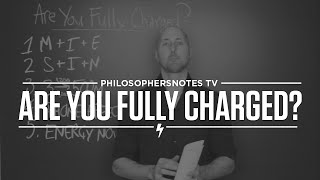
Tom Rath argues that a vital life rests on three things: meaning (using your strengths for what matters), interactions (brief positive moments with full attention), and energy (eating, moving, and sleeping well). Remove your phone during conversations. Use immediate rewards, not distant health goals, to stick with exercise and sleep.
Chapters
Hi, this is Brian. Welcome back to Philosopher's Notes. TV Today, another great book, Are youe Fully Charged? By Tom Rath. Are youe Fully Charged? Subtitle the Three Keys to Energizing youg Work and Life Tom Rath is an incredibly inspiring guy. You might know him From Strengths Finder 2.0, eat, move, sleep, which is going to be the next episode we're doing. And this book, Are youe Fully Charged? His books have sold something like 6 million plus copies.
He spent over 300 weeks on the Wall Street Journal bestseller list.
He's a great writer, compelling, inspiring, takes a ton of research and boils it down into the simplest big ideas we can apply to our lives today. My kind of guy.
Philosopher's Note, Bunch of big ideas.
Five of my favorites. We'll start with the three keys to getting fully charged, fully energized and vitalized today. Meaning, interactions and energy. Worth writing down. Meaning Creating meaning in your life, having positive interactions and dialing in, AKA optimizing your energy. Those are our three conditions for being fully charged. When we're living a life full of.
Meaning, which we're going to talk about.
In the next big idea here. And you have positive interactions you're deliberately cultivating throughout your day and you're taking care of yourself by optimizing your energy via eating well, moving more and sleeping better, you're going to have a higher charge. The book is organized around these three conditions. Like I said, ton of big ideas.
On how to go about doing it.
But think about that meaning plus interactions plus energy. We'll look at some of my favorite big ideas and how to dial in each of those. Now, next one is meaning. Meaning has three components. Tom tells us it's very similar to the idea we talked about in make youe Mark by Jocelyn Gleich. We talked about the fact that you discover your purpose at the nexus of three different circles. Now, Jim Collins, in one of his.
Books, I Think It Was Good to Great, either that or Built to Last.
Talked about the hedgehog concept, where there.
Were three different aspects of it.
What you love to do, what you can be great at, and what the world needs. Tom says something very similar. He says you need to find the nexus point of your strengths.
We're going to talk about that more in a moment.
Your interests, so what you're good at, what you like to do, and very importantly, what the world needs. Too often, as we've discussed many times in these episodes, people are just focused on what am I passionate about? How do I follow my passion Right. And Cal Newport wrote a whole book on the fact that you need to move from the passion mindset to the craftsman mindset, where it's not just about you. Of course, you want to find your strengths and your interests, but you need to think about what the world needs. Find a very productive way to sustainably use your strengths, often doing what you love to do in service to the world. That's how we find meaning. Important distinction here, too. Tom's grandfather was one of the world's leading psychologists and the first to study strengths, the psychology of strengths. He created the Strengths Finder Test, which then became Gallup, which has done all kinds of amazing research. And Tom makes the brilliant point that you need to double down on your strengths at every opportunity. Too often people are spending tons of time on their weaknesses, trying to be well rounded, trying to bring up their weaknesses. He says, look, that's like kind of working against gravity. Another great researcher, Robert Sternberg out of Yale, says you need to take care of your strengths to the degree that they aren't hurting you.
Right.
So if they're really limiting you, you need to make sure you get them up to a level where they're not kind of ruining the party.
Right.
But beyond that, you want to focus on what you're good at. You want to focus on your strengths and cultivate them. There's a multiplier effect of that. And if you want to be truly great at something in your lifetime, you can't try to do a ton of things and be mediocre at all of them. You've got to be willing to double down on your strengths and put all of your energy into optimizing that, doing what you love to do with, while finding a way to meet the world's needs and serve profoundly. That's S plus I plus N, the root of meaning. Third big idea is one of the cornerstones of the interactions condition. Tom tells us that when you do the math, roughly you have 500 million moments over the course of your lifetime that are going to dictate the quality of your life. He says, look, every moment, let's just say it's three seconds long. Three seconds, there's a moment, another three seconds, there's another moment. If you add that up, you're going to get roughly 1200 of those moments in an hour, and you're going to get roughly 19,200 of those moments in waking hours, in a day, right? Three second moments, 1200 seconds an hour leads to over time, 500 million moments. And he says the quality of your life is not going to be determined over what you do over years and decades, but what you do moment to moment to moment to moment to moment over the course of your days. So if you want to have a full charge and a life full of meaning, you need to do your best to make each moment count. Bring as much positivity as you can to each moment. And you can do it in very mundane ways. Simply smiling to someone as you see them walk across the street. There's a good use of a three second moment. And he says if you track people and research shows and you see that they had many positive moments, a high frequency of nice, pleasant moments, not necessarily super intense, but a high frequency, those people who have a higher number of positive, frequent experiences moments will feel better then an individual who has one intense, amazing moment or experience.
Right.
You want to find ways to increase the frequency. Emerson and I, as I was reading this on our adventure, I literally said, let's go see if we can have positive interactions today. And we're going out running around, we see people across the street and we wave at them, right? Hi, how are you? Good morning. Awesome. Everyone feels a little ripple of that, so find ways to make it fun to have more positive interactions. Remember, your life is going to be dictated by the quality of those three second interactions. There are a lot more of them than you think, and they're a lot more important than you may think. 500 million roughly, over the course of your life. Fourth big idea is a big one to optimize the quality of your interactions when you're spending time with people. Tom talks about a research study that actually looked at the effect of having your iPhone or any mobile communication device, a smartphone, whatever, out and visible when you're in a conversation with someone. The short story is that Tom talks about the fact that iPhones and smartphones are useful when you're alone and you want to do certain things. Or he talks about being bored in line at the store. Okay, cool. Text a friend, learn something, whatever. But when you're with people and you keep your iPhone out, research shows that the quality of your conversation with will diminish by simply having your iPhone present on the table. For example, if you're having a conversation or if you're holding it in your hand, people rate the quality of their interaction with individuals who are holding their iPhone or have it out in front of them as lower than less empathetic connection than if the iPhone was not in visible sight. That's nuts. It's not surprising, actually. It's very obvious. And obviously don't be the one who's sitting there talking to someone. And oh, there we go, blowing up again. Got another text. Let me look down, right? Oh, wow.
I'm gonna totally just go off and.
Reply now while you're talking to me. What you're telling that person is one of two things. One, either you're that rat we talked about in an episode not too long ago, totally addicted to stimulation that you need to get a hit on right now, and or two, that you just don't care about the person. Which one is it? Neither one is particularly positive. So choose to let go of the addiction. You will survive if you're not connected to your smartphone for X minutes while you're hanging out with someone and demonstrate to someone that you care about them. The greatest gift you can give anyone is your presence. If you've chosen to be in someone's company and then put your phone in airplane mode and put it away, put it out of sight. Another little fun tip. Don't put it on the table when you're having lunch. Put it away. Give the person your full attention. Increase the quality of that interaction. X number of those, maybe a thousand of them over the course of that lunchtime or whatever it is. When you choose to be with someone, be with them fully. That's our fourth big idea. And I'll say, as a former iPhone addiction, it was a huge thing for me. When we had our son, I was really clear I didn't want to condition him to be like me. Frankly, at that point, where I was constantly looking at my phone more often than I would like. It was kind of always there and I'd run to it or look at it in spare moments and all that kind of stuff. Now I'm on the other end of the spectrum in hermit mode, creating. I turn on my phone once every one or two weeks, but I never have my phone when I'm in front of Emerson or with Alexandra. It's a time to be with them. I don't need that. And it's a time to recover and rest from the constant stimulation. But try it out. It's huge. I think you'll enjoy it as much as I have. Fifth big idea here is from the third component, energy. So we want to have deep meaning. We want to have positive interactions. We want to have optimal energy. Eating, moving, sleeping. Again, the next episode is going to be on a book named that by.
Tom, which is awesome.
But the basic idea here is that in order to optimize your energy, you need to make a connection between what you're doing right now and this moment and the next one and today and your energy level today. Abstract motivation, things like, I want to live longer, I want to lose weight. Even those things don't motivate us as much as making the connection to, wow, when I work out, I feel better. I work out before I do one of these every single time I do my movement. Why not so I can feel good in 10 years or extend my lifespan by five years, but so I can be plugged in and I can get what John Ratey says, right? A little bit of Ritalin to focus my attention and a little bit of Prozac to boost my mood. That's what exercise does. We know that scientifically. That's the connection I've made. If I want to feel good, I move. If I want to do something complex, I exercise to get my body feeling good. If I want to have a good morning, I have a good night of sleep. I make connections to how I'm going to feel throughout the day. Same thing with nutrition. If you want to feel great and feel fully charged, don't make your motivation losing weight make your motivation feeling great right now. Michelle Seeger, who I referenced in the note, who we profiled before her book, no Sweat. Michelle Segar is out of University of Michigan. She's one of the world's leading researchers on the science of motivation for health behaviors. She talks about research she did where she asked people, why do you exercise? 75% of them said it was some abstract goal like losing weight or living longer or whatever. Only 25% of the people said they exercised because they wanted to feel better or more centered right now. Yet when she looked at how much they actually exercised, the people who had an abstract goal exercised 30% less, like 32% less or something than the people who had the clear motivation to exercise for an immediate benefit. So think about your motivation. Make the connection. When you move, you feel better. It's certainly been my connection. When you get a good night of sleep, you feel much better the next day. Get out of the abstract into the concrete. Optimize your energy. What's one little thing you can do that you know you could do to dial that in?
Think about that.
Put your smartphone in airplane mode and away test the iPhone effect. This is one of the most powerful ways to boost the quality of your interactions I can imagine. Remember your 3 seconds and and 500 million moments. This is the quality of your life. This is where it's determined moment to moment. To moment day by day by day in aggregate leads to higher senses of well being. We talked about how to create meaning, strengths, interests and needs. The nexus point of those is what it's all about. Double down on your talents, double down on your strengths rather than spend all your time trying to shore up your weaknesses. And then finally, the three components of getting your charge up, meaning interactions, energy. I hope you enjoyed and I look forward to sharing more. Let's get our charge fully up more and more consistently.
Have another awesome day. See you. Hi, this is Brian. I hope you enjoyed that PNTV episode. A lot of people don't know all the stuff I do beyond these free videos I share on YouTube. So I thought I'd do a quick video to give you an overview of our membership program that you can get access to and get a ton of other stuff. So here's a quick look. 10 bucks a month Join the Optimal Living Membership Program. You get Instant Access to 250 Philosopher's Notes on some of the best Optimal Living books out there. Old school classics, Positive Psychology, Modern Stuff, Mindfulness, Peak Performance, purpose, neuroscience, wealth, etc.
And what you may not know is.
That in addition to the PNTV episodes, I create PDFs on all these great books. So six page PDFs. Let's take a look at one of them. Joseph Campbell, you want to figure out how to live your hero's journey? Well, this is a great place to start. I basically pull out my favorite big ideas, riff on them, connect them to other books and other ideas and help you apply this wisdom to your life today. That's what the PDF looks like again. We have 250 of these on all these different great books. And then I record those PDFs as.
An MP3 so you can listen to.
That MP3 while you're on a walk or working out or doing some errands or whatever that is. Philosopher's Notes. A lot going on there. And then in addition to Philosopher's Notes, you get access to optimal living classes. Optimal Living 101 idea here is that all those great teachers come back to the same big ideas again and again and again. I distill those ideas into classes. Super practical, fun, inspiring classes ranging from Habits 101, Confidence 101, Getting Stuff Done One on One, Meditation 101 instant access to all those classes. And then Future classes include Relationships One on One, Energy 101, Purpose 101, Business Goals, etc. Those are our full length classes. And then I create micro classes 2 to 3 to 5 minute little bursts of wisdom on my favorite great ideas from these great books across the domain that you want to optimize in your life. So we have dozens of these so far. I create 50 more new micro classes every month and 10 new philosopher's notes every month for 10 bucks a month. So we're blessed to have thousands of members who are enjoying the program and sharing some incredibly kind words with us. And super simple 10 bucks a month. Cancel anytime. Would be honored to be a bigger part of your life, and I appreciate your support. And here's to optimizing and actualizing.






