PNTV: Chasing Excellence by Ben Bergeron (#376)
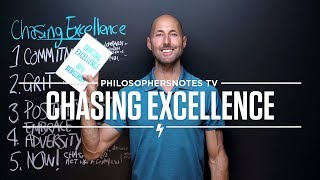
Ben Bergeron's Chasing Excellence lays out how to build world-class athletes. Commit to your best, cultivate grit through sustained practice, train your attention to the positive, and treat adversity as the path to strength. Excellence happens moment-to-moment, not in grand gestures.
Chapters
Hi, this is Brian. Welcome back to another episode of Philosopher's Notes. TV Today we have another great book, Chasing Excellence by Ben Bergeron. Chasing Excellence subtitle a story about building the world's fittest athletes. As you know, if you're into CrossFit, Ben is one of the world's leading Cross CrossFit coaches. In 2016, he coached both the men's and the women's champion. And this book is basically his story of those 2016 CrossFit Games. And he uses that context to teach us the 12 characteristics that he teaches his athletes to perform at their absolute best. It's a truly phenomenal book. Whether you're into sports or not, I think you'll really, really enjoy it. If you are into sports or you even coach sports, this is pretty close to a must read. It's phenomenal, concise, practical, inspiring, etc. As always, we've got a philosopher's note, a bunch of my favorite big ideas. Let's look at five of them. Now. We're actually going to look at the first 1, 2, 3, 4 of his 12 character traits. And then the final idea will kind of be a meta approach to bring all 12 character traits to life. We talk about each in the note and of course, get the book for more. But the first thing Ben tells us we need to do is, is commit. If you don't commit to chasing excellence, to striving to be your absolute best, then you're never going to have a chance to actually figure out what that is. That commitment is a moment to. Moment to moment thing, which we'll talk about in the fifth big idea. But you got to start there. You got to start by wondering, what am I capable of? What is the absolute best version of me look like? And then you relentlessly chase that best version of you. The title actually comes from a Vince Lombardi quote, a little adaptation of it. Vince Lombardi, one of the greatest coaches ever. He is ranked by ESPN as the second best coach of the 20th century. John Wooden is the number one. Lombardi is number two. They had a very similar coaching philosophy. Lombardi once said, and I'll paraphrase, gentlemen, we. We will chase perfection relentlessly, knowing we're never going to actually catch perfection. But in the process, we'll catch excellence. We'll never be able to actually be perfect, but in the process of going for that, we will catch excellence. So Ben adapted that to chasing excellence, chasing the best version of you. And he says most people don't do that. Most people have a bit of Ambition. But they start working a little hard and they're like, eh, meh. He says, meh. Good enough. I'm good enough. They realize how hard it is to actually live like a champion, to actually show up and do your best, moment to moment to moment, in pursuit of that perfect version of you. Again, unattainable. But in the process, you catch excellence. Most people start the process, then they give up, they go back into complacency. They don't have that audacity and that commitment to. To go through the meh. I'm good enough to actually live like a champion. Commitment. It's our first rule. And this isn't just Lombardi or Wooden. Wooden said the exact same thing, by the way. He said that literally. He told his players, look, we need to go after perfection. We need to know that it's not possible to ever be perfect. We'll never hit it. But in the process, we can create a masterpiece practice and a masterpiece day. And if you aggregate and compound enough of those masterpiece days, what do you do? You catch excellence. And in the process, you win championships, whether you're Lombardi or Wooden. But that's a byproduct of your commitment to being your best self when moment to moment to moment, which we'll talk about in the fifth. Big idea here. So there you go. But again, it's not just coaches like Ben and Lombardi and Wooden. Confucius back in the day, in the Analects, great Chinese philosopher, said that he pursued his mastery in his optimization as if he was chasing someone he was afraid of losing. That's the intensity with which he showed up. Moment to moment to moment, to be the best version of himself starts with commitment. That's our first character trait. That's our first idea, the second character traits. So you commit, right? You go for it. You say, look, I'm actually committed to being the best version of myself. Perhaps I'll define it in the context of being an athlete, in this context, the CrossFit games, or whatever it is for you, right? You go for it. You say, I'm all in. I'm actually going to do this. Then what happens? Then you get knocked down. So the second characteristic helps. If I put up two fingers. The second characteristic we need to embrace is grit. And Ben says the essential aspect of grit is the harder you get pushed, the harder you push back, the harder life knocks you down, the stronger you get up. So in the context of the note, I talk about Angela Duckworth, the leading scientist studying grit, and my coach, Phil Stutz, So a couple of quick things there. Angela Duckworth literally is the one who's led the scientific pursuit of grit. She says there are four things to consider when we think about cultivating our grit. She also says if she ever was going to get a tattoo, it would be something along the lines of knock down seven times, get up eight. You get knocked down, you get back up. Exactly what Ben says. The more you get knocked down, the harder it is, the harder you push back. But she says the number one thing you need to have to cultivate your grit is passion. You need to be excited about it, you need to be all in, you need to be committed. And she says this is not a fireworks passion that it goes up and then it dissolves. It's more like a compass. It's a sustainable, sustaining passion that drives you. The second thing you need to have is a practice. It can't be a once in a while thing. It needs to be an everyday thing. You show up, you practice day in, day out, whatever it is you said is important to you. The third thing is purpose. She says to have true, sustainable grit, it needs to be about more than just you. You need to be committed to something bigger than yourself. So the question is, what are you passionate about? Are you practicing it daily? And is it about more than just you? And then the final thing is hope. She says that again, you're going to get knocked down. You need to maintain hope that your future will be better than your present to the extent you continue to show up. Right, that's the scientific definition of hope, is you have a goal of a better future. You have a sense of agency that you can make that future a reality, and then you're willing to do what needs to happen day in and day out. That's the quick look at the science of grit. And then my coach, Phil Stutz, he calls it emotional stamina. He says the harder it is, the more you get knocked around, the more committed you are to your protocol. So whatever it is you do when you're at your best, he would call that your protocol, your basic fundamentals. What do you do? The algorithms, as we described in our class called optimizing algorithms, what are the rules you've set up for yourself? So I'm going to go to bed at a certain time, I'm going to unplug from technology, I'm going to get up early, I'm going to meditate, I'm going to do my deep work, I'm going to train, I'm going to spend time with my Family. That happens to be my morning ritual. That's my protocol now. The worse I feel, the more I'm getting knocked around by life, the more I am committed to actually engaging in that protocol. Right. There's an inverse relationship. Not an inverse relationship. The harder it is, the more committed I am. I used to go the opposite direction. Now it's the harder it is, the more committed I am. And then you navigate the tough times with grit. There you go. Emotional stamina. Our third thing is positivity. Positivity. If you walk into Ben's gym in New England, apparently he has a big sign on the wall that says something along the lines of never whine. No whining, no excuses, no complaining, period. You're never going to show up with a negative attitude. He says, look, we evolved, our brains evolved to perceive the negative. We are much more attuned to the lion than we were the butterfly. Thankfully, our ancestors were very attuned to the negative elements of their environment, or they wouldn't have survived. Right? So he says we need to deliberately train the positive. And then he talks about some cool science behind it, something he calls, or the researchers call, the frequency illusion. This idea that when you actually decide what you're going to focus your attention on, and in this context, it can be the positive or the negative, then you tend to see more of it. He walks us through two different facets of it. One is selective attention, and then two is confirmation bias, right? So you can think of it like a car. When you want to buy a new car, you selectively focus your attention on whatever make and model of a car you want to get. He uses an example of a Jeep, right? Jeep, Laredo, or something like that. So then all of a sudden, you see that you have this selective attention. You told your brain, basically, hey, this is important to me. Then what happens? Then you start seeing that car everywhere. And then that leads to the second part of the frequency illusion. Once you focused your attention selectively, then you have a confirmation bias. You're seeing more evidence that basically says, yep, there it is. There it is. There it is right now. Did the number of cars change on the road? Of course not. There were always the same number of cars. But you told your unconscious mind that it was important and it found it for you. He says the exact same rules apply for your positive and your negative thinking. You need to be ruthless on the positive. Whatever you have control over, demonstrate that control by doing what you can do. The stuff that's outside of your control, let it go. But choose to find the positive within whatever's happening in your life. Never whine, never make excuses, never complain, etc. That's positivity. And then our fourth idea here is embracing adversity. Again, these are the first four characteristics. He's got 12. They're all perfect and awesome. The fourth, after you've made your commitment, you know you need grit, you're focusing on being positive. Then you embrace adversity. And he says the irony is that the thing that's going to make us strong is the thing that we most avoid and that we most fear. And he uses the metaphor of training. So if you want to get strong athletically, what do you need to do? You need to, in exercise science parlance, overload your body. You need to put more stress on it than it can currently handle. And then what happens? Your body over compensates, whether that's muscularly or cardiovascularly. This is what happens. You overload. And again, not as an idiot to a point where you get injured, but enough to stress your system such that you recover, you overcompensate, you get stronger. It's how strength is born in every situation. He says, knowing that you need to embrace adversity, because that's when you get better. When you feel fear and you want to curl up in your comfort zone, you need to yell at yourself. As my coach would say, bring it on. Knowing that that pain is what sets you free. That's what actually allows you to tap into your infinite potential. There's you. There's your comfort zone. There's your infinite potential. How does it feel, as I've said many times, to be outside of your comfort zone, by definition, being outside of your comfort zone feels uncomfortable. So we need to reverse our desire. We need to get excited about feeling uncomfortable, such that every time that we feel uncomfortable, we need to say to ourselves, bring it on, bring it on. This is good. I need to reverse my desire. Rather than run away from those challenges, I need to run toward them. Embrace adversity. If you want to tap into your infinite potential. That's the fourth idea. Quick look at it. And then the final one is when you do all this, you do it right now. You act like a champion right now. You don't become a champion and then start acting like one. You act like a champion now, now, now, now. Moment to moment to moment. And one of the fun things I said in the note was you could call this book Chasing Arete. So it's Chasing excellence, right? And we talked about Lombardi and wooden and Confucius. Well, this is exactly what Aristotle said in his ethics, right? The highest good is to become a eudaimon, right? To experience a good soul, to be the best version of yourself. How do you do that? You practice virtue, you chase excellence. The Greek word for excellence, arete. Chasing arete. When do you do that? Not once in a while. Moment to moment to moment. You act like a champion. You maximize minutes, is another one of the characteristics. Every single moment, every single minute of your day. Not just while you're working out, if you're an athlete, like Ben's guys and girls, but every single moment when you're doing the dishes, you're hanging out with the kids, you're driving to work, you're doing whatever it is you do, you have an opportunity to act like a champion. Right now, focusing your mind on the positive, getting yourself right, even standing up, sitting upright, you're acting like a champion. Right now. You're chasing excellence, you're chasing arete. Moment to moment to moment. That is a very quick look at this great book again. Commitment, grit, positivity, embracing adversity. When? Right now. With that, I hope you have a bunch of great nows today. What was the idea, if any, that jumped out and landed with you? How do you make that a more integrated, applied, practical part of your life, starting today? Get on that. Have fun. Chasing excellence. See you.






