PNTV: Die Empty by Todd Henry (#234)
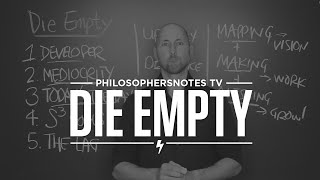
Todd Henry's Die Empty outlines five models for building a lifetime body of work: become a developer through mapping, making, and meshing; move from mediocrity to excellence; use the "Today's the Day" exercise to expose priorities; link daily steps to sprints and stretch goals; and understand the lag between effort and results. Pick one insight and act on it immediately.
Chapters
Foreign. Hi, this is Brian. Welcome back to Philosopher's Notes TV Today, another great book. Die Empty Die Empty by Todd Henry. Subtitle Unleash youh Best Work Every Day. It's a fantastic book. Philosopher's Note, bunch of big ideas. We've got five of my favorites here. This book reminds me of kind of a mix of Steven Pressfield' War of Art, do the Work, Turning Pro. Chris Guillebeau's the Happiness of Pursuit. A little Spartan up. Really good, intense stuff. Todd Henry is a leading creativity consultant. He helps people come up with brilliant ideas, come up with them and implement them. And he wrote another book called the Accidental Creative, runs a business doing that. Lots of smart, practical, well thought out exercises and kind of models through which you can figure out your purpose and how you're going to die empty. So first big idea, who do you need to be if you want to die empty? Creating a body of work over your lifetime that you're proud of. He uses that phrase a lot throughout the book. I love that. Creating a body of work that you're proud of at the end of your life. You can ask yourself during the day is what I'm doing right now and how much of what I did today work that I'm going to be proud of? It's a really cool question. So the developer is the one we want to become. The developer integrates three different aspects of getting stuff done. This is one of the models that Todd comes back to. There is mapping, there's making, and there's what Todd calls meshing. Mapping, making and meshing. So the developer integrates these three things. Mapping is basically having a clear sense of your vision, where you're headed. Making is doing the work and meshing is growing. So you need to know who you are, what your vision is, what your mission is, so you can choose your battles wisely. Then you need to show up and do the work. And he uses another great phrase, you want to have urgency plus diligence. I don't know how many times he said that in the book, but it was a lot. Show up with urgency and diligence. Urgency and diligence, isn't that a great phrase? That's what you do in the making phase. And then meshing is when you bring it all together and you invest in time to become a better person, basically so you can take advantage of the opportunities to that present themselves in the future. That's a developer. He gives other models that aren't the developer, where one of these is missing. You can be a dreamer you can be a driver, you can be a drifter. Check out the book for more. In the note, we talk about it a little bit more. But for now, know that you want to integrate mapping, making and meshing. Think about what you're good at and what you're not so good at and get clear. What's your vision? Are you showing up with urgency and diligence? Are you investing in growth? That's our first big idea. The entire book, of course, is basically helping us become a developer. Second big idea is a really cool one as well. Mediocrity. Mediocrity. I never knew this, but the root of the word mediocrity comes from two Latin words, medias and acris. Medius. Acris. Medius means the middle. Ocris means a rugged mountain. So you put them together and mediocrity literally means basically stuck on a rugged mountain. You haven't summited it. You started it, but you only went halfway. You're in the middle of a rugged mountain. You're mediocre. Wow. And in mediocre. I looked up the definition in my little Apple dictionary and I shared synonyms for mediocre. There's like 20 of them. Ordinary, average, bush, league, etc. Right? Mediocre. Stuck in the middle of a rugged mountain. And there's only one opposite to mediocre. 1Antonym. In Apple dictionary, that antonym is excellence. Excellence. So if you want to summit the potential of this rugged mountain, which is called life, or whatever creative project you might be on, you need to be committed to excellence. You need to be committed to doing your best via this type of stuff and everything else we talk about. But how cool is that? Think of being stuck in the middle of the mountain and being mediocre when you aren't willing to go all the way up. Life is inherently challenging. Don't beat yourself up or think you're somehow unique in the fact that you get your butt kicked once in a while. You're climbing a worthy mountain. We talked about this in the Upside of stress with Kelly McGonigal. We all have our personal Everest. And if you're climbing Mount Everest, you're not complaining about the things that go wrong. You know stuff's going to go wrong, but you have a big goal and you're going to go summit. That's how we want to approach things. Move from mediocrity to excellence. Really cool idea. Medius. Ocris. Middle of a rugged mountain. Third big idea is today's the day. This is another extraordinarily cool exercise, he says, look, a lot of people ask the question, what would you do if today was your last day on Earth? He says, come on. Most of us would go jump out of a plane or spend time with our family, telling we love them all interesting things and important things, obviously with our family. But a much more powerful frame he suggests, is this. Imagine that someone is going to spend a day with you tomorrow. And from the moment you wake up until the moment you go to sleep, they're going to document every single thing you do. You're going to watch everything you do and they're going to document it. Then they're going to spend a few days and they're going to create a report on what you did, and they're going to interpret what your motivations must be, what's important to you, and they're going to create a little book based on that one day of your life that's going to serve as the entire description of your entire life. That one day translated into one book by this person who watches every single thing you do. What would you do on a day like that? Is it different than what you do right now? How would things improve? What things would go away? That's a really cool way to frame how to create a masterpiece day. And as you're going through your day and you're about ready to do something, kind of look over your shoulder and say, wow, do I really want that person documenting this and publishing that? I'm doing this right now as the testament to my life. It's a really, really powerful way to frame things. And then remember, talk about this in the note. The fact that someone is keeping track every single moment of the day, that someone is you. And Abraham Maslow says that every single thing we do, whether we're stepping forward into growth or back into safety. Registers is the word he uses, quoting another woman named Karen Horney who wrote about this. Every single thing we do registers. It either registers as a negative act or as a positive act, negative act or a positive act. And if you accumulate a ton of the negative stuff, you're not going to like yourself very much, to put it directly, he says. You're going to have self hatred and is pretty intense about it. So pay attention to what you're doing moment to moment to moment, and know that someone that being you is keeping track. You can't ignore this stuff. So you're not going to be perfect. But be more deliberate and conscious when you do step backwards. See how quickly you can get back on track. And remember that exercise of someone actually watching you, how would you spend your day? Super powerful. That's one of the most powerful exercises I've ever read in all the books I've read. So hope you enjoyed and I hope that you think about it a little bit more deeply. Third or fourth big idea is S cubed goals, another great model. You can tell that he does his consulting work. He's unpacked all these ideas in really, really sophisticated ways or packed them up, I could say, or packaged them. This, this is another good example. So we talked about in the one thing that you want to have your one thing goal long term and you want to bring it all the way down to today, right? Psychologists call this coherent goals. You want to have vertical coherence. They map it this way. But you want to have coherence, right? You want your long term goals to match up with your near term goals. But he models it in a really cool way. He says, you want to have a stretch three S's. You want to have a stretch goal, then you want to have a sprint goal, then you want to have a step goal. So what are you going to do today, the step goal that's going to support your next two to three weeks. What can you do over the next two to three weeks to sprint to challenge yourself to hit your stretch goal, the big out of your comfort zone. I'm going to go forward goal, which is more like a year or two or three or whatever. It's kind of like training for a marathon. If you want to do a 26.2 mile marathon, that's a stretch goal. You've got to set up sprint goals. How are you going to train over the next two to three weeks? Then you need to show up today and literally take X number of steps so you can hit that S cubed step, sprint, stretch, really cool frame. Think about your goals. What's your long term stretch goal? What are you doing to sprint toward it over the next two to three weeks? And. And what are you doing today? This is how, I don't use this language, but this is how I frame all of my goals. I have a very clear sense of what I want to do in five years. I can look at where I want to be in a year, in 12 months, by the end of this year, and I bring it all the way back to, okay, what am I going to get done this month over the next one to two to three weeks and what am I going to get done today that's going to support that process? Then you just show up with urgency and diligence. You don't do the stuff that doesn't need to get done and you focus on what matters. That's s cubed goals. The fifth big idea is another good one. The lag. The lag. That's what he describes as this space that exists between all of your hustle, all the hard work you're doing and the results. There's often a lag and people give up too often and too quickly because they don't understand the lag. The developer gets the lag. They have confidence to stick through this little lag process and do the work. We need to remember to measure our time on horticultural time, not clock time. You can't be looking at your stopwatch in terms of achieving the things you want to achieve in your life. You start a new exercise program or nutrition approach or creative brainstorming or a business. You can't snap your fingers and expect that to be done in 17 seconds and whatever, right? You've got to actually do the work. Realize there's going to be a lag, tend the work, continue to do the work, and then you reap your harvest. You don't plant and harvest. There's always a lag. I just love that phrase, the lag. So if you're currently in the lag, show up like a master, realize that's part of the process and get back to work. Map it out, make it happen and continue to grow. And you can position yourself to die empty. That was fun. The lag are S3 goals. Right step Sprint Stretch. Today's the day. Wow. Today's the day. Someone's following you today. How is your ideal day going to come to fruition? That's going to represent your entire life. Unbelievably powerful again. We're not going to be perfect with that, but having that ideal and then seeing where we fall short gives us an opportunity to move forward and positively the mountain of mediocrity. Don't get stuck in the middle. Summit your potential as you become a developer and die empty. Hope you enjoyed what was the big idea that jumped out at you, which was really just a reminder of something you already knew. And how do you make that a more practical, embodied part of your life? This isn't about ideas. This is about moving from theory to practice. I throw a ton of ideas out there because I want to throw a bunch up and see what lands. But when something lands for you, what? Run with it. Make it part of your life. Figure out what you're going to do. Today, right now to make this wisdom more practical. Hope you enjoyed and I look forward to sharing more soon. Have another awesome day. See you. Hi, this is Brian. I hope you enjoyed that PNTV episode. A lot of people don't know all the stuff I do beyond these free videos I share on YouTube, so I thought I'd do a quick video to give you an overview of our membership program that you can get access to. Get a ton of other stuff. So here's a quick look. 10 bucks a month Join the Optimal Living Membership program. You get Instant Access to 250 Philosopher's Notes on some of the best Optimal Living books out there. Old school classics, Positive Psychology, Modern stuff, Mindfulness, Peak Performance, purpose neuroscience, wealth, etc. And what you may not know is that in addition to the PNTV episodes, I create PDFs on all these great books. So six page PDFs. What's take a look at one of them. Joseph Campbell, you want to figure out how to live your hero's journey? Well, this is a great place to start. I basically pull out my favorite big ideas, riff on them, connect them to other books and other ideas and help you apply this wisdom to your life today. That's what the PDF looks like again. We have 250 of these on all these different great books. And then I record those PDFs as an MP3 so you can listen to that MP3 while you're on a walk or working out or doing some errands or whatever that is. Philosopher's Notes. A lot going on there. And then in addition to Philosopher's Notes you get access to Optimal living classes. Optimal Living 101 idea here is that all those great teachers come back to the same big ideas again and again and again. I distill those ideas into classes. Super practical, fun, inspiring classes ranging from Habits 101, Confidence 101, Getting Stuff Done 101 Meditation 101, instant access to all those classes and then Future classes include Relationships 101, Energy 101 Purpose 101 business goals, etc. Those are our full length classes. And then I create micro classes. Two to three to five minute little bursts of wisdom on my favorite great ideas from these great books across the domains that you want to optimize in your life. So we have dozens of these so far. I create 50 new micro classes every month and 10 new philosopher's notes every month for 10 bucks a month. So we're blessed to have thousands of members who are enjoying the program and sharing some incredibly kind words with us and super simple. 10 bucks a month. Cancel anytime. Would be honored to be a bigger part of your life, and I appreciate your support. And here's to optimizing and actualizing.






