PNTV: Focus by Daniel Goleman (#316)
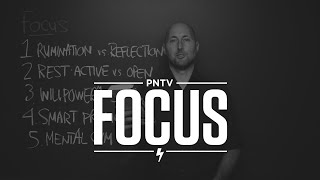
Brian Johnson breaks down Daniel Goleman's Focus with five tools: how to stop ruminating and reflect productively, why your mind needs rest between focused work, three ways willpower works, the power of deliberate practice, and meditation as training for attention.
Chapters
Hi, this is Brian. Welcome back to another episode of Philosopher's Notes. Tv. Today we've got another great book, Focus by Daniel Goleman. Focus, subtitled the Hidden Driver of Excellence. Daniel Goleman is a former New York Times science writer who, who wrote the New York Times best selling book Emotional Intelligence, which has sold something like over 5 million copies. Uber best selling classic. We've got a note on that as well. And I'm excited to share some of my favorite big ideas from this great book. Philosopher's Note, bunch of them. Let's look at five of them here. We'll start with the idea of what focus is. So focus is basically the ability to put your attention where you want, when you want, for how long you want. There are many different facets to it. And Goleman walks us through the neuroscience of what's actually going on in your brain as you engage in these different facets of focus. And of course, how to cultivate our skills to do so on a day to day basis. I'm going to focus on the practical stuff. We'll start with rumination versus reflection. So one of the key things with focus and our ability to control our attention is to notice when we start ruminating and shift that to productive reflection. So he says, look, what's the difference between fruitless rumination and productive reflection? Fruitless rumination is when a thought continues to go into your head again and again and again and again, but you're not doing anything about it, right? So negative thoughts aren't all bad. As we've discussed in many of these episodes. It's a signal that you have a challenge in your life you need to address. But the solution isn't to repeat the thought again and again and again. That's remember, rumination comes from the same word of what a cow does when it's chewing on its cud. So a cow chews grass, right? Swallows it, regurgitates it, chews it again, swallows it, regurgitates it. That's ruminating, right? We don't want to ruminate. What we want to do is productively reflect on our challenges. The difference is when we're reflecting productively, we're looking for solutions. We talk about in the note, and we talk about often here, an idea called relentless solution Focus. We are constantly looking for solutions. So say you had an emotional issue with your significant other, right? Something blew up and now you're just thinking about it again and again and again. The relentless solution focus approach to that would be to find one thing that you could do just a tiny little thing. The guys who came up with that call it a plus one concept. Find the smallest possible thing you can do to, to move in a constructive, productive direction. It doesn't need to be solved immediately. Very few problems are solved with the lightning bolt of inspiration and solution. They're solved as a process. And the first step in the process is the most important. Get out of rumination into productive reflection by focusing on a solution to your challenge, plus one. Then after you've taken that tiny little step, you take another tiny little step, you add together plus ones and the impossible solution comes into focus, becomes possible. Second big idea is that we need to rest our minds. So let's say that you're all about deep work, right? And you're just going hard and you're thinking deeply and doing some good stuff, right? Well, you're engaged in what you would call top down voluntary control and active control of your focus. Obviously a very important thing to cultivate. But you can't be in that state all the time. This is, I did a recent kind of audit on my year so far and looking at what can be optimized, this is one of the key things for me is to continue to oscillate between what they call the active focus state and an open focus state. Seneca in on the Shortness of Life talks about the same exact thing 2,000 years ago. He said, you can't be in a constant focus state. That's like a field that, that you try to make produce all the time. It will stop producing. You've got to let it lay and just kind of relax and rest if you want to do good work. One of my fun things and distinctions is tied to Seneca, where he said that back in the day, the Roman Senate and some of the leaders in Rome would stop thinking about big things and big issues at their 10th hour. Their 10th hour was 4pm The 6th hour was sexta, which is where siesta comes from, which is when they recommended taking a nap. Right. So the 10th hour is 4pm 4pm essentially for them was shutdown complete on the big stuff. So I'm going to engage in that. I'm very excited to make this little tweak. My digital sunset has been in place for a while, but I'm going to jack that back to 4pm 4pm done. No more online time, no more big thinking or working. It's time to recover. So think about how you can recover some more. And know that hitting Facebook, hitting your email, web surfing, video games and stuff like that that is not a productive way to rest and to move from active to an open, bottom up, receptive perspective. It's much better to relax, do your meditation, do your yoga, go for a walk, go for a hike, be in nature. Goleman talks about attention restoration theory. Being in nature is the best possible way to reboot your mind and to give it some rest. So that's going to become a bigger part of my practice as well. So then third big idea here is willpower and the three aspects of focus. So he talks about Walter Mischel in his marshmallow test. Remember, Walter Mischel brought these kids in. He can have one marshmallow right now or two if you wait 20 minutes, right? And what he found was that those who were able to wait 20 minutes outperformed those who couldn't on their SAT a decade later. And their BMI, their body mass index was better decades later. It was crazy. The predictive value of the ability of these kids to delay gratification. Goleman and we talk about this a lot in Willpower 101. And we have an episode on Walter Mischel's the Marshmallow Test. But Goleman says there are three aspects, focus that come into play for willpower that we want to think about. First of all, we need to have the ability, the focus to notice and then disengage from the impulse. So in these kids, with these kids, the ones that succeeded were able to actually disengage from thinking about that one marshmallow. Those who couldn't disengage ate it. Boom, gone. He said they're marshmallow just disappeared, right? That was the first step. You had to be able to disengage. The second step is you have to keep your focus off of that temptation. You have to focus on something else. And the third is you want to keep your focus on your future goal. You got to know why you're delaying gratification, right? You got to cool the impulse of immediate gratification, whether it's a marshmallow or whatever else trips you up by making your future goal. You want more hot. If the impulse is the only thing that's hot, you're never going to resist it. You're going to eat the marshmallow every single time. So those are the three areas of focus that drive willpower. And he says willpower is destiny. It's the engine of all the work that we talk about here. You've got to cultivate your willpower. Be able to disengage from the impulse, be Able to keep your attention away from that distraction and then be able to keep your focus on the goal that's firing you up. Three facets of focus as it relates to willpower. The fourth big idea is smart practice. He talks about Anders Ericsson, who interviewed last week. We just shared the interview on that. Smart practice is another way to describe deliberate practice or purposeful practice. Remember, we had four facets to purposeful practice. One, we need to have a goal. We need to know how we want to improve ultimately and specifically in this practice session. And then two, do you remember what it was? It's focus. You need to focus intently. If you want to build your skills, you need the ability to focus. If you're just kind of sort of going through the motions, you're not getting better. That does not qualify as smart practice. Then, of course, three, we have feedback. And then the fourth is we need to leave our comfort zone. All growth occurs outside of our comfort zone. But remember the focus. You've got to practice putting your mind where you want, when you want, for how long you want, throughout your day. And which leads us to the fifth big idea. We need to hit the mental gym. I often talk about the fact that training our minds is like training our bodies. And Daniel Goleman says exactly that. And then he walks us through the actual science behind it, the neuroscience, and the fact that when you meditate, for example, or when you concentrate on anything, one sole thing, and when distractions come, you put your attention back to whatever you're focused on. You can do that in meditation, you can do that in your work during the day. You can do it praying. You can do it in a ton of different ways. But the research on meditators shows unequivocally that the connection between the parts of their brain that are tied to the wandering thoughts and the part that can disengage from the wandering thoughts is stronger in meditators than in non meditators. And he says it's almost exactly like the analog is the bodybuilder that goes to the gym and has perfectly sculpted pecs. Not using myself as an example there, do a fair number of burpees, but I'm not quite at that level. Right. But imagine that bodybuilder that has the perfectly shaped pecs. They've worked, they've done repetition after repetition after repetition in a very precise way to cultivate that physique. Well, we can do the same things. And he says it's the same rule. More repetitions equals more strength. Be smart about it. Focus and be consistent. The alternative is, he says, our attention is like a muscle. Right. So you can hit the gym or if you don't hit the gym, you can be kind of a mental couch potato. Nibbling on click bait all day long and blowing up your attention. It's going to be very flabby and unfit. You won't be able to hold your attention on one thing. So if you're finding yourself challenged to concentrate, whether it's at work or on a book or whatever it is, notice you might be kind of the equivalent of that couch pillow. And get to work on concentrating. Picking one thing of focus. The anchor we talk about in meditation. One on one and building your strength. One repetition at a time. You wander, you bring it back, you just got stronger. Wander, bring it back, you just got stronger. Every single rep shapes your mental physique. Remember our smart practice. You got to have focus in addition to the goals, feedback and exiting the comfort zone. Willpower is driven by focus. Disengage focus on whatever's important, avoiding the distractions. And then see your goal to stay motivated. You gotta rest. You can't be inactive all the time. Remember the 10th hour. 4:00pm okay, cool. Give your mind a chance to recover. Shut down. Complete is how Cal Newport described it. He's not thinking about his day and all the challenging math problems he's trying to solve. He's done. He's giving his mind a break so he can return fresher to the next day. And then rumination versus reflection. Fruitless rumination is when we're just thinking the same thoughts again and again. Productive reflection is when we're solution oriented. We're looking for that plus one. What's one tiny little thing? Not how am I going to solve it completely, but what's one tiny little thing I can do? Incremental improvement. That's how we want to focus on everything in our lives. We're not looking for the weekend seminar that's going to change everything. What a state. Experience of feeling great. But then we need to do the work to make that state a trait of who we are. You do that incrementally. 1% better day in and day out, compounded, aggregated over time equals awesome. There you go. Thank you, Daniel Goleman. And what was your favorite idea? How can you optimize your focus a little bit more today? Think about that and get on it and have another awesome day. See you. Hi, this is Brian. I hope you enjoyed that PNTV episode. A lot of people don't know all the stuff I do beyond these free videos I share on YouTube. So I thought I'd do a quick video to give you an overview of our membership program that you can get access to and get a ton of other stuff. So here's a quick look. Ten bucks a month. Join the Optimal Living Membership program. You get Instant Access to 250 Philosopher's Notes on some of the best optimal living books out there. Old school classics, Positive psychology, Modern stuff, Mindfulness, Peak Performance, purpose, neuroscience, wealth, etc. What you may not know is that in addition to the PNTV episodes, I create PDFs on all these great books. So six page PDFs. Let's take a look at one of them. Joseph Campbell, you want to figure out how to live your hero's journey? Well, this is a great place to start. I basically pull out my favorite big ideas, riff on them, connect them to other books and other ideas and help you apply this wisdom to your life today. That's what the PDF looks like again, we have 250 of these on all these different great books. And then I record those PDFs as an MP3 so you can listen to that MP3 while you're on a walk or working out or doing some errands or whatever that is. Philosopher's Notes. A lot going on there. And then in addition to Philosopher's Notes, you get access to optimal living classes. Optimal Living 101 idea here is that all those great teachers come back to the same big ideas again and again and again. I distill those ideas into classes. Super practical, fun, inspiring classes ranging from Habits101, Confidence101, Getting Stuff Done101, Meditation101, instant access to all those classes. And then Future classes include Relationships 101, Energy 101, Purpose 101, Business Goals, et cetera. Those are our full length classes. And then I create micro classes. Two to three to five minute little bursts of wisdom on my favorite great ideas from these great books across the domain that you want to optimize in your life. So we have dozens of these so far. I create 50 new micro classes every month. 10 new philosopher's notes every month for 10 bucks a month. So we're blessed to have thousands of members who are enjoying the program and sharing some incredibly kind words with us. And super simple. 10 bucks a month. Cancel anytime. Would be honored to be a bigger part of your life and I appreciate your support. And here's to optimizing and actualizing.






