PNTV: He Can Who Thinks He Can by Orison Swett Marden (#145)
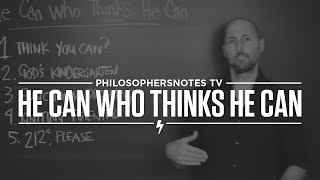
Brian Johnson summarizes Orison Swett Marden's 1908 book on self-belief and potential. The core idea: you become what you think you can be. Marden argues that vision without consistent action is useless, hardship ignites dormant abilities, and reaching your goals takes 212 degrees of commitment, not 211.
Chapters
Hi, this is Brian. Welcome back to Philosopher's Notes. Tv. Today we've got another good one. He can. Who thinks he can? Long title by Orison Sweatt Martin going old school. This was written in 1908 or so when Teddy Roosevelt was president. Orison Sweat Martin founded Success magazine. Really cool. Kind of a blend of James Allen. Really inspired by Ralph Waldo Emerson and just all about virtues based success. I love it. Good book. Philosopher's Note. We've got a bunch of big ideas in there. We're going to look at five of my favorite right now. We're going to start with think you can. Well, do you think you can? As Henry Ford tells us, whether you think you can or you think you can't, you're right. Scientists agree. They call it self efficacy. Do you believe in yourself? Do you believe in your ability to create that which you aspire to create? It's the greatest predictor of our ability to do it. You're not going to create too much stuff that you don't think you can do. Do you think you can? So he tells this really cool story about, well, do you want to be a lawyer? I dropped out of law school. Would have been class of 2000 at UC Berkeley's Bold School of Law growing me. Dropped out before a semester was over. But if I knew I wanted to be an attorney, would it make sense for me to study medicine? Makes no sense. If I wanted to be an attorney and I'm studying medicine, there's something wrong with that, right? Doesn't make any sense. I need to immerse myself in the study of law. He says, you need to graft yourself to the tree of law so that the SAP circulates through you. That's how committed you need to be to law. Then he draws the parallel and he says, look, if you want to be successful, all you think about are your fears of failing and being a failure. You're going to have as hard of a time becoming an attorney as someone who has studied medicine would. It's not going to work. You need to graft yourself to the tree of success. You need to think about success. You need to study success. You need to embody success. You need to act such that success comes to you. You need to think you can. Really cool concept. That's the first big idea. The second big idea, God's kindergarten. That's what life is. Life is one big classroom teaching us lessons we can choose to learn or not. Every single moment gives us an opportunity to get a little bit wiser. Just a Little bit if we're open to it. Or we can numb out and shut down and not pay any attention. We want to approach life as our classroom. All the great teachers talk about this. God's kindergarten, he says. I love that. God's kindergarten. Moment to moment to moment to moment to moment. What can we learn? How can we optimize just a little bit, get 1% better day in and day out. Yesterday we talked about dominoes. You line up 1% gains, compound effect style that doubling penny or the 50% bigger dominoes. You have huge potential. We've got to start by seeing life as our classroom. Next big idea, functional dreaming. He calls it practical dreaming. But I like the idea of functional dreaming. So think of functional training or functional medicine. We talked about functional optimism in our note on Tony Horton's the Big Picture. Right? Talked about. Functional optimism is where you believe your future will be awesome because you know you're going to do what it takes to make it awesome. It's positive belief plus positive action. You need to put both of them together. Well, same thing with functional dreaming. He has some great stories about how powerful it is to dream and that we need to be able to see our ideal future and cherish those visions. As James Allen says, we've got to be able to see our ideal future, then live from that place. And we need to be practical about it and combine our dreaming with grit and persistence. Doesn't matter how awesome our vision board is or whatever we see as the possibility, if we don't take consistent, gritty, persistent action. Got to show up. Functional dreaming. Positive belief and positive vision mixed with a tenacious iron will. Which is another one of Orison's great books, Functional dreaming. Are you functionally dreaming? Are you kind of sort of just dreaming? We want to get the action in there. Next big idea is a good one. Igniting potential. Igniting potential. So this is 1908. And he talks about a torpedo, a maximite torpedo. Apparently that was pretty awesome back in the day. And it could blow up a warship, right? It was so powerful they could blow up a warship. But he said kids could play with this torpedo all day long every day for the rest of their lives, and they could never set it off. You could bang it around. You can kind of throw it through a wall. You can do whatever you want. That will not set off this huge torpedo. It required tremendous force, an extraordinary amount of force applied to it, shooting it through a couple feet of iron, a cannon, in order to ignite its potential. It has this huge, huge, huge, latent potential that could only be ignited by a huge force. And he says we're exactly the same way. And he compares Lincoln without the Civil War and with the Civil War. Lincoln needed the Civil War and the huge horrific challenges of trying to preserve our Union in order to call forth his latent potential. It was the responsibility he willingly accepted that allowed his highest self, his greatest potential, to come through. Most of us avoid responsibility. We don't take on big projects. We don't go for it. We don't lean in. But he says if we want to ignite our potential, we have to. We have to lean into responsibility. It's the responsibility that creates the ability, he says, igniting our potential. Think about that in your life. I've known, I've experienced that. It was when the best was required of me that I showed up with my best. It's probably the same for you now. It's gnarly when we do that. It's scary. So we kind of want to pull back a little bit more into our comfort zone. But if we want to see our infinite potential, we need to be willing to bust through our comfort zone, through our fears, and ignite our potential. That's the fourth big idea. Igniting our potential. Can you step into a little more responsibility or take a little bit more risk? Can you dare a little more greatly Again, he was president when Teddy Roosevelt was president, daring greatly be in the arena, have that supreme confidence, knowing that you can. He who thinks he can can. Now the final big idea. 212 degrees, please. So we're in 1908. Steam engines are changing the world, right? They have over the last X years, X couple of decades, whatever it is, right? Well, what's it take for water to create steam? Huh? What's it take? Will 200 degrees do it? No, 200 degrees won't do it. Will 210 degrees do it? No. 210 degrees is useless. 212 degrees is what it takes to boil water to create steam. And he says lukewarm water won't do it. Even 200, 210 degrees won't do it. 212 degrees is what it takes to power a boat via steam power. We need to bring ourselves to a boil, is what he says. We can't be lukewarm. We can't kind of sort of go through the motor. 212 degrees. So where are you? Are you just kind of tepid? Are you like room temperature? That's not going to get it done. You got to be willing to turn it up. As Campbell says, quoting Ramakrishna, do not approach life or enlightenment unless you approach it like a man approaches a lake whose hair is on fire. You go for it. You. You're all in. Nothing's going to get in your way. When we have that tenacity, that grit, that persistence, that commitment, we ignite our potential and we become functional dreamers. Then we're also much more willing to see life as a classroom, because we're all about growing. We're all about getting a little bit better. We're daring greatly. We're all in. And then we cultivate our ability to know that we can. So there you go. He who thinks he can, or she who thinks she can, can. Do you think you can? I think you can. Let's go do it. Hope you enjoyed. What was your favorite big idea? What landed the most for you that just reminded you of something you already knew or just opened your eyes to something that might have inspired you? How do you take that idea and apply it to your life more consistently? Theory to practice is what we want to do. Hope you enjoyed. I look forward to sharing more with you soon. Have another awesome day. See you.






