PNTV: How God Changes Your Brain by Andrew Newberg MD & Mark Robert Waldman (#180)
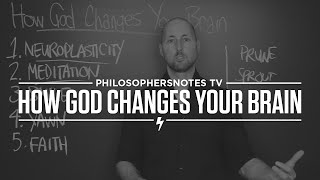
Andrew Newberg and Mark Robert Waldman argue that meditation, prayer, and contemplation physically reshape your brain through neuroplasticity. Daily practice rewires neural pathways to boost well-being, while harsh religious thinking can damage them. Simple exercises like smiling and adjusting your posture trigger measurable changes.
Chapters
Hi, this is Brian. Welcome back to Philosopher's Notes. TV today, you guessed it. Another great book, how God changes your brain. Andrew Newberg, Mark. Robert Waldman. Great stuff. Breakthrough findings from a leading neuroscientist. These guys are out of University of Pennsylvania. And the basic idea is faith, belief. God can positively impact your well being and specifically your brain. Philosopher's Note, Bunch of big ideas. Five of my favorite ideas. We'll start with the first one. So how does God change your brain? Well, to answer the question very directly, via neuroplasticity, we talk about this quite a bit. You're probably familiar with it at this point. Neuroplasticity, basic idea. Your brain is plastic, it's not fixed, it's malleable. And your thoughts, your behaviors, what you do on a moment to moment to moment basis is literally restructuring your brain via neuroplasticity on a continual basis. Couple of my favorite words that we throw out here often is you prune certain neural connections and pathways and you sprout new ones. Remember that each thought, each behavior literally is either reinforcing certain behaviors or habits, sprouting and deepening new pathways or pruning them. If you quit doing the things that don't serve you, they lose their power. You prune certain connections in a really powerful way. And again, positively, when you do the right things again and again and again, you make that more likely via neuroplasticity. You see extraordinary benefits quickly when you do those things. So what do you need to do? We've talked about this before. Meditation or prayer or any spiritual practice brings you not only closer to your God or whatever you call it, but it rewires your brain in healthful ways. So if you aren't meditating yet, what do I need to do to convince you that it's a good idea? We know that literally when you meditate for just one session, you're already planting the seeds of change. You're already starting to do this. You do it for a matter of weeks and you can see measurable results in a lab that's incredible. Positive changes in your brain which then come into your life. Reduced anxiety, stress, depression, etc. By learning to discipline your mind. We talk about it in so many other places. I will leave it at that for now and encourage you to create a practice daily is what they recommend. Again, we talk about this all the time. If you want to create a new habit, the most important thing you can do, besides making 100% commitment to creating that habit, is to do it every day. It's really hard to create habits that you're going to do once in a while or Monday, Tuesday, Thursday, Saturday and Sunday. That little voice in your head is going to come in and say, hey, today's the day to take off daily. Whether it's a minute of meditation or prayer or contemplation or whatever, or 10 or 12 to 15. Do it every single day. And as you'd expect, the more you do it, the more consistently you do it, the deeper the results. Not complicated, most of this isn't. But do it often. That's the key here, consistency over intensity. So they give us a bunch of exercises on how we can rewire our brains. I'm just going to share a few here. First one is to smile. Literally, the act of smiling rewires your brain and gets you in a happier state. They've done research with people where they bring them into a lab and they have them put a pencil or a pen in their mouths and bite on it with their teeth. Do that right now. If you have a pen handy put in your mouth, I'll grab one. So I have a pen, my favorite old school Bic pen. I know they're ridiculously awesome. So if I put this pen in my mouth between my teeth, right. That kind of elicits a smile, right. If I put it between my lips, kind of generates almost a frown, right? Neutral to frown. So they can bring people into a lab, split them into two groups randomly, right? Split them into two groups. One group that puts the pen or pencil or whatever between their teeth, right? Simulating a smile. And another group that puts it between their lips, simulating somewhat of a frown. And then they'll measure their well being, happiness, whatever, after a brief period of time. And they'll see that those who smiled even without knowing they were smiling and got a boost in their well being. That's nuts. So something as simple as smiling when you're feeling down or you're feeling stressed or whatever, the simple act of smiling creates more happiness. Feelings often follow behaviors we talk about a lot. Whether you feel like it or not doesn't really matter. Just do what needs to get done and do certain physical things. If you want to feel good, hold yourself in a physical posture as if you felt good, right? Shoulders back, legs nice and strong, breathe deeply. You're going to feel better than if you roll your shoulders and you breathe shallowly and you kind of go into the wilted flower pose. Simple ways of moving our physical behavior change our brain. Smiling is one of the easiest ways to do it. And then a super weird, powerful practical tool they come back to a number of times in the book yawning. So faking a yawn is one of the best ways to basically slow down, get out of any fight or flight and relax yourself. Mental training experts, sports psychologists, and peak performance guys and women talk about this as well. Next time you're watching a championship match or something, whether it's an NBA championship or an Olympic event, notice that certain athletes are cruising around yawning on purpose. The yawning. Yawning is associated with deep relaxation, right? Well, if you want deep relaxation when you're feeling a heightened level of stress, do the thing that elicits it, that's associated with it. Yawning is associated with that level of rest. So doing that just like the smiling will actually create that state in your being in remarkable ways. So try that out next time you're feeling stressed or you just want to kind of relax and hit, reset, yawn once or twice or three or four or five times. Crazy. Who would have guessed? All right, that's the fourth idea. Then the fifth one brings us back to more of the God conversation. So spiritual practices have been shown to boost your personal well being, your neurology, all that good stuff. Quick caveat. Fundamentalist beliefs and kind of the harsh passages in the Bible, the Quran or whatever are negatively correlated. Those create negative issues in your well being. So we want to have, and they jokingly say that the surgeon general should have warnings on certain passages in the Bible, warning, this particular passage is not good for your health. So we want to focus on the benevolent God, not the merciless, ruthless, kill our neighbors who don't agree with us approach. Right, but the essence of what we want to get out of our faith is faith. And faith can be in the God of our choice or of our practice or in ourselves, in our own beliefs. So having a sense that we have a positive future in store for us, faith in the quality of our lives in whatever frame with which we arrive at that is essential. We need to believe that our lives are getting better and better and better. We need to have faith, we need to have hope, we need to have optimism. Doubt is toxic. Not having belief in something good that's about to happen or faith in the bigger picture is toxic. We want to cultivate our hope, our optimism, our faith, our self efficacy, our self confidence, our trust in ourselves and that in what we believe is right for us. Huge repeating myself there, but there you go, Quick look. Some very basic ideas on how God changes your brain. Neuroplasticity. We're constantly rewiring our brains, pruning and sprouting, etc. Meditation, prayer, contemplation, qigong, yoga. These are great practices to connect to something bigger and rewire our brains. Smiling experiment. If you frown, if you wilt, you're going to feel worse than if you smile. And if you stand up straight and act physically like you want to feel. Big idea Yawning. Next time you're watching a sporting event, pay attention. You'll see someone likely yawning, inducing a state of relaxation where they can perform at a peak level. We want to do that as well. And then faith. Your belief in a positive future is huge, unbelievably healthy for your mind. Cultivate that optimism, that hope, that belief in yourself and in the life that's unfolding for you. There you go. Hope you enjoyed and I look forward to sharing more with you soon. All right, have another awesome day. See you.






