PNTV: Power Up Your Brain by David Perlmutter and Alberto Villoldo (#194)
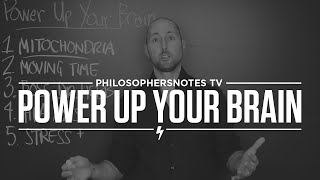
David Perlmutter and Alberto Villoldo frame enlightenment as optimal brain function. They identify five neuronal levers: optimize mitochondria, shift from amygdala to prefrontal cortex, harness neuroplasticity, calm the stress response, and reframe stress as adaptive. Practical tools include breathwork, meditation, and exercise.
Chapters
Hi, this is Brian. Welcome back to Philosopher's Notes. TV today, you guessed it, another great book, power up your brain. Power up your brain by David Perlmutter and Alberto Fiordo, who we covered yesterday. Yesterday we talked about Alberto's book Courageous Dreaming. I heard about him from this book. Subtitle of this book is at least tied for first for best subtitle ever. The neuroscience of enlightenment. The neuroscience of enlightenment. How to power up your brain. Amazing stuff. I'm going to read to you a quote, a brief one from the Philosopher's Note. We've got a bunch of big ideas we will cover. Five of my favorites. But Perlmutter and Violdo tell us in the language of neuroscience, enlightenment is the condition of optimal mitochondrial and brain functioning that allows us to experience both well being and inner peace and the urge to create and innovate. Really cool idea. So enlightenment isn't something that's available to a few select individuals who are levitating in the Himalayas. It's available to all of us to, to the extent we're willing to do the work to dial in our brain functioning. And then the result isn't just spiritual bliss. The result is of course, well being and peace and all the joy that comes with that and this deep connection to something bigger than ourselves that allows us to create powerfully and give our gifts to the world. Super cool. Alright, so five big ideas on how we go about doing that. Obviously going to take a practical look at the neuroscience of enlightenment. They have a ton of ideas and tips and nutritional techniques and other things you can do, therapies you can do fascinating stories. Great book, fun read. If you're into this stuff, I think you'll dig it. For now. First big idea, mitochondria. So I remember in my high school biology class that mitochondria did something related to energy, but the way they describe it as fascinating. So mitochondria is basically the energy factories of every single cell in our body. And they kind of orchestrate the epigenetic dance that's going on. They turn on certain genes, they turn off certain genes. They're extraordinarily essential to the functioning of our life force, our energy, our vitality. That's part one of mitochondria. Part two is mitochondria. All the mitochondria in my body, in your body and everyone's body came exclusively from my mother, which came from her mother, which came from her mother, which came from her mother. It's feminine. It's completely feminine in its evolutionary history, all the way back, all women, all the time. So this life force that's so essential to our functioning is feminine. It's amazing. So they talk about that. This is what the shamans described as the feminine life force is mitochondria. And again, I talked about it in my note about Alberto, but he's a shaman and a medical anthropologist and Perlmutter is one of the world's leading neurologists. So they came together to talk about kind of mysticism and shamanism and modern day science and neuroscience. Fascinating look at mitochondria. And we obviously want to do everything we can to dial it in. We'll talk about a few ideas. The book is essentially all about how we optimize our mitochondria. Second, big idea, moving time. Specifically, we want to move from our reptilian brain, our amygdala in our limbic system, our mammalian brain, up into our prefrontal cortex. That's where the magic happens. You, if you're living in fight or flight all the time, amygdala is hot, you're in your little lizard brain, afraid and reacting all the time. Then you're going to have a really hard time experiencing enlightenment. You need to move into and live from your prefrontal cortex. Quiet down that lizard brain if you want to experience enlightenment on a more consistent basis or period. Now, he tells a great story about research done where they bring people into a lab, they have them observe faces, angry faces and fearful faces. And the group does two different things. First, they mirror them so they see the anger and the fear, and then they mirror it in their own expression, right? And what happens, their amygdala lights up, right? They're in their prehistoric fear based brain. They're experiencing it. Right? Right. Now, what's fascinating is those same people, second part of the experiment, rather than ask them to mirror what they're seeing, the negative emotion, they ask the individuals to name it, to describe it. So they see anger and they say, I see anger. They see fear and they say, I see fear. What's fascinating is although their amygdala, the little reptilian brain, lit up when they mirrored the emotion, their prefrontal cortex lit up and their amygdala was quiet when they simply stated intellectually what they saw. Now this is huge because we want to engage in the practice that I talk about in the note and that I talk about in Dan Siegel's mind site. He has a great phrase, he says, you need to name it to tame it. Name it to tame it. When you can actually Label the emotion that you're experiencing, it loses its power over you. You're able to step outside of the emotional experience of it, and you literally are moving out, moving time out of your lizard reptilian amygdala up through and into your prefrontal cortex. It's a really big idea. So think about this the next time you're feeling all stressed, and whether it's anxious or afraid or angry, notice if you can describe the emotion you're experiencing. That intellectualization will move you out a state you don't want to live in and move you toward a more enlightened experience. It's a big idea. Moving time. Third big idea here is meet your new boss. Your new boss. You've got a new job. Congratulations. Your new boss is Dr. Hebb. Dr. Hebb is the guy who came up with one of the primary tenets of neuroscience and neuroplasticity, which is neurons that fire together wire together. So if it fires together, it wires together, which is an exciting fact. I think it was 1949 they stated that. Now that's an exciting thing. We want to work for Dr. Hebb and with Dr. Hebb's wisdom and create new neural superhighways. We've been talking about this a lot, but if you continue to replay old stories, you're going to continue to groove. You're going to fire and wire and fire and wire certain neural pathways. If you want new neural pathways, then you need to stop thinking those old thoughts, stop doing the old things and start doing the new ones. You need to power up your brain through a new way of being. Huge idea. So playfully, you have a new job, it's working for Dr. Hebb. Rewire your brain. Fourth big idea, your HPA axis. So when we talk about the lizard brain and your amygdala, or basically and being in fight or flight, we're talking about the HPA axis. So if you're constantly reacting to life, you're constantly stressing out your HPA axis. Hippocampal, pituitary, adrenal, HPA hippocampus, pituitary gland, and your adrenal gland firing. That's what exhausts you. That's what enervates you. When we talked about Stephen King feeling like he had jumper cables on his brain, that's what he was experiencing, a jacked up HPA axis. So you want to think about how you can be nice to your HPA axis, calm it down. Things like deep breathing, meditation, exercise, unplugging from the Internet for gasp, a whole day, even a whole week, or maybe just the weekend or maybe after the sun goes down. All of these things are key to relaxing your HPA axis. And when I look at what I'm striving to do right now, to read and create notes on 250 different books in 2015, which is just inside the realm of possible. And to do one of these videos every day, 350 of them. Current goal, I need to manage my energy. It's not time management, it's energy management. You can only put out so much in any given day. And if I'm sitting here and jacking up my HPA access all day long and not getting good nights of sleep and getting rest throughout the day and oscillating throughout the day, being on and then relaxing, there's no way I can produce. Obviously, it's the same with all of us, but it's been really fun to notice that this is actually the most important thing that I'm paying attention to right now is can I be engaged and on like I am right now and be equally off and relax and rest. We're going to talk about this a lot more in. We have a class coming up called Getting stuff done 101. We're going to talk about Tony Schwartz's ideas around the power of full engagement. And he says it's about energy management, not time management. And this is going to be the cornerstone of what we talk about. Longer conversation. Fifth big idea. So stress can be. When it's chronic and it's unmanaged and our perception of it is negative, stress can be debilitating. But stress can also be positive. And we want to see that stress can be positive. This is the whole changing obstacles. Making obstacles the way is what Ryan Holiday described it as changing poison into medicine. Stress can be an extraordinarily adaptive thing if we choose to respond to it in an optimal way. Right? And these guys talk about some really cool stories. And the reality is we wouldn't be walking on two legs if the ecosystem in which our ape like ancestors in Africa lived didn't change. If they didn't experience stress and have to leave the comfort of where they were and and explore new lands, they would never have gone from four legs to two. So we want to embrace our evolutionary history as based on our adaptability and our ability to learn from stress and to adapt to stress. So we want to see that. And then Alberto shares a story in his book Courageous Dreaming Superheroes. Almost all superheroes, their lives as superheroes begin after a tragedy, horrific event, they lose their parents, or they get rocketed off of a planet that's blowing up, or they get bit by a radioactive spider. These are not good things. They're stressful things. But in the midst of that challenge, they became extraordinary. So we want to reorient our relationship to stress in the same exact way. We want to power up our brain, eat that stress like a healthy energy bar, and experience some benefits from the neuroscience of enlightenment. So there you go. Stress can be good, but you also want to control your HPA axis. Your new boss, Dr. Hebb, has you digging new neural superhighways. It's moving time. Get out of your lizard brain into your prefrontal cortex. How? In this case, name the emotion you experience. Name it to tame it. Try that out. It's seriously a huge idea. And then mitochondria, the energy factories in every single one of our cells are inherited through our feminine lineage. What? Unbelievably cool. So there you go. Power up your brain. Neuroscienceman Weidman. Hope you enjoyed, and I look forward to sharing more with you soon. Have another awesome day. See you.






