PNTV: Relentless by Tim Grover (#379)
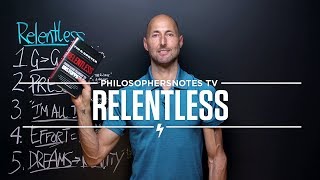
Tim Grover's Relentless teaches how to move from good to great to unstoppable through ceaseless effort. Embrace pressure as fuel, treat failures as data, and out-work competitors. The book's 13 principles show how to translate quiet visions into relentless action.
Chapters
Foreign. Hi, this is Brian. Welcome back to another episode of Philosopher's Notes. TV Today, another great book, Relentless by Tim Grover. Relentless. Subtitle From Good to Great to Unstoppable. Tim Grover, as you may know, was Michael Jordan's trainer and and mental toughness coach. He also worked with guys like Kobe Bryant, Dwyane Wade, hundreds of elite athletes. This book is his recipe for becoming unstoppable, for becoming relentlessly Great. Quick context. 1989. Michael Jordan hadn't won a championship yet. He was getting pushed around by the Detroit Pistons, the bad boys, and he wanted to get physically stronger. Now, at the same time, Tim Grover was a trainer in Chicago who had been trying to get a job working with the team, the Bulls. The Chicago Bulls. Reaching out to the staff got no response. So he said, you know what? I'm just going to reach out straight to Jordan wound up getting a meeting with him, and Jordan gave him 30 days to prove his plan, whether or not it worked right. 15 years later. Grover worked for them throughout his career. Before his first championship, throughout everything he did, Tim Grover was the guy behind the scenes as both the trainer and the mental toughness coach. Again, this book is about what he learned and what he taught and teaches his elite athletes. The book kind of reminded me of 12 Rules for Life. Same type of intensity, in your face. Shoulder, more responsibility. What are you here to do? Whatever you dream of, which we'll talk about in our fifth big Idea. Whatever dreams you have for your life that in your quiet moments when you're rested, you're inspired, you're optimistic, and you know you can do, that's what you're here to do. Go do it relentlessly, right? So anyway, that's the theme of the book. Philosopher's note. Bunch of my favorite big ideas. Five of them here. Let's start at the top. Good to great to unstoppable. Tim has a fun way to break that down. He says if you're good, he calls those people a cooler. If you're great, you're a closer. If you are unstoppable, you're a. You're what he calls a cleaner. A closer will show up and they'll be able to close out games. But a cleaner, the unstoppable person, shows up moment to moment to moment with a relentless obsession to be their absolute best. Right? The first thing we need to do is we need to move past this whole, meh, I'm good enough, which is exactly what we talked about in Chasing Excellence. Ben Bergeron, right. Ultimate or one of the best CrossFit Games coaches. What does he teach his champions? 12 character traits. The first one, commitment. You have to move past the meh, I'm good enough. Most people feel the work required to push that big boulder up the mountain of greatness. And they say, whatever, meh, I'm good enough. And Grover, all these great teachers primary point is that can't be good enough. You need to get curious about what greatness looks like. And then he says, continue to evolve into what are you capable of? Move from one level to the next relentlessly. And when I looked up the word relentless in the dictionary, right. One of the words used to define relentless is incessant, right? So the relentless heat of the desert, right? Incessant. If you look at the etymology of the word incessant, it literally means without ceasing, right? In Latin, without cessation, without stopping. Ceaseless. What's interesting is my coach, Phil Stutz, that's one of the words he uses most often in our work together. One on one. He says we need to have a ceaseless immersion in the process of. To use my words, actualization, to use his words. You're ceaselessly fighting part X, that part of you that wants to pull you down from your ultimate potential. And you need to relentlessly battle that if you want to experience your ultimate potential. So that is our first idea. Moving from good to great to unstoppable. You got to be willing to walk away from the whole meh, good enough, and relentlessly commit. Which leads us to our second big idea here. Before we get there, though, context. The book is organized around 13 principles. He calls them relentless. Tim calls them relentless. Thirteen, right. Two funny things about that. One, he came up with 13 of them because he doesn't believe in luck. He believes in hard, hard, relentless work, not luck. And the second funny thing is, it's not. His principles aren't 1, 2, 3, 4, 5, 6, 7, 9, 10, 11, 12, 13. They're number 1, number 1, number 1, number one, number one, number one. Point being they're all essential if you want to move beyond greatness to being unstoppable. These are the principles you need to embrace. So anyway, one of the next ones, we're skipping, one I talk about in the note, which is, do the work work harder than everyone else around you? Which we'll talk about a little bit in a different context in a moment, but for now, we'll talk about pressure. He says to his athletes, pressure, pressure, pressure. We want to move toward pressure. He says. This whole idea that stress Is bad, is wrong. We need that stress in order to be energized, to be our absolute best self. We got to feed on it, and science says the same thing. Kelly McGonigal, the upside of stress. She says, and we discuss in those notes, that how you perceive your stress will literally dictate how you physiologically respond to that stress. You can have either a threat response or a challenge response. If you have a threat response, that means that you think of stress and you say, oh, man, that's killing me. Well, guess what? Your physiology will reflect that belief. But if you look at the same exact stress differently and you say, you know what? This is forcing me to be my absolute best self, right? No pressure, no diamond style. This stress, this pressure is what I need to actualize my potential. Then you don't have a threat response. You have what's called a challenge response, which has a totally different physiological makeup than your threat response. Knowing this, we need to. Again, as we talk about all the time, we need to get comfortable being uncomfortable. There's you, there's. There's your comfort zone. Right inside that comfort zone, it feels what? Comfortable? It's awesome by definition. How does it feel the moment you leave your comfort zone, even if it's just a little bit outside? Well, by definition, being outside your comfort zone is, of course, uncomfortable, right? But Grover and all great teachers tell us, you better get really comfortable if you're serious about tapping into your potential. Get really, really, really, really comfortable playing right here, being uncomfortable, right? And so you need to say, pressure, pressure, pressure. Rather than saying, stop, I feel stress, you say, go. Adam Grant says that in originals, right? My coach, again, Phil Stutz, his thing is a mantra. Bring it on. Pain sets me free. That discomfort, that's where my infinite potential exists. Therefore, I want to reverse my desire. I don't want to curl up in a ball. And in wish life was easy. I want to wish for the strength to deal with more pressure. Again, no pressure, no diamonds. We did a plus one on that based on Steven Kotler's wisdom from the rise of Superman. When I asked him his number one piece of advice, if you want to become the super you, he said, no pressure, no diamonds. Pressure, pressure, pressure. It can bust pipes, Grover tells us, but it also can make diamonds. We want to get really good in dealing with that as well as we can. Third, big idea, which will be important as we play outside of our comfort zone. What happens? We make mistakes. Things don't work out according to our plan all the time, obviously, right? So as we've discussed in that context, it's a mistake. No big deal. You don't start a film. Scene one, action. Oh, cool, we're done. Hour and a half later, we've got everything we needed. One cut. It's not how it works. One scene might have 100 takes. It's a miss take, you get back and you get at it. So in this context, Grover says, look, you say, I'm all in, I'm going for it, and I might be wrong. It might not work. And that's fine. If that's the deal, then I'll adjust and I'll come up with a new plan and I'm going to be fine. He says, I don't even recognize failure. Yeah, I've made a lot of mistakes and I'll make a lot more mistakes, but whatever, it's just data with the right mindset. And Seth Godin in the Icarus Deception, he says the most confident thing you can say is we're gonna go for this. This is my vision of what I want to create. And it might not work. Takes a lot of confidence to say, and it might not work, right? You're simultaneously all in and you're not attached to the outcome. You're committed to learning, getting better, evolving relentlessly. That's that idea. Oh, and in this context, so, so mistakes, failures, et cetera. It's amusing to me that the world's leading. Not amusing, but awesomely interesting to me that the world's leading researcher on the science of the growth mindset, Carol Dweck out of Stanford. She quotes Michael Jordan's Nike ad to make her point. She says that Jordan gets it in his Nike ad, as you may know, and if you haven't watched it, go watch it. Nike, Jordan fail, right? Jordan says, look, I've. What is he. He's missed 9,000. He says, I've missed over 9,000 shots in my career. I've lost over 300 games, right? I've been given the game winning shot 26 times and I've missed. I've missed it 26 times. People trust me with the game winning shot, I failed. He says, I failed over and over and over again and that's why I succeed again. Stanford researcher uses that as a textbook case study on the growth mindset. And she also says that when he missed those shots, you can bet she says, he went back and practiced it 100 times. And you know what? He practiced it with Tim Grover or at least chatted about it. They got strong about it and they alchemized it and they got better. Knowing that you can only achieve greatness if you're willing to fail or make mistakes again and again and again and again. But if you have a problem with making mistakes, you can have a problem with admitting you're making mistakes. Never go for it. Never have a shot at being great or unstoppable. Fourth big idea is connected to the last one. So let's just say it was after the game. Jordan missed the game winning shot, right? Doesn't matter whether he made it or he missed it. Tim Grover would come up to him and say the same exact thing he says after every game, five, six or seven, he would say, are we going to get together at 5am, 6am or 7am tomorrow morning? Didn't matter. Win, lose, sore, tired, didn't matter. Five, six or seven. Jordan would give him an answer and Grover would be at his door at that time, ready to train again while everybody else is still sleeping. Right? So he was following up on that. Carol Dweck missed a shot. He's going to go practice it ruthlessly, incessantly, relentlessly. In this context too, I'm thinking of Jerry Rice and Michael Jordan. So in our notes on Jerry Rice's autobiography called Go Long, I talk about the fact that Jordan and Jerry Rice, Jordan's arguably the greatest NBA player ever. Jerry Rice, arguably the greatest NFL player ever. Right. They were born within five months of each other and they have a lot in common, including this. Their work ethics are almost identical, just relentlessly intense in everything that they did. Right. So little example. Jerry Rice sets the all time NFL receiving record one Sunday afternoon. Right. Congratulations, Jerry. You now have caught more touchdowns as a receiver than any other receiver in history. What does Jerry do that night and the next morning? He does what he did every night and every morning he replayed the game in his mind, went to bed, got up early, showed up at the field, was busting it, working out incredibly hard before everybody else even got out of bed. That's what Jerry Rice did after he set the NFL receiving record. And Grover says, isn't it interesting using Jordan as the case study, that the most talented guy, the most successful guy is also the one who works the hardest. Isn't that interesting? Which makes me think of grit. Right. So grit, science of grit. We got Carol Dweck, then we have Angela Duckworth talking about the science of grit. What does she tell us? She tells us that talent is important, but it's only one variable. You need to run it through an equation. Here's her grit Equation. She says, talent, you start with that, but then you times it by effort, and then you get skill. So talent is your general starting point, right? So you have more talent in some things than I do. I might have some more in different areas than you. Jordan Rice, all these different people have a different latent potential, right, in their talent. Angela defines it as the speed with which you can pick up new skills. Right? So you have a certain natural capacity that's important. We don't want to ignore that. But that's not it. Obviously you can see a lot of people that have a lot of talent, they never made anything of it. They never achieved anything. Why? Well, Angela would tell us because they didn't put in effort. So you talent times effort equals skill. But that's not the end of the story. She then says, you take that skill, you put in more effort, and then you get achievement. And the important thing to notice here, Duckworth tells us, is effort counts twice. Effort shows up twice in that achievement equation. It's people who say, oh, I just had a lot of talent. But look, if Jerry Rice and Michael Jordan weren't the hardest workers ever in their sports, there's no way they would be the greatest ever. The two needed to go together and they squeezed out every ounce of their potential via their hard work. So the question for us is, what are your talents? What can you do and what do you love to do? And what do you want to spend your life doing? And how can you put in the requisite amount of effort so we can see what you're capable of? Again, relentlessly showing up, not being satisfied with meh, good enough and going out and putting in effort, remembering that it counts twice. Which leads us to our final big idea, turning your dreams into reality. So in the note, I share the very last words of the book and I always love the very last words of the book. Because you know that the author put a lot of time into a book, which is why I read books and not blog posts. I want to see the most crystallized, well thought out thoughts of an individual's author. An individual author. So this is the best that the Tim Grover's come up with over decades of work, right? And those last words in the book are going to be the most poignant. That's kind of when he says, look, everything I've learned, this is it. Boom, right here. So I like to pull those out and talk about them in the note in this context page paraphrasing. The basic idea was Tim said, look, I'm telling you What I tell my daughter, right, Because I believe this is the truth. That whatever dreams you have, whatever vision you have for your life, in those quiet moments when you're feeling most inspired and optimistic and hopeful, that's what you're capable of. Then you have the voice that comes in and tells you why you can't do it. But ignore that for a moment and think about what you would do if you weren't afraid. Pause for a moment now or after you watch this and spend a minute, literally a minute, two minutes. Make a quick list. 10 things. 11 things champions do more. 11 things that you would do if you had absolutely no fear. If you were guaranteed to succeed, what would you do? And he says, those fantasies aren't fantasies. That's what you're here to do. The question is, can you believe it? Can you stop thinking about it and doubting yourself long enough to go get to work and work relentlessly on it, remembering that effort counts twice, that you're going to need to go through a lot of mistakes and failures in order to deal with the pressure that comes with dreaming big dreams, right? And getting to a point where you move from good to great to unstoppable. There's only one way to get there, that is relentlessly. So there you go. Quick, look, if you enjoy this, I think you'll enjoy the book. And most importantly, what idea jumped out and landed? How can you make it a more applied part of your life? You ready to go do that dreaming and then make it a reality through your relentless work? Get on that and make today another awesome day. See you.






