PNTV: Stillness Is the Key by Ryan Holiday (#401)
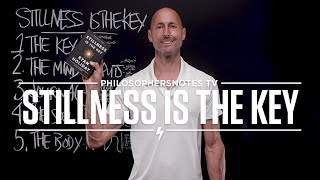
Ryan Holiday argues that stillness, or euthymia, is the mental clarity you need to flourish. The book covers three areas: mind, soul, and body. Key practices include cutting information intake, daily journaling, and alternating between intense focus and full recovery.
Questions this video answers
Mind; Soul; Body.
Six pages.
Sixteen pages.
About $10 per month (depending on monthly vs. annual billing).
14 days.
Chapters
Hi, this is Brian. Welcome back to Philosopher's Notes tv. Today we've got another great book, Stillness is the Key by Ryan Holiday. Stillness is the Key. No subtitle necessary. Ryan is one of my absolute favorite authors and thinkers. We have covered a few of his books already. We started with the Obstacle Is the Way. Then I think we did the Ego is the Ego is the Enemy and then the Daily Stoic. All of which are fantastic. I highly recommend each. He's basically a modern day practicing stoic. You can check him out@thedailystoic.com if I got emails on a daily basis that I'd read, it would be that one in another email. Somehow Ryan finds enough stillness to create two daily emails. The Daily Dad, Alexander gets that one and I checked it when I briefly went back in the email for a while. The Daily dad, the Daily Stoic. Check them out. Anything Ryan Holiday does is worth checking out. One of the thoughts I share in the PDF was a director in Hollywood who said something along the lines of, I have very few rules in my life, but here's one. If Ryan Holiday writes something, a book, a new book, I read it. I agree. Ryan's awesome. We've got the six page PDF Philosopher's Note on this and all of Ryan's other books. And now 600 plus great books out there. Check it out at Optimize Me. We've got the free two week trial. Check all those out. 101s, et cetera. So stillness is the key. We've got five big ideas here. First we'll start at the top. So Ryan tells us that stillness is the key and he kicks off the book with a story of Abraham Lincoln. Now, one of Ryan's many skills is his ability to tell a great story. So he reads like a beast. And he can integrate all these different historical references into a coherent systematic overview of whatever idea he's exploring. And his books always have three parts. So three parts in this book are the mind, the soul and the body. We're going to touch on each of them briefly. But this book kicks off, and I should say before I forget the 16 pages at the end of this book, Ryan talks about Winston Churchill, who we're going to discuss when it comes to the body and oscillating and being all in and then completely recovering. But the 16 pages at the end of this book, I read it and I'm like, I've read a lot of books at this point in my life and it was some of the best writing and storytelling I'VE ever read. And when we did the interview, Ryan and I, for this book, I told him that. And if I recall correctly, he was like, that's awesome, because I really was proud of that section. Phenomenal. So the book starts off with another great story about Abraham Lincoln, who, by tapping into stillness, realized that what they needed to do to win the Civil War was to get capture Vicksburg, to take control of Vicksburg. And he said, that is the key, and we will not win the Civil War until we have that key in our pocket. So stillness is the key. And Ryan tells us, as we discuss in the intro blurb to this note, every great tradition across time has a different word for stillness. Doesn't matter what tradition you're studying. Christianity, Judaism, Tao, all of them have a word to capture the power of being able to flip the switch and get calm and still at will. Now, of course, in our modern society, we're constantly being barraged by inputs, which will be one of the practices we talk about. But stillness is the key. And the Greek word for stillness is euthymia, which Ryan introduced me to and Seneca talks about in his work. Euthymia translates as tranquility. So over the years, I've been developing an idea that I call energized tranquility. I'll write it down because it's a powerful idea. I want to have it there, present for us. So the idea is energized tranquility. You're simultaneously energized and inspired, but you're also really grounded. Now, Barbara Fredrickson, who's one of the world's leading scientists, positive psychologist, wrote a book called Positivity, short another book called Love 2.0. She says, you don't want to be all up. You can be too positive. Right. She says you need to have buoyancy, where you have levity and you have gravity. You're grounded into, boom, the earth, right? I like to think of being inspired and grounded, and that's expressed in energized tranquility. And again, we're going to talk about how to create that as we move on. But stillness, your ability to on command, silence your mind, to be able to get still and present and focus on what's most important right now and is the key. And until you get that key in your pocket and you master the ability to do that, not going to win the civil war that's raging within you. Ryan quotes Martin Luther King, who says, we all have a civil war raging within us. That's what we're talking about all the time. With our minus one or plus one. You've got your daimon whispering in your ear, and you got your demon, the diminutive of the daimon. The soul is. And the demon. They're battling it. Who's going to win the civil war? I'll tell you what, stillness is the key to winning that war. Let's get on it. Now. The mind, the soul, and the body are the three parts of the book. Number one way to win that civil war and to achieve stillness in our minds is to reduce your inputs. Ryan does his thing here and talks about the fact that we live in an era that is just crazy in information overload. He quotes Herbert Simon, the Nobel Prize winner who came up with the whole idea of attention, the attention economy. So the attention economy is now trillions and trillions and trillions of dollars. Big right? Digital minimalism, Cal Newport, we talk about that and the fact that they are going after your very soul. And you need to get really good at controlling your inputs. So Simon said back in the day that a wealth of information creates a poverty of attention. Now, he said that in 1971, 1971, when we had like five TV channels, you had to tune in with your rabbit's ear, one local newspaper, and very few inputs, very few sources of information. Yet even then he said, look, a wealth of information creates a poverty of attention because that information consumes your attention. And then you have nothing left to give to anything meaningful. If you're always absorbing the shallow stuff, which again, is why Cal Newport and Ryan are two of my favorite guys. You gotta say no to the inputs in order to go deep. So know that. And then also know that if you want agency, which is your ability to do what needs to get done, your sense that you can do what needs to get done in your life, it's the kind of linchpin to your hope, a better future agency and then pathways. The number one way to cultivate your agency, according to the guys who wrote the Power of Agency on the Science of It, which we'll cover soon, is to control your stimuli, control what gets into your consciousness, and be ruthless about it, right? So I go to the extreme. I rarely use my smartphone. I don't do email Ryan. And I actually had my assistant email Ryan for something. And he literally told me, ryan, love you. Be a normal. Why can't you be a normal person? Use email. Playfully pushing back. And I'm like, buddy, this is it. This is how I'm choosing. Why would I want to be a normal person? In today's world, I want to get to the bottom of things, not stay at the top of things. Now, we need to find our own way of communicating, et cetera. So that's a playful chat to be had beyond the scope of this, but we need to have what Ryan calls an information diet. An information diet where we're literally choosing what we're going to consume very, very mindfully and consciously. So my question for you is, are you over consuming information in the process spending all of your attention on nonsense? Remember, stillness is the key. And remember, too, one of my favorite thoughts ever from Ryan, I think it was in the Daily Stoic, where he said, you know what? You don't need to keep up on every single thing. And it's okay to say I don't know about what's going on, the latest and greatest thing going on in pop culture or whatever, say I don't know, or say I don't care. If you want to be even more provocative, but you need to know you got to control your inputs if you want to have control over your mind and be able to flip that switch. And again, you're going to choose your own idiosyncratic expression of what that looks like. There you go. So then another practice here, which is awesome, that Ryan talks about and we talked about in our interview, is journaling. So Ryan journals on a daily basis. He quotes Julia Cameron, who says that journaling is like spiritual windshield wipers. Spiritual windshield wipers. Ah, I get a little bit rainy. I need to do some journaling. And Ryan makes the great distinction that journaling both demands and creates stillness. You must be still in order to journal and focus your mind, reducing inputs. And then it creates the ability to create more stillness by reflecting. Now he says, just do it. Doesn't matter what you do. It doesn't matter how often you do it, but do it. Whatever idiosyncratically works for you. I journal every morning. We have our optimized coaches. Again, as a requirement to become certified, they need to journal on a daily basis. Not anything. We've got what we call a carpe diem, seize the day journaling. I actually brought mine in today. Here's what I journaled this morning. You won't be able to see it, of course, but perhaps I'll take a picture of this or share it in some other means. That's this morning's journaling. What I journal on every single morning is what we're going to talk about next. We'll get there in a moment, which is virtue. How Do I embody virtue? How do I express the best version of myself today? And moment to moment to moment today? Because we know and I talk about in this note, the philosopher's note. Marie Forleo, another great book we'll cover soon. Everything is figureoutable. Fantastic book. She says that simply keeping writing down your goals increases the likelihood of achieving them by something absurd, like 42%. Now I say if your ultimate goal, your summum bonum, which again we'll talk about in a moment, is to live with virtue, then write that goal down every single day. Use that as a core of your journaling practice. Increase the odds of you achieving the most important thing in your life by 42%. And then, of course, strategically analyze and reflect on other important things in your life. Energy, work, and love wise. But that's what we want to journal. Which leads us to the virtue game, which is the essence of the section on the soul. And I'm going to find a quote from the note which I'd never seen before, and it's fantastic. By Ralph Waldo Emerson. So we named our son Ralph Waldo Emerson. I'm sorry, we named him Emerson after Ralph Waldo Emerson. And I had not seen this quote before. I love it. Emerson tells us the essence of greatness. The essence of greatness is the perception that virtue is enough. Aristotle again tells us that the summum bonum, the highest good, the greatest good, is to live with virtue, to live with arete, such that you can experience as a byproduct, eudaimonia, the sense of flourishing, knowing you are in integrity with your highest self. There's no greater game in town, and that again, requires stillness. You want to win that game. Stillness is the key. So, yeah, this is what we journal. So to connect it back to the journaling. So what I journal, and we encourage our coaches to journal every day is to get really clear on what your identity is. Energy, work, and love wise. We call that our big three. Energy, work, love times two. Identity, virtues, behaviors. So who are you at your best? Energy wise, that's your identity. For me, it's an athlete. I show up like an athlete. I move around, I train like an athlete. That's my identity. The virtue I want to embody today that I wrote down on the journaling today is discipline. I'm disciplined. I show up with the discipline of an athlete, then what am I going to do? Identity, virtues, behaviors is the other big three. Energy, work and love. Identity, virtues, behaviors. So I have my set of behaviors I'm going to engage in, and then Work. I quickly reflect on the same thing. I can do this in one minute now, literally. Boom, boom, boom, boom, boom, boom, boom, boom, boom. Ah, I'm good. And again, Ryan says, the spiritual windshield wipers, it can be a minute, 2, 5, 10. Take your pick. Of course, the journaling is to get us into action. We don't want to spend all day journaling. You want to use it as a vehicle toward the destination of being your best self. But reflect on how you can embody virtue in your life today. So going through it for me, philosopher, is my identity for work. I'm a lover of wisdom. It's my job. I want to be great at what I do and inspiring you to step into the next best version of yourself. The virtue I want to embody is I'm prolific. I show up with discipline, consistently helping you. I'm prolific. That's the virtue. And then what am I going to do? Well, I'm going to count and log a certain number of deep work hours and then love my identity as soulmate in the deepest sense of soul. Daimon, my daimon. I wanted to hang out with my wife, with my kids, with you, etc. Soulmate. The virtue is I'm connected. I want to be present, I want to be still, energized, tranquility, etc. And be connected. Let go of all pretense and what's standing in the way and be connected. And then what am I going to do? I've got practices as a dad, as a husband, and then, of course, my work is an expression of love, etc. The soul, remember, virtue is the ultimate game in town. Which leads us to the body. And those 16 pages of epic craftsmanship in writing. They kick off this chapter. So Winston Churchill, one of the most prolific human beings in history, served public service 65 years. He wrote something like 10 million. Is that what it was? 10 million words? 40 books, 500 paintings. Oh, yeah. And he led us through World War II. Thank you, Winston. Right, now, Winston went all in and crushed it and worked hard. Right? And this is the oscillating thing that I want to stress. So then he was on and then he was off. And he was on and he was off and he was on and he was off. He was all in or he was completely off. Worked like a beast. And then he would nap for two hours, or he would paint, or he would do whatever he was going to do to recover fully and bring joy into his life. All in, off. Now, you can't do that if you're like this kind of in a semi perpetual distracted mode. You're never fully on and you're never fully off. That flat line is burnout. You want to be on and then off. And that's how we cultivate the energized tranquility where we're able to flip the switch and be engaged in whatever's demanding our attention and then fully check out and have active leisure. As Cal Newport talked about, don't be passive in your leisure, allowing things to input into your mind that you gotta process, etc. Go out, be with your kids, go train, read deeply undistracted, et cetera. But this idea of getting our body right is huge if we want to tap into stillness. The opposite of energized tranquility, by the way that we talk about in our mastery series for our coaches, is enervated anxiety. If you are constantly allowing inputs into your mind and you're drowning in those inputs and you're going from thing to thing to thing to thing to thing, you're going to have a hard time falling asleep at night. You're going to wake up in the middle of the night with your mind buzzing. You're going to experience what most people experience most of the time. And I experience when I allow myself to go too far this way and why I don't do email is I find it to be an addictive thing that just gets me bubbling more than I want to be bubbled and I want to go deep and I'm going to make the trades in different styles, but enervated anxiety versus energized tranquility. And again, it all comes back to stillness being the key we got to put in our pocket. Lincoln style. Euthymia tranquility. I forgot to say one other thing here. The dao de jing, Ryan tells us, is actually the way of virtue. This is what that literally means, the way of virtue. Virtue is the game. So get your mind right by reducing inputs. How can you do that a little bit more today? Create some deep work. Deep living time blocks. Journal, spiritual windshield wipers. Try it out. Super powerful. Demands and creates stillness. 42% bump. Focus on what's important to you by writing it down. Your soul and virtue. And then again, the body energized tranquility. Be on and then be off. Today's a good day to do that. Ryan, thanks again for another great book. Look forward to the next one. And again, check out the Daily Stoic. Check out the Daily Dad. Both of those are just extraordinary daily newsletters. And of Course, get the book. This is one of those super quick reading, super impactful, life changing. Especially in today's world where we've got so much noise. We need to find stillness today more than ever before. Here's to the key. Here's to having another awesome day. Look forward to sharing more soon. See you tomorrow. Hey guys, this is Bry. Hope you enjoyed that video. We have a lot of people ask us what Optymyze is all about. So I just wanted to give you a super quick tour of our site, tell you what we do. We do two primary things. We have an Optimize core membership and we have an Optymyze Coach certification program for people that want to go from theory to practice to mastery. So the core membership is basically 10 bucks a month depending on whether you do monthly or annual. And you, you get instant access to over 500 philosopher's notes, the six page PDF, you know, 25 minute or so MP3 recordings of these great books. And then you get over 1000 optimized plus ones, 50 optimal living 101 masterclasses, et cetera. And we have a free trial the team set up, get it, you know, free for 14 days and then go from there if you like it. So we're blessed to have a lot of people who subscribe to this, including some of my friends who happen to be some world class peak performance gurus like Tal Ben Shahar, who taught the two of the largest classes in Harvard's history. Starts every day with Optimize. Ben Greenfield, friend and coach optimizes, bar none. My go to source for taking a deep efficient dive into some of the world's best books via the Philosopher's Notes. It's an indispensable resource. Thank you Ben. Marcy Schimoff loves Philosopher's notes. Mark Devine, retired US Navy SEAL commander, dear friend who starts his days with Optimized plus one winning win in the mind routine to charge him up for the day's battle. If you're serious about leading heroically, I recommend you use them too. Huya. Thank you. 10,000 plus other awesome humans around the world. That's the core membership. Then we have, and I should say we have apps. Excuse me, you can get apps, iOS and Android. You know, we feel pretty proud and blessed to have basically a 4.9 ranking and people saying some great things. You can check that at Optimize Me Apps. And then our Coach program is all about helping you master yourself so you can serve heroically, so you can empower others to do the same. We have trained over a thousand optimized coaches from over 50 countries. And, yeah, really excited about this. This is one of the core levers for us to fulfill our mission to change the world one person at a time together. Starting with you and us today, We've been told that here's one little thought and we have hundreds of testimonials you can check out about how it's transformed people's lives. And if you want to be a coach, your coaching practice Now. Half the people who do this want to be coaches. The other half just want to master their lives. But Barb, a coach of ours, says I already had two coaching certifications, but optimize coach was indisputably the most valuable I have taken. Thank you, Barb. Honored to be part of your life. You can learn more about what we're doing with optimize coach at optimize me coach. There you go. Hope you're doing great. Look forward to sharing more with you soon. Have an awesome day. See ya, Sam.






