PNTV: The Entrepreneur Roller Coaster by Darren Hardy (#357)
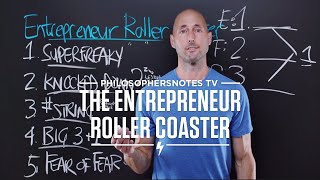
Brian Johnson breaks down Darren Hardy's five ideas for entrepreneurs: be a "super freak" obsessed with your work, recover fast from setbacks, lead by example, focus on three goals with one daily habit, and act quickly because anticipatory fear is worse than the thing itself.
Chapters
Hi, this is Brian. Welcome back to another episode of Philosopher's Notes. TV Today, another great book, the Entrepreneur Roller Coaster by Darren Hardy. The Entrepreneur Roller Coaster Subtitle Think you don't have the time, money or experience to start your own business? Then read this book. Why now is time to join the ride. Darren Hardy is the publisher of Success Magazine. He also wrote one of my favorite books, the Compound Effect, where he talks about the fact that if you want to optimize your life, you need to show up and aggregate and compound small, tiny little habits and gains over an extended period of time to see magic step into your life. This is a great book, all about entrepreneurialism. Of course, he starts by making the point that all of us are entrepreneurs. Muhammad Yunus, who won the Nobel Peace Prize for his micro financing initiatives, says that back in the day when we lived in caves, we were all entrepreneurs. We all were responsible for making sure we were fed and clothed. We were our own bosses. It's a really important psychological thing to have autonomy to do that which we choose to do. And entrepreneurship is a great way to achieve that. Darren Hardy, as the head of Success Magazine is all about helping us see the fact that today is the greatest opportunity in history to make the most of our gifts in service to the world and prosper in the process. So if you've been thinking about starting a business where you are an entrepreneur who's in the process of starting a business and enjoying the ride that is the roller coaster of entrepreneurship, then I think you'll love the book. And Darren's whole thing is let's go from Roller Coaster. There's always going to be the loop de loops and all those ups and downs. We want to have fun with it and make it a rocket ship. I really enjoyed the book. Philosopher's Note as always. Six page PDF, 20 minute MP3 for your enjoyment. And these are five of my favorite ideas. First one, super freaky. I'm actually going to bust out the official definition of freak. So Darren starts by making an invitation to be a freak. Be super freaky, in fact. And he says, look, let's look at the definition of what it means to be a freak. Here's what it says. Here's what he says. You open the dictionary. You can do that now. And I actually did that. I opened up my Apple dictionary. Is that really the definition of freak? It is. This is it. It's a noun. A person who is obsessed with or unusually enthusiastic about a specific interest. I will repeat, a person who is obsessed with or unusually Enthusiastic about a specific interest. Darren tells us that it's absolutely essential for us to not only be a freak, but to be super freaky. He says all the people who have ever made the COVID of success magazine are super freaky. They are super obsessed, Wildly enthusiastic about something that really interests them. And it's not just Darren or the dictionary. It's not just Darren who's saying that that's a positive thing. Mihaly csikszentmihalyi, one of the world's leading thinkers on creativity, who I quote and reference in this book, studied the greatest creators. Guess what? They were freaks. They were wildly enthusiastic, passionately enthusiastic, obsessed about that which captured their interest. It's the only way you can make a really significant contribution is. Is if you're willing to go all in, be super freaky. Obviously, you want to stay grounded. We're going to talk about this in one of the PNTVs we're doing soon. Barking up the wrong tree. You want to be the right kind of crazy. You don't want to be crazy crazy. You want to be brilliant crazy. So you want to stay grounded in your fundamentals and do the little things, but you also want to be willing to lean in. Everyone thinks that being obsessed and is a negative thing. Well, of course it is. When you're ungrounded and you're doing crazy things right. We're not talking about obsessive compulsive behavior. We're talking about a willing to dedicate all of your life force to that which most fires you up. I remember opening a book. Well, first I'll say Grant Cardone, who wrote the 10x rule. He's all about redefining obsession. Most people think it's a disease. He says, it's absolutely essential if you want to actualize your potential. And then I remember opening up Dan Siegel, one of the world's leading neuroscientists and mindfulness experts, to his new book, mind. And he says in one of the early pages, I've been obsessed about how the mind works, basically for my entire adult life. He's been obsessed. This is a psychotherapist, right? A psychiatrist out of Harvard. But he's been willing to focus with a really intense enthusiasm on his specific interest. And as a result, he's contributed something of meaning. So long way to say, let's get super freaky. What fires you up? What in your life really, really inspires you? Can you groundedly dial that up to a healthy level of really strong intensity in a healthy being? Very intense. Think about that get your super freak on. Go check out the definition if you need to. Darren has a great idea. He says, look, first of all, entrepreneurially, you will get knocked down. This is going to happen. Welcome to the game of life, and specifically the game of entrepreneurship. You will get knocked down. Know that fixed mindset version of me and version of any entrepreneur is, I got knocked down, something's wrong with me, or something's wrong with the business. Well, we all have work to do, and every business has work to do on it, but no growth mindset. That's just how it works. Darren says the trick is, when you get knocked down, you've got to see how fast you can get back up. He says that back in the day, he'd get knocked down and knocked out, something bad would happen, disappointing, etc. He'd get knocked out for two weeks. Then he trained himself to see the lesson in it and to not take the failure so personally. And he was able to recover in two days. Then he got even better at seeing the lesson, and he was able to whittle it down from two weeks to two days to two hours. And then he got even better at it, and he said, I'll give myself 20 minutes to be upset about it. I'm going to find the lesson. I'm going to bounce back. And now he gives himself two minutes to be upset about whatever happens. And he gets back. Jason Selk calls this a relentless solution. Focus, he says, give yourself 60 seconds to be knocked down and then to get back up. And I've shared this story in different contexts, but it's appropriate here. I. I've raised, I don't know, over $10 million now to finance a few different businesses that I've built and sold. And one of the times in my last business, I had raised a few million dollars. And one of our investors was a billionaire who was introducing me to some of his friends in Aspen. And it was the strangest introduction ever because he got up and said, hey, this is Brian. He's been knocked down and bloodied, and he knows how to get back up off the mat. Brian, tell him about your business. That was literally all he said. He didn't say, we did this and this and this. That was what he chose to say. What he admired in me and I didn't get for years, until years afterward, was the fact that I was decent at getting knocked down and getting back up. We'd face some significant challenges in that business. And he loved the fact that we got knocked down and I got back Up. So this is a constant discipline for us entrepreneurially. And again, we're all entrepreneurs ultimately, to see how fast we can get back up. Equanimity game 101, Marcus Aurelius style. And as my coach, Phil Stutt says, you want to have emotional stamina. The worse you feel, the more committed you are to the protocol. Right? You get knocked down, you get back up the next day. You're more committed to your meditation, you're more committed to working out, you're more committed to eating. Well, whatever it is you said is important, you add a drop more intensity to it that day after you got knocked down. And rather than spiral down like you might have in the past, you bounce back stronger than ever. That's a long look at that idea. Gets me fired up. Third big idea is string. I'll tell you what that means in a moment. We use that in our team. String is how we capture this idea. Again, people always ask how I actually apply these ideas. Here's one way. So Darren tells a story. Well, Darren establishes the fact that. That leaders set the pace. They have to set the pace, right? That people will only really actualize their potential if their leader is really actualizing his or her potential. And he shares a story of D day, World War II, 1946, right? I think it was 1946. D Day Normandy. Dwight D. Eisenhower is the commander leading that. And everyone's describing all the other generals get up and describe what they're going to do. And Eisenhower gets a little frustrated. He pounds the table and says, no, no, no, we need to change how we're approaching this. And the story goes, as Darren tells it, that he takes a string and he pushes the string from behind. Imagine a string. Imagine pushing the string from behind. What happens? It just folds up on itself, right? Nothing happens that you want to have. It just gets confused. He says, you need to take that string and you need to pull it from the front. You need to lead from the front and energetically and sometimes literally, right? You need to be the embodiment of the type of performance you wanna see from your team. So in our team at Optymyze Enterprises Public Benefit Corporation, my right hand guy, Evan, and I will often say, string. It's time to step up. We've gotta pull that string even more taut. Ly right? To lead our team, to show them by example what we can do. Let's create some masterpiece days. Hashtag stringstyle. There you go. Leaders set the pace. The fourth big idea is a really cool one. Another really cool One. Darren tells us that we need to identify what's really important to us. And we can have a laundry list, a bucket list of things that we want to do, 50, 100 things we want to do before we die kind of thing. He says, oh, that's nice. But boil it down. If you have more than one or two or three really important goals, you have too many and you want to identify which goals, if I achieve them, will have the most positive impact in my life. And he says, think of three, alright? 1, 2, 3. If you think of your next year, and this is something we use in our greatest year ever 101 classes, and I'm going to use it again this year. When you imagine having the greatest year of your life, what three goals, if you achieve them, would make that year just crazy awesome. Think about that, what is it? What would really make your year amazing? He says, when you get clarity on that, throw away all the other options, all the other possibilities. As Peter Drucker says, there will always be more good ideas than time to execute them. Therefore, you need to make first things first and second things. Not at all. The way I like to frame this, I like to think of it as what energy goals do I have? My big three includes energy, family and service, right? So I can either have one big goal for energy, one big goal for family, one big goal for service, which creates these three goals, or I can have three for each. We talk about that more on Greatest Year Ever. But for now, think about what's important to you. And then the second part of this is you think about, okay, what do I need to do? What one habit do I need to install? He says one or two things you do on a daily basis to hit this goal. So this is kind of our lag goal, to use the 4 dx guys terminology. The lead goal is what are you going to do? Simple thing that you're going to do on a day to day basis to make that happen. So for example, when I read the book over a year ago, I wrote the note, I talked about one of my goals which was to do. I hadn't done a Spartan race yet, but I was going to do the trifecta, right? The sprint, the sprint, the super and the Beast, longer Spartan race, okay? That was an important goal for me. So I set that up, I wrote it down and it was life changing. It wound up getting me in the best shape of my life in every sense right now. The one thing that I needed to do to make that lag goal a reality was very Simple. Show up and do a hike every day, show up on the trail. That became the thing that I measured. And I did it every single day. I might have missed it if I was traveling, but otherwise I did it. I showed up and I did it. Very, very simple. And you do that over an extended period of time, you can achieve a goal. So think about your number one goal. Think about the number one thing you're going to do to achieve that. And then put all of your focus there. Give it time. Aggregate, compound, compound effect style. That's our big three plus one. And then our fifth big idea is the fear of fear again in life, and particularly when you're entrepreneur. When you are an entrepreneur, you're going to be afraid. That's just how it works. As Phil Stutts, again, my coach says, that's a reverse indicator. That's an indicator you're doing something right, not that something's wrong with you. You're out of your comfort zone. Of course you're going to feel fear. But Darren, along with all these other great thinkers, says the only thing you should really be afraid of is your fear. Because your fear is stopping you from doing that which you need to do and where your infinite potential lies. And then he says, what's interesting is the only time you're really afraid is when you're thinking about and anticipating the thing that you need to do or you want to do or you're afraid to do. And he uses the example of a skydiver. So a novice skydiver is going up on their first jump. Never done it before, right? You watch them as they go up on their first jump. Their heart rate is going crazy as they're approaching elevation and they're getting ready to jump. But the moment they jump and they move from thinking about it and being afraid of it to actually doing it, their heart rate comes down and they report enjoying the experience. So the fear was in the anticipation, not in the doing. And the research shows the exact same thing in an fmri when you ask people to think about math. For example, if people are afraid of math, they're math phobes, right? And the idea of doing math problems scares them. You can actually measure that in their brain, right? As they think about doing it and they actually feel pain. Their pain centers light up in their brain when they imagine doing it. But guess what? The moment they do it, their pain center does not continue to be lit up. It dissipates and they're fine. Right? I call that procrastipane. The pain is in the anticipation when you just do it. It feels a lot better to go back to grant Cardone 10x rule. He says you need to starve fear of its favorite food. What is fear's favorite food? Time. You give fear time and it builds and grows and becomes a monster. But if you're afraid and you do it anyway and you make that just how you show up in life. Right? Speed is a force style. I'm afraid I'm going to do it. You see the power. So remember the skydivers and the math phobes. As you lean into your fear and think about it right now, what's something that you know you could be doing that you just know is a wise thing to do that you've been putting off? Might now be a good time to do that and then make that your habit. It's just how you show up. And as Emerson says, do the thing you're afraid to do. And the death of fear is certain for that particular thing. Or at least in that moment, you'll still have fear. But you build the strength to deal with it more and more gracefully. We talked about the big three that would make your life and your year amazing. And the one little thing you're going to do on a consistent basis to make that happen as a byproduct. String. Pull the string. Leaders. Set the pace. Be an exemplar of what you want to see on your team knocked down. Welcome to the club. Get back up. See how fast you can get back up. Maybe it's two months you're knocked out. Two weeks. Two days. 22 hours. 20 minutes. Two minutes. How quickly can you recover your center? That's the trick here. Not never getting knocked down, but knowing you're going to get knocked down and practice seeing the lesson getting a little stronger as you get back up. Super freaky. We want to be willing to be obsessed and intensely, passionately enthusiastic about something. What is it for you? This is obviously what I'm excited about and willing to be super freaky about. I love helping you optimize your life so we can change the world together. One person at a time. And together. Starting with me and. And with you. What was the big idea that jumped out? How do you make it a more applied part of your life today? Get on that and make today another awesome day. See you. Isn't it a bit odd that we went from math to science to history but somehow missed the class on how to live? For some wacky reason, optimal living 101 never made the schedule of course it's too late to go back and change that and and you're too busy to read full time to catch up. But if you're like us, you're all about optimizing your life so you can actualize your potential. So imagine this. Imagine having someone read the best books on how to optimize your life and pull out the big ideas that can really change your life. You know those sections? You underline an asterisk and mark all up. Then imagine that guy me connecting those awesome ideas to other great books and helping you actually apply the wisdom to your life today. Well, that's what I do with something we call Philosopher's Notes where I've distilled hundreds of great books into 20 minute super practical summaries. Then imagine me taking the absolute best big ideas from those great books and sharing them with you in hour long Optimal Living 101 classes. Everything from productivity, purpose and confidence to nutrition, goal setting and conquering procrastination. Helping you optimize every facet of your life so you can actualize your potential. You've got a personal trainer. I'm kind of like your personal philosopher. Ancient wisdom, modern science and practical tools. That's what our optimized membership program is all about. If you're feeling it, we'd love to have you join us.






