PNTV: The Practicing Mind by Thomas M. Sterner (#129)
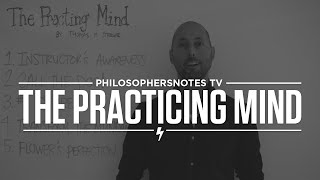
Brian Johnson breaks down Thomas M. Sterner's The Practicing Mind, which separates deliberate practice from passive learning. The core: develop an "instructor's awareness" to observe yourself, use the Do-Observe-Correct cycle, and make the process itself your goal instead of chasing results. Even mundane tasks become practice when you focus on the present moment.
Chapters
Hi, this is Brian. Welcome back to another episode of Philosopher's Notes tv. Today we've got another great book. So good that I think Alexandra borrowed my copy. We have it on the Kindle and a hardcover paperback. I think she's reading it. So, the Practicing Mind by Thomas Stirner. Book Philosopher's Note. Really good book. As you know, I'm all about willpower, cultivating habits, etc. This is a really cool practical guide to cultivating what Thomas Stirner calls the practicing mind. So we'll start by differentiating practice vis a vis learning, and then talk about the mind and then go through our five big ideas here. Practice versus learning. So learning is more of a passive activity, right? You can learn something, but there's a more deliberate intention to practicing. You're showing up deliberately and with a very specific intention to improve your skills when you're practicing. That's the aspect we want to think about when we think about practicing. And we want to cultivate the practicing mind. We approach our life and important tasks with that orientation. Very deliberate intentionality to be present in the moment, doing what needs to get done as we get a little better in the process. So to cultivate that, we need to cultivate what most teachers call a witness perspective, the ability to observe ourselves. But I love the way that Thomas describes it, an instructor's awareness. One of the big things that all meditation teachers talk about is you can get swept away in your thought stream or you can observe your thought stream. So one of the benefits of meditation is we cultivate the ability to observe our thoughts, to witness our thoughts. Witness perspective. I used to think it was kind of a weird, abstract concept. I understand it more now. But I much prefer the idea of an instructor's awareness when we're showing up in life and trying to work on our practicing mind. So imagine this. Imagine if that part of you that can see you is like an instructor. And Thomas also talks about the fact that you have this dialogue going on in your head, but who's listening? So if you're talking to yourself all the time, who is it that listens to you? He says, that's your true self. The rest is more or less healthy. Ego talking, right? Being kind of thrown around, driven by the id, driven by the superego. What can see that is your true self, your witness, your observer, your instructor's awareness. So imagine this. Imagine you're an instructor observing your student, whether they're playing a sport or a musical instrument or whatever. And you're observing them and you notice when they're doing that, which is the proper thing to do for that particular behavior, or when they're doing something that's suboptimal. If you're an instructor, you don't get all emotional about it when they're a little bit off, but you do correct them and you say, oh, wow. Okay, what we want to do is bring the club this way, or the racket or the instrument. You want to do this and this and help them do it properly. That's an instructor's awareness. Non emotional, non judgmental, yet separate from the behavior and able to adjust it to optimize it. That's a really cool idea. And it's a big part of the practicing mind. The instructor's awareness, that's what we want to cultivate. I don't have it up here, but guess what? The number one way is to cultivate that. Exactly. Meditation. I'm going to keep on talking about this until you cultivate a practice or step yours up. It's a big, big thing that naturally Thomas says when you meditate, this naturally arises the ability to witness more and more naturally. You don't even need to force it. Just show up, practice in mind, and do the work and you'll cultivate this skill set. Now, the next idea is a fun one. Call the doc. Call the doc. So the instructor. What does the instructor do? Well, what we want to do is we want to do the doc, right? So we've got doc, three steps, D, O, C. We want to do something. So you're behaving, you're doing whatever you're doing, and you want to observe it. All right, I did something. It was either effective or not effective. I don't need to get emotional about it. I'm just going to observe it and then I'm going to correct it. So if it was suboptimal, I correct it. It's really that simple. I do, I observe, I correct. That's the instructor's awareness in a nutshell. We don't need to do and then observe and then judge and go nuts on ourselves thinking we're idiots. And I can't believe you did that again. Just do it. Observe it and correct it. Not that complicated. We seem to practice and cultivate the practicing mind. That's the second big idea called doc, do observe. Correct. And then he says, your number one desire should be what most people's number one desire is to get the outcome they're after. They want to do this and this and this so that they can get that. And that's their Number one desire. That's what's on their vision board. The big house and the six pack and whatever, right? All the money in the bank, etc. Thomas tells us your number one desire should be to be as present as you can and to practice this presence, to show up and to perform at the highest level you can in this moment, to just be present in this moment. We want to make that our number one desire. And paradoxically, when we do that, those outcomes we want to have, we're able to kind of settle down. We need to have goals, no question about that. But you want to look at them occasionally. Thomas says, let them be a rudder for your ship. But you don't need to be staring at them all the time. It's like planting a seed in their garden and then digging it up the next morning to see how the roots are doing. It's just not a smart thing. Just tend the seed, give it water, give it the nutrients it needs. Do the work, but focus on the process. Be passionate about the process. We talk about this all the time. Superhuman, by habit, talked about focusing on process, not the results. We talked about it this week in Imagineering in the Art of Mental Training. We talked about imagineering that Pele didn't imagine getting huge multimillion dollar checks and getting gold medals. He imagined performing at a high level. So we want to focus on performance. How can we show up and make today a masterpiece? Make that your number one desire. Big idea. Particularly on the practicing mind. And then we want to transform the mundane. Transform the mundane. What does that mean? Well, it means that we all have things in our lives that just aren't that interesting. In the compound effect. We talked about the fact that if you want a fairy tale ending, you've got to be willing to do the mundane, the boring, the unsexy, sometimes difficult, deliberate practices, daily disciplines day in and day out. So imagine if you were able to take the most mundane things that you need to do. Doing the dishes, mowing the lawn, whatever. Thomas uses the example of mowing the lawn. Now you can go mindlessly mow your lawn, kind of complain about it while you're doing it, or you can say, you know what? This is going to take me X minutes. I'm just going to do it. I'm just going to be focused on mowing the lawn. I'm not going to be looking out at the new car my neighbor got that he's washing. I would have been thinking about other things and wishing I was doing something else. I'm just going to Mow the lawn. I'm going to see if I can make the lines as straight as I can and kind of get tight and just make it look good and kind of go up and come back and appreciate the green of the grass and do the best possible work I can with this most mundane task, do that, and it's just extraordinary. He says, don't expect it to be awesome, just do it. But what will happen is it will be amazing. Bring that full attention to any task and there's a life force that comes to that. We get into flow, we have this aliveness. This is a really cool way to practice this practicing mind. George Leonard says, how many moments could we recapture if we used every moment as an opportunity to practice? In his book Mastery. Great book. You could literally use every moment as an opportunity to show up and do it with as much grace and poise that you possibly can. Walter Russell in the man who Tapped the Secrets of the Universe says, any mundane task that is given to me, I'm going to make an art of it, an art of it. I'm going to see how expertly I can do it. A really cool orientation, transforming the mundane. And then the final big idea here is a really good one as well. A flower's perfection. Thomas asks us the beautiful question, at what stage in a flower's development from seed to bloom has it reached perfection? At what stage is perfect? What would you say? Well, I would say that at every stage, is the seed any less perfect than the full bloom or anything in between? Each stage, each step in the process is perfect. And he says, we need to look at our lives that way. We don't need to get somewhere. Wherever we are is perfect. Let's accept that, let's embrace that. Let's see the perfection in all the things that have brought us to this point and embrace that. And from that orientation, we can achieve the next level of our blooming, of our blossoming, of our actualization. But if we're always thinking that we need to get there in order to be happy, we're never going to be happy. So think about that. At what stage is a flower perfect? Think about yourself in that light. We're perfect and we're excited to get a little more perfect. It's just have fun with it, to allow that essence to be presence while we're having fun becoming the next iteration of ourselves. But each step along the way is essentially equally perfect. It's a cool orientation, easier to say than to do, but let's get on that practicing mind. Instructor's awareness. Really cool. Witness observer the instructor's awareness who brings in the Doc do observe and correct. No emotion, no judgment. Just observe what needs to be corrected and corrected. Call him Doc. Your number one desire to practice, to be engaged in the process. To show up every day and to do what you can to get a little bit better and just to show up and be present in whatever you've chosen to do. Let the outcomes be secondary. Let the outcomes be by products. They're there. Your goals are exciting and they're driving you. We don't even obsess about them. Check in on them occasionally. Make your number one desire to be present in this moment. Try transform the mundane. Make an art of it. Super cool idea and the flower is perfection. There you go. Hope you enjoyed what one idea landed the most. Kind of inspired you the most and how do you make that a more applied embodied part of your life Starting today? Think about that. Get on it. Have fun and I look forward to sharing more with you soon. Have another awesome day. See you.






