PNTV: The Practicing Stoic by Ward Farnsworth (#408)
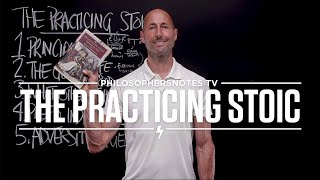
Brian Johnson breaks down Ward Farnsworth's The Practicing Stoic into five core lessons: control what's in your power and insert judgment between stimulus and response, choose virtue over fleeting good moods, resist conformity, practice indifference toward external outcomes, and use adversity as fuel for growth.
Chapters
Hi, this is Brian. Welcome back to Philosopher's Notes tv. Today we've got another great book, the Practicing Stoic by Ward Farnsworth. Subtitle A Philosophical User's Manual the Practicing Stoic Ward Farnsworth is the dean of the University of Texas Law School, which is about 30 minutes away from us here outside the. In the country, outside of Austin. We're kind of on an Austin roll here. We just featured admiral William H. McRaven for two of his books. He also is outside of Austin. So I thought we'd keep the Austin theme going. Here we are, Ward Farnsworth again. Fun side note, I went to law school, however briefly, would have been the Class of 2000 at the University of California, Berkeley, Bolt School of Law. So I have a particular affinity to the logical precision with which Professor Farnsworth, the dean of UT's Austin's law school, University of Texas School of Law, approached this book. It's literally an outline format. Now, I'm the kind of guy that the LSAT to kind of attest of your logical precision was like a sport for me. I just love thinking logically. Law school wasn't my thing. I want to argue on behalf of your daimon, your higher self. But I love the way that Professor Farnsworth approached it. Truly, literally astonishing. Just the clarity, the precision with which he architected the book and walks us through the different themes of Stoicism. So as always, we have a six page Philosopher's Note PDF, we've got the 20 minute MP3, we've got the apps. Check it all out. At Optimize Me, the team set up a free two week trial, blah, blah, blah. So five big ideas we're going to talk about today. The first, we always got to start at the top. Stoicism Principle Number one Pop quiz. If you have been following along, then you probably know what I'm going to say right now. What's the number one principle of Stoicism? Again, we now have, I think, a couple dozen notes on Stoic philosophers and their books. Actually, I certainly have a couple dozen. Check it out at Optimize Me, Stoicism, the full collection, the growing collection of notes and our class, Stoicism 101. But what's the number one principle of Stoicism? It is, in short, that some things are within our control and some things are outside of our control. The practicing Stoic is very, very aware of those things that are within our control and those that are not. And we're basically indifferent to the things outside of our Control. Yet we do have some preferences which we'll talk about in a moment. Our main focus is on living with wisdom, expressing sound judgment. That's principle number one. Now, most people, Professor Farnsworth tells us, Dean of Farnsworth. Tell us. Tells us most people think that it's event, boom, reaction, that it's a two step process. Something happens in my life and I react. Well, how else was I supposed to react? This person cut me off on the freeway or I lost my job, or this happened, or that happened. The event happened. Of course I have that reaction. He says, wait, wait, wait, wait. You need to add another step to the process. It's not a two step process. It is a third step process. Somewhere in here, your judgment about what happened creates your reaction. Now, if you miss that step, you're not practicing your philosophy, my friend. The Stoics tell us it's all about the judgment. It doesn't matter ultimately what happens to us. We have the sovereign power and the freedom, at least the wisest among us, to choose a response to that given situation. And again, the, the classic Stoic heroes will be taken away to be executed or whatever, and they'll just be, you know, whatever, I knew this was going to happen at some point, so let's go. You can't harm me. Even in death, right where they're going on exile. And they'll say, well, we have time for lunch, so why don't we have lunch right now? They're not moved by that because they're so committed to practicing their philosophy and their virtue. Now, again, some of that is, is a playful, actually beautiful, extreme representation. But here's another Stoic philosopher, Viktor Frankl. He attributes his logotherapy in the cornerstone of his philosophy to Stoicism. He framed it slightly differently, saying the same thing, though. Stimulus, response. Most people think, ah, I got a stimulus, so this is how I respond. He says, no, no, no, there's a gap. And in that gap is your freedom. Never let go of your freedom. We're going to talk about Epictetus. Take on that in a PNTV soon by looking at a note on A book by A.A. long, one of the leading academic researchers and scholars on Stoicism. We'll look at that soon. But that's principle number one. Let's let Marcus Aurelius join the party for a moment. What does he tell us? Here we go. This is Farnsworth quoting Aurelius to bring the point home. And again, he's leaning on the classic ancient Stoics, Seneca, Epictetus, Aurelius, we recently talked about Musonius, Rufus. Can't forget the fourth great Roman Stoic, who actually taught Epictetus, who taught the tutors, who taught Marcus Aurelius. We had that history lesson right. And then Farnsworth also connects some wisdom and share some wisdom through modern Stoics, even those who may not be known as Stoics, but were influenced by the Stoic thinking. So Marcus Aurelius says, if any external thing causes you distress, it is not the thing itself that troubles you, but your own judgment about it. And this you have the power to eliminate right now. And that is the ultimate freedom. That's the ultimate power to choose your response to any given situation.
We don't ever want to give up that power.
That's principle number one of the practicing Stoic. Second idea. I love this distinction. So Farnsworth tells us, look, you need to make a decision. The Stoics tell us. And we in the 21st century, dusting off the Stoic wisdom and applying it meaningfully to the 21st century, need to decide, do we want to go for a good life or a good mood? The good life or the good mood? Right. Do you want to feel good moment to moment to moment? Well, then you're going to choose to pursue and structure your life in pursuit of hedonic pleasures. You want to know that's fleeting. All of the science, ancient wisdom, modern science, has the same thing, hedonic adaptation. You're going to run harder and harder and harder chasing all these things, all the money, all the wealth, all the fame, all the extrinsic stuff, and you're never going to be satisfied. Like being on a treadmill. You run faster and faster, you get nowhere. Or are you going to. That's the good mood. Or are you going to go for the good life? You're going to go for the good life in which you pursue virtue, the summum bonum, the highest good. That's your ultimate target. That's eudaimonic joy. And Farnsworth tells us that the byproduct of that pursuit of living with virtue, doing the hard work to become virtuous in service to others. So you're ultimately grounded in love. The byproduct of that, the epiphenomenon of that is joy, a sense of deep, eudaimonic joy. But you're not going straight for that. It's a byproduct of it. And he shares this just beautifully. And I love that phrase, the good life or the good mood. And then it made me Think of. One of my favorite thoughts on the subject comes from Viktor Frankl. So again, let's extend our 20th century stoic, the heroic Viktor Frankl. Now, it's funny because this is one of my favorite quotes. And back in the day before I created Philosopher's Notes, when I was running my second business called Zods, I had the opportunity. I was 20. No, actually I was in my 30s then. Gosh, time flies when you're having fun. I was in my early 30s. So this is like 31, 32, maybe 14 years ago. Probably 13, 14 years ago. I'm in Austin and I have an opportunity to meet with John Mackey for the first time, the founder and CEO of Whole Foods. Now, our business was a social platform. Before Facebook. We created a social platform. MySpace was big. We created one that was just for people who wanted to change the world. And we had the opportunity to partner with John's nascent conscious capitalism movement before it was called that. We were going to build the technology for him and in a community forum. So anyway, he and I had some time together. We were supposed to have an hour. It stretched into more than that, two or three hours. And we were talking about this idea. And again, I used to carry quotes with me before I had Philosopher's Notes. So I actually had this thought, and I'm hanging out in his house and I read this to him, and he knew it basically by heart. We both just totally resonated on this and connected against it, around it. So, Viktor Frankl, again and again, I therefore admonish my students in Europe and America, this is what Epictetus and all the great what Farnsworth is admonishing us to think about. Don't aim at success. The more you aim at it and make it a target, the more you are going to miss it. For success, like happiness, cannot be pursued. It must ensue. And it only does so as the unintended side effect of one's personal dedication to a cause greater than oneself, or as the byproduct of one's surrender to a person other than oneself. Happiness must happen, and the same holds for success. You have to let it happen by not caring about it. He says, I want you to listen to what your conscience, your daimon, commands you to do and go on to carry it out to the best of your knowledge. Arete. Then you will live to see that in the long run. In the long run, I say exclamation point. Success will follow you precisely because you had forgotten to think about it. It's a byproduct of your commitment to something bigger than yourself and ultimately your commitment to living with virtue. Another great quote I want to share here that I wrap up the note with that Farnsworth shares. Give me a moment, please, as I turn to page six of the Philosopher's Note. John Stuart Mill, deeply influenced by Stoic thinking, if I recall correctly from Farnsworth's wisdom. He tells us, those only are happy, I thought, who have their minds fixed on some object other than their own happiness, on the happiness of others, on the improvement of mankind, even on some art or pursuit followed not as a means, but as itself an ideal end, aiming thus at something else. They find happiness, by the way. Again, we need to make our ultimate target to live with virtue, to express the best version of ourselves in service to the world. And when you do that, you catch that eudaimonic joy, that sense of energized tranquility. Euthymia we talked about recently with Ryan Holiday. Stillness is the key. Euthymia is tranquility. When you know you're walking your authentic path, you're not comparing yourself to others. You're not second guessing yourself all day, every day. You're giving your gifts in greater service to the world. That's the good life. That's what we want to pursue. Then we have what others think. What should we do about what others think? Farnsworth has a great section on this. He tells us that the Stoics had a. What was his phrase for it? They had contempt for conformity. Contempt for conformity. They realized that this is 2,000 years ago. Most people are not functioning particularly well. So why am I going to conform with what the average person does? What most people do isn't healthy. Look at our society. Most people are overweight. Most people are mildly anxious. Most people are going to get a chronic disease. We don't want to be like most people. As Krishnamurti says, it is no measure of health to be well adjusted to a profoundly sick society. I'll repeat that. It is no measure of health to be well adjusted to a profoundly sick society. Mark Twain said that anytime he found himself on the side of the majority, he paused and reflected. We want to have a healthy contempt for conformity. We don't need to be ridiculous for the sake of it. But we want to step back and look at it and go, really? Just because everybody else is eating ultra processed food or ultra processed technology and information doesn't mean I should be doing that. In fact, it's. It means I should probably step back and look at what would the noble action would be here now. We named our son Emerson after Ralph Waldo Emerson, who wrote an entire book on the theme called self reliance. In his book he says, trust thyself, every heart vibrates to that iron string. And he also says, for your nonconformity, society will whip you with its displeasure. What do you mean you're not going to eat the pizza and drink the soda at the pizza party after your kid's baseball game, you weirdo? Well, hate to break it to you, but that is toxic food. And because everyone else is doing it, doesn't mean I need to do it now. We need to have a noble acceptance of that scorn that will come. Don't want to be surprised by it. And we don't need to make it a big deal. We don't need to make anybody wrong about it. We don't need to proselytize per se, but we do want to be mindful and pretty much ignore what others have to say. That's a fun one. Fourth idea is preferred indifference. So again, the summum bonum, the highest good of ancient, you know, Socrates and Plato and Aristotle, etc. But then through the Stoics, if we want to practice our Stoicism, then our number one target, the only thing we ultimately care about, is living with virtue, living with arete, and experiencing as a byproduct, the eudaimonia that comes from that being. Eudaimon, a good soul, the archetype of the ideal person. Right? That's our commitment. Anything outside of our control, ultimately we're indifferent to because we do not have control over it. Right? So you can't need to be anything other than the person that's living with virtue. Right? Your health, your wealth, these things are ultimately out of our control. So the Stoics would say we need to be, if we're aspiring practitioners of the philosophy, indifferent to them. Yet we can have preferred indifference. So this is the fun distinction. Preferred indifference include health? Of course. I want. I would prefer to be vitalized and energized. I'd prefer not to be in a wheelchair. Now you can go back to make youe Bed and see stories with William McRaven. Remember the story Moki Martin, his guy that was hammering him in training, the ultimate quintessential Navy Seal, wound up in a wheelchair after a triathlon accident.
Boom.
Ultimately, he's indifferent to that. That didn't take away his freedom to choose how he's going to respond. His judgment is perfect. Life's not fair. I'm going to drive on now. What needs to get done now? I'm going to lead triathlons from a wheelchair and I'm going to do other things within the constraints of my new reality. So we have preferred indifference, like health, like wealth, money. Money is a neutral thing. Used wisely, it's a very, very powerful tool. We prefer to have wealth than not have wealth, but we're ultimately indifferent to it. It's the attachment to our health, to our wealth, to any other thing in our life that we don't have control over, which would be everything other than our virtuous thoughts and behaviors. Right. But again, we can have preferences. So it's a really fun distinction on that. My coach, Phil Stutz Yoda, who's coached a ton of Oscar winners, kind of Hollywood elite, etc. High, high peak performers, he teaches us. I can share most of his stuff. He's got some secret wisdom of which this is a small component that is just for me and him. But part the discussion is you want to be all in, committed ultimately to being committed to virtue. In our context here, you want to be committed to being the best version of yourself. And yes, of course, you set up goals, outcomes that you'd like to see in your life. You need targets to focus your energy, and you're all in on hitting those targets. You don't hold anything back. Right. Yet simultaneously, you're not attached to the outcomes. You're fiercely committed to being committed and to going for an outcome, yet paradoxically, you're not attached. That's how we show up with a preferred indifference and go all in on the good life in service to the world. And then I think we have another good Marcus Aurelius quote we could share in this context. So let me find that, yes, this is Professor Farnsworth here. He tells us. Marcus makes it clear, actually, I'm sorry, this is Donald Robertson. This is Donald Robertson from How to Think Like a Roman Emperor. Now, I heard of Ward Farnsworth because of Donald Robertson. So Donald and our team were trading notes. I use paper to communicate virtually. The team supports me in sending out the email, so I can stay out of email. Thank you, team. God bless you. Love you. And Donald and I were chatting about playing together. He was inviting me to one of his stoic events that was coming up in the future. And Ward Farnsworth was one of the speakers, along with William B. Irvine and Massimo Pilucci, who wrote how to be a Stoic, and Ryan Holiday. Right. And I hadn't heard of Ward yet. So that's where I actually got introduced to him. I googled him, found the book, got it, loved it. Donald Robertson, how to Think Like a Roman Emperor tells us. Marcus makes it clear that his internal goal is to live with virtue, particularly wisdom and justice. And we again translate justice into a broader, more powerful sense of love, wisdom and love. But his external aim, his preferred outcome, is the common welfare of mankind, not just of Roman subjects, incidentally, although the outcome is ultimately indifferent to Stoics, it's precisely the action of pursuing the common good that constitutes the virtue of justice or love. So again, beautiful paradoxes in life that we get to resolve through our action, moment to moment to moment, as we spiral up. Final idea, adversity. It's fuel for our growth. We talk about this all the time. And I love, again, the way that Farnsworth articulates it. He tells us that no one seeks misfortune in any particular sense. Yet we need to go through some challenging times in life to achieve great things and to do great and noble things. So on a particular level, we're not looking for it. But yet on a general level, we frankly should be, because that's a reverse indicator. We're on the right path. We're pursuing things that are worthy of us, such that the Stoic philosopher, when they experience the event that is negative and they have a judgment which is fantastic. Fuel for the fire. Now it needs to get done. Covid happens. Your business gets slammed a bit. Ours did. We had a huge event planned. Optimized 2020. We're going to have 101 luminaries from around the. Well, around the world, but primarily North America, but people from around the world coming to our event in Los Angeles. We're going to live stream it. Aggressive targets and all that. We had dozens and dozens and dozens of luminaries signed up. Boom. Covid happens. We're not having large events this year, folks. Oh, bummer. What are we going to do? What's the response? How do we use that adversity as fuel? We pivoted. We took those luminaries, we invited them to our optimized coach program. We've now had dozens and dozens of my favorite teachers join our optimized coach program, 60 to 90 minutes, where they share their most practical wisdom tools and then they coach our coaches one on one. It's been epic. So again, we took it as fuel. We could. And we. Whatever you can go one way or the other, right? We chose to use it as fuel for our growth. We always have the ability to step in between stimulus and response, and use it as fuel. And then again, Ward, Professor Farnsworth gives us the brilliant distinction. He talks about Hermes wand via Epictetus. So Epictetus says Hermes was said to have a wand that can basically turn anything into gold, right? And epitaph is like, okay, that's fine. But the real wand you want to have that the Stoic philosopher has is the ability to transform anything into something positive. Anything that happens to us is fuel for our growth. This is the whole idea behind our mantra of ohms, Obstacles make me stronger. That's the whole optimized coach program. Hero's Journey mantra, Obstacles make me stronger. Alms. We've actually got our first graduating class. We had a thousand people in the first class. As I've mentioned, over 500 of them, nearly 600 came to LA for the first graduation. And we had the entire group do the chant of ohms. We'll put a link to that as well. It's pretty fun. You can listen to that. Obstacles make me stronger. Remember, as Nassim Taleb tells us, the wind is neutral. It will extinguish a candle, but it will fuel a fire. With the right mindset, we can get stronger with every adversity we face. Again, this is Ryan Holiday's the obstacle is the way, quoting Marcus Aurelius. Got an obstacle in the way that becomes the way. Use it to your advantage. That's what the wise practicing Stoic does is. And finally here, if your ultimate goal is to be the best version of yourself, then anything that supports you in becoming that best version of yourself is good. Then we can just transcend the apparent dichotomy between good and bad and say, well, whatever, it's all fuel for my growth. Bring it on. Let's go. Let's alchemize it. Adversity is fuel. Preferred indifference. I'd prefer that we were able to produce our event, but ultimately I have to be indifferent to it because it's not within my control. Boom. What am I going to do about it? What do others think? I don't care. Let's. Come on, step back. Look at reality. See how dysfunctional it is. Then choose how you're going to play your role well within the constraints of your and our reality and be a radiance exemplar. Be a leader. Be an iconoclast who's willing to break some icons in an unhealthy society as we strive to live the good life. And again, our society is all in on hedonic pleasure. Everything needs to be quick, everything needs to be easy. It needs to be perfect. And we're seduced by that constantly. We'll move away from that towards the good life. Know that the good mood is a byproduct of your commitment to a good, virtuous life. As you practice principle number one, there's not two steps in the process, there's three. Something happens. You step in between stimulus and response. Exercise your freedom and choose the best response, moment to moment to moment. As a noble, worthy, exemplary, practicing stoic. Thank you Professor Farnsworth for the awesome book. Highly recommend it. Check it out, check out the notes. And most importantly, as always, what's the number one thing you got out of it? And what are you going to do about our discussion today? Moving from theory to practice to mastery. Make today another awesome day. Look forward to sharing more with you soon. Tomorrow. See you.
Hey guys, this is Bry. Hope you enjoyed that video. We have a lot of people ask us what Optimize is all about, so I just wanted to give you a super quick tour of our site. Tell you what we do. We do two primary things. We have an Optimize core membership and we have an optimized coach certification program for people that want to go from theory to practice to mastery. So the core membership is basically 10 bucks a month depending on whether you do monthly or annual. And you get instant access to over 500 philosopher's notes, the six page PDF, you know, 25 minute or so MP3 recordings of these great books. And then you get over 1000 optimize + ones, 50 optimal living 101 masterclasses, et cetera. And we have a free trial the team set up, get it, you know, free for 14 days and then go from there if you like it. So we're blessed to have a lot of people who subscribe to this, including some of my friends who happen to be some world class peak performance gurus like Tall Ben Shahar, who taught the two of the largest classes in Harvard's history, starts every day with Optimize. Ben Greenfield, friend and coach, optimizes, bar none. My go to source for taking a deep, efficient dive into some of the world's best books via the Philosopher's Notes. It's an indispensable resource. Thank you, Ben. Marcy Shimoff loves Philosopher's notes. Mark Divine, retired US Navy SEAL commander, dear friend who starts his days with Optimized plus one winning win in the mind routine to charge him up for the day's battle. If you're serious about leading Heroically. I recommend you use them too.
Huya.
Thank you. 10,000 plus other awesome humans around the world. That's the core membership. Then we have, and I should say we have apps. Excuse me, you can get apps. IOS and Android. You know, we feel pretty proud and blessed to have basically a 4.9 ranking and people saying some great things. You can check that at Optimize Me Apps. And then our coach program is all about helping you master yourself so you can serve heroically, so you can empower others to do the same. We have trained over a thousand optimized coaches from over 50 countries. And yeah, really excited about this. This is one of the core levers for us to fulfill our mission to change the world one person at a time together, starting with you and us today, we've been told that here's one little thought and we have hundreds of testimonials you can check out about how it's transformed people's lives. And if you want to be a coach, your coaching practice now. Half the people who do this want to be coaches. The other half just want to master their lives. But Barb, a coach of ours, says I already had two coaching certifications, but Optimize Coach was indisputably the most valuable I have taken. Thank you, Barb. Honored to be part of your life. You can learn more about what we're doing with Optimize Coach at Optimize Me Coach. There you go. Hope you're doing great. Look forward to sharing more with you soon. Have an awesome day. See you.






