PNTV: The Second Mountain by David Brooks (#421)
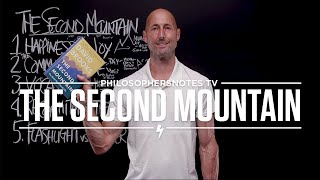
David Brooks argues a flourishing life requires climbing two mountains: first conventional success, then moral joy through four commitments—vocation, marriage, faith, and community. Brian Johnson distills this into energy, work, and love, and shares Brooks' advice to bring a flashlight, not a hammer, when examining your failures.
Chapters
Hi, this is Brian.
Welcome back to Philosopher's Notes tv.
Today we've got another great book, the Second Mountain by David Brooks. Subtitle the Quest for a Moral Life. That might be my favorite, if not certainly one of my favorite subtitles for a book ever. The Quest for a Moral Life, the Second Mountain. David Brooks is a New York Times Op Ed writer.
He also wrote the great book the.
Road to Character, which we featured.
Check out the notes and the PNTV on that.
I read this book and then I read the book that we just talked about called Falling Upward by Richard Rohr. Richard Rohr is one of the luminaries that David Brooks leans on in this book and they talk about similar things. So Richard Rohr talked about the two tasks of life. David Brooks extends that into the two mountains of life. So the second mountain is the mountain we aspire to climb after we've checked the box on the first mountain stuff, which tends to be what society tells us we should go for. As David said in the Road to Character, it's kind of like pursuing your resume virtues. Then you move on to your eulogy virtues. Which brings us to the first big idea again, as always, We've got the 6 page PDF, 20 minute MP3, check it out at Optimize Me, et cetera. We got 600 notes like this. Now, First Mountain, you're going for happiness. Nothing wrong with happiness, but it's kind of about you, right? You're going for all the things that you think will make you happy. Then you get to a point you realize, you know what? This isn't quite it. Then you move on to a deep sense of pursuing joy on this second mountain. And David says, it's as if there are two peaks. There's the first peak. Congratulations. Oh, there you go. The second peak, the one we really want to go for, is what he calls joy. And the highest form of joy he breaks down a few levels, is moral joy, which again is exactly what our.
Dear friend Aristotle said, the summum bonum.
The highest good eudaimonia, good soul.
How do you achieve that?
By living with virtue. What can we call that? Moral joy. Those are the two tasks of life and what we want to pay attention to. The other thing to notice is two mix little images and metaphors here as we ascend and become the best version of ourself, as we discussed with Richard Rohr, you actualize yourself, but then you move beyond yourself. You transcend that. Again, two tasks, two mountains moving from pursuing happiness to letting joy be a natural byproduct. Of your commitments. So the underlying theme in this book is that there are two mountains to pursue. We want to go after the second. A moral quest, right? A quest for a moral life. And the way we win that game and we succeed in that quest is to make commitments. A good life, a joyful life, a eudaimonic life vis a vis a hedonic life, when all we want is our own happiness and good mood. The good life is one founded on commitments. He says there are four. Call them the big four commitments to your vocation, to your marriage and family, to your philosophy or faith, and to your community. Those are the big four as he articulates them. Right, pop quiz.
Do you remember what they were? Do I remember what they were?
Vocation. Should we write that down? Why not? Vocation? First commitment. Second commitment was family. Third commitment was philosophy or faith. And then the fourth commitment is community. He spends a ton of time talking.
About the importance of each of those.
Of course, in the book, and getting out of this myopic, narcissistic sense of self to a relational, hyper relational sense of community and giving ourselves to the world. Now that's his big four commitments. I think we can actually boil those down into a big three, which would be our big three, which is energy, work and love. Now, very importantly, the philosophy is what drives this. So the philosophy we want to commit to is the summum bonum, the highest good. We want to go after moral joy, right? Then when we see that, we realize to play that game well, I'm going to need my energy taken care of, which David doesn't talk about, but is a very important thing. If you have a hard time getting out of bed because of lifestyle choices, good luck showing up powerfully in your work, AKA vocation, and in your love, AKA family and community, energy, work and love. Again, Freud told us a good life is showing up powerfully in your work and your love. We say yes, and you need to have great energy and you need to.
Know the game that you're playing and.
How to play it well via wisdom, self mastery, courage, love, etc. So that's our committed life. Big four, big three edition. Now, I'm skipping numbers here. Let's go to vocation. So the idea with the vocation is you are being called and we talked about this in the context of Richard Rohr's Hero's Journey. You're being called to go on a quest and then to come back and serve us profoundly. So the question here is simple for what are you being called? David? References Viktor Frankl again in the Holocaust, etc. He realized that, look, it's not so much what do we want? The question is, what is the world asking of us? What is being asked of us right now? For him, in the concentration camp as a psychotherapist, it was to bring wisdom to individuals suffering with him in that environment. But what is life asking of you? What roles are you being asked to play? And again, we break it down in our big three. Energy wise, who are you at your best, energy wise, so you can show up in your roles at work and in your roles at love as a husband, a father, a community leader. In your profession, what are you? What's your identity? What are your virtues? What are your behaviors? As we talk about the big three times two, Know your role, play it well. Find that place where your great joy meets the world's great needs and give us all you got today as a vocation. Commit to that, then recommit to that every time it wavers, which it will, and then recommit in the context of your marriage. He talks about the power of recommitment, and he says that marriages are not made. And he's had his own challenges in his marriage, which he's honest about and open about, ended one marriage and started another one, and there's some drama around that. So he's very vulnerable and transparent about that, but goes off on the importance of committing to our marriages and committing to our families and recommitting. Because marriage isn't there, he says, to make us happy. It's there to make us grow. And when we make this shift, we realize that. And then we do things like stand in love vis a vis falling in love. Most of us just want to fall in love, right? Oh, that feels so good to fall in love. It's a lot easier to fall in love than it is to stand in love. When the buzz of the honeymoon wears off. Then what? Then you better make the shift from happiness to joy. And know that eudaimonic flourishing comes with issues and challenges, especially in your most intimate relationships. You want to check in on our relationship? Ask Alexandra. I jokingly told her as I was preparing for this, hey, good news. Marriages are supposed to lead to growth, not happiness. Ha ha. We have fun pushing our edges and going forward. And that requires standing in love, choosing to love, right? And then he also says, look, it's. I do not. I'll try. A commitment is a commitment. It's a sacred vow. And if you are married, when you got married, you said, I Do I do commit not. I'll try now. Again. Asterisk. Some marriages need to take their own idiosyncratic path, and that might be ending the relationship as the most healthy thing. But we want to step back and check and see how deeply committed we are to things in our life. These big four, the big three, and again, in our relationship, it's all about recommitting. And again, that's the same in our love and in our work. Recommit, recommit, recommit. Again and again and again. And that leads us to the last idea here. I love this distinction. He talks about community work and one project in particular, where they looked at the data of what was working and what needed work. And he said they brought a flashlight to it, not a hammer. I thought that was a genius distinction. Bring a flashlight to what needs work in your life, not a hammer. Most people, when they fall short of their standards, they don't hit their targets, right? What do we do? We shame ourselves. There's no need for shame. There's no room for shame when we're committed. And we're committed to being a serene disciple, but of God, as Richard Rohr said, then we just realized even St. Paul was imperfect, right? Why can't I get myself to do what I know is best for me? You want to get curious. Which leads us back to the compass that we want to have ready at hand in this game of ours, right? We got the virtue compass, the cardinal virtues. Wisdom, self mastery, courage, and love. Then we have the other virtues that science says are most correlated to our flourishing. Hope, gratitude, curiosity. We haven't talked a lot about curiosity. Curiosity and then zest, right? Curiosity is being open to life, seeing what's working, seeing what needs work. And when things don't work, you bring a flashlight to it.
You don't bring a hammer of shame to yourself. So I ask you, how are you showing up?
As you pursue your greatest version of yourself, do it within the constraints of reality and know that your ideals, as Talbin Shahar, says, are guiding stars, not distant shores. We're never going to get there, because there's no there there. If you're suffering from overwhelm and perfectionism, realize that. Bring a flashlight to what you're doing. We talk about this a lot in Conquering Perfectionism 101. Conquering Depression 101. Conquering Anxiety 101. Check all those out. Bring a flashlight to your life's challenges. Get excited about where you can grow, what opportunities exist for you to get a little bit better. Quit hammering yourself. Recommit when you need to and then recommit again and recommit again to your relationships, to your vocation. What is life asking of you? What is life asking of you? Commit to your life, the big four. Your vocation, your marriage and family, your philosophy and faith, your community. Go all in, Give us all you've got. As you move from hedonic. I'm sorry, yeah, hedonic happiness to eudaimonic joy on the quest for a moral life. Thank you for the great book, David Brooks. And what about you? What did you get out of this? What idea just may have jumped out and landed reminding you of something you.
Already knew to be true?
But perhaps we can go even deeper. Theory to practice, to mastery.
That's what our work is all about.
Let's go do it. Check the box on the first task, the first mountain of life. This, my friends, is the peak we.
Want to go after.
Now let's go. Hit it hard today.
Hey guys, this is Bry. Hope you enjoyed that video. We have a lot of people ask us what Optimize is all about. So I just wanted to give you a super quick tour of our site, tell you what we do. We do two primary things. We have an Optimize core membership and we have an Optimize Coach certification program for people that want to go from theory to practice to mastery. So the core membership is basically 10 bucks a month depending on whether you do monthly or annual. And you get instant access to over 500 philosopher's notes, the six page PDF, you know, 25 minute or so MP3 recordings of these great books. And then you get over a thousand optimized plus ones, 50 optimal living 101 masterclasses, et cetera. And we have a free trial the team set up, get it, you know, free for 14 days and then go from there if you like it. So we're blessed to have a lot of people who subscribe to this, including some of my friends who happen to be some world class peak performance gurus like Tal Ben Shahar, who taught the two of the largest classes in Harvard's history, starts every day with Optimize. Ben Greenfield, friend and coach, optimizes, bar none. My go to source for taking a deep, efficient dive into some of the world's best books via the Philosopher's Notes. It's an indispensable resource. Thank you, Ben. Marcy Shimoff loves philosopher's notes. Mark Devine, retired US Navy SEAL commander, dear friend who starts his days with Optimized plus one Winning win in the mind routine to charge him up for the day's battle. If you're serious about leading heroically, I recommend you use them too.
Hoo ya.
Thank you. 10,000 plus other awesome humans around the world. That's the core membership. Then we have, and I should say we have apps. Excuse me, you can get apps. IOS and Android. You know, we feel pretty proud and blessed to have basically a 4.9 ranking and people saying some great things. You can check that at Optimize Me Apps. And then our coach program is all about helping you master yourself so you can serve heroically, so you can empower others to do the same. We have trained over a thousand optimized coaches from over 50 countries and yeah, really excited about this. This is one of the core levers for us to fulfill our mission to change the world one person at a time together, starting with you and us today. We've been told that here's one little thought and we have hundreds of testimonials you can check out about how it's transformed people's lives. And if you want to be a coach, your coaching practice now. Half the people who do this want to be coaches. The other half just want to master their lives.
But.
But Barb, a coach of ours says I already had two coaching certifications, but Optimize Coach was indisputably the most valuable I have taken. Thank you, Barb. Honored to be part of your life. You can learn more about what we're doing with Optimize Coach at Optimize Me Coach. There you go. Hope you're doing great. Look forward to sharing more with you soon. Have an awesome day. See you.
Sam.






