PNTV: Trying Not to Try by Edward Slingerland (#366)
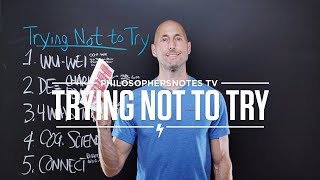
Brian Johnson explores Edward Slingerland's book on wu wei, the ancient Chinese concept of effortless action. The paradox: you reach spontaneous virtue through disciplined habit-formation, not by trying harder. Confucius, Mencius, Chuang Tzu, and Lao Tzu each offered different paths to the same goal.
Chapters
Hi, this is Brian. Welcome back to another episode of Philosopher's Notes. TV Today, another great book, Trying not to Try by Edward Slingerland. Trying not to Try Edward Slingerland Subtitle Ancient China Modern Science and and the Power of Spontaneity so Edward Signerman is a fascinating guy. He is an expert in both ancient Chinese philosophy, Taoism and Confucianism and modern cognitive science. And this book basically integrates the two in a super fascinating way that I am excited to explore at a high level today. If you're into those two subjects, I think you'll really enjoy the book. I read it in one day, just kind of one sitting, basically just super fascinating, compelling stuff. Philosopher's Note as always with some of my favorite big ideas and five of these ideas here that we will walk through now. So again, ancient Chinese philosophy, modern cognitive science, how do they come together? Here's how. The first is via U way, which literally means no trying or no doing they but it has a deeper meaning, something closer to effortless effort. So it isn't about no action, it's about effortlessly doing the right thing. Oo wei. This is the ancient ideal in ancient China is wu wei. How do you get yourself to a place where you can effortlessly do the right thing excellently every time? It's not a bad goal, right? And what happens when we get there? When we get there, we experience something called. This is the coolest word ever with for an English translation, the worst pronunciation ever, duh. So D e is pronounced duh, but it means something like charismatic power or virtue power or moral power. When you live with wu wei and you just get yourself to do the right thing effortlessly, it's just who you are, right? Effort emanates effortlessly from you. You have duh, you have this charismatic power. You have a radiance and a presence of moral charisma or virtuous charisma. This is what all the ancient leaders of ancient China were after. To live with wu wei so they could lead with a magnetism where people wanted to follow where the leader was taking them. This is why wu wei was such a prized way of being and why duh, or this charismatic power, this moral and virtue power, was so compelling. I just love that idea of moral power, virtuous power, when you are just so plugged into something bigger than yourself, which is what we'll talk about at the end. This wasn't just about being excellent at something and developing skills. It was about developing virtue in your life. Now what's fascinating and what the book is really about is, okay, so we have Wu Wei, we have duh, right, Effortless action, doing the right thing and the resultant charismatic power. But how do you get that right? And this is where it gets interesting because in ancient China we had a couple different approaches. Edward talks about four different approaches. So here's a basic spectrum of how we can think about it and where the book gets its title. Trying not to Try. So you want to get to a point where you don't even need to try to do the right thing, but you kind of got to try to get to a point where you don't need to try, right? That beautiful paradox. Now, on one end of the equation or the spectrum rather, we have Confucius. On the other side we have Lao Tzu, Lao Tse, however you want to pronounce it, right? So Confucius, Lao Tzu. And then we have a couple of other individuals we'll introduce in a moment who kind of split the difference between the two of them. Now, Confucius approach philosophically was you've got to try really, really, really hard in order to get to a point where you don't need to try, you need to discipline yourself like polishing a stone or carving a stone. You need to write really, really discipline and work on yourself in virtuous living in order to get to a point where the right thing becomes effortless. One approach, Lao Tse, Lao Su had basically the exact opposite approach. So try hard was Confucius's mantra, right? And then say Lao Su was stop trying. And he went extreme. He basically said, you know what, I'm going to check out of society entirely. I'm going to move into the countryside, I'm going to grow my hair long, I'm going to change my name, I'm just going to drop out. I'm going to stop trying entirely. I'm going to be completely one with that bigger force. That's how I'm going to arrive at that point of Wu Wei. Okay, well a lot of people believed in Confucius approach and a lot of other people believed in Lao Tzu's approach. And we're all going to have our own orientation to it. And there's partial truths to all these approaches. Edward tells us. But let's look at a couple of other individuals in between. So Edward walks us through each of these different great thinkers perspectives. There's a guy who is brilliant who adopted a take on Confucius approach. Mencius was his name and he basically said, okay, so we want to lean toward trying, but we don't need to try quite that hard. We want to. Rather than sculpt a stone or chisel a stone into perfection, we want to. We want to look at our inherent good, like little seedlings and nurture those sprouts. We need to make sure we're kind of a good gardener of those sprouts, right? So we want to try, but not quite as hard as Confucius would tell us to try, right? So a little bit on this side, but still moving toward that, trying hard, right? And then you have a gentleman named Chuang Si who oriented toward Lao Tzu's approach, but he said, okay, we don't need to check completely out of society and change our name and grow our hair, right? Still engaged in the world, but we just need to flow with the harmonious union. That's what we need to do. Chuang Tzu, if my memory serves me correctly, I read this book over a year ago. Edward leans more toward the kind of cheongsu approach. I lean more toward the Mencius, Confucius approach. As you have probably figured out if you've watched many of these, I believe in discipline and incrementally getting a little bit more virtuous, such that we're able to train our minds. We use our willpower wisely to install habits that run on autopilot. Our basal ganglias has taken over the show, and we're able to do effortlessly that which seemed really hard but is now easy for us. We do the right thing. We live with arete virtuously by disciplining ourselves moment to moment to moment, such that we don't need to discipline ourselves anymore. We just do the right thing. Now, again, we're all going to have different philosophical orientations. Each of these is appropriate for different people in different times, right? The paradox of partial truths. But think about where you fall on that spectrum and how you can engage in what you feel to be most resonant as you work to try to not try. Now, I mentioned that Edward is both an expert at ancient Chinese philosophy and modern cognitive science. So in the book, he basically connects the two. And what's cool is that when you think about trying not to try, you think about Oo Wei, which is again, effortless action. Effortless, right. Action. Doing the right thing without having to think about it. That can be thrown into a model of the hot and cool and, you know, kind of the Daniel Kahneman thinking fast, thinking slow model, right? There's the hot, spontaneous. You just do it, right? Then there's the cool, thoughtful, rational, slower thinking that complements the hot flow fast thinking. So the basic idea is you want to get to a point where you're able to use your cool rational cognition such that you can quickly fast hot do the right thing. In the book, he talks about it some more. It's fascinating stuff. And as I mentioned, I love the idea of using that cool, slow, rational, conscious cognitive thinking to discipline ourselves, to create the habitual behavior, such that we hand over that conscious, deliberate thinking over to our part of our brain, the basal ganglia, that just runs the show. It's just autopilot for us to do the right thing, because it's the right thing every time. That's a really fun game from my vantage point. And that's how we can connect it back to cognitive science. Then the fifth big idea here is connecting it to something bigger than ourselves. So Edward makes the distinction that this isn't about just kind of Mihaly Csiksiks Etmihaly's flow, where you're in the zone and you're just kind of doing your best and you're performing at your best from a skills perspective. He makes the point that we can't divorce this from ancient Chinese philosophy and culture, where Wu Wei and D had a very religious connotation. This wasn't about the individual becoming the best version of themselves so they can kind of show off their skillset. It was about the individual connecting to something bigger than themselves in a very spiritual, religious sense, such that they can give themselves to their communities in the most powerful way. So that idea of kind of flow plus something bigger than ourselves, that's what we want to connect to. That's the ultimate essence of Wu Wei. That's the ultimate essence of DA or moral charisma and virtuous power. And he makes the point from a cognitive science perspective that when you are that type of person who has worked hard enough, or if your approach is simply checked out and connected to that heavenly force as these ancient philosophers described it, and that just flows through you naturally, there's an ineffable, imperceptible magnetism that exists there kind of that charisma that exists that isn't the charisma of someone who's learned how to pick someone up at the bar or whatever. It's a deeper charisma that as human beings we are programmed to respond to that. There's a deep level of trust and a leaning into that energy when it's clear that someone has done this work to get to this point. So that is a Very quick look at this great book again. If you're into ancient Chinese philosophy and modern cognitive science, I think you'll enjoy the book as much as I did. As you connect to something bigger than yourself, connect the hot and cool, fast and slow systems such that you can live with spontaneity via one of our four ways, right? We've got Confucius try hard carve that stone. We've got Lao Tzu say stop trying, just completely flow. We've got Chuang Tzu leaning away from Lao Tzu but extending his vision of yeah, you want to flow, but we can do it in a little more integrated way with society then Mencius who extends Confucius ideas more toward the center, which is we've got these sprouts of goodness. Let's just tend them and let our moral virtue kind of arise as we discipline ourselves and then experience the moral charisma that comes from this practice as we effortlessly live with Wu Wei. That is an exciting invitation, at least for me. I hope you find it interesting. And practically speaking for now, what was one idea that kind of jumped out and landed? And how can you make it a more practical embodied part of your life today? Get on that cultivate your OO way and let your duh shine. Have another awesome day. See ya. Isn't it a bit odd that we went from math to science to history but somehow missed the class on how to live? For some wacky reason, optimal living 101 never made the schedule. Of course it's too late to go back and change that and you're too busy to read full time to catch up. But if you're like us, you're all about optimizing your life so you can actualize your potential. So imagine this. Imagine having someone read the best books on how to optimize your life and pull out the big ideas that can really change your life. You know those sections? You underline an asterisk and mark all up. Then imagine that guy me connecting those awesome ideas to other great books and helping you actually apply the wisdom to your life today. Well, that's what I do with something we call Philosopher's Notes where I've distilled hundreds of great books into 20 minute super practical summaries. Then imagine me taking the absolute best big ideas from those great books and sharing them with you in hour long Optimal Living 101 classes on everything from productivity, purpose and confidence to nutrition, goal setting and conquering procrastination, helping you optimize every facet of your life. So you can actualize your potential. You've got a personal trainer. I'm kind of like your personal philosopher. Ancient wisdom, modern science and practical tools. That's what our optimized membership program is all about. If you're feeling it, we'd love to have you join us.






