PNTV: Your Life Is Your Message by Eknath Easwaran (#146)
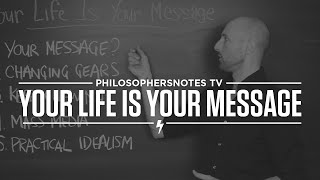
Brian Johnson breaks down Eknath Easwaran's five teachings, including training your attention like a stick-shift to slow down or speed up, and the idea that persistence makes bitter practices sweet. Your life itself becomes the message you send.
Chapters
Hi, this is Brian. Welcome back to Philosopher's Notes tv. Today we've got another great book, you, Life is yous Message by Eknath Eswaran. Your life is your message. Philosopher's note with a bunch of big ideas. We've got five of my favorite ones. Let's walk through them now. We will start with Eknath Eswaran. Eknath was one of the leading spiritual teachers of the 20th century. Grew up in India. He walked with Gandhi as a young man, came to America on a Fulbright scholarship, and he's just an extraordinary human being. We used his translations of the Bhagavad Gita and the Dhammapada in our philosopher's notes. And he also wrote a great book called Conquest of Mind, all about meditation. Just a good guy. One of my favorite teachers. Let's jump straight in. Your life is your message. First big idea. What's your message? Well, before we get into that, we. Where does this come from? Your life is your message. Many of you probably know, Gandhi was once asked, he was on a train traveling somewhere in India and a European reporter came up to him and said, gandhi, do you have a message that I can bring back to my people? Then Gandhi was practicing a day of silence. That day. He wasn't talking. We're going to talk about that in a moment. But he wasn't talking. So he wrote this message. He wrote, my life is my message. My life is my message. Gandhi. I'm not sure if he added a smiley face or not, but you get the idea. My life is my message. What an extraordinary concept. My life is my message. Which is amazing, of course, but then also think about the fact that he wasn't speaking. We take it for granted, but he wasn't speaking that day. People can talk to him. And he chose to write back. He knew that he needed to take care of himself. He needed to rest, needed to restore. He was putting out a ton of energy. And he had the discipline in an extraordinary level of self mastery in all aspects of his life. To practice silence, that in itself is amazing. Easy to take for granted, but it's extraordinary. It's a little bit of practical idealism we'll talk about in a moment. So the question here is, what is your message? If Gandhi's life was his message, which was an extraordinary one, how's your life? And how's the message of your life? Is it what you aspire it to be? Well, let's look at some ways we can optimize that. There's always ways to optimize changing gears is our second big idea here. Gandhi sayswaran says that we need to be able to change the focal point of our attention. It's kind of like your car that has a stick shift. You've got to be able to change the gears so you can have the most amazing car in the world. Imagine your fantasy car, your race car, whatever, right? Just amazing, beautiful car. You drive it off of the lot, and it has one little problem. You can't shift gears. Now, maybe you're stuck in first gear and you can't really get moving. Maybe you're stuck in third. You can't really go slow down, or you can't really speed up, or maybe you're in fifth gear. You get on the freeway, then you realize it doesn't work anymore. You're stuck in fifth. You can't slow down. Or maybe you're stuck in reverse and you're always looking backwards. We need to be able to shift the gears of that car. We need to be able to shift the gears of our mind. So notice if you happen to be stuck in reverse, always looking backwards and ruminating on things you wish you could have done. Or maybe you're always in fifth. You can't slow down. You're anxiously looking forward. Maybe you're stuck in first, you can't quite get going. Whatever it is, we want to have control of our minds such that we can put our attention where we want, when we want. We talk about this all the time at will. And ultimately Eswaron tells us we, we want to be able to park our car, just have it in neutral when we're not moving. Then we can invite something bigger into our lives. We can connect to that. That's a big idea. Changing gears. Notice where you may be stuck next big idea. Keep chewing. So eswaron shares a great story about how oftentimes when you start a spiritual practice, whether it's meditation or even just general optimal living, whether it's exercise or nutrition or whatever, trying to get a proper night of sleep, you often find that it's actually more challenging when you start trying to optimize your life was actually pretty cool. Maybe you're numbing a little bit, but it was pretty awesome. Now, as you try these practices, it actually gets, and I quotes wor on icky. That's what his students would tell him. Now it's a little icky. And he says, well, you know what? That happens when I was a kid. Eswaron says in India, his grandmother was his spiritual teacher. She once he was Complaining that things were hard. And his grandmother was very simple and straightforward. And she took him outside to an amla tree, picked a little piece of fruit and said, hey, Eknath, eat that. So he took a bite and it was super bitter, just horrible tasting. He said, grandma, this tastes terrible. It's icky. She says, keep chewing. So he kept on chewing. It still didn't taste very good. And she said, keep on chewing and keep on chewing. He chewed and he chewed and he chewed. And all of a sudden this bitter, sour, untasteful fruit started sweetening. It became sweeter and sweeter and sweeter and s Worn tells us that's how it is. When you apply yourself diligently, patiently, persistently, things that are icky and challenging in the beginning become sweet. All the great teachers talk about this. It's hard work to put in the effort to move from something being uncomfortable to being something that actually gives us a great deal of joy, not only as a byproduct of the work, but in the moment. Seneca says the same thing. He says, how much better to have the discipline, to pursue a straight path such that the things that are best for you are the things that you most enjoy. Now when we start, that's not quite the way it works, but we need to stay with it. Diligently, patiently, persistently, we need to keep chewing. If you find your practices are a little bitter right now, keep chewing. It sweetens in the chewing. It's a big idea. Next big idea, mass media. Eswaron tells us that we need to notice how seduced we are by mass media and how much we consume it. We might take it for granted, but when we're constantly consuming talk radio on the way to work, maybe we turn on the TV right when we wake up or watching the news. Got to catch up. Can't miss five minutes of what's going on. Talk radio, come back, we're watching some entertainment and some news, etc. Etc. Etc. We're constantly getting mass media bombarded on us. He says, you know what? We need to replace some of that with some really healthy food. That's kind of like junk food for your mind, right? What would happen if you detoxed on that junk food for a little while, turned off the mass media, and got some really healthy, wholesome mind, spiritual soul food, Some superfood for your soul. Read some great stuff, whether that's the Bible or the Bhagavad Gita or the Dao de Jing or whatever it is that inspires you. Feast on that. Take a Half an hour out of your normal television or Internet viewing or whatever. Replace it with some really, really solid, strong, nutrient dense wisdom. It's a good idea. Detox from mass media. Connect to something bigger than yourself. Fourth big idea. The fifth one is practical idealism. We've been talking about functional optimism, functional dreaming or practical dreaming. Now it's practical idealism. And Escrow says, look, this isn't fantasy land here. We want to bring this idealism into our day to day lives where every moment gives us an opportunity to practice the ideals we believe in. In Heroic acts of courage are wonderful, but we need to find ways to have ordinary courage as Brene Brown describes it. Ordinary courage, where we show up day in and day out, just try to get a little bit better. Make our life a work of art is another one of his big ideas from the book. Have practical idealism, the moment to moment to moment experience to be a little bit better. Then we bring our ideals into our current reality. We live with deeper integrity and our life becomes a more compelling message. The message that we aspire to share with the world. So there you go. Super quick look at this great book. Eknath Eswaran. I highly recommend his translations of the Bhagavad Gita and the Dhammapada and then Conquest of Mind as well. I'll put links to those below. What is your message? How can you dial that in a little bit? Remember Gandhi? My life is my message. Smiley face Gandhi. He took a day off from talking. Can you take a day off from the Internet or from mass media? Might sound weird, but heroic people do heroic things. Ordinary courage, practical idealism, the little things add up. Remember changing your gears. A car that you cannot shift its gears is not a very useful car, no matter how beautiful. Same with our minds. We've got to be able to shift our minds, put our attention where we want, when we want. Keep on chewing. If it's tasting a little bitter right now, it's part of the process. Keep on chewing and chewing and chewing and it will sweeten in the process. So there you go. Hope you enjoyed. I look forward to sharing more with you soon. Have another awesome day. See ya.






