Haven Point | Holly Furtick Book Club
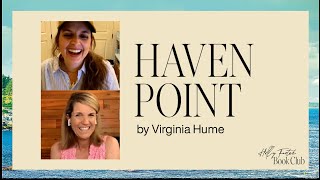
A Holly Furtick Book Club interview with Virginia Hume about her debut novel Haven Point. Hume discusses her multi-year, tenacious writing process, the novel’s origins in a closed coastal community inspired by 19th-century literature, character development (Maren as an anchor, Sky’s anxieties), themes of friendship, forgiveness, and alcoholism, the audiobook production (narrator Cassandra Campbell), and hints at a forthcoming related novel set in 1895.
Chapters
Foreign.
Welcome to another Holly Furtick book club. It's one of my favorite nights of the month. Abby said tonight to me. We were cooking dinner and she was helping me chop. And she said, mom, when's your next book club? And I said, tonight. And she goes, it just feels like book club tonight. And then she said, I think it's because you're making spaghetti. And she said, I think you make spaghetti every time you have a book club, so maybe I do. I don't know. I like spaghetti and it's easy to make and fast. I am so excited, though, that it is book club night and that you are joining me and that we are going to be talking about books. And most specifically, hard. Hard word to say this book, Haven Point by Virginia Hume. We're going to be talking with Virginia. I'm so excited about that. So let's do it. Okay, let's talk to Virginia. Here we go.
Hi. Hello. How are you?
I'm so good. Thank you for joining us tonight.
Oh, my gosh. Thank you for having me, Holly. I was so excited because I'm in Maine and I was going to have, like, the water in the background, and now I'm in this, like, shared, so I feel like I'm in a board meeting or something. But anyway, do you like my wood? It's really rustic. If I start flop sweating in the middle of this, like that scene in the movie Broadcast News, just let me know and I'll wipe myself off.
I'm so glad that you're here. We'll just pretend like there's the main.
Ocean in the background. Imagine an ocean.
We really loved your book as you. I think you've been on. You've been watching Haven Point. It was your first book.
My first book.
Tell me, like, what was your process? How hard was it for you to push through and finish it, edit it, all of that? What was that like for you?
That's such a great. That's actually the perfect question, because I would say the thing that emerged in me writing this that isn't. I'm not commonly considered that tenacious, but this took a ton of tenacity. I think I started it years ago. It took like a year and a half to get a draft done. And then it was just this long process of, you know, redrafting and edits. And I had readers, and at one point I had an outside editor and then getting an agent, and it takes years. And it was a side hustle. You know, I had a job, I had kids, I had things going on And I don't. I didn't really. I tried at every step not to get ahead of myself. So I didn't really think about agents until it was time to find an agent. And when I had an agent, I didn't think about publishers until it was time for my agent to find a publisher, which was good. It sort of kept the main thing. The main thing, you know, And I didn't talk about it. I mean, you know, there are people who knew my family and actually a lot of people who are helping me with content or in one or another ways. But it was just. I sort of just quietly went along writing and rewriting and drafting and restructuring. And then after I sold it, I had another rewrite. So this is not, as I've been saying, a very efficient way to make a living. Just wondering. But it was really gratifying. And I said to my daughters, who are now. My older daughter's 22, my younger daughter's almost 20, and it was before, I think, I even had an agent. And I said, you know, girls, I've already gotten the benefit of doing this project even before I sold it, because it really was. It did require a lot of tenacity. And I learned so much. And I found it such an incredible intellectual challenge. And it was fun and gratifying and satisfying and creatively stimulating. And I felt like it really kind of changed me in some ways. It made me bolder. Suddenly I was like, well, I can bake French macarons. Why not? It's just work, you know, you just keep trying until you figure it out. So anyway, it was a long process. I joked that it's the same way I put together IKEA furniture, which is do it wrong, don't read any instructions, and then be like, oh, my gosh, I've made like 10 Billy bookcases in my life, and I still can't put together and then figure out what's wrong and try it again, keeping at it. So it was, yeah, a little epic, but. But definitely satisfying and obviously a very gratifying outcome.
So how did these characters come to you? What made you. What, like, where do you start when you want to put a story into words?
So that I started really with setting. I wanted to write a novel set in a insular community like this. They're so great for just, you know, like boarding schools or small towns or. Because you get a lot of humanity together in close quarters. You know, summer after summer, things will really start to percolate. I read a lot of 19th century literature, and I Have this great affinity and affection for the heroines in those novels. You all were talking about Anne of Green Gables. And I've been plowing through the entire series this summer. Yeah, I'm a little regressed.
I love Anne.
I love Anne so much it's funny. I owned the whole series when I was young, but I don't think I read past the first book because they weren't familiar to me. And of course, she's really only a child in the first novel. I mean, she's so young, but she starts teaching in like the second or third. But, you know, their flaws are a little bit more like pride or impulsivity or stubbornness or they're not particularly neurotic, these characters. And sky, of course, is very anxious, but she's also funny and spirited and you sense that she likes herself. And so that's what I wanted from my main characters. And Maren, I mean, I really like Maren too. I noticed a lot of your book club members were saying that she was a favorite and they identified with her most. I more aspire to Marin. This. Sky has a little of me. I mean, none of them are really like me. I definitely have. Not for the same. Like, my parents are very moderate drinkers and I don't have anything like her challenges, but I definitely have, like, fear, financial insecurity. I can identify with. Like, this was a creative challenge. And I, of course, was going to keep it as a side thing until I, you know, knew that this is what I was going to do for a living. And so having to kind of find that courage, I could really understand. I think by the end of the novel, the reader has a sense that she's gonna go forward probably with a more creative, maybe less certain career. So. But Maren. Maren's just kind of true north, I think. You know, she's. She's got a moral. Strong moral compass, but she doesn't moralize at all. She wasn't too perfect. No, she felt like an anchor. Yes, she did. And she is old fashioned in a way, just because she's. You know, there are certain things she's so absolutely sure about in really critical moments. I think most particularly when Oliver. When Charlie dies and Oliver is tempted to blame himself for it and she won't let him. She just knows, as purely as she knows anything, that as it says in the novel, that down that road lies hell, that they can't go forward as a couple. They can't survive this. If he does that and just says to him, you have to for Me, you have to believe that this is not your fault. And which is sort of a funny concept because, you know, can you just make yourself believe something? But she asked him to take it on faith, and he does, and it saves them. But she was imperfect with Annie and admits her own mistakes there, and she.
Was unable to convince Annie of that same thing. Right. And right. So I like. I liked that because it didn't feel like, like, you know, like she was this superwoman who was able to save everybody. You know, she was able to salvage her relationship with her husband in more ways than one, but then she wasn't net. She was never quite able to save Annie. And. But then I loved how she was redemptive because she did save Annie in a sense of the way that she explained her to sky, you know, and.
So I think she saved. And she saved Anne's memory and legacy for her granddaughter. And she did her best to step in where she could in the same way that the women of Haven Point stepped in for Pauline. And I like that. I just liked the, you know, it's a novel about friendship, certainly, but it's also a novel about forgiveness and about loving people in all their wholeness. And there are very few black. And I mean, there's a couple little villainesses, you know, Gretchen Hathaway early on, and Caroline Sturgeon, Walter Reed, who plays sort of bit parts. And those are your more typical one dimensional characters. But to me, I think the lesson of the book is that, you know, nothing's very black and white. We're in a very black and white time and a lot of, like, snap judgments and, you know, it's like I've said, it's not a political book at all. But I do think it has a message for our political moment, having worked in politics, because everyone is so certain all the time about who is good and who is not. From, like a tweet. So, yeah, that's what I was after.
I love that and I loved how there wasn't, like, necessarily like, good and bad. I thought that was. I thought that was really great. I've heard a lot of people say when they write a book that when they're finally finished, that they miss the characters as if they were their own friends or their own family who has. Who left or disappeared or whatever. What character do you think you. You missed the most when you finally turned in the manuscript?
So I actually still feel like most of them are with me. I sometimes have these, like, what would Maren do? Moments. How would Maren handle this? Or what would sky say? Because Sky's very funny, but certainly Maren, I mean, she is. I think you use the perfect word, Holly. And saying she's like an anchor. Um, and she is that. And she doesn't really seem to self identify with that, which makes it easier, I think, to see her that way. And she.
She doesn't see herself like that.
No, not necessarily. She love her. Right. She has that. I say she has Lutheran modesty. You know, that Minnesota kind of, you know, that farm girl thrift. And, you know, she's just. She is. She's modest, but not. But not. It's not that she's unsure of herself. And I don't know, I just think she's a very. She's very steady. You know, she's a very steady character. And at the same time, she's kind of modern. I mean, she. Grandparents. The way I aspire to parent, you know, the way she is with sky, she has that tendency to kind of run toward the emotion that you're afraid of, you know, which is like the core of empathizing. So when sky is a young teenager and is visiting because her mother's drinking and she's furious that she's been, you know, snatched away from home and away from her new best friend and has to go to Haven point where she doesn't feel like she's in the swim and she's complaining. She's like, I'm so angry. And she's like, you know, or it's so unfair. And Maren's like, it's so unfair. You know, she kicks it up a notch. And I, of course, fall short of that all the time, because when your kids are complaining, you just want to argue with them about why they shouldn't be complaining. So in that way, I'm like, she's kind of modern, but not. She's not doing this out of a parenting book. You know, it's just her instinct about human nature. And so anyway, I still. I have Maren in my head a lot. I also, you know, dialogue is kind of the only thing that sort of comes really naturally to me about writing. And I say I hear the characters talking in my head, which sounds kind of crazy, but I still do, you know, so in that way, I. They really felt very alive to me as I was writing and in many ways still do. It was fun listening to the audiobook for that reason, because it was like hearing somebody else say it out loud to me. And I've gotten through it over a period. I've only just listened to it pretty recently. And anyway, so it's. It's fun. So they're still around. They're still here in this little phone booth with me.
Any questions for you to piggyback off of some of the things that you're saying, But I need to comment on the audiobook first, because I love audiobooks. It's like the primary way that I like to experience novels. And so my husband and I always kind of have. We've had this discussion about how when you're listening to an audiobook, it's really. So much is left to the narrator's interpretation of the story and how they use, you know, inflections and voices and all of those things.
Was, did you.
Were you happy with the way the book was read? Was there anything that you were like, I wish that she hadn't, you know, read it that way or anything like that?
I was really happy with it. And I kind of thought that. That I would get some phone calls or something as the audiobook was being put together, because I don't know anything. I've never published a novel before, so. So they'd asked me one pronunciation before they had even brought the narrator on. The audio producer did. And then I didn't hear anything until the audiobook was produced. And so I thought, oh, gosh, well, I hope. But the interpretation was really good. And there had been. They had sent me two possible narrators. It isn't really, I don't think, authors. It's kind of like covers and titles. Like, I don't think, ultimately, I. It's not up to me, but they were nice enough to consult with me, and they were both great and what they read in their samples, though one of the narrators did a better job intuiting what the. You know, what the meaning was than the nar. Just in this one little segment that they read, like, part of the prologue. And Cassandra Campbell was not that one. But I asked the producer, and she said, well, neither of them had read it, which, of course, I knew. And so, you know, once they have actually read the book and understand what's going on, then they'll be able to, you know, be able to interpret it. I just thought it was interesting. And so, again, I didn't hear from her, but she obviously read the book, groked what it was that. That, you know, that was. Was being conveyed. And I thought she did a really good job. I really like her voice.
Cassandra Campbell, she's amazing.
Yes, she's really good. And so I thought she was great. Both options were great. It was a little bit of a, like, coin toss on my part. But anyway, I was pleased with it.
Yeah, she's. I've actually listened to a lot of books that she's narrated, and a lot of times, if I'm on the fence about what book I want to start and I see that she's narrated it, I'll be like, oh, I'll do this one, because I know she's good.
Okay.
So another thing that you touched on was how we have two of the characters in the book, not primary characters, but Annie and Pauline, who both struggle with alcoholism. And I thought it was really interesting how you address this topic and sort of, without saying, talked about how it's so much more shameful of a situation for women, necessarily, than it is for men. And I was just wondering, like, what made you feel compelled to write that into the story? Was there anything that you have heard or experienced or just what compelled you to sort of want to make that statement and sort of the statement of, like, women covering each other?
Well, so as I said, my. I was. I'm the daughter of moderate drinkers, but a lot of. There's a lot of alcoholism in my family, so. And I also come from a family of storytellers. I didn't really realize this until it's really been brought home to me recently because I've been posting from time to time just these random family stories. Just as I come across pictures, it's somehow fallen to me to become the family archivist. And so. And people are like, that's an amazing story. And I realize not everybody knows these stories about their family. And my parents are also both very candid. You know, they don't walk around talking about these challenges all the time. But I was raised knowing that, you know, we're probably not great drinkers as a people, you know, just biologically and otherwise, and then some kind of funny stories and then some, you know, challenges that were presented. I have one grandparent who was a binge alcoholic, so, like Annie, more of an on, off, switch. Pauline always struck me as someone who's drinking. I mean, she doesn't drink all day, but she kind of drinks whenever she can and never really stops, versus Annie, who's in and out of rehab and, you know, supposedly sober for long stretches of time. So I thought it was interesting for me to think about sky and how that would affect her. And I didn't think of Pauline's husband as an alcoholic. He's a heavy drinker, as all these people are, and can kind of stop Himself. But, you know, it's a story about these women and how they support one another despite their flaws. Yeah. And you hear early on in the novel or read early on in the novel that as. As Maren is just learning about her mother in law's, you know, the depth and the breadth of her mother in law's problem, she's saying, well, you know what? Everyone says, what about rehab? Well, what about this? Or whatever, you know, they didn't call rehab, but what about, you know, putting her in some kind of facility? And Georgie's like, you know, or we should talk to her. She's like, yeah, give it a try sometime. And for years, you know, Marin's thinking, I really should try and talk to her. I really should try and talk to her. And then she finally does in the chapter when Charlie is.
She has the baby. Right.
When she has a baby on Haven Point. And you see it going in this circle, you know, and that you can't get off. It's like this merry go round. And I think that that's like real life sometimes. And are they enabling her? Well, they're not married to her. They're not her parent. They're not. These are just friends, I think, doing the only thing they feel like they have within their power to do, which is to keep her safe, to try and minimize her humiliation and to get her home and to not have her die, you know, on their watch, and it's some horrible public, you know, terrible way or to harm anyone else in the process. And I think that's kind of real life. Sometimes not everybody gets well, and it's hard for us to believe that, but I think it's just. It's just a fact. And you can love someone within limits of, you know, while still protecting yourself.
Having boundaries, but having exactly.
Perfectly said so. So I think that's why I thought it was worth exploring. Like everything else, you know, that situation is not black and white either. Yeah. So you're not good or bad.
It wasn't like. Because I feel like a lot of times in a book or a movie, you know, the person who is an alcoholic, they go to rehab and they get clean. And the reality is most people don't. And they just manage it and live with it. And so I thought that was. I thought that was. I thought that was well done in the book. Okay, here's an. Here's another question for you, because you're talking about friendships. Talk about the power of friendships. And you've got these really strong friends. You've got Adrian, you've got Dorothy, who I loved her character and Georgie, do you like, do you have any friends like that in your life? Did you have any friends that were reading the book along with you and giving you feedback or, you know, anybody that you modeled some of those characters after?
Yeah, definitely. So Adrian and. Well, they're all composites in a way of various people. I. A product of girls school education. I went to girls sleepaway camp for years and years until I was finally like, I need to see boys. At some point in the summertime, I got to put a stop to this and went to co ed college and I worked at a resort in the summers when I was in. In college because enough was enough. But my friendships with girls have, you know, and women have always been really important to me. My best friend from college, Beth, who I thanked in the acknowledgments, and I think I said something to the effect of I made at least one good decision my freshman year of college. It might be the only good decision I made in my freshman year of which was finding a friend who was fearless enough for both of us. And so Beth has a little bit of Adrienne, you know, definitely that tendency to just be interested in talking everything out. You know, Adrienne is. The great thing about Adrienne is that she doesn't have shame. You know, she's just sort of like, oh, yeah, you know, Sky's talking early on about how she was teasing her about her musical taste. And she's like, I know it's really sad, you know, that I have such bad taste in music. So some of my best friends, I think, are like that. And Dorothy. I liked the contrast between Dorothy and Georgie, and I feel like I have friends of both kinds. Like, Georgie's a little bit more matter of fact, a little more New England, and Dorothy's a little more dramatic. And she's very wealthy and more glamorous and adventurous in some ways and more. I think Maren refers to her as sort of her caressing ways. But the out of town friend.
Like, to me, Dorothy was the out of town friend who is always there for you. And I think that's why I connected with her because I have some really, I have some incredible in town friends, but I also have some really incredible out of town friends. And so I just, I loved how, you know, they had a season of their life where they were together, but then they always maintained their friendship. And yeah, I just, I thought Dorothy was great. She's probably my second favorite.
Yeah, she's great. And I think that, you know, that that experience that sky has early on with Gretchen and trying to impress her, and that. That the importance that Sky, I think, stumbles upon of finding friends you can trust and with whom you can really be yourself. And Adrian is. Adrian is exactly that. And Georgie, to Maren, in a way, is the same, partly because they are so similar. You know, Georgie comes from a similar background. Maude, her mother, comes from a more, you know, their farming family. They're not super wealthy. And you can tell that Georgie just appreciates Maren. You know, she can be friends with anybody on Haven Point, but she's just drawn to Maren, and she's not, you know, going to talk about it a whole lot, because that's just not her way. Yeah. So I feel like the friends, the real friends in Haven Point represent kind of the spectrum of people and qualities that I've looked for also, even after stumbling through an adolescence, you know, the mean girls or the people that you're. You realize you can't trust or you can't tell them something or have your confidences capped. So.
Well, thank you so much. Thanks for pushing through. You got anything? Are you like, let's do another one or. I need a break?
Yes. Yes, I am. I'm working on another one now set in the same place, but the present day of the second novel is 1895.
Okay.
So, yeah, it's sort of Haven Points birth story. Okay. Yeah.
That sounds amazing. Well, thank you so much for being.
Thank you. Thank you so much.
I really enjoy talking to you, and we look forward to more from you.
Well, good. I'm glad. I didn't want to get Ann Bogle in trouble. I know you were, like, you know, taking a risk here on picking this book, so.
No, it was awesome. It was my first blind nil. So.
Great. Thanks, Holly.
Thank you. Have a great night. Well, that's another book club wrapped up, and I hope you enjoyed that as much as I did. We read Haven Point, we got to talk with Virginia Hume. I always love chatting with authors, and I hope you enjoyed that conversation as much as I did. It's a book about friendship. It's a book about women covering each other, and. And it's just a great summer story, so I hope you enjoyed it. If you got all the way to the end of this video, you probably read the book. If not now, you know how it ends. But I hope that you will join us again for the Holly Furtick Book Club. If you'd like more information about how you can join us how you can find out what we're reading every month. Head over to Holly Furtick.com all you have to do is is sign up, give me your email address. I promise I'm not going to spam you. I only send out one email a month, sometimes two if I have something really exciting to say and just to let you know what we're reading next and who the author is if we're going to chat with the author when we're going to chat all those great things. So just head over to hollyfurtic.com give me your email address and you are an official member if you'd like any of our amazing book club merch like this hat and some of the other awesome things that's also@hollyfurtic.com also if you liked this video, make sure to like it. Comment below. Let me know what books you are reading and loving and make sure you subscribe so you can find more amazing videos and content just like this one and I'll see you back here next time.
More from Holly








The Ultimate Packing Guide: Nurturing Your Soul with Gratitude for the Journey Ahead


