Alumni Day 2024 Chat with Roam Founder Howard Lerman '98 - from our Roam Virtual Office Platform!
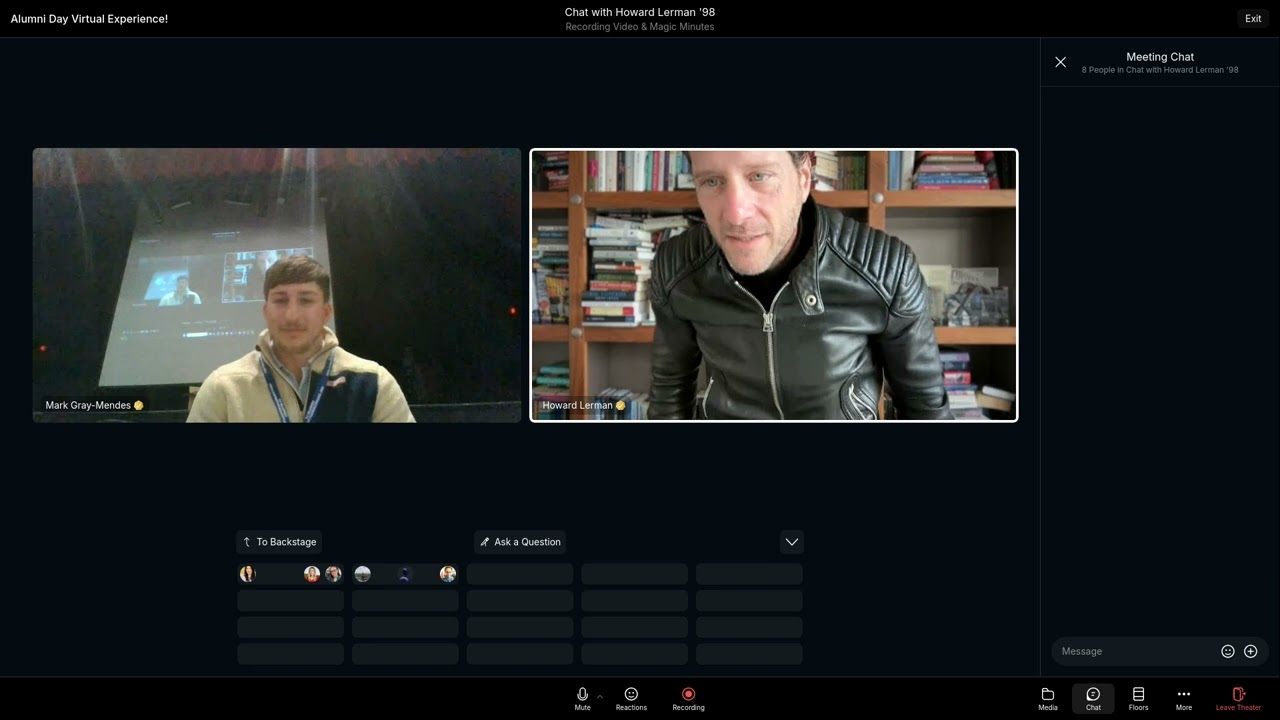
Howard Lerman, a 1998 TJ graduate and founder of Yext, talks about his path from early ventures like JustATip to building Yext into a public company. He's now working on Roam, a virtual-office platform that uses AI agents and digital maps to recreate the office experience online.
Chapters
Already recording, right? So we're all set? Yeah. Okay, awesome. We'll officially kick us off. All right, we'll kick things off. First of all, thank you all people here in person for joining the TJ Alumni Day activities in general. Those tuning in online, thank you for being here as well. It's been a full day of festivities. We got started at 10 AM and we're kicking off the next round, which is a guest talk with Howard Lerman. I think we just lost Howard. No, he is in the backstage.
I just wanted to play my entrance music.
With Howard Lerman. For those that do not know me, my name is Chappie. I am one of the co-founders and executive director of the GenAI Collective, which is a grassroots nonprofit community of basically representing the global forum for AI and technological progress. We are the largest such AI community with 25,000 members and counting. founders, investors, researchers all across the nation. And actually, as of last week, international, we opened our first chapter in Paris. So really excited about what we're doing there from a nonprofit grassroots standpoint. I'm also TJ class of 2017, and I'm so excited to be chatting with Howard Lerman, who is TJ class of '98 and is also a serial entrepreneur. So for those in the audience, both tuning in online and in person. We will do 10 to 15 minutes of Q&A at the end after I chat with Howard. So if you have any questions bubbling up in your mind, save them till the end and we'll have time to address hopefully 3 or 4 of them. With that being said, Howard, I only very briefly introduced you. You have an incredible background. So I would love to just start with an overview of your journey up until now, where you came from, your journey through TJ, post-TJ, All the companies you started, would love just a little 5-minute intro of yourself walking through all that.
Look, I mean, I was born in Vienna. I was fortunate enough to go to Longfellow. And I always say that the thing that was the sort of first thing that changed my life was in 7th grade, getting a math teacher named Mr. Williams at Longfellow. I don't know if anybody had Mr. Williams at Longfellow, but he was the first person that made math cool. And I always loved math and science, and he was just so unique and different than any other teacher I'd ever had. It completely opened my eyes. And so the power of one, you know, teacher to be able to unlock not just a single student, but also that's where I met so many amazing people. I actually met my Yext co-founders in 7th grade. believe it or not, in Mr. Williams' math class in room— I think it was room 211 or 212 or 206. I forget the number. But, and they used to kick my— kick me— kick my butt in math pretty bad. In math counts, they would get like, you know, 1, 2, and 3, and I would be, you know, in the middle of the pack. But at least it was a way for me to first meet somebody and then learn that there were other people like me. I don't know about you guys, but I definitely— did not feel when I was in my normal elementary school that I was a normal kid. And it was just really fun to be able to meet other, other wizards, if you will. And then being able to go to TJ, which is basically the Hogwarts of math and science, was literally, I think, probably the luckiest break I got in my life. Not lucky in that it wasn't earned, but lucky in that I was born in a place and time in which case such an institution existed. Think about how many people around the world don't have access to something like a TJ. And having been born in 1980 in Vienna, Virginia, it just so happened that I did. And being able to, you know, go into 9th grade and 10th grade and then be exposed to the hard sciences at such an early age was a completely unique experience. I think it comes down to you're looking today at so much stuff happening in space, so much stuff happening in all these new eras. It was just amazing that companies like Lockheed— I didn't know what Lockheed Martin was but I read about planes and I started to read about B-2 bombers and stealth. It completely made me— it opened my eyes into the power of what is possible. Not only did it open my eyes, it surrounded me with people that I still to this very day work with, even at the age of 44, which I suppose is 26 years after I graduated.
Beautiful. So we have a lot of companies to talk about, but before that, me coming to TJ here today, it was a rush of nostalgia, right? It's the first time I've really been back in a few years. And it was just a rush of all these memories. I would love if you could just start with some, any specific memories that come to mind that stand out to you when you reflect on your time at TJ, whether that's taking classes, extracurriculars, moments with friends, anything along that that informed the rest of your journey.
I'm gonna actually give you an unconventional answer here.
Okay.
This is one that, that, you know, you see me and you hear TJ, and so you think math, science, math, science, math, science. You and I were just talking about weightlifting, and in my, in my life, I have always endeavored not just to push my, my mind forward, but also my body too. And I don't have 225 pounds of chiseled muscle like you, and I, and I can't. I've tried, and it just doesn't— it doesn't happen for me. I don't have your genetics. But at TJ, I played baseball, and let me just tell you guys all, I was terrible. You know, we're talking to Mark. I tried to play basketball. I was cut from the basketball team, but freshman year I happened to make the JV baseball team, and I was really bad. But I would get up every morning. I was a catcher, and Jim Julian was the coach. And what we used to do was we used to have a— the catchers and pitchers used to have to come at like 6:00 AM for extra practice before practice. And so, you know, my friend JD Wilcox and I would, would, you know, get a ride down and we would, we would practice every morning. And what I learned from that was the power of grit and perseverance, because by the end of my senior year, I was the captain of the team and I was named All-District in baseball, 3rd team, 3rd honorable mention All-District, which, you know, starting from a crappy, barely making the team beginning, uh, was sort of a— was sort of— and I was MVP senior year. And so going through the sport— sporting competition, I think, trained me to deal with discomfort. And the most successful people I know are those that both are able to operate at a high level intellectually, but at the intersection of high intellect and discomfort, because achieving something great is like eating glass.
I mean, It's—
there's so many barriers and so many things that block you along the way, uh, and you've probably eaten worse things than glass in your, uh, journey to become a 225-pound weightlifter down to 185.
That's a great unconventional answer. Uh, my father says sports is an allegory for life, and, and I feel that so much. I think sports is such a critical part of even the TJ experience when we tend to think, as you said, so much about science and technology.
So, and there is some— there's a lot of historical basis for this. Um, you know, if you look at the ancient Greeks and the ancient Romans, they— the whole phrase, the whole meme about being in the arena. Well, guess what? Being in the arena— let's take Elon. He, you know, he keeps saying he wants to fight Zuckerberg anytime, anywhere. I mean, it's a funny thing, but there's a physicality behind that. And it's not to say, oh, you gotta be macho and do something. It's, it's really about pushing yourself to a limit and You have to be able to do that mentally and physically to achieve something outsized. And at Yext, we found that at least in certain roles, for example, in sales, and by the way, all of you guys starting companies, all of you founders or builders, executives that are looking to build companies, you're gonna have to hire, even if you make your product, a lot of salespeople. And we found a direct correlation between success and salespeople. sports and success in sales. That's the conviction it takes to really win.
So you said being in the arena, I love that quote. And speaking of being in the arena, you entered the arena very early on, right? As you went to Duke, as you were majoring in history, you started a company very early on. Do you want to talk about those first few companies that led up to Yext?
You know, when I— so I started justatip.com in 1999 with Tom Dixon and Sean McKiesack. And they were my high school, the TJ classmates, TJ '98. They both went to Princeton. And over the summer, our freshman summer— this was so long ago, this was in '98, this was like kind of even before the internet boom— we had this insane idea to start a website that let you send your friends anonymous tips telling them about their annoying problems. It was like a joke, and it was funny, and I won't even get into the vulgarity around This was pre-Facebook. This was pre-Instagram. This was, this was pre-any social network. You would get an email that was basically from Just a Tip, and it was like, we, you know, we've asked to anonymously inform you that you have X problem. And it was like all configurable, and it was, it was very funny. It was obviously tongue-in-cheek. And then Jon Stewart sent one on The Daily Show, and when that happened, it went viral and everyone started doing it. And, and then, you know, 6 months after that, we sold it for a couple hundred thousand dollars when we were 19 or 20, which at the time felt like an enormous amount of money. That said, I, and I think we were lucky to have that early taste of success because, you know, it's funny, you mentioned stepping into the arena. I never, and probably people like Charlie Wu, never even felt that you were intentionally stepping into the arena. It just, it just happened. Like, it's like you woke up one day and you were in the arena because that's where you were supposed to be. And it just— that's how your life goes. And, you know, in Charlie's case, he's probably on some tractor, you know, selling to an apple orchard in Seattle. In my case, I was making a joke website about bodily functions that got huge. And after we sold it and, you know, you pay your taxes and then you divide it 3 ways, you're like, okay, Now what are we gonna do? And so we started another company in Northern Virginia and we hired a bunch of TJ folks at that as well called Entwine. And that was a software consulting company. And this was right after 9/11. And so we were like, well, how can we have an impact to help the country during this time? And so we started a— at the time Microsoft was developing a new technology called .NET. And this was their sort of newest platform. And we felt that we could have a business model by which we sold to government agencies. and help them implement software, basically charge them a services model. Very unexciting, but it was, it worked. And we built it up to 50 people and sold it in 2004. And then, and then that's when things kind of started to take off. And, and I started the X and T a little bit after that.
Beautiful. Awesome. So a couple of times you mentioned that you founded these companies, or at least brought TJ people on very early on with both Just a Tip and Entwine. So I first learned about you, Howard, and Yext when I was going through high school. I was class of 2017 and we were all applying for summer internships, right? And one of the big things was Yext and it was legendary as a place where a lot of TJ people went for internships and looking for jobs and things like that. What do you think made Yext such an attractive place for TJ students? What did you find attractive in TJ students and how did that kind of impact the company culture?
You know, when I went to TJ, there was this kind of vibe, and I hate to use the word vibe because it's so amorphous. I love that term. Yeah, it's obviously, it's a loaded term, but there was this vibe, and it was kind of this vibe that you were all in it together, and we were all in this crazy journey where we were sort of picked to go to this Hogwarts thing. And it was gonna be hard and we were gonna be up late doing problem sets together. Maybe other kids weren't doing that. And yes, there was a pressure cooker element to it, by the way. Like anything hard requires a lot of pressure. So that, you know, at an early age, learning to tolerate that discomfort, I think is huge. And, you know, at Yext, starting a company is really hard too. And so I started Yext in 2006. I started with Brent Metz, actually another TJ guy, believe it or not. I called another TJ guy, this guy by the name of Jordan Feil, who was Brent's best friend, and tried to convince him to join with me. And he was very content with his job at Goldman Sachs, but kind of sucks for him. And Goldman Sachs is a great company. They were a lead bank in our IPO. Jordan is very happy. Uh, but he did miss out on founding Yes with me. I definitely— I def— he definitely got the call and didn't do it. Uh, but Brent did. And Brent was an awesome engineer at IBM who, uh, I have a picture of from 1998 when we were seniors in high school. He built my band's website. So I— this was back in the day, like, having a website was like a big deal. And also so was even making an album. In fact, if you go into Spotify, you can find this album that Tom and I made when we were 16, and it's still, it's still there. It's called Everything Seems Clear. And Brent, we hired to make our website. And so I, uh, I have a picture of him from 1997 or 1998 when we were juniors and seniors of me handing him his first dollar. He wanted that to happen. And then, you know, fast forward 19 years later, uh, we were ringing the bell, uh, on the New York Stock Exchange together. So, um, that kind— that one kind of came full circle. But I think what made TJ an attractive place for, uh, for— sorry, what made EX an attractive place for TJ people to join was simply the fact that that same we're all in this together vibe. It was sort of communal. Uh, I don't want to say unprofessional. There was a sense of humor about it though. Like, there's something funny about going to TJ. Like, you're almost— you have this awareness of being kind of I don't know, when I, when I meet someone from TJ, like, we can— we sort of laugh about the same stuff right away. And Yext absolutely integrated deeply that, that kind of nerdy humor, um, where everything is kind of funny. Um, and actually, there's definitely— if you, you know, if you follow Elon on X, I mean, he definitely has some of that kind of sort of funny, funny side to him. And TJ had that, and so did, uh, and so did Yext. And, um, and so I think that made it a great place, and also the standard of excellence. Great people wanna work with other great people. That's a kind of an answer that's like too obvious to say, but it is also a reality that when you hire, I haven't met a lot of B players that came outta TJ, I'll tell you that.
It's a good way to put it. So you were at Yext for a while. How did that continue to evolve as you were at Yext, both the culture and your approach, maybe leadership approach, management approach, and just how the company itself evolved?
You know, when you start a company, you're a guy in a room and then maybe a couple of people in a room and then, and that's kind of your main job is to create momentum. And that is the most important job of any founder is to create inertia because you're starting from a standstill. So frankly, there's a lot of evangelization and that can happen, by the way, through your own Force of sheer will in you know conviction of personality. So I would call up like this this AT&T subsidiary called Supermedia, and they were the Yellow Pages company. And somehow I managed to get them to resell the X Power Listings platform. And that was a crowning moment for our company because here's the old Yellow Pages company that couldn't compete on technology, and they decided to resell X. And so. That took my force of personality, I think, to get them to do that. At the same time, you can also create a product that is so compelling that it attracts users. And that's what consumer is. You can build the next Snap or Robinhood or Instagram. And in that case, the, the energy needs to go into making your product experience so good that people find it, they love it, and then they spread the word about it. So, but what I would say is that starting a company is best described in different chapters. Just like TJ is a chapter of your life, and then college is a chapter of your life, and then maybe your first step outside of college is a chapter of your life. You know, when we were 3 people in a room starting Yext, that was a chapter in our company. And then all of a sudden we were 50 people in a room, and then all of a sudden we were, you know, a few hundred people and we exceeded Dunbar's number. And that was definitely a step because I didn't know everyone's name. I always thought like, oh, I'll know everyone's name and I'm going to know everything going on. I'm going to know everything about what people are doing. I'm going to know everything that everyone's working on. And then all of a sudden it just hits you in the face and you do not know anymore. And it happens really fast. And, and so that, I guess what I would say is that each of these sort of phases along the way is like a different chapter where you as the founder and really the CEO, you grow from a younger into a CEO. And those are really 2 fundamentally different jobs. And I think many, many founders are capable of growing from a founder into a— into the CEO job, which is a totally different job, running a 2,000-person global organization and capital allocation and resources and speaking to the press and being, you know, dealing with investor relations and all that kind of stuff. Versus like moving the pixels around when you're a guy in a room. And so I guess what I would just say there is that they're really two different skill sets. I will note, I've noticed more people able to go from founder to CEO. Professional CEOs generally can't be founders. That's much— it's not impossible, but you don't see a lot of examples of guys like Frank Slootman, who is the quintessential professional CEO that took Snowflake from this to that, or, you know, ServiceNow, from this to that, you know, starting a new company, finding product market fit, which is the holy grail, and then scaling it out from there.
Yeah. Yeah. Okay. So you talked about going from founder to CEO, and you did that successfully, incredibly successfully with Yext. And now you're going backwards, right? You've gone from CEO to, you left Yext and now you're starting a new thing, Roam, right? That's the platform we're currently on. I would love to hear the story behind Roam. I love stories about how you come up with names. I would love to hear the story about how you came up with the name and what problem you're trying to solve and how these first few years have been.
Well, let me just start off by saying I have a spreadsheet on my, in my Dropbox called Namestorm, like brainstorm but Namestorm. And whenever I come up with a cool name that I like, I put it in there. And so I have like hundreds of names, hundreds of names that are sitting around like waiting to be used for a brand. I'm gonna tell you one right now, and I have a trademark on it, so it hasn't been used yet, but it's called Magicast, like magic, A-S-T. That's one I love. We made an AI music company called Dynascore, but it was about dynamic score, but the logo was a little dinosaur. So naming is a really— thingifying a thing is a really important part of helping humans grasp like what's in front of them. Like their brain, the brain is like anchored around names. Like the brain works by location and people and has, and, you know, and so a name is a really important anchor point. So, yes.
One very quick question there. You have a beautiful URL with ro.am. How much does the URL factor into naming?
Oh, I mean, you absolutely want to make sure when you're looking for something that it's not going to conflict with other stuff. So, you know, Yext is a made-up word. So when you make up your own word, you're usually going to be okay. So that, that the origin of Yext was the next Yellow Pages, actually, believe it or not. And, and so I was making— that one actually came to me in a dream. And I find that— I don't know about you, you sound like you experiment with your mind and body. Like, I mean, I definitely come up with a lot of stuff as I'm falling asleep and then pop back up and like write it down.
Uh-huh.
That's a good trick because I think your subconscious is good at like wiring stuff together. Also, one other trick. I took a train yesterday. Trains are a great place. There's something about when you're moving that unlocks your brain in a different way. And there's science behind this that I don't understand.
Mm-hmm.
But if you are stuck on an idea, it's, it's similar to walking, but any type of locomotion works. So even sitting on a train typing, like I had some of my best ideas and, and, you know, breakthroughs on the fricking Acela Express between, uh, Washington Union Station and, uh, New York City Penn Station.
There's a whole book I can send you on this. It's Look Again by Tali Sharot. It's all about that movement and how movement leads to more creativity.
Okay.
So, that's the name. Okay. Let's get into the actual company, right?
Yeah. So, one thing about Roam is that there is a Roam Research, and that company has a— is sort of— they're dying. And so, I made the choice to still proceed. We're able to secure the @rome Twitter handle, the @rome Instagram handle. We basically snaked them on every single handle. And we knew that this would be a great brand for what we're trying to accomplish, which is, you know, I mentioned when we started DX, we were a few knuckleheads in a room, and then suddenly we were 50 people in a room, and then suddenly we were 1,500 people around the world. And when we were small, Our culture and energy was outstanding. I mean, our productivity, like I would see people talking, like 50 people in a room. The idea of scheduling an internal meeting like did not exist. Like if I wanted to talk to Chappy, I would like walk over and talk to you, like, or I'd see you were talking to Sally and then like jump in the conversation or vice versa. And so these conversations basically flowed naturally. And then when we got big and we had people around the world, my calendar became literally backed up with back-to-back Zoom calls all day long. And so it was always 30 and 60 minutes, which I thought was really stupid because who's to say that a topic should take 30 minutes? And meetings are like a gas. They will take— they will expand to the length of time that you give it. And so I wanted to have— I wanted to make a— I wanted to get back to that sort of everyone's in the same room feeling. so that we could bring that productivity and culture where everyone could see what was going on. The other problem with the Zoom and the Slack is you can't— no one sees what's going on. There's no presence, there's no visibility. And so we made Roam, we invented Roam. And the basic idea is take an office and put it inside a computer. Now I want you to, you know, you can think about this one for a second, but imagine a bustling corporate headquarters. And actually in New York we have that at Yext. Actually also in Ballston, Virginia, a tall building filled with people collaborating, running around talking. They're not on Zooms. They're talking. They're having fast conversations. And I want you to take that idea and imagine, except imagine everyone is able to just teleport in from anywhere because the office is inside of the computer. And that's the idea behind Roam. And, you know, the signature feature is our map. where everyone can see what's going on and jump in and knock on doors to have quick, fast conversations, as well as our meeting summarization, all this other stuff. So I borrowed the compound startup from Parker Conrad, which he famously kind of coined. And Parker, you know, has this idea of all-in-one, which is, you know, Rippling is your all-in-one HR. And so Roam, the big idea is all-in-one virtual office. And it handles all the video conferencing. It's got the map, it's got meeting summarization, it's got all the chat you could possibly want with threads and replies, and it's got whiteboards, it's got a theater, it has different types of rooms. The surface area for this company is just huge. And so you might be wondering like, why the heck would Howard post-IPO, you know, living on a beach in Miami, decide to jump right back into the arena proverbially? And the answer is because I don't know any other way.
Well put. Well put. Okay. So what I mostly heard there is that you are, you're taking office and you're making it virtual. And a lot of that's like addressing a problem with what currently exists in terms of the virtual office, the 15-minute or the 30-minute, the 60-minute meetings you said in Zoom. I agree.
And the average, this is a fun fact, the average meeting time in Rome is 8 minutes. So that's a media time savings.
Yeah. Okay. So there's that. And I want to hear how you take that to the next level as well as in you are now in a virtual office, you're in the Roam virtual office. What, how does that take the office experience to the next level? Not just replacing what's in person, but to the next level?
Well, you know, Chappy, I think you know how to answer this question just as well as I do, which is that as you look towards an agentic future, the companies that, I mean, we sit at, I mean, let me just say this. Sort of colloquial, like we sit at the dawn of a new era of civilization right now, and we are going to see an accelerated boom in the next ten or twenty years that we have not seen since the 1960s, which yielded the Manhattan Project, which yielded you know obviously Manhattan was in the 40s, but but that that kind of era moon nuclear. And frankly, the transistor was invented around that time as well. And we've sort of had a flatlined productivity for the past 30, 40, 50 years, and that's about to go away due to AI. And when you look around and you see AI and you see space and you see robotics, you know, what Charlie thinks, people like what Charlie are working on in the physical world. It's an extremely— we are We are about to enter this boom era. And so let's imagine for a second what the organization of not just the office of the future looks like, but what does the company of the future look like? And in my mind, the company of the future really looks like a virtual company where there's no compromise on talent. So I'm able to get literally the best possible person for— I'm making this up— composable architecture iOS, you know, for a certain— to solve a certain task, certain problem, like immediately and get them up to speed so that they can do a thing whether or not they're in Sydney, Australia or in Berlin, Germany and get them productive and going with the team. So being able to access talent instantly from anywhere and quickly onboard them is huge. But I think maybe what you're really getting to is where does AI play a role in this? And what's been fascinating to watch is how AI— so much of what's missing right now is the interface. And I just— and I really do believe that this agentic interface is going to be the one because back to how human brains are anchored, Like brains are anchored on people. And so like having like Jarvis to me doesn't feel quite right. What feels much better is having, you know, Sally to be the lawyer and, you know, Jill to be the general, you know, the accountant, and then to have people or bots or agents doing these kinds of things and agents assisting people. And so if you can picture Roam, you can imagine an entire digital worker marketplace where you're able to find maybe the person that can do composable, but you can also find and bring in a bot and pay for that bot to do certain tasks alongside of you made by third parties. Like, we're not going to be making these bots, but we're going to have a digital worker marketplace that is going to enable any Roam customer to go and find— I'm going to make up an easy one— an SDR to go do outbound, right? That's kind of the first one that you can do, but it would be produced by a third-party company. Like 11X, we're not going to produce it, but the interface will happen in Roam. The agents can knock on the doors, they can talk to people via our voice APIs and get summarizations and have, have all these kinds of things here. So, you know, the company of the future is, is a, is an exciting place to be. And we, we think that we can be the platform upon which the future is built.
I love it. You're, you're totally speaking my language. You're thinking one step ahead of me with how does AI apply to this? I'm an AI guy, so I love hearing your thoughts here. How about, like, let's step back a little bit more, and you were hinting at it with how AI changes everything, but just there's this notion that goes around in, let's say, Silicon Valley, where I spend a lot of my time, of AI-native companies and non-AI-native companies, and these non-AI-native companies need to catch up. And you could say that Roam, okay, it could be like the AI workplace of the future. You want to just talk a little bit more about that? Maybe do you believe in the concept of AI-native companies and how that's different and how Roam plays in here?
Oh, I think Roam is gonna be the, I mean, Roam is going to be the platform that upon which AI-native companies will be built. And the, I mean, an AI-native company is gonna need to have people. And I know, you know, forgetting the whole, you know, political debate about remote work or not, the fact is 100% of successful companies have people everywhere as they scale. You can't name a single company that has everyone in the same office. And by the way, Even if they try, by the time you've got a guy on the 12th floor of your HQ and you're on the 68th floor, the other person might as well be in Timbuktu. So I know a lot of people that used to go to the office every day and sit on Zooms with their team on a different floor. So, you know, the, the idea of being able to mesh agents and people together to me is a very exciting one. And I think also— This notion of copilot is a really interesting one too. There's going to be AI-native interfaces that help people do their jobs. I'll give you one example. I saw a tweet the other day. I forget who it was from. But basically, some guy saw somebody built an AI bot that called, physically phone called 1,000 people and asked them for their daily summary and sent the summary to— and then compiled those summaries and sent it to the manager. 1,000 people. That voice interface, I think people are under— I mean, even Sam tweeted this the other day, like, people are underestimating how big voice is gonna be because voice is so natural for how people interact. And with Roam, our audio, you know, 76% of the calls, meetings in Roam are audio only. And with our offices, we think audio only is the future for how people are gonna interact with AI mainly. You know, you can imagine getting, you know, an AI bot Knocking on a door and knocking on your office door and asking you for your summary, and people can kind of see it coming around, and they know that it's kind of time for them. Like, that's the future that we're gonna live in.
Awesome. Well, I wanna be in that future, and very soon.
You are defining that future, man.
Okay, okay. So we've got a couple questions left. Just as a reminder, we're gonna do question and answer right after this. So if you are attending virtually, You can also ask a question. There's a button I see on the room. So you can ask questions there. You can also do questions and answers here. The couple questions I have for you is first, for TJ students who want to follow a path like yours, maybe like myself, what specific advice would you give, whether that's building technical skills or learning leadership or anything like that as it relates to being an entrepreneur?
We'd love to hear.
Well, first, yeah, I mean, first, do not go get your MBA. That's a total waste of money and time. It's arguable whether college is or not, but that I'll let you make your own personal choice with your parents about that. And my number one piece of advice for people is get started. Just get going.
Get started.
Just do something. Is it, you know, no matter how small, celebrate a tiny bit of progress and just go.
Yep, I, I live by that. Okay, so last question and then we'll turn to Q&A. So as somebody who has maintained a very strong connection to TJ, whether it's founding companies with other TJ co-founders or just staying involved and hiring people from TJ, why is it important for you to give back to the school? And how do you see things like the Partnership Fund, which is part of this whole TJ Alumni Day, help shape the next generation of TJ innovators?
Well, I mean, part of life is paying it forward. And I mean, like I said, the luckiest thing in my life was having gotten into TJ and being born in a place where TJ even existed. And so I think when you look at the best educational institutions, whether, you know, and they tend to be, you know, the colleges, right, where people get PhDs and Harvard and Oxford and Princeton and All that kind of good stuff. Like, they have an enormous amount of funding, and they get that funding through— I mean, some might even suggest Yale is more of a hedge fund at this point than a university. But they, in these endowments, are just so well capitalized. But I think, you know, Duke, for example, where I went, calls me for money all the time, and I give them some money. And, but they don't need it. They don't need it. They have so much. There's, you know, of course they can always use it. But like TJ is very special and it's unusual because it's still a public school. And so it gets public funding. But I think that something like this fund can really help to bring more alumni into the fold that could really make a difference in somebody's life. And I think, like I said, I see a lot more innovation coming out of TJ than I do seen coming out of many, you know, the higher educational institutions out there today.
Yeah, I love hearing that. And, and this is something I'm thinking a lot about. I'm kind of in that reflective phase now of my early career where I'm thinking a lot about the impact that TJ has had on me. And I talk with a lot of my friends from my same class, class of 2017, about it. And I think everybody looks at TJ more and more fondly as they grow distant, and they realize just how strong that Really permanent bond of your classmates and people who have been through this TJ experience is, and they're looking for ways to give back. And this is something that I think we can all do, as you said, to pay it forward. And that's really a beautiful notion.
Yeah. And I would add to that, which is Duke does a really good job not just of getting the big checks, but getting the small checks. They're really good at getting people to give $50. And I say that facetiously, but like, They— that, that is the sort of gateway drug to getting more later on. So even if, you know, you think, hey, $50 or $100 doesn't make a difference, actually it kind of does, because that's what gives other people— it starts the critical mass. And, and this isn't intended to be a fundraising pitch, but it is intended to say that you can start small with giving as well. And if you look at the higher eds, they do that with people. They do a really good job of that.
Yeah, great. Okay, so we have about 5 minutes for questions. We'll look at the chat to see if there are any questions there. I guess, Howard, if you see any questions there, you can let us know. Does anybody have any questions here? If you do have questions, you're welcome to come up front. We have a microphone here as well. If anybody wants to come up, I put you on the spot. You have a question? No. Any questions over here? Oh, okay. Steven, do you want to come up here and ask a question? If you want to get yourself in the camera, that's—
There is someone up here at the— Jacob Cohn has a question.
Oh, okay.
Yeah, Jacob, did you want to ask a question? You can be able to talk right now. Jacob? Let's see. Jacob. He is in the speaker lineup. All right, well, we can flip to Steven.
Hey, Steven, if you— okay, you can come ask your question while we wait on Jacob.
Here we go. Hey, Howard, I'm Steven. All right, so, uh, my question is, what's like the strangest TJ coincidence in your career?
Like you're pitching to a VC and they went to TJ, or you needed to hire someone and that dream candidate also went to TJ, and it was just like a serendipitous moment where you used the network.
I was pitching a reporter who was the editor of Valleywag, which was a like kind of gossipy Silicon Valley site. And he went to TJ. His name is Owen Thomas. He's now, by the way, the editor of the San Francisco Business Review.
Wow.
That was, that was a hilarious coincidence. I will also say that when I was raising my first round from IDP, which is this you know, Silicon Valley firm. I mentioned I went to TJ and one of their partners there was like, oh, I just saw a magazine in the back of a taxi cab that said you guys are the number one high school in the country. And then they asked me, and they still tease me about this, they said, well, what's your recruiting strategy? You know, you have 6 or 8 engineers that went to TJ. How are you going to get to, you know, how are you gonna scale up to hiring hundreds of engineers? And I said, well, each TJ graduating class is 400 people, so that's how we're gonna do it. I said that in all seriousness, but I think they didn't really— it was not a good answer.
I like it. I like it.
Thanks, Howard. Okay, we gotta—
Am I audible now?
Yeah. Hey, Jacob.
Hey, uh, nice to meet you, and thanks for, thanks for joining us. Um, so, uh, a bit about me. So I graduated TJ in 2008, um, and then did a city planning grad degree from MIT, um, and then out of of that, actually got some funding from a startup ecosystem to start my own startup in India. So that's actually where I'm calling from. So a bit late here. But yeah, a lot of the points you touched on are really salient. And so my question for you is, you know, since you mentioned, you know, we're creating a new paradigm of the future, here in India, we see technology just developing so incredibly fast, especially around AI. And so a lot of the conversation now is, You know, you're starting with a society that for a lot of people, you know, they're having smartphones for the first time, they're getting connected for the first time. And so in that kind of environment, you have all of the scope for designing tools that, you know, should be ethically used. And so what do you think is kind of the responsibility of people who are thinking about starting their own companies, how to build trust, build transparency, and guardrails for for AI. And so how do TJ students— how can TJ students maybe prepare themselves to be both successful in their companies and ethical at the same time?
Well, I mean, I think, you know, Warren Buffett said it takes a lifetime to build a reputation and a moment to lose it. So you should always have ethical dealings in all of your dealings with people. You know, I do think it is problematic, the idea that AI could be controlled by, like— and this, I feel like this is an open-ended question that we could have a long, quite long discussion about, and Chappie probably has some opinions here too. I'm more on the, like, Elon camp where I can see kind of things going sideways. But I think that is also the case for all technologies, whether it is nuclear, whether it is Pretty much any invention from mankind has negative potential uses to it. And so I think it is in it. We have to— we do have this manifest destiny where we have to pursue the innovations, and that should be the main guiding factor more than the safety. That's my opinion. It's the cart ahead of the horse to be worried about safety before we have AGI.
Okay, we have another in-person question. I also see that we have Hillary. Do you want to come first?
Here, Jake, if you go back to the audience, then Hillary can ask her question. She's up next, or someone who's in—
We have one person here.
Hi.
Here we go. Yeah.
Hi, my name is Rhea. First of all, thank you so much for coming here. I'm TJ class of '22 and current student at UMich and founding a company right now. And I'm kind of curious, as we're kind of exploring, as you discussed earlier, like product market fit, And also customer discovery. How did you carry about doing that in your early stages of Yext? And how do you continue to do that in Roam as you're, you know, growing and expanding Roam as well?
Product market fit is the holy grail. And so, you know, if there was some formula for like, if I could tell you, oh, here are the 12 steps to achieve product market fit, like everyone would do it and then everyone would be very successful. And so frankly, there is not. It's like, what are the, what are the steps to writing a hit song? Well, there are no steps. There are certain patterns you can kind of look for after the fact, but there's no, like, there's no recipe for product-market fit, unfortunately. What that means is that when you're looking for product-market fit and whether you're trying to assess whether or not you have it, there are certain things you can kind of look for. One of those things is that people tend to be like, if leads are finding you and you don't know where they're coming from. So, like, if you make something and then all of a sudden, like, all these people are showing up and you're not sure how they heard about you, that generally means you made something that someone is using, that they're talking about because they're excited about it. And, like, they told their friend and then, like, now they're, you know, other people are curious about it and checking it out. So that's like, that is usually a signal that you're doing something correctly because What I found is that particularly in B2B, and is your startup B2B or B2C?
B2B.
Yeah. B2B people lie. They're just, they're like, oh, like, you know, it's awesome. I love it. And then like they don't use it and like, oh yeah, they're just trying to be nice. And that's not, that's not love. It's like, you know, it's like Chappy, if you were lifting weights and you had like a Domino's pizza and your mom was like, that's a good idea. And no, it's not. Like it just, gonna go right to your left app. Like it just, it's not helpful. So in consumer, nobody lies because it's just the data of what works or not. So with B2B, I find, you know, what did you do? What are your actions? Not what did you tell me? And if you have something that other people, that customers are, you know, are purchasing. So I actually don't like freemium for this either because if you make something that people buy, then they're voting with their wallet. And if they choose to purchase something, then that is generally a really good sign. And then if you're referring to somebody else, it's a really good sign. The other thing I would say is, what does the company do, by the way?
So it basically helps psychiatrists through a reimagined AI EMR, basically. So we actually carried out around 100 interviews before going about this because my mom's in psychiatry. So we're kind of like part of like an accelerator. So it's, it's an AI EMR basically.
Yeah, that's a cool idea. You know, I would say like the other, the other thing you can do to guarantee product market fit is make a product for yourself or for your mom, because then you at least have a product market fit with a market of one. Because if she likes it and she uses it all day, every day, or you do, You know for a fact at least that somebody is doing something. Somebody is using it.
Yeah, for sure, for sure.
So I always advise founders to make a product for themselves first.
Yeah, definitely gonna be working with psychiatrists on this now.
Absolutely.
Yeah.
All right.
So much. By the way, I'll be in Miami next week.
Oh yeah? For Art Basel? What are you coming down for?
Yeah, absolutely.
You're coming down for Art Basel?
No, we're coming down for like our decision day for the accelerator.
Okay, well, if you wanna ping me, I'll find some cool Art Basel parties for you guys to get into.
Okay, yeah, absolutely. I'll message you on LinkedIn. All right, thank you so much.
Awesome. I saw somebody was trying to join. Were you able to get them in?
I see there's somebody asking a question. It looks like Hillary. Gustave, go for it.
Hi, hi, Howard. Chappy, thanks for doing this. So Howard, I just happened to see you quoted this week in a Wall Street Journal article about performance improvement plans being just absolutely terrible. So, um, I don't know if you could elaborate just for everyone a little bit about what your thoughts, philosophy are around that, because it sounds like some people might think that's a little ruthless. That sounded like To you, that was the most compassionate way for everybody. So whether you're a manager, a founder, a CEO, just an individual contributor, kind of what your experience has been to help people figure out the right fit and when to make moves and decisions on what's working and what's not working.
Hillary, before I answer the question, can you just tell me a little bit about your background and where you are and what you do and TJ and all that?
Yeah, so I'm class of '95. I've been in Colorado since 2005. Background, I did a lot of technology consulting, change management, some qualitative research. Right now I'm focused on executive and organizational coaching, leadership development, and corporate culture transformation. So definitely focused on how the people contribute. to whatever someone's trying to build.
Got it. You know, here's, here's what I would say with regard to, and just for the context for everybody, the article Hillary is mentioning was on the front of the Wall Street Journal yesterday, and it was about performance improvement plans or PIPs and the dreaded PIP. And this is a technique that companies come up with. The idea is like, okay, if you're Perform— if you're a low performer, we're gonna put you on a performance improvement plan and it's gonna be a 30 or 60-day plan, in which case, if you don't hit certain objectives or goals, it's kind of like being in purgatory, then you're gonna be walked out. And having implemented a number of PIPs over the years, having worked with many founders who have discussed how they use PIPs, what I can tell you is I've never seen someone recover from A PIP. And this is just me personally and the other founders I talk to. It may be possible to use these effectively, but I think they're kind of not the most compassionate way to deal with someone. And frankly, the point of them is to give the company a legal protection against a wrongful termination lawsuit. So all they're basically saying is it's helping managers not fire people Fire them more gracefully, and that actually is the tone and tenor of the article. So I don't think I'm in the minority on this one. I think I made someone that was willing to kind of say, "Hey, these are really just a tool to help companies legally protect themselves, not to help comp, not to help employees improve." By the time you're on a PIP, it's too late, and managers, great managers, should be helping people before they fall off that track. And frankly, If you shouldn't be at a place, shouldn't be at a company, then, you know, then you deserve as an employee to find a place that's going to respect and love you. That's my— that's always— so I always, you know, you could say it's compassionate or not, but I like to take, you know, to kind of have frank conversations earlier to make sure everyone— I think everyone deserves a job.
Yeah, that reminds me of Radical Candor. I'm sure you've read that book. Awesome. So we're right up on 3 PM. We have to end the interview now, but Howard, it was a pleasure. So once again, Howard's class of TJ '98. I'm Chappy, class of 2017. Thank you all for joining both online and in person. This is awesome and hopefully the first of many on the Roam platform. So thank you all for joining.
All right.
Guys, I love you guys. I love TJ. You can always find me on Twitter @Howard. And you can email me. I'm H, just the letter H, @ro.am. And if you're in Miami, I'd love to help you out. I'd love to help your companies. I love TJ. Thank you, chapter.
You're awesome, dude. Thank you so much. All right.
See you guys.
End the recording.
Do you click to backstage?
More from Howard

Howard Lerman - Founder, CEO @ Roam: How to Build a Fast Growing Startup Without an Office


SaaStr CRO Confidential: Howard Lerman, Founder & CEO @ Roam | Founder-led Sales