How to Become a Certified Pilot Car Driver
Hunter Nelson explains how to start a pilot car escort business, from state certification and the required 8-hour training course to vehicle setup and insurance. Commercial auto liability costs $3,000 to $10,000 annually per vehicle, and you don't need a commercial driver's license.
Chapters
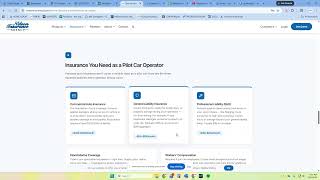
Hey guys, I am Hunter with Nelson Insurance. So I just created this webpage here today, or yesterday, I'm sorry. Let's go over how to become a certified pilot car driver. I feel like there's maybe a little bit of information about this online, but really not a ton for you guys here. So I've got everything from insurance to certifications to estimated cost, resources, everything on those lines. So I see a decent amount of people trying to get into the pilot car world right now. Trucking, you know, has got a pretty tough market. I think the oversized guys are doing a little better than the rest of the market. And yeah, so I see a decent amount of guys here. If you guys would like to check this out, this is nelsoninsurancesf.com, and under resources here you got this. I mean, if you guys are, um, looking at a pilot car— I'm sure you guys, uh, know what a pilot car is. So you got PVO, pilot car, escort vehicle, whatever you'd like to call it. There, steps becoming a certified pilot car operator. You're the base requirements. Most states are required to be at least 18 years old. 21 in certain states with a valid driver's license. I mean, I mean, you guys aren't gonna be driving anything super heavy, so no CDL is gonna be required. Um, so I apologize, I'm a little bit out of breath here. I just, I just got back from working out. But so there's that. A lot of the guys we'll see have like a van or something. A van is really good for a pilot car just based off of what I see. You get lots of room in the back there. Some people have gone through, removed the passenger seat. On either like a van or a pickup truck, anything on those lines. Throw a bed there, kind of like we'll do in hotshots too, or do anything in the back where, you know, install like a little spot to sleep in it. That way you're not paying for motel or hotel costs every single night because that can add up pretty quick. You know, if you guys have any certifications that are needed there, enroll in a state-approved 8-hour pilot car or escort vehicle training course. Of course, you know, flagging, low dimension, that type of stuff. You want to find out, you know, what are you guys going to be doing too? You'll be doing chase, you'll be doing high pull, anything on those lines. You know, these certifications are widely accepted. 8 states share an interstate compact. They cost, you know, $200 to $500. I can tell you guys where to get this stuff too. Excuse me. After completing the course, you know, demonstrating, making a score of 80% or higher, you know, get your vehicle, all this type of stuff. You know, reliable vehicle, kind of say an SUV, pickup truck, anything on those lines. I mean, obviously gas mileage, something you want to take into account. But I see a lot of pickup trucks out there for pilot cars. I think I was saying, I really like the vans. I think those are a good idea. Anything where you can maybe, maybe sleep in the back, it's reliable, durable, all that type of stuff there, you know, as well. Proper insurance. We'll get to proper insurance here a little bit later. But one thing I do want to specify, you cannot use personal auto insurance for your vehicle. There are 3 types of insurance. Personal auto is none of them. I do literally talk to people who are insuring their personal auto. You are paying for absolutely nothing right now. It is cheaper, but you can pay a little more and actually get something, or you can pay less and get nothing, and you're just literally burning money. So there is, there is that. Um, set up an LLC. LLC is a good option. A lot of people are setting up LLCs, or, you know, or you can go as a sole proprietor, whatever you like to do there. Here are state certification requirements. So you see some states do not have them at all here. And then you can see that other states will be accepted. You know, certain states here, you are going to have general liability be required for the state. There is more than just Colorado. I'm blanking out here right now. I want to say Pennsylvania is one of them. If I'm not mistaken, I'll have to double-check that. I'm blanking out here at the moment, but I know it is more than just Colorado. Needs $1 million and it says proof of $1 million liability, you're gonna have 3 different million-dollar liability policies. Million-dollar liability insurance is not a thing. It is not a blanket million-dollar liability. There'll be 3 different types of insurance you guys need. So like I was saying here, depending on what you guys been doing, you've got all your different equipment here. So feel free to pause the video if you want to look at this, or obviously you can go to the website here too, and I'll also be on here. You know, you can see rough cost. I found these costs to be pretty accurate here, but there is that startup cost. Vehicle, I mean, $0, you know, I threw that in there just in case you already got something. Obviously, you know, you don't want to go out and buy a brand new nice vehicle. So $20 grand, you know, equipment and signage kind of depending on what you guys are needing up here. Certifications and training. Depending on how you guys get your business set up, you guys can go do it online, you can go through— you can go do it through a lawyer. Um, you know, you have to sign minutes on it and such. So, you know, it's just kind of dependent on what you guys want to do. It is going to be cheaper on going online, obviously, versus going through a lawyer. Uh, so as you can see here, estimated cost really do vary quite a bit. The two biggest variations here would be insurance and vehicle. Your insurance, yes, it very well— I think this is extremely accurate. $3,000 to $10,000, um, that's pretty much me per vehicle. You— I've seen people we've insured for $11,000 for 3 vehicles, um, but most of the time you need $1 million in auto liability. And the auto liability is anywhere from $200 to $400 a month. I should say auto liability but to me, a million dollars is auto liability, but to be auto insurance, commercial auto insurance, that'll be anywhere from $200,000 to $500,000. That is the bare minimum. You will 100% need commercial auto insurance no matter what. It is not like going to be filed or need to be on file with most of the states or anything on those lines. It's not like a federal regulation like it is with trucking where you have filings and it's posted with the FMCSA or the DOT, anything like that. But you will need commercial auto insurance no matter what. It doesn't matter if it's in your personal name, If you are going to be doing a pilot car, you need per— you need commercial auto insurance. If, um, the state's requiring it or a broker is requiring it, you know, like OD North America, um, anything on those lines, general liability is always recommended. As you can see, is the cheapest coverage here, $50 to $100 a month. You, uh, can get a package with your general liability— or I'm sorry, your professional liability. And that can be anywhere from like $1,500 to like $2,500 a year, you know. So again, like some of this stuff is just going to vary. Like the highest end here is $300. That's, that's pretty uncommon. That's definitely on the high end. You know, it could be $150 a month too. You know, it's very, that's very realistic. So, you know, on the low end here, you could have, what is this all, $350 a month. So, you know, call it $4,000 a year for all, all 3. Which is very doable. It is not, uh, is not always going to happen, and you totally could be paying $10,000. What does that look like? How they really differentiate that, it's going to depend on the state. Are you in California or Iowa? Um, is your credit score a 500, a, or a 400 to 500, or is it like a 700, 800? Credit score makes a huge difference. You know, what's your radius? Almost everybody's going to be going all over the nation, so if it is more local, great, you're going to get it way cheaper. But I mean, come on, uh, most of you guys are going over the road, so that's going to be pretty much just kind of like everybody type deal. And you will not have insurance coverage if you go outside the radius. So I would not ever recommend lying on it. You know, then just your driving record and that stuff too. So your driving record has made a huge difference. And then workers' compensation, you know, in some states workers' compensation is required, just like in Nebraska. Workers' comp is required for all employees, no matter what, even if you just have one. And so if you have any W-2 employees, workers' compensation may be required. If it's not required by the state, it's always a good idea. Inland marine insurance is going to be like your equipment, your light bars, your high pulls, radios, and type of stuff. You could add this on your commercial auto insurance if it is permanently attached, like it's bolted in and it's, it's on there, you know. And then your inland marine would be a little more like equipment, like you got traffic cones or anything like that, and you're And your vehicle, anything that's not permanently attached, that is gonna be insurance. And as you can go through here, you can click this and get a quote. And Nelson Insurance can get you a quote here. We are one of the largest pilot car insurance agencies in the nation, which is why I am making resources of pilot cars because we know the transportation space. You can join the National Pilot Car Association. That's a great deal. I think it's like $50 a year. You get all sorts of perks. That is awesome. Evergreen Safety Council does a great job of really going through, you know, some people like the WIPAC, some people don't, some think it's a waste of money. My opinion, you know, it's been in the insurance industry. Any education is good. There's some insurance education stuff I take that really, I don't really learn anything from, but it's good to just test my resources, make sure I am not missing anything. And, you know, having, having this doesn't hurt with any, any, any partners either. You know, I, I've got my Transportation Risk Insurance Professional certification. You know, I really didn't learn a whole lot from it. I knew most of this stuff. It just because I've already done a lot of research, but it would teach a lot of people a lot of things. But when I go to my underwriters now and I work with them to go to bat for you guys, they now know I know what I'm talking about. So, you know, it's, it's good. You can never go wrong investing in safety and education, right? Um, you know, you get the training manual here as well. I've got links to it all as here, so it keeps you guys' life easy. Frequently asked questions: you need a CDL, You know, here, this stuff is, uh, certification, how long does it take to get certified? Can I use my personal auto insurance? Heck no. Personal auto insurance will not cover a vehicle in a commercial use. So no, do not do that. And yeah, so we are happy to help. So once again, here's a resource on it. I'm throwing out blogs. So if you guys got any more questions on it, we are throwing out blogs on just every little piece of pilot car knowledge out there. and we just insure the transportation space. That is our specialty, that's our niche. If you guys got any questions, feel free to reach out. I appreciate you guys watching. Um, so yeah, once again, Hunter Nelson Insurance. We insure in 40-some states based out of Sioux Falls, South Dakota, and our specialty is transportation, especially pilot cars. Thanks again.










