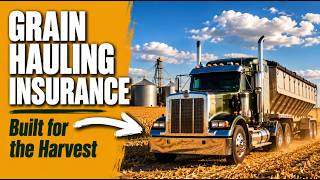
In this solo presentation, Hunter Nelson of Nelson Insurance Agency (Sioux Falls, South Dakota) explains the unique insurance landscape for grain‑hauling trucks. He begins by noting that trucking insurance is generally expensive, but grain haulers can often secure much lower rates because a larger pool of regional insurers specialize in agricultural freight. He contrasts national carriers—who lose money on trucking lines but stay in the market for investment returns—with regional carriers that focus on low‑risk, local routes (typically under 600‑750 miles) and therefore can offer cheaper, better‑tailored policies, including superior cargo coverage and optional cyber protection. A key regulatory point is the MCS‑90 federal filing, which makes insurers liable for public liability and environmental damage; thus, grain haulers must obtain pollution coverage, either as an endorsement or a separate policy, which is relatively inexpensive compared to overall premiums. Nelson provides concrete premium examples: first‑two‑year costs can be $30‑$50k per truck, dropping to $9‑$10k after a year, and in some cases as low as $2k annually for clean, local operations. He emphasizes the importance of a $1 million liability limit, the impact of operating radius on underwriting, and the advantage of working with a specialist agency that writes in 42 states (excluding the upper Northeast). He closes by inviting viewers to contact his agency for quotes or questions.
Chapters
Hey guys, I'm Hunter with Nelson Insurance. We are out of Sioux Falls, South Dakota. Today I'm going to talk about grain hauling insurance. I'm going to talk about coverages, I'm going to talk about insurance companies, I'm going to talk about the average price, I'm going to talk about why you guys are different than the average trucker and it actually plays in your advantage. So let's get into it. All right, so the first thing what everybody cares about is price, right? Trucking insurance is ungodly expensive. I love working with grain haulers, and usually I would say they like working with me, um, hopefully. But, uh, the reason I really like working with grain haulers is because we've got so many insurance options for it. It's cool to go in there and really get a nice policy, and especially with it being a lot cheaper, it's just kind of a cool deal to see. You don't have the same couple insurance companies. There's a lot more of them out there. The prices are a lot cheaper. And so I'd like to go out there, just give a quote where I'm saving a good couple thousand a truck. And it's like, holy crap, they didn't know that option was out there because I thought it was only just a couple big guy names. It's why is that coming to play? You've got your big national insurance companies who like trucking. Some of them, well, the guys who do like trucking, and they're in play on most of trucking insurance policies when it comes to just play with trucking insurance, right? When it comes to play with truckers. But with grain hauling and agricultural trucking, there's a lot more regional insurance companies who really like the farm and the commercial side, but they're like, we're going to get into trucking. Trucking insurance, fun fact, has the highest loss ratio in the insurance industry for any insurance product. So the statistic is over the last 5 years that the average trucking insurance company has paid out 2% more than what they've received for insurance dollars. So that's actually an unprofitable thing for them to sell. Why do they sell it? Because they invest the money, they make 3%, right? But on paper, they actually go out there and lose money every year. So it's a really tough product. So why did— so some of these guys are going to say, I'm going to try to get into it, but we don't have the billions and billions backing us up where we can take some big losses. So we're going to try to take the cream of the crop, the grain haulers. We're a regional insurance company. We want regional guys. I don't want a guy going 1,000 miles for a radius. If you're going 500, 750, 600 or less, depends on the insurance company, and they're hauling low-hazard cargo— grain, hay, feed, seed, anything on those lines, agriculture-related— they want to ensure you guys know the routes, you guys are local, they have the underwriting appetite for farm. And these guys already got trucks, they're just not for hire and you are. And so they understand how to price this risk, and so they want to insure you. Now with that, what's the benefit of going with these regional insurance companies and how many are there? There's a good chunk of regional insurance companies that almost nobody knows because they're regional. They don't work with a lot of agencies. They're very particular. Not a lot of the big trucking names have them because they go to the big national guys. Big national trucking insurance companies. And so you really need a specialist who's got a lot of this stuff or writes a lot of farm, which we don't. We just have a lot of agricultural trucking. And so we have a number of these guys that will automatically include cyber, which are like, oh great, another insurance policy. It's $90. And trucking companies are one of the highest risks for cyber and I'll shut down your whole business in a week with how much money is moving in and out of your guys' account. They've got all sorts of other miscellaneous coverages. I'm not going to bore you guys with it. But their policies are fantastic. They have better cargo coverage for livestock, for grain, for everything than 90% of insurance companies. You're going to be in a lower risk pool because they're only taking the low risk stuff that's local. It's the cream of the crop. And so they're going to— you're going to be in a little bit of a lower underwriting, lower risk pool, which typically means their insurance is going to be a heck of a lot cheaper. Their policy is going to be better and they can afford it because, uh, they're not taking on the long haul stuff, trying to figure it out throughout the way. And you guys are not dealing with the big national claims, it's going to be a lot more of a regional focus. And so that's a big key piece there. Your guys' coverages as a grain hauler that's local are going to be pretty much the same as everybody else. You might be exempt for hire. And so you might not have to have the filings and everything on those lines. Most likely in the Midwest, you're going to have a couple, um, state filings, but, uh, yeah, you're always going to want that million dollars in coverage. No matter what. Your radius does make a massive impact on your insurance, so that is just something to kind of keep in mind there. But the one big key piece that's going to be a lot different from grain and agricultural from a general freight guy is going to be that you guys are now going to need pollution. The MCS-90, which is you guys' federal filing which activates your authority, says that the insurance company is on the hook no matter what for public liability. Which includes bodily injury, property damage, which are things that happen in an accident. You hurt somebody, you damage their vehicle, a building, whatever. And environmental hazard with grain hauling. The grain gets on the ground, it ferments, it becomes an environmental hazard. The EPA is going to get involved. Well, where you guys have more risk is the insurance company's on the hook for that no matter what. And, um, even— and so if you guys do not have pollution You guys are not in luck. It doesn't mean they're going to cover pollution and just say, we're on the hook for it, sucks to be us, right? It's going to be 10 times worse. They are going to pay the claim. And since it is not your guys' insurance policy, they're going to sue you to the ground to get their money back. It is even worse than just not having coverage and them not paying it because you can't settle. They're going to pay out that full amount and they're going to sue you to the ground for it. And so with having that pollution exposure, you guys are going to want either an endorsement on your auto liability policy, which many insurance companies do not offer, or you're going to want a separate pollution policy. And pollution is going to be very, very inexpensive compared to your normal coverage. If your auto liability is $6,000 a year, it might be $1,000. And so you got $1 million in coverage for a sixth of the price. And what is, what is typically this insurance cost? Your first 2 years can be your most expensive with grand hauling. We had somebody who was paying $52,000 for 2 years. They came to us, realized they were insured as a general freight hauler and not a— and well, and over the road. We got them fixed up, literally kept the exact same policy, and it was $30-some thousand a year. The next year they renewed, they got a year in business, and they— granted, they did have a guy who's under 2-year CDL, uh, they renewed back to $18,000. So after 1 year in business, they're at $9,000 a truck. Hauling grain in South Dakota. And a lot of the guys who will see— they have 2+ 3+ years in business— will be easily sub-$10K, $1,000 a year. I've seen guys— I literally insure a guy for $2,000 a year. Most people do not believe me when I say that price. It's not everybody, it's just somebody we got. We'll see around that $5,000, $6,000, $7,000 a year if you got a fairly clean record and, uh, are hauling grain not over the road. And so insurance gets to be way less expensive. And I'm all talking yearly premiums. I literally have a guy for 2— like $2,200 a year. And, um, a lot of these regionals are going to come into play and do a lot better. So the national guys will still compete, but you want to have those regional options that are available because they can be very good. And so that's really just kind of the bulk of it for grain hauling insurance. Those are things that are different. I didn't get into all the specifications for trucking insurance in general, but pollution is going to be a big key piece for you guys. Having access to those regional insurance companies, those guys who are different, are going to be huge for you. And, uh, if you guys have any questions or want to talk about this more, please don't hesitate to reach out. Happy to help. Again, I'm Hunter Nelson with Nelson Insurance Agency. We're based out of Sioux Falls, South Dakota. We'll write grain insurance, grain hauling insurance, trucking insurance, whatever. All over the nation. We're in 42 states. We avoid the upper northeast, pretty much anything above like Pennsylvania there. So if you guys have any questions, please reach out. Please like and subscribe, and I appreciate you guys watching.