What Are CSA Scores And How To Improve Them
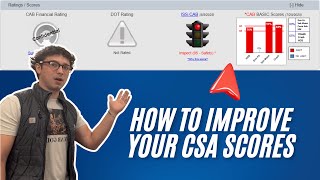
Hunter Nelson (Nellis Insurance) explains CSA/CAB alerts, ISS scores, and practical steps trucking companies can take to improve safety/scores. He describes the three main report sections (DOT rating, ISS, alerts), the seven BASIC categories (unsafe driving, vehicle maintenance, hours-of-service, hazardous materials, driver fitness, controlled substances & alcohol, crash), and how color bands/thresholds map to enforcement risk. He emphasizes culture, use of ELDs and fleet software (Motive, Fleetio), pre-/post-trip inspections, dash cams (forward-facing and dual-facing tradeoffs), random drug testing and quick termination for violations, and monitoring licenses/med cards. Includes insurer/broker perspectives and a payout anecdote.
Questions this video answers
1 to 100.
Green: 1–49; Yellow: 50–74; Red: 75–100.
Around 65 (category-specific; some show alerts at 65).
Unsafe driving; Vehicle maintenance; Hours-of-service; Hazardous materials; Driver fitness; Controlled substances & alcohol; Crash.
Monthly (or quarterly if lower risk); monthly if near losing loads or under audit.
Chapters
Hey guys, I am Hunter with Nellis Insurance. I'm going to get over, I'm going to go over CSA CAB alerts and all that sort of stuff here, what it means and how to improve it. So let's get into it, alright so most of you guys as you're checking up on your CSA scores, your CAB scores, all sorts of stuff are probably using SMS through safer. A lot of like insurance agencies, brokers, everything on those lines they're going to be using a deal called Cabin it. Basically all it is is safer times 10. So it's going to give a lot more information. It's going to show your ISS scores, your serious violations, give you guys your scores, your alerts, all sort of stuff. Okay now sms, you guys can still use that. I would ask your insurance agent for a CAB alert probably every quarter, every, every month depending on your situation. If you are as clean as can be, you got a couple units, you probably don't need your capital or your CAB report all that much. If you guys get 50 trucks and you guys are on the brink of losing some loads, the dot's auditing you, all sorts of stuff. Yeah, I'd be asking for that probably monthly if not more from your insurance agent to go see how your scores are doing and what all is. So I'll go over the CSA scores, the alerts, all sort of stuff, what everybody's looking at here. So when you got a broker or an insurance company, insurance company, insurance agency, whatever, both are looking at it. Look at your guys scores, here's what they are seeing and here's what this means here. Okay so you're gonna have three main sections. Your DOT rating, your ISS and your alerts. The ISS is one of the most important things and I'll get into what makes it up. So the ISS right here you guys have an ISS score of 1 to 100. Green is gonna be 1 to 49. I don't have a yellow supposed to be orange here but yellow is 50 to 74 and then red is 75 to 100. You guys obviously do not want to be red. You don't want to be yellow. Obviously you want to be green. If the DOT officer sees you and you're green, you're going to get let by 99 of time. Yellow, it's like okay, they can kind of do what they want, depends how busy they are. Red is like they see you guys DOT drive by, they're supposed to be pulling you over. So you're going to get way more inspections. That could be a Good or a bad thing if you guys are noticing that trying to clean it up, great, you want more inspections to lower that score. If you're not really doing much and your score just keeps creeping up, obviously you don't want to be red. You don't want to inspect a whole lot more because it's just going to make things worse. Your ISS scores are your hours out of service, your basic alerts, which I'll get into here in a second and your serious violations. So don't get any of those obviously. Then you get your alerts here. This is based on your seven categories here of basics. And so really should be changing this to basics instead of just alerts here. So whatever, it's basic alerts. And then what this means here is you have these scorings of like the ISS, your ISS made up of all these 100 same deal goes into the nitty gritty of all several of them. So I include five because you may not have any violations or anything along them. So typically nobody's got all seven. Let's say you got a little bit of hours of service violations, a little bit of vehicle maintenance, a little bit of crashes. It's nothing too major. So you're not going to be getting an alert for it. Some are going to be a threshold of 65. So once a score goes over to 65, now you're getting an alert. Now your ISS going up. Now it's showing red. That's when problems starting to begin. Same swipe right here. I've got unsafe driving. You're over 65 volt. Now I get an alert. I have controlled substance and alcohol. Now you're over 80. That doesn't mean the threshold a your threshold 65 there. But those are the two thresholds where depending on the violation or depending on the basics category, you could begin to learn why is more bad. Well shows up in a bright red bar. The first brokers insurance companies see. Insurance companies like Canal, who's typically been fairly lenient on this stuff, only allows two basic alerts. So if you got three of them now, you're going to be happy you get three. You're going to have a hard time finding insurance and you might be having a hard time with getting loads, you might be having a hard time with keeping some of your contracts, your direct customers, all sort of stuff, they go look at this stuff when they're looking at giving out direct contracts. So unless you guys want to be stuck taking the bottom of the barrel on the DAT board or truck stop, I wouldn't Recommend getting all these violations. So let's get into what these violations are here. I'm not going to get into the chameleon alerts and the severe violations. Some of that here today. I'm just talking about the basic basic alerts, basic scores, your CSA scores. So you got seven categories here. Unsafe driving, vehicle maintenance, hours of service, hazardous driver fitness, controlled substance, alcohol and crash. I'm not an artist here. I don't write for professionally. So if my underwriting or my handwriting and my art is not great, I apologize. There's a reason I'm on insurance and not those two things. So you guys really should be knowing what most of the stuff is. I can give you a basic overview here real quick. I mean crash, pretty self explanatory, you get a percentage. So if you got 10 power units, you get one, one crash every two years. You know, you could be at a 10% there. Control themselves with alcohol. They get caught with weed or drinking or anything on those lines. However, fitness is going to be like licensing all that type of stuff. Hazardous, pretty self explanatory. Hours of service is false logs going over your hours of service, what you require, what you maximum could drive a day, all type of stuff. Vehicle maintenance is light bulb out, crack bigger than a quarter in the windshield, tires are going bad. Anything on those lines, Unsafe drivings, no seat belt, speeding, all sorts of stuff there. Right? Okay, so let's say nobody's. Well nobody's perfect here. I've seen guys, 50 trucks and they got some red alerts here. Everybody's gonna have an issue in some spot, right? I'm not gonna go over the definition of every single violation. Here's how you stop all those violations. The biggest thing I can see right here on how to improve it is just creating the culture. Most, the most of the stuff. The DOT provides you with ways on how to stop this. Like you guys required to do a pre trip, post trip inspection. If you guys did it every single time and the truck is look good, there's a good chance you're probably not gonna get a vehicle maintenance inspection or vehicle violation. But yes, something definitely can break while you guys are driving. That's, I mean it happens all the time. But you know, it's the, the, the basics are really provided to you guys. It's all about creating the culture. That's the main thing. I'm not saying anybody here with violations doesn't care about their company or doesn't care about the culture. It's just pushing on people getting rid of the bad Guys keeping the best drivers you can, figuring out a way to obtain those good drivers and create that culture of hey, if you guys get a violation, there's going to be some punishment or you reward people for safety bonuses. So if you get a clean Inspection, great. Get 200 bucks. 200 bucks depending on the level of the inspection. So a lot of people do that. And I've got guys who with Amazon who keep their scores extremely, extremely low because they just created that culture. But let's say you guys are five trucks or 50 trucks and I try and figure out how to improve. I'll go right here. So the first one right here I've got unsafe driving. I'm just going to do again the basics. I want to make a 50 minute long video. Speed limiters is a big thing, dot or eld software. So if you guys are got a problem speeding, put speed limiters on the truck. I understand that you guys gotta get loads to a certain place at a certain time, but you gotta think about what's gonna cost you more money in the long run. Okay, so there's that and ELD software. Like everybody, a lot of the big trucking companies I know all love motive because you get the dash cams, you can get the ELD software in there. You can put scores on each truck, on each driver, so you can see who's doing what, who's, who's hurting the scores, who's better in the scores, all sorts of stuff that's actually a big deal. So you can really keep tabs on that. Motive's a really, really good one. Vehicle maintenance. This is one that's probably one of the most common I see like the brain dead answers. Pre trip, post trip inspections. Everybody knows this, but what if you got to get more into it. I, I really like the spare parts. Keeping spare light bulbs, keeping a spare any part you can in the truck where if it's, it's broken down and you gotta stop, hey, go replace that thing real quick. There's softwares out here. One of the biggest ones I know is Fleet IO I came out of the other one. That's really big here too. But there's software is where you can keep tabs on all the maintenance need on the trucks. You can do digital pre trip, post trip inspections. Hey, this light bulb needs to be changed real quick. Okay, great. I'll need to stop and grab a new one. You know, light bulbs are really, really the most common things. Tires are a big one, all that sort of stuff. And I'll get into this Here in a second too. But the time matters on this stuff as well. So then you got hours of service. Really the most. I mean this, this is kind of the most basic one. I mean you guys have VLDs for a reason. Again, I'm not, I'm not, I don't own a trucking company. My father did. I'm no, I'm no expert on this stuff, but I help a lot of companies with this. But yeah, I mean ELD software is really just a good one. Having a good eld. Don't cheap out on that thing. Have a good eld. That's going to show the hours of service. Make sure you guys not plug in the deal. You know, you guys are needing to get to a spot really, really quick. But yeah, I mean just, that's just a culture deal. A lot of it is just they're just running over the hours of service. People know this stuff and I understand that. You know, sometimes you just gotta get a load a certain place broker puts you in a tough spot where you got, you gotta run someone, something, somewhere very quick. And it just, it can just sometimes be tough. Hazardous stuff. We don't deal with a whole lot of hazardous guys. So I mean the FMCSA put a lot of false notifications on people's profiles. So if you got that to go hit the data queue, try to get raised that thing, you know. Most people know that's not really a big deal right now because the FMCSA did put a mass false notification for alcohol. A lot of people or not alcohol, hazardous materials on a lot of people's DOT profile. Well, yeah, I mean there's that. Understand the requirements. I mean make sure you guys understand, you know, when placards are needed, when the endorsement on your CDL is needed. All type of stuff. Stuff. Driver fitness. I'm gonna equip these squiggly lines here. Driver fitness is right here. Monitor license information. I mean like I've got the same thing. We're licensed in 35 states, so we keep a spreadsheet about, you know, when does license renew. All type of stuff. Do the same thing with your drivers. Hey, you need to get your med card updated. You got it. Your CEO's about expired. Just kind of ask the driver. So that stuff as this stuff's coming up, just make sure that stuff's sitting pretty good. Controlled substance and alcohol is pretty basic one. Random drug testing, quick terminations. You got somebody who's got it. Get, get the DUI while they're grabbing for you. I mean get rid of them as soon as possible. That's the main problem is if you keep them, that's when insurance companies are gonna hate you. That's when brokers are gonna hate you. They're ask about that stuff. Hey, what's going on here? You know, so I mean, if you're telling about, hey, you know, we did our background checks, we did our drug testing up front. You know, there's no way to really know that stuff. You know, a good story and what you guys are doing to correct it, it really goes a long way. And then random testing is what helps prevent in the first place. I'll get into a story here real quick on, you know, something that kind of shed some light on this. Where there was a trucking company, I think they had 11 trucks. Driver got out, stole one of the trucks. And I kid you not, ran somebody over so he committed murder. And you would think with that, that that's just gonna shut their company down. Well, the company themselves had a good story on how they did all the background checks on the guy and how they monitored him and all this sort of stuff. And you know, when the, when the incident happened, what they did to prevent this again in the future, which there's not a whole lot you really can do. I mean, how do you, how do you stop that? My office, somebody can just walk up with a gun and shoot somebody. I mean, it's just, that's horrible. But, you know, how do you, how do you prevent something like that when you do your background checks and everything? So they had a good story on what they're doing to prevent it and how they did the due diligence up front. And really the insurance company actually renewed them at the exact same price, even though that insurance company paid them out $2 million. $2 million that year for bodily injury on liabilities. So now granted, they stay at the same insurance company. It was progressive. They end up going somewhere else. But the new insurance company heard out the story, they used common sense underwriting and listened to it and they renewed them or they offered them, quote, the exact same price renewal was dash cam or not dash cams. Crash indicators right here for dash cams. I mean, the big thing here with crashes is put in make sure you're putting the right drivers behind the wheel. Do your onboarding have be pull with an experienced driver? Do an onboarding before you put somebody behind the wheel there and then as you've got people who are driving for you now, make sure you've got dash cams. Now do you Go with dual or forward facing. I know everybody hates dual facing dash cams. Everybody hates them, drivers hate them, company owners, don't put them in place. And what I might say might actually what you guys actually might like. So there is a, there is a benefit and a negative to actually having dual facing dash cams. I think dual facing dash cams are good if you really need them. You've got fatigue driving violations, you've got a lot of accidents, you are short on drivers and you're having to hire people that maybe are not ideal or whatever the case is. And you got a lot of accidents, right? There's no, I mean, like what do you, what are you supposed to do besides putting dual facing dash cams and training these drivers and having the culture of safe driving while you have this stuff. So if you guys are getting a bunch of accents, yes, dual facing dash cams is what I recommend. At that point, whether drivers like it or not doesn't really matter because you guys are going to go out of business if you don't install dual facing dash cams. These dash cams can alert you, you and the owner, the driver and the owner, if they're distracted, if they're fatigued, if they're looking at their phone, if they're keeping their eyes off the road, whatever the case is, it alerts them. Hey, keep your eyes on the road. Hey, wake up. You need to pull over. You look way too tired to be driving right now. It helps with that stuff. It alerts the owner. They can prevent, right there, they can do something to stop it. Now let's say you guys are fairly safe, right? Let's say you guys are in the green, maybe in the yellow and you'll have a lot of crashes, but you're expanding quickly and you're worried about having crashes. Is a dash cam good or dual facing dash cam good? Yes or no? Now here's where the negatives of a dual facing dash cam come in is if you are fairly clean and you don't have a lot to maybe improve on already, if you have a dual facing dash cam, one of the drivers does get an accident, it's gonna happen no matter how many trucks you have, no matter how long you've been driving, right? It's gonna happen where you have an accident. If this is one of those deals where guy just messes up because we're all human, he's gonna go look at all that dual facing or driver facing dash cam footage and find reasons to put your driver more at fault and to get More money out of you guys so they can go look at the dash cam footage. The other lawyer is going to figure out every, every single second they took their eyes off the road, they look tired, they checked their phone, they did anything. They're going to go back and look at months of footage and it's actually going to hurt you guys. So there's the plus and the negative to dual facing driver face. Forward facing is without a doubt a no brainer. We had a guy with 35 trucks and three accidents in the last, I don't know, like year or something. He said two of them were just people just pulling out from the truck claiming to be hit by the, by the semi truck, you know, just trying to get some money because I know these guys got a million dollars liability. Sure enough, with the forward facing dash cam footage, this gear, guys at fault sent it to the other adjuster or the lawyer, whatever the case was, looked at it 30 minutes later like, yep, no, my driver's a fault. We weren't returning in through his insurance. So you know, that could really save you guys there. I mean just really saves the claim. If you are at fault, great, whatever. Not great, but okay, it's what it is. At least the claim is getting turned in quickly. At least it's being settled quickly. You don't have lawyers going back and forth, oh, they did this and they did this. It's here's the dash cam footage. We messed up. We're gonna pay out quickly. It's gonna make that claim pay out way, way less because there are way less lawyers involved. You're gonna pay your money quicker. Everybody is gonna be happy on the situation. You messed up. You can see what you can do next time improve on it. And if you guys are not at fault, great, you're going to prove you're not at fault right away. There's no this and that going back and forth. And you guys might be caught on the hook for it. Some of these insurance companies don't litigate. Especially if you're dealing with progressive Geico, anything like that. They're not going to litigate and go fight on your behalf. Oh, you got a claim. This guy says, your fault. Okay, we're paying out right now. And you might be like, shoot, this should not be my record. This should not be paid out. My insurance is going to go sky high. Now what the heck, Your forward facing dash camo lease is going to help out a little bit there. So there's cab alerts, basic alerts, CSA scores, how to improve it what they mean. So if you guys have any questions on it, please reach out to me. I love helping people out with this stuff. Again, I'm no no safety director by any means, but I do have resources, two safety directors, multiple people I work with. So yeah, appreciate you guys watching. Please like and subscribe. But if you have any questions, reach out to me. Thanks SA.










