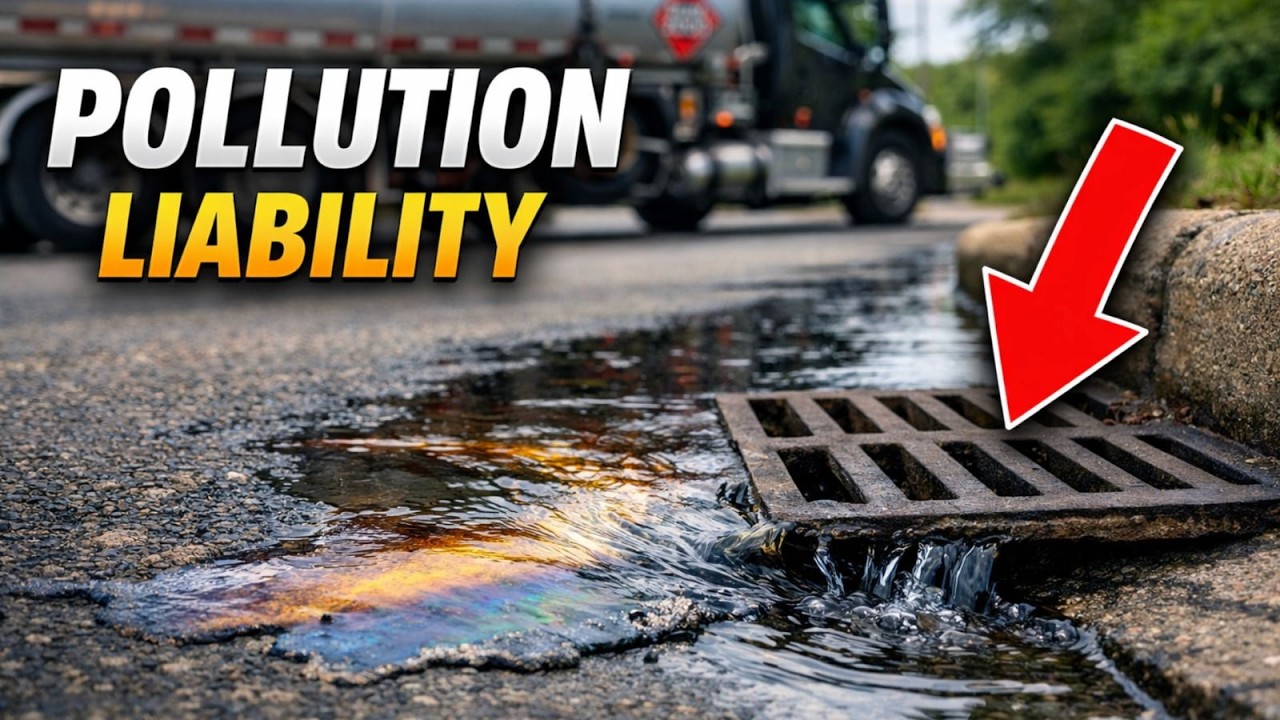
In this solo presentation, Hunter Nelson of Nelson Insurance Agency— a trucking‑specialist insurer based in Sioux Falls, South Dakota— walks fleet owners and owner‑operators through the insurance landscape for trucking and makes a focused case for adding pollution liability coverage. He first outlines the four primary policies most small‑to‑mid‑size fleets carry: auto liability (the FMCSA‑required third‑party bodily‑injury/property‑damage coverage), physical damage (comprehensive and collision for trucks and trailers), cargo (protecting the freight), and general liability (covering non‑vehicle business risks). He then explains why auto liability, even with the MCS‑90 endorsement, typically excludes environmental‑hazard liability, leaving fleets exposed to EPA cleanup bills. Real claim anecdotes illustrate the financial stakes: a New York water‑spill claim of $3 million, milk‑spill lawsuits, diesel and antifreeze spills, and a $100 k debris‑removal claim after a trailer fire. Nelson notes that pollution liability policies are relatively inexpensive (≈$1 k per truck versus $10 k auto liability) and can be added via a standalone policy or more cost‑effective through the ISO CA 9948 endorsement on the auto liability policy. He warns about low cargo‑pollution limits (often $25 k split with debris removal) that can leave fleets under‑insured. Finally, he stresses the importance of looking at total cost of risk—direct claim payouts plus indirect losses such as downtime, driver injury, lost relationships, and broker fallout—arguing that modest pollution coverage can prevent far larger out‑of‑pocket expenses.
Chapters
Hey guys, I am Hunter with Nelson Insurance. I'm going to talk about one of the coverages that is not as common in insurance for trucking, but it's definitely needed and definitely not talked about enough, and that's going to be pollution liability. So we are a trucking specialist agency, it is dang near all we do. My father grew up in trucking and we are based in Sioux Falls, South Dakota. So I'm going to get into it here. So when you guys are looking at insurance, there's going to be 4 main policies that come into play, uh, if you guys do not have a ton of drivers, because there's a lot more to come into play. Your auto liability— this is what gets filed with the FMCSA, activates your authority, activates your MC number, all that sort of stuff. Your auto liability is a third-party coverage protecting you while driving and hitting somebody with your auto. Physical damage is comprehensive, and collision coverage protects your truck your trailer, whatever the heck else you got there. It is the quote-unquote full coverage. It covers your truck and trailer if they get destroyed for our— for fire, theft, wind, hail, auto accidents, right? Cargo protects the cargo. You guys understand that. And general liability is a general business liability coverage for third parties suing you guys. That is why it's called general liability. And what it does, it basically covers anything involving the business except for what it excludes, which happens to be a lot of things, which is why it is a lot cheaper. So where is it actually going to come into play? If there's advertising or personal injury, you say something to somebody or you advertise something that gets you guys sued, uh, anything outside of the truck. So you guys deliver the load and, uh, stack the box too high and it falls on an old lady. There's general liability, right? So now where does pollution come in? Pollution is a liability policy, and here's why I say it is so important, just based off this pretty much one thing here. You guys have filings. There's a thing called the MCS-90. This is an endorsement to you guys' auto policy. It's filed to the FMCSA, and it's your filings. And what that says is no matter what, pretty much, You guys are responsible for public liability, and public liability is environmental hazard, bodily injury, and property damage. So what does that mean without the insurance jargon in there? Bodily injury is you causing injury to somebody and sending them to the hospital. Property damage is you guys hitting a building, another vehicle, causing damage to property. Both of those things are covered in auto liability. So auto liability is made up of property damage and bodily injury, but it does not cover environmental hazard 90% of time. I'll get back into that, how it kind of— most of the time you guys need pollution liability because something happens to the environment, the EPA is going to come clean it up and they're going to bill you for it whether you like it or not. There is no settling, there is no I don't have pollution liability, there's I'm gonna do it myself. EPA comes, cleans it up, you guys get the bill, and, um, That ends up being bigger than auto liability claims half the time. And so where is pollution going to come to play? Where, where does this happen that you guys need this? Who needs pollution? Like, your general freight guys are going to be the less at risk of a pollution claim. The— doesn't mean you guys still don't need it, but you guys are going to see it come into play more on grain hauling because if grain gets on the ground, it ferments, whatever the case is there. Um, obviously liquid pollution is defined as anything where it's not supposed to be. So water in a gas tank is pollution. Um, anything along those lines— hot water gets into a stream. There was a $300,000 claim where the state of New York sued the trucking company for the guy hauling water got into a stream. It was a cold stream, killed a bunch of trout with the rapid change in temperature. Got sued there. Guy hauling milk It's not a hazmat deal. Also got into a water source, killed a bunch of animals, whatever the case was. And, uh, actually there's a couple where one just spilled out and just kind of got on land. Both were multi-million dollar claims. I think the stream one was a $3 million claim. So you think milk and, and grain are not big of deals, but there's 100% that you guys got oversized. You got all sorts of different liquids in that thing. Antifreeze, diesel, all that stuff, oil, get into the ground. That stuff is a pollution exposure. I've talked to fleets locally and, uh, one truck tipped over, had some diesel on the ground, whatever. Ended up being like a $5,000— like a foot down, easily said, uh, getting into the— it is big, big stuff. So that's where pollution's gonna come in. And so pollution insurance policies are typically fairly inexpensive. Uh, your guys' auto, let's call it an average of $10,000 a year per truck. For pollution, you're looking at maybe $1,000. It gets cheaper the more trucks you have, and, uh, obviously depends like what you guys are hauling. So it is very necessary, very inexpensive compared to it. And, uh, I'm really— I, I really do— can have just too much insurance at some point. Insurance is just a transfer of risk. So anything you guys don't buy insurance for, you're saying I'm comfortable carrying the risk for it. And, uh, if you cannot afford the risk of having no insurance on it. You either just every day get in the truck praying to God you don't go to business, or you got a million dollars laying around and you're fine getting sued for everything you got there with a pollution claim. So that's, that's kind of what comes into play. Now, where would you guys maybe not need to go get another pollution policy and you can just stick it on your auto liability policy? I'm gonna get really deep in the weeds on insurance jargon here. There is a policy form that is written by ISO, which is who does a lot of the policy forms, saying what and what is not covered. Okay, there's a form called CA, stands for commercial auto, 9948. When you guys have this endorsement on your auto liability policy, it's actually going to cover pollution for, like, to, to on your guys' auto liability policy. So it is really good. It's an endorsement, so it might not be quite as comprehensive um, as like an actual policy of pollution, but the language will be the same. It's going to be very good. It's really, it's really best bang for your buck that you can get. A lot of insurance— I shouldn't say a lot— there are some insurance companies out there, um, who will offer— for sure, Canal, Great West, Eastern Atlantic, etc., etc. Some of your big names, uh, Progressive, Geico, all the guys are not going to be offering anything like this. The other thing you guys will have for pollution on, uh, on some insurance companies is going to be $25,000 on the cargo. So you have $25K there, but typically it's also a limit of $25,000 for pollution and debris removal. And we've had a $100,000 claim of debris removal, so that guy would have had $0 for pollution. So it's not like you got $25,000 split between debris removal, which can also be a pretty hefty deal. Um, and the Debris $100,000 claim we had was a guy's trailer burning up full of meat. So yeah, that's, that's pollution. I don't, I didn't tell you guys information to just sell you guys more insurance. Um, I don't care if you guys call me or not on it. I would love to help you guys with it. All I put this out there for is just so you guys are aware of this stuff, because trucking companies are shutting down like crazy. Insurance is expensive, and I know people don't want to pay insurance, but you guys have to look at the total cost of risk. The premium dollars is not what's costing you guys money. It is your total cost of risk. If you guys pay $500,000 a year for insurance because you got a fleet and you guys turn in $300,000 a year in claims, that's a direct loss. $300,000 is a direct loss. That is what the insurance company is paying out. That's what actually happens from the claim.. But when you guys have a claim, you guys also incur indirect losses. The truck being in shop, lost revenue. The driver going home because he's on work comp now, collecting money, sitting at home. And then he's at home for 3 months and doesn't want to come back. And so now you got to find another driver. And you've got a broker that doesn't want to work with you anymore because you just destroyed their— the relationship between the shipper because you destroyed their cargo. That's the indirect cost. The downtime, the lost relationships. We see it all the time. Brokers don't want to work with some of the truckers we work with because of a— because, or whatever the case is. And if you guys don't have insurance for it, again, you guys are going to be paying out of pocket. So as an insurance agent, I don't just spend money on insurance all the time and have crime insurance and errors and omission insurance and every little policy I can have because I'm an insurance freak and I love it. I don't love paying premiums. I want the cheapest rates just like you guys, but I look at the total cost of risk. So it's just something for you guys to think about. I appreciate you guys watching. If you got any questions, please reach out. And again, I'm Hunter with Nelson Insurance Agency. Thanks again.