A Conversation with Jack Conte

Jack Conte traces how technology reshapes art, from film to synthesizers to YouTube. He built Pomplamoose into a viral band, then founded Patreon when algorithms killed their reach. Now he's warning that AI is using creators' work without payment, and artists need new ways to survive the next disruption.
Chapters
Thank you. Thanks.
Appreciate it. Have a good one.
Hi, everybody.
Hello.
So nice to see you all. I'm really psyched to be here today. Maybe just before we get started, could I get a— just kind of want to get to know you all a little bit. Can I just see anybody who works in media? If you work in media, raise your hands.
Oh, great.
Okay. A lot of people work in media. How about people who work in tech? If you work in tech, Okay, cool. Creators? Any creators in the house? A lot of creators. Awesome.
Cool. Hello. Great.
I figured it was probably a good time to talk about change today. So that's what I'm gonna talk about. I'm gonna talk about change. I remember when I discovered the camera for the first time. My buddy brought his video camera over to my house. I was like 10 years old, and we started making these little movies for fun. It didn't shoot on digital. It shot on like 8mm analog tape. That's me. I begged my parents for a camera, because I was just— I started making tons of movies with my friend. And eventually, they got me one. And I was filming movies for Spanish class, and family vacations, and action movies with friends. I ended up shooting hundreds and hundreds of hours. I have boxes and boxes. It's hundreds of hours of footage over the last however many years. And then one day, my buddy showed me that you could double-click the record button on the back of the camera, and then move a little piece of clay, and then double-click the record button again, and then move the clay a little bit. bit more, and I started learning about animation. We started making these characters and sets, and I just like started going nuts for animation. And then I discovered these movies. Any Wallace and Gromit fans in the house? Okay, yes. I had these— I had the 3 VHS set of the Wallace and Gromit films, and like as a 10-year-old kid Saturday mornings, like I was— my VHS remote had a little frame forward button, and I would sit on the ground and I would watch the frames. I watched the movies frame by frame. These are 25-minute movies filmed at 24 frames a second. It was like a lot of frames. I'd start in the morning, and I'd finish after lunch sometime. I just studied the heck out of these films because I loved them so much. And look, if good artists borrow and great artists steal, I was the fucking greatest artist in the world. I stole these movies as my own films. I made them, remade the movies frame by frame in some cases. Then I got a little bit older. I got a little better at animation. But really, my films were just still copies of my heroes. So this is an interview that I did with a reindeer for one of my movies. And this is a film from Creature Comforts. It's a shot from Creature Comforts, a great movie by Nick Park, a short film by Nick Park. This is from a film I made called North Pole Plantation where we interviewed the snowman. And this is, you know, some polar bears being interviewed for Creature Comforts. Even my live-action movies, I was still really just copying my heroes. So this is when I started learning about lighting and silhouette shots and how to make something feel mysterious and menacing through lighting. And this is Indiana Jones. When I started learning about dialogue and how to film 2 shots and all that kind of stuff, this is a movie I made senior year. This is the opening shot of Pulp Fiction. So just lots of copying. This is when I started learning about over-the-shoulder shots and how to establish a relationship between characters. And this is the best chemistry in the history of cinema. So look, I didn't realize what I was doing at the time, but essentially, I was learning 100 years of cinema vocabulary and culture. I wasn't even doing it on purpose. In a lot of cases, it was just unconscious. But I was learning how to recreate patterns in my own films that were embedded in 100 years of cinema history and culture. These patterns had not always been there. So this is the cinematograph. That's the first basically fully contained motion picture and projection camera system. It was invented by these folks, the Lumière brothers, in 1895. That's when this first camera system was invented. The first filmmakers to use this camera had no patterns to learn from, no patterns. So they drew from the storytelling predecessor to film, theater. The filmmakers approached film like they were trying to copy theater, literally like they were trying to recreate what it felt like to be at a play. So they had these big elaborate sets, single shots on a super wide-angle lens, just 4 minutes of the camera sitting there with a wide-angle lens looking like from the front row of where the audience would be in a theater. Big expressive overacting as if everyone was on stage. There was this critic named Maxim Gorky at the time. He saw a film by the Lumière brothers one night in 1896, and he described it like this. It's a world without sound, without color. Everything there, the earth, the trees, the people, the water, the air, is dipped in monotonous gray. Noiselessly, the ashen gray foliage of the trees sway in the wind. And the gray silhouettes of people, as though condemned to eternal silence and cruelly punished by being deprived of all the colors of life, glide noiselessly along the gray ground. Their smiles are lifeless. So, like, a lot of people weren't exactly impressed by early films, because, you know, it was like a play, but not as good. It was— it had a couple of problems. It was 2-dimensional. It was silent. And it was in black and white. So as much as you tried to simulate a play, as much as you tried to make it seem like you were at the theater, it just was never as good at being theater as theater was. And then there was this filmmaker named Georges Méliès, and he had been experimenting with new techniques for storytelling through cinema. Specifically, he was experimenting with something called the cut, a cut, where you would cut the film and then tell the next part of the story. And sometimes you could cut the film and move the camera. Sometimes you could cut the film and not change anything, keep the camera exactly where it is and just change one little thing, and then something magical would happen. So actually, Georges Méliès was a magician too. So one thing he would do is he'd show that a box was empty, and then he'd cut the film, and then someone would get in the box, and then he'd restart the film, and they'd pop out of the box, and audiences were like, wow, how did that person get in the box? But people didn't know about cuts at this point. So he started developing this new vocabulary. And in— sorry, in 1902, he came out with this film called A Trip to the Moon, using all these new techniques, using cuts and a bunch of other stuff. It still had some big sets. It still had some elements of theater. But it changed locations so you could push the story forward. It played with time and space. It involved these guys who got together, and they built this rocket, and then they got in the rocket, and they brought it up to the roof, and they got inside the rocket, and they loaded the rocket into this big cannon. And then it instantly cuts to a shot of the cannon pointed at the moon, and the guy standing up there behind the cannon literally lights the cannon with a flame. He lights the camera with fire. And the cannon fires, and then it cuts to the POV of the rocket moving toward the moon. And suddenly, you feel like you're moving toward the moon. Imagine being alive and 1902 and feeling like you're approaching the moon. Then you see the rocket landing on the moon, and the guys get out. They're wearing freaking top hats, and they look at Earth from space. So George flips the whole perspective around, you know, something that's very hard to do in theater. And then they visit this, like, forest of mushrooms. You can't help but wonder if George was inspired by some of those mushrooms. Then they all get captured. They get bound. They get captured by aliens who live on the moon. They get bound. They get escorted to this alien court. The main guy grabs the head alien, throws him down on the ground, and then George does a match cut. So they stop the camera. They replace it with a bomb. The bomb explodes. So it looks like the main alien guy explodes. And then they run back to the rocket. They point it off a cliff. They fly back to Earth. They land in the ocean. And they're welcomed back at home as adventurers and heroes. So this whole thing, this was 14 minutes long. It had narrative structure. It had cuts. It had changing locations. It had special effects. It had match cuts. It had explosions, it plays with geography and space, it had fantasy, it had heroes, aliens, rockets. Like, if that's not the beginning of cinema, I don't know what is. But more importantly, it wasn't trying to be theater. It wasn't trying to reproduce the experience of watching a play. It was taking advantage of the fact that it was not a play. One thing I see in my favorite artists is not their ability to recognize and recreate patterns, but their ability to break those patterns and still make you feel something. It's that invention outside of the collective consciousness, outside of the zeitgeist, outside of even a medium, that at least makes me interested in my favorite artists. The exact same thing happened with recorded sound and music. This box here is called a Digi-003. It's a recording studio in a box. It allowed you to connect a microphone up to your computer, and you could run the software called Pro Tools, which would allow you to record and mix multitrack songs in your house. And my buddy Ryan Lerman showed me how to use this thing to record my songs. I had always loved music. My dad was a jazz piano player. When I was 6, he taught me the blues scale. I started writing songs. And all through high school, I did a cappella groups and jazz combos, and I wrote songs, and I performed at school assemblies. And so by the time I was 16 and Ryan showed me that it was now possible to record my songs on my computer, I lost my mind. I turned my entire garage into a recording studio immediately. I hung up this cheap foam that I got at The Container Store. I don't think the foam actually did anything, but it made me feel like I was in a recording booth. I put blankets on the walls that dampened the sound a little bit. I spent the entire summer holed up in this garage recording a bunch of my songs. I remember this one time, actually. I was playing the guitar, and I was recording it. I listened back to it, and some— it didn't sound right. It sounded like the time was off, and I thought maybe there was a problem with the box. And so I zoomed in to the to the waveform. And I was trying to see what's going on. Is it just— maybe it has a delay or something. And some of the hits were ahead of the beat, and some of the hits were behind the beat. And then I realized what was going on was I sucked at guitar. And so I spent the next 45 minutes on my back with the guitar after realizing this, just playing the same 3 chords over and over and over again to a metronome. before I did the next take. And then when I did that take, it was a little bit better. And I had this, like, insanely motivating feeling, like, oh my God, I could just put in a bit more work and make my records better and better. It was really such a good feeling. I'd just met this girl named Natalie at the time. She played bass, and she started coming over to my house on weekends. We would record together. She wrote these incredible, like, melodies on bass. She had this amazing voice. We were 20-year-old kids, so we couldn't afford to go to a recording studio or hire anyone to help us make these recordings. So we just learned to do everything ourselves. I would play guitar and drums and piano. Natalie would play and sing just about anything because she had an amazing ear. I'd record and mix and master the tracks myself. I was just obsessed. I thought recording was the coolest thing in the world. But when recording technology first emerged commercially in the 1930s, a lot of people were worried that it would actually ruin the music industry. I didn't know this. This is James Petrillo. He's the president— was the president of the American Federation of Musicians. That was the major musicians union back then. He estimated that recorded music was stealing 60% of live music jobs. That might sound crazy, but the way that people were approaching recording back then in the 1930s, I can understand why James was so worried about it. Because similar to the invention of the camera in 1895, where filmmakers were just trying to simulate theater, that's how early record producers thought about recording. They thought of it as a way to reproduce close, you know, what a live band sounds like. So to make a recording, they'd invite a band into the studio, you set up 2, you know, microphones, you record the band once all the way through, and then they're done. And that's the recording. You try to get it as close as possible to what it sounds like when that band plays live. That was what the first wave of records actually were. And so James Petrillo felt very threatened by this. And the— this fellow, the president of this union, organized a national ban on recording music. This is actually true. It was a union-level strike against any recording sessions. Lasted years. No one was allowed to record music. He said any musician doing any recording gigs was playing for their own funerals. And the union actually ran ads through the '30s against this idea of recorded music. They called it canned music. This is one of those ads. And like, if you can see this, there's a robot up there loading acoustic instruments into a meat grinder, and it's outputting biff, bang, bop, boom into a thing labeled canned music. And so they ran a bunch of ads like this. There were a whole bunch of them— trampling art for profits, profit without honor, you know, the robot's lullaby. There was a whole series of these. And then, of course, over the next decade or two, a whole lot of amazing recording artists emerged and started using recording not as a way to simulate live music, but as this new medium. Until 30 years after the union ran these ads, the Beatles made this record called Revolver. It's one of my favorite albums of all time. And the Beatles were stringing together tape machines. They were looping 2-bar drum sequences. They were playing sounds backwards. They were running their vocals through Leslie organ speakers. They were doing a whole bunch of things and making sounds that you could not make live. This is George Martin. He's their producer. He described the recording studio for the Beatles as a new canvas on which they had to paint. He was basically saying recording is a new medium. So in just a few decades, we went from banning recording music to thinking about recording as this new cherished art form.
hard form.
This is something that happens with new technological mediums that impact artists and storytelling. There is this period right after this new medium gets developed where collectively we all just use our previous reference points as what that medium is for. So if you're You know, if it's 1895 and you're using film, you think of theater, you know, or if it's, if it's 1920 and it's recorded music, you think of a live band, you know, or, or if it's now, you know, you use an image generator to make something that looks like it's hand-drawn, or you use, um, you know, a video generator to make something that was, looks like it was shot by a camera, or use a music generator to make something that sounds like a, a human playing bass and a person playing drums. That's where we are now. We're at the very early stage where we haven't figured out what this new medium is yet. And I think that's why it feels and seems and is like slop. That's what slop is. It's that lazy phase after the introduction of a new medium where we're all just trying to reproduce existing things that are honestly just better if the people do them, if we do them that way. And I know the tech is going to catch up and it's going to get better, but right now we're just all using these existing, these preexisting frameworks. I'm actually going to talk about this more later, but I'm so upset about how this tech has rolled out. I'm upset because in order to do that, in order to create all this stuff as a creator, my work has been used. For a lot of creators in the audience, our work has been used. Without our consent, without paying us, and without giving us credit. Our work has been used to create these models.
It—
and it feels like that keeps happening. Okay. If that's all I felt, if I just felt angry, I wouldn't be up here giving a talk, because it's more than that. I have this incredible sense of conflict, because I don't just feel angry about it. There is a piece of me, like, as an artist, there's a big piece of my personality that is attracted to things like this, to new technological innovations, because I feel like maybe there's a way it can help me express myself. And there's a piece of me that feels really grateful to be— like, I feel like I get to be alive in 1895 for the invention of the cinematograph. That's what it feels like right now. I feel like I get to be alive in the 1920s for the invention of recorded music. And I feel both of those things fully. I feel so angry, and I feel so, like, strangely grateful and excited. I have this incredible sense of conflict around those things. I know, you know, on social media these days, it's— it does such a good job of just creating the pros and the cons, creating the fors and the againsts. And we're so polarized on social media. The algorithms just sort humanity. They just sort humanity into the this group and the that group, including for topics like this, for AI. I think it's such a shame because this is such an important time for artists right now. It's so important right now. And if you're a creator who feels a sense of conflict about this stuff like I do, one, that's okay. You don't have to feel singularly this is good or this is bad. You don't have to feel singularly about it. There's a lot of people More than you would know. More who say so publicly. There's people in private. I talk with thousands of creators. You know, I think there's a difference between what people are willing to say online and how people feel internally. I know a lot of creators who feel conflicted about this. And so that's okay. That's okay if you feel conflicted. I just ask— I'd ask, especially in creator communities, this is really important for us to talk about right now. We're at an important moment in history. I think it's really important for us to each approach this world with our own sense of how we feel about it. By 2007, Natalie and I had started making a lot of recordings together. That was right around when this new website emerged called YouTube.com. There was no iPhone yet, there was no apps, so it was a website. It was YouTube.com. I thought it was the coolest thing in the world that this new tool allowed me to put out my music without having to sign a record deal or get lucky somehow and get discovered. So Pomplamoose set a YouTube— we set up a YouTube.com page, and we started making videos of our recording process. Now, they weren't music videos, because in a music video, right, the band makes the album first, and then they, like, mime the music video. That's not what we were doing. We were showing the actual process. recording process. It wasn't a live video, which also existed, because in a live video, the band plays and then it's done, and then the live thing comes out. Instead, we were filming the actual recording process layer by layer: vocals and electric guitars, acoustic guitars, piano string plucking, Wurlitzer, synth, background vocals, and then we usually goof off at the end for a little bit. And then Natalie would film, like, would edit the whole thing into these little 3-minute clips that we would upload to YouTube of our songs. And you could see all of the layers that went into the recording. It might sound really obvious right now with me talking about it this way in 2026, but no one was really doing that back then. It was either like music videos or live performance videos. You couldn't really see the at-home recording process. So we started making dozens of these videos. They started getting millions of views on YouTube. And it was so much traffic that we decided to start selling these songs as MP3s. on iTunes. And we started selling tens of thousands, tens of thousands of MP3s. So we went from, like, being bedroom musicians to being full-time professional recording artists, like, in a period of months. I couldn't believe how well it worked. It was like, you know, film ourselves making music, edit it into videos for YouTube, and then sell the MP3s on iTunes. It was such a simple model, and we lived happily ever after. Thank you, everybody. Safe travels back home. Thank you. Okay, so no, seriously, what was nice about this for me as an artist was, no delusions of grandeur here. I don't feel like I was Georges Méliès inventing cinema or the Beatles inventing recording here, but But I didn't feel like I was copying Wallace and Gromit anymore. I felt like I was doing something new as an artist. Even if it was just a small little thing, I felt like I was saying the next sentence in the conversation as an artist. I was helping to kind of make something interesting, and that felt really good. That was like a really nice moment.
Thank you. The introduction of the Vitaphone has been received both by the public and the artistic world with a great deal of interest. A development which is destined to create an entirely new art where the medium of expression is the synchronized reproduction of sound and scene.
In 1927, Warner Brothers released a film called The Jazz Singer. It was the first mainstream film with sound. Theaters played this film using a machine called a Vitaphone that was able to synchronously play back film and audio together. The Vitaphone cost between $9,000 and $15,000 to purchase, so it was a significant investment for the theater owners, but for the first time, you could show movies with sound. These films were called talkies, because you could actually hear the characters talking, and they had sound effects, and they had music, and audiences loved it. Movie theater attendance exploded from 50 million moviegoers per week in 1926 to about 90 million moviegoers per week in 1930, just 4 years later. But not everyone, of course, was excited about this new technology. A group of Soviet filmmakers published this statement on sound in 1928. They wrote, this new technical discovery may not only hinder the development and perfection of the cinema as an art, but also threaten to destroy all its present formal achievements. And the pushback on the new technology wasn't just philosophical. At the time, movie theaters in the United States employed tens of thousands of musicians every day to create live scores behind the otherwise silent movies. Many theater owners paid for the new Vitaphone technology by firing their orchestras, because a 15-piece band could run around $50,000 per year. So in a few months, the investment in the Vitaphone paid for itself, and the theater owners were thrilled about it because they could now play movies all day long and not have to worry about overtime and employing union workers and dealing with union rules. Musicians organized strikes, and the union bought ads to fight canned music, but it didn't matter. By 1930, the union estimated that 22,000 musicians lost their jobs to the Vitaphone as talkies became the new standard. A lot of actors didn't make it either. John Gilbert was often cast in leading roles during the silent era, but his Vocal delivery was evidently a bit stilted, and it made audiences laugh when they weren't supposed to. Clara Bow was nicknamed the It Girl of silent films, but she hated talkies. She had this thick Brooklyn accent. She got so nervous delivering lines out loud that she eventually had a mental break, and she checked into a specialized hospital for her emotional health. Her career was over by 1933. Charlie Chaplin also hated talkies. He said, I loathe them, and he felt like they were spoiling the art of pantomime. Charlie refused to make the transition. In 1931, 4 years after the first talkie— 4 years— he released City Lights, a film with no synchronized dialogue. His next film was Modern Times, almost a decade after the introduction of the Vitaphone, and long after culture had moved beyond silent movies. Modern times had some sound effects, but almost no speaking. Why did Charlie refuse? Why did he refuse this new technology? I don't know, but I wonder if Charlie felt conflicted about it, conflicted about the potential, but scared about what it meant for this great art form he had worked so hard to protect.
Thank you.
to perfect. I wonder if he felt like he was choosing between being left behind and becoming irrelevant or changing his work in a way that he was angry about and didn't believe in. Finally, in 1940, 13 years after the introduction of the Vitaphone, Charlie released his first actual talkie with synchronized dialogue and picture. He did it. It was called The Great Dictator, and it was a satire of Hitler and fascism. At the time, Germany had just invaded and occupied much of Western Europe, including Belgium and Poland, Denmark, France. Nazi planes were dropping bombs in the UK, and the United States hadn't yet entered the war. Political neutrality was the going strategy. At the end of the film, Charlie gets up in front of an army of soldiers in a nation that his character just conquered, and he breaks character. He gives a speech right to the camera with the whole world listening.
I'm sorry, but I don't want to be an emperor. That's not my business. I don't want to rule or conquer anyone. I should like to help everyone if possible— Jew, Gentile, black man, white. We all want to help one another. Human beings are like that. But we have lost the way. Machinery that gives abundance has left us in want. Our knowledge has made us cynical, our cleverness hard and unkind. We think too much and feel too little. More than machinery, we need humanity. More than cleverness, we need kindness and gentleness. The aeroplane and the radio have brought us closer together. The very nature of these inventions cries out for the goodness in men. Even now my voice is reaching millions throughout the world, millions of despairing men, women, and little children. To those who can hear me, I say, do not despair. The hate of men will pass, and dictators die, and the power they took from the people will return to the people. And so long as men die, liberty will never perish. Soldiers, don't give yourselves to brutes, men who despise you, enslave you, who regiment your lives. Tell you what to do, what to think, and what to feel? Who drill you, diet you, treat you like cattle, use you as cannon fodder? Don't give yourselves to these unnatural men, machine men with machine minds and machine hearts. You are not machines. You are not cattle. You are men. You the people have the power, the power to create machines, the power to create happiness. You the people have the power to make this life free and beautiful, to make this life a wonderful adventure. Then in the name of democracy, let us use that power!
Let us all unite! I'm sorry, Jack. By 2013, Pomplamoose was getting featured in magazines and the press about this new age of internet musicians. We were making so much money from our MP3 sales on iTunes that we were able to buy a house, build a recording studio. We were touring the entire United States and playing 1,000-person venues in major markets. Our catalog of videos on YouTube had gotten almost 100 million views. We were investing the money we were making back into our music videos, making them more complex and crazy, building sets and doing projection mapping, renting production spaces and hiring collaborators and other musicians. Natalie and I felt like our dreams as artists were coming true. And then a bunch of things changed pretty suddenly. First, our YouTube growth fell off a cliff. Right around here, YouTube rolled out a change called Cosmic Panda, and Pomplamoose's growth just flatlined. We didn't know at the time what caused it, but we just knew we weren't growing anymore. Second, streaming had started to become more popular, and iTunes was slowly dying and being replaced by Spotify as the main way people listen to music. The economics of streaming were different than iTunes. And third, I had started a company called Patreon. And it was a ton of hard work and late nights to get the company off the ground. What a likely thing to see happen back then was, you know, we worked really late. The first couple years of a startup are insane. So, you know, I'd start at 8, work till 10 PM at the office, and then I was still doing Pomplamoose. So Natalie would come over at 11 PM. And we'd start making a Pomplamoose video, and we'd film a Pomplamoose video from 11 to like 3 AM. And I'd go to bed at like 4, wake up at 7 to get to work by 8 the next day. And I was doing that for like a year and a half, 2 years. And finally, our head of ops at the time, this guy named Tyler Palmer, who's one of the best people I ever worked with in my life, he came over to my apartment, sat down, it was like an intervention. And he was like, JC, he was like, this isn't working. He was like, you can't do this. And he was right. Like, I was dying. And so we made this really hard decision at the time to put Pomplamoose on hold. And I felt like I had failed, is what it felt like, especially with all those other changes and the growth flatlining. I found this interview that I did for Hypebot right around this time. And the way I'm talking about Pomplamoose, it's as if Pomplamoose had died. It's as if we, we were gone. As if it was final. Here's some things I said in this interview. I look back on things we could have, that could have been better, and it kind of feels a little rough. I feel like maybe we should have tried to trust more people and bring more people into the circle. We did a really good job taking it from 0 to 50%. And then I think we got paralyzed and we needed to be better leaders and have a cabinet of smart people around us to help us take it from 50 to 100. But I think we could have gone much higher if we had been better business people. This was the first time for me and for Pomplamoose where like a tech— a technological change in the world and just some other changes had broken our model. That was the first time. I was like 27 or 28, and I just didn't have perspective on what that meant. Like, what I actually thought, and I think what you can— what I read in myself in that article, and what I remember thinking, is like, I failed because I didn't— because I was unable to build this thing that persisted beyond technological changes. And if I had just been more strategic, if I had just had better business acumen, if I just been more capable, I would have been able to build this permanent model that could kind of withstand the changes of the world. Like, I felt like I took it very personally. I felt like it meant that, like, I had failed as an artist. So, Jack Conte, That's a Hammond Nova chord. Designed and invented by Lorenz Hammond, the Novachord was introduced at the 1939 World's Fair. It's often regarded as the first commercial synthesizer. 163 vacuum tubes, over 1,000 hand-wired capacitors, and it weighed almost 500 pounds. This machine could sound like strings or a piano, or a trumpet, or a whole orchestra. Popular Mechanics ran a feature on the Novachord, writing, the Novachord is virtually an orchestra in itself. Almost immediately, the musicians' union announced a complete prohibition of the instrument out of fear that it would take the jobs of even more orchestral musicians. That might sound like an overreaction, to ban the synthesizer. But many of the union's fears around synthesizers actually played out over the next 100 years. In 1941, every single song that hit number 1 on Billboard was recorded by an orchestra. Every song. Today, it's essentially none. While it's unfair to blame the synthesizer solely for that change, the synthesizer was a step toward the decline of the orchestra. Because it was addressing a larger, darker problem: the economic model to sustainably run a 40-piece band. Economist William Baumol called this problem the cost disease of the performing arts. He said that the output per man-hour of the violinists playing a Schubert quartet In a standard concert hall is relatively fixed, meaning essentially if the musicians' salaries remain constant or increase—
sorry.
If the musicians' salaries remain constant or increase, there's no way to squeeze efficiency. Out of a string quartet. Thanks. Sorry. In '91, the American Symphony Orchestra League—fuck, I'm sorry, guys. Sorry—published a longitudinal analysis of multiple orchestras, concluding. including that the orchestra industry was in financial crisis. And a Stanford GSB study from 2008 found that 46 of the 63 largest orchestras in the US are in deficits. Meanwhile, the synthesizer exploded in popularity over the same time period. It was adopted by the most culturally influential musicians and artists in the world. The Beatles Stevie Wonder, the Bee Gees, Whitney Houston, James Brown, Prince, Madonna, Radiohead, Björk, Daft Punk, my heroes, just to name a few of them. But everybody uses synthesizers now. I found a synth player that I love recently. Yes, God, thank you. I found a synth player that I love recently, and I want to introduce you to him. His name is Brian Knoll. Brian, come on out. First, I want to just— maybe just let me acknowledge it is so weird to to be a synthesizer player and have that be your fucking intro. So can we give Brian one more round of love here? Can we give Brian some love? Brian's going to play a piece for us that he composed in a second. And what I would like us all to do while we're here is Try to hold 2 opposing ideas in your head at once. Humans are capable of this. We can do this. We do it all the time. Hold 2 opposing ideas in your heart and in your head at the same time. Don't try to decide whether the synthesizer is good or bad. Think about all of the beauty that this instrument has created and think about the incredible technical capability of this this machine. Think about all the self-expression that it's enabled from people over so many years. But also just think about the terror of what this instrument means and how tough it's been. Think about all the people who've been touched by hearing synthesizers and what it's meant for them and how it's helped them make decisions and change their lives in beautiful ways. And hold all that at the same time as the difficult history of this synthesizer and what it's meant over the last 100 years. Hold all of that at once in your hearts and in your heads as Brian plays through this piece. This— Brian's project is called Light Bath, and this is his composition, Baby Steps. By 2017, Patreon was starting to take off. Pomplamoose had been basically dormant for 3 years, but a new dynamic had started to emerge on YouTube: the daily vlogger. YouTube was rewarding frequency of uploads. If you uploaded every day, every week, you were more likely to get wider discovery and distribution. I had just started another band called Scary Pockets, and this strategy of weekly uploads was starting to work for us. So Natalie and I wanted to try it too with Pomplamoose. The idea was to fly down to LA once per month, record 4 songs in one day, film the whole thing, and then edit together the whole episode into 4 music videos, one per week that we would release. Then rinse and repeat this process every month. That would allow us to publish weekly on YouTube, 52 music videos per year, to see if we could find a new model that took advantage of this idea of frequency leading to better discovery and distribution for creators. After some debate and planning, we finally got on a flight to LA and decided to give it a shot. It worked. Our Spotify streams went nuts. And we grew to over a million monthly listeners. In just the first 2 years of the new strategy, our music videos got over 80 million views on YouTube. And that flat growth that we had seen from the algorithm change that we had been experiencing for 7 years now, that was completely inflected by the new upload strategy. And on top of all that, our revenue was growing insanely fast too. Our combined income from Spotify and our membership and our ad revenue on YouTube was way higher than it had been when we were just releasing iTunes MP3s. And we were using that money to employ a giant team of musicians and videographers and mixing engineers and producers. We had found a new model. And we lived happily ever after. Thank you, everybody. See you next time. Thank you. No. Okay. Love that joke. Okay. So this was actually like an important moment for me. Because, no, it didn't last forever. It lasted 5 or 6 years. But it's when I learned a very important thing as an artist, which is that change does not mean death. You can get back up and you can fucking go again.
Yeah.
When I was 27, I didn't understand that. I had this sense that we had peaked and that it was over and that change meant death. But happily ever after is not a real place. This does not exist. Yes, I am on a stage at South by Southwest saying the tritest fucking thing in the world, that there's no such thing as happy endings, but God, it is so true. We don't get this. As artists. Nobody gets this. You go to conferences like this, you go to the movies. At the movies, you see the same story format. There's struggle, there's struggle, there's struggle, the hero has redemption, and then they make it, and then the movie ends. And you go to a talk, and you hear about a person who tried a bunch of things, they tried a bunch of things, and then they finally figured it out, and then the talk is over, and then they tell you how they did it, and it's really exciting. That is not how life works. That's at least not how my life works. It is not that. It's this, you know, as an artist, you figure something out, you figure out a model, and you put it out. It took years to figure out. You finally got it, and then some new tech comes out, and it breaks everything, and then you've got to rebuild from scratch. And then you rebuild, and then the world changes, and something happens, and it breaks again, and then you rebuild again, and then it breaks again. And then we just keep doing that over and over and over. It's this infinite sine wave. That's what we get, this infinite cycle, just up and down forever. Because then COVID hits, and then we all have to wear masks and record across the room from each other, and the videos don't do as well because you can't see our faces, and then we have to build quarantine boxes for ourselves in order to play without masks so that the comments section doesn't yell at us, and then those videos do better, and they actually look kind of cool even though in retrospect it's also a little stupid, but then TikTok comes out, which is like, whatever, but then every platform copies And that blows everything up again because watch time shifts to vertical, so we have to study vertical native production and design completely new camera setups and systems and pipelines and workflows and turn all our cameras sideways, even though the camera manufacturers don't make them for shooting sideways yet. And then we have to figure out how to sift through 50 hours of footage. Thank God for Athena, our editor, who chops it all up into 30-second clips of the band in the studio, and it kind of works because our views go nuts. But it turns out views are now just empty calories because short form is different and the conversion to Spotify is different and there's no more ad revenue. And oh my God, the infinite sine wave just keeps on going. It keeps going. So, okay, thank you. In that light, I have something I'd like to say. say to the AI companies and to creators about this moment that we're in. As creators, here we are again. We're at another moment on the internet where not only is everything changing, but our work, our life's work, is being used without our consent, without credit, and without compensation. And that feels painfully familiar. The AI companies are claiming fair use, but this argument is bogus. It's bogus because while they claim it's fair to use the work of creators as training data, they do multimillion-dollar deals with rights holders and publishers like Disney and Condé Nast and Vox and Warner Music. And I have nothing against those media companies. They should be doing deals right now. They deserve to be paid when their work is used as training data too. That's why they're called rights holders, because they have rights. Of course they do. But if it's fair use, why are the AI companies paying them for their work? If it's legal to just use it, why pay? And why pay them and not creators? Not the millions of illustrators and musicians and writers whose work has been consumed by these models to build hundreds of billions of dollars of value for these companies. I say this not as a Luddite. I'm not anti-AI, just like I'm not anti-synthesizer or anti-talkie or anti-camera or anti-recorded music. I'm not anti-AI. I can't be. I run a fricking tech company. If Patreon didn't adopt new technology at a blitzing clip, we'd be dead in 3 years. And my promise to creators is we will not be dead. We will be thriving. We will be a rock for your businesses and for your communities. I have a deep love of technology. I hold technology in my heart like I hold the synthesizer, in all its beauty, in all its horror, all at once. And I still believe this technology can be used to help people. I I say all this to the AI companies not as a nostalgic, change-averse idealist who misses the past. I don't expect everything to stay the same. And as an artist, I don't feel like the world owes me anything, certainly not consistency. No one gets that. That's not on the table. I accept the inevitability of change, and I feel agency in discovering my next path through the chaos. A part of that challenge even excites me. Still, the AI companies should pay creators for using our work. Not because the tech is bad, but because a lot of it is good, or it will be soon, and it's going to be the future. And when we plan for humanity's future, we should plan for society's artists too. Not just for their sake, but for the sake of all of us. Societies that value and incentivize creativity are better for it. That's why IP laws exist. That's why copyright exists. That's why rights are established for artists in the Constitution. The task of building technology in a way that considers artists is hard. I know that. But it's nowhere near the hardest problem our species has tackled. If we're going to task people with figuring out how to build data centers in space, then we ought to task people with figuring out how to pay creators for their work. For the creators there— out there watching this, I have something to say to you all too. What's about to happen to us over the next few years is going to be really, Really hard, but it is not the end of human creativity. I don't believe that. I know there's people who do. I'm not one of them. We're about to go through a steep dip in the infinite cycle. It's going to break a lot. All the models that so many creative people have worked so hard to build for themselves, all those economic models, it's going to break so much of that. But there's something even more painful happening. I've heard a lot of creative people question the value of their own artistry in this moment, their own purpose. If AI can just make anything now, what's the point? On my worst days, I have that feeling too. It's this sort of existential hopelessness that feels final. But I recognize that feeling now. It's not new to me anymore. And I believe in human creativity. I believe that humans will make and enjoy the creative work of other humans for a long, long time. And I'd like to explain why I believe that with a little help from Lightbath. So Brian, can you come back on stage? Great, thank you. I know a lot of people who don't like electronic music, but I do. I remember when I first heard dubstep emerge in the early 2000s, artists like Scream and the whole UK dubstep scene, and eventually artists like like Skrillex in the US. What made these— yes, Skrillex fans, shout out— what made these producers so exceptional wasn't just the sound that they made, it wasn't just their output, it was their values that led to that output. The fearlessness, the experimentation, pushing the definition of what's even considered music. Before those artists, a lot of people thought pop songs needed to have melody and words and choruses, but these artists changed song form and they changed music. In some cases, they didn't even use melodies. They used timbres and sounds and physical vibrations and subsonic frequencies. Great artists don't play back what already exists. They stand on the shoulders of giants. They push culture forward. They break people's conceptions and definitions about what an artistic medium If you train the Suno model only on historic music recorded up to '59, but nothing beyond that, just music up to 1959, so it was never exposed to modern music, could it have gotten to music that sounded like the Beatles without John, Paul, George, and Ringo? Would it have then gotten to the '70s and created Carole King and Stevie Wonder? Could it have gotten to things like Prince without Prince in the '80s? Could it have gotten to Nirvana then and grunge without Kurt Cobain? Remember, it's only trained on pre-1959 music. Could it have gotten to Biggie Smalls and hip-hop or Beyoncé and Daft Punk by the 2000s or Frank Ocean by the 2010s or Jacob Collier in the '20s? Maybe one day there will be some technology that can autonomously make these cultural leaps without humans, but that tech does not exist today. And if it does, I haven't seen it. Leaps like this require a spirit of rule-breaking and invention that I haven't yet seen demonstrated by these models. I'm not saying it's impossible, but the fundamental technology that these companies use is essentially a statistical model that performs pattern recognition over vast amounts of data. And I'm not convinced that pattern recognition is the only thing going on in the human brain that makes us so freaking creative. There's so many other interesting things about humans, our ability to experience emotions, our consciousness, the fact that we sometimes straight up ignore logic. We are weird, complex creatures, and I don't think the fundamental technology being used in these models has us pinned down quite yet. Again, I'm not saying it's impossible. I'm just saying a lot of people seem to be worried that it's a done deal. But so far, I'm not convinced. And there's another reason.
Risk. Risk.
Hasan Minhaj gives this great interview with Conan O'Brien where he essentially says comedy requires some form of risk. In a normal distribution of things that are socially acceptable to say, comedians don't operate in the normal range, that'd be the most boring comedy show ever. Comedians operate out there. They defy the collective wisdom, they shit on the popular consensus, and they show us an unusual perspective that somehow still feels true. And in doing so, the range of accepted thinking is pushed outwards and culture is catapulted forwards. I would argue that's not just comedians. Great artists take risks. They're interesting to us because they're putting themselves on the line. There's a great movie I love called Sing Street. The older brother of the protagonist says, rock and roll is a risk. You risk being ridiculed. I love that quote. It's interesting to watch someone take a risk, to watch them put themselves on the line. There's something special about the willingness to do that. If an LLM says some crazy shit, it's not interesting to me. What's it risking? Who cares? But the hot dog finger scene in Everything Everywhere All at Once, just ketchup and mustard sex juice all over the place? That shit is so out. That is so weird. It's so risky. I'm so interested in the Daniels as humans and as directors after seeing them make something like that. When Taylor Swift flips the industry the middle finger by re-recording her back catalog and coming out with Taylor's Version, I'm interested in her as a person, someone who's willing to lay it on the line and go to battle with the machine. There's something compelling about that, compelling about watching a human take a risk. Okay, there's more. There's more reasons I'm excited and bullish on human creativity. CarrotXChang, one of my favorite creators in the world, said this best. She said art is scarcity. Art is not what's easy to make, it's what's hard. I remember when I first saw the invisible selfie stick videos and tiny planet videos popping up online. I thought they were so cool. They were getting millions of views. No one had seen videos like this before. Turns out it was a setting on an Insta360 camera, and it got really, really popular, and a lot of people started buying those cameras and coming out with those videos. And now, years later, if you upload an invisible selfie stick video or a tiny planet video, nobody cares. It gets no views because it's not scarce. It's lazy. It's boring. It's easy. And easy isn't interesting. Hard is interesting. I think there will always be humans who decide to do something hard, pushing the edge of what their tools or bodies or systems are capable of. And that will be interesting to us. Not just something that requires more compute or more money or more connections, but resourcefulness, ingenuity, patience, and practice. That's Braylon Browner. Braylon's a student right now. He told me this morning, He's only allowed to miss 4 days of class in a semester, but everyone wants to work with him, so he's missed 28 days of class. Content is a word that I hate. There's so many different types of creative works that fulfill different purposes in our lives. A beautiful album by Monty Booker, for example, and a video on how to plunge your toilet Are very different types of media. This is partially why I hate grouping everything together as content. There is some artistry that's more about connection with other conscious beings than it is just about the information or the output. Yes, if my toilet is clogged, I probably just want to know as quickly as possible how to fix it. I'm less interested in building a deep connection with another human in that moment. But when I listen to an Elliott Smith record, it's not about the information. I'm connecting with Elliot, the human who lived through this experience I'm hearing about. When I listen to a Kendrick Lamar record, I'm hearing the experience of another conscious being who grew up as a black kid in Compton. Yes, the sound of the kick drum is cool, and I like his chord changes, but that's not what matters about Good Kid, M.A.A.D City. That record isn't special because of what it sounds like. Like, that's ridiculous. It's special because of the whole thing. Who Kendrick is, his background, his story, what he went through, his pain, the connection I feel to him when I'm listening. Kendrick is what's special about that record. All that to say, yes, some media serves a non-emotional function in our lives. There will be some restaurants that put on an AI dinner jazz playlist in the background because it's cheaper and it cuts the silence. There will be AI descriptions of how to hang a picture on a wall that a lot of people will find fast and useful. There will be AI headline summaries that people read in the morning when they want a 10-second update on the world. But there will also be great, honest creators who say who they are and communicate something important and take risks and lay it on the line and do what's hard and push culture forward. There will be creative people who keep building and keep getting back up and keep creating and keep learning and keep being true. There will be creators who don't just create new works, but new mediums, new vehicles for expression that become the vocabulary of the creators 50 and 100 years from today. There will be creators who feel something that's never been described, and they'll feel compelled to figure out exactly how to convey that feeling, and they'll search for just the right way how, and it'll be beautiful, and it'll be hard, and it'll be rewarding. There will be artists who help us see something about ourselves that we've never seen, and it'll change culture forever. Humans will do that for a long, long time. Thank you, everybody. Thank you.
Thank you.
Thank you. Thank you. Braylon! Braylon, are you here? Come on up! Braylon! Let's do a bow.
Yeah. Crushed it.
Yes! We needed that after all 4 episodes! All right! All right.
More from Jack

The Artist-Founder: What Silicon Valley Gets Wrong About Creativity | Patreon's Jack Conte
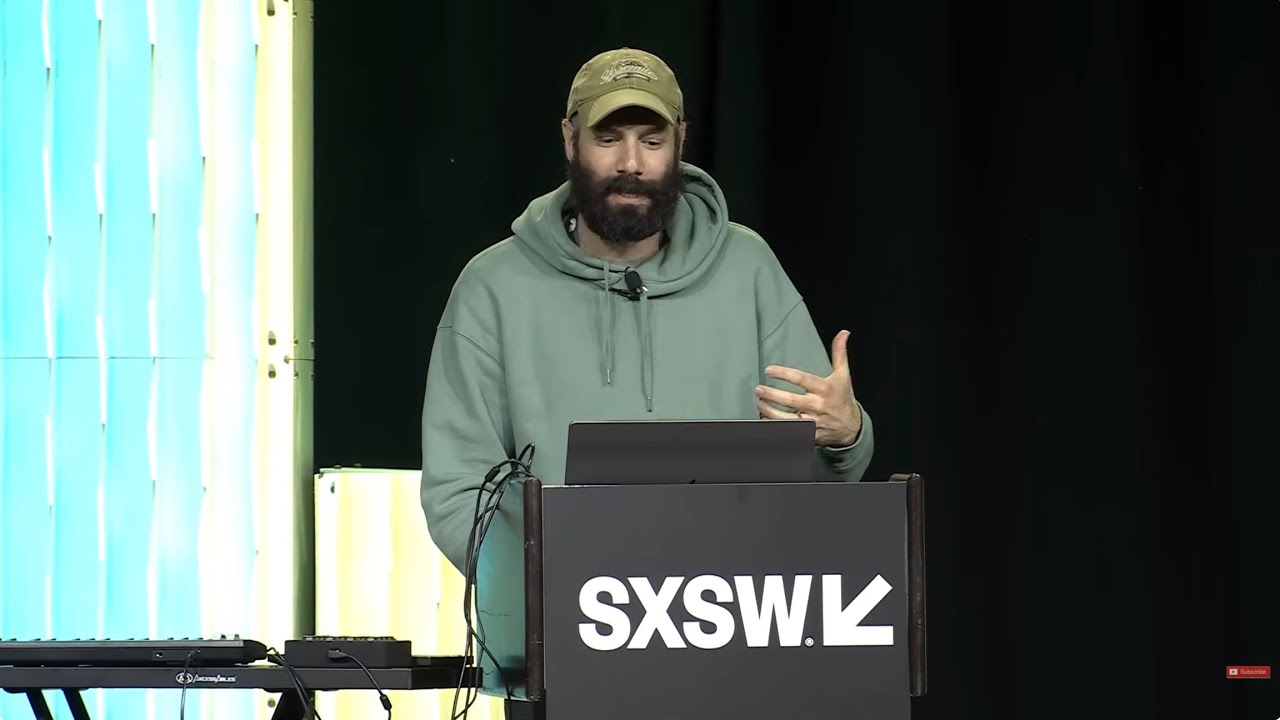



Death of the Follower & the Future of Creativity on the Web with Jack Conte | SXSW 2024 Keynote