A Conversation on How to Turn Your Next Executive Move into Millions with Jacob Warwick
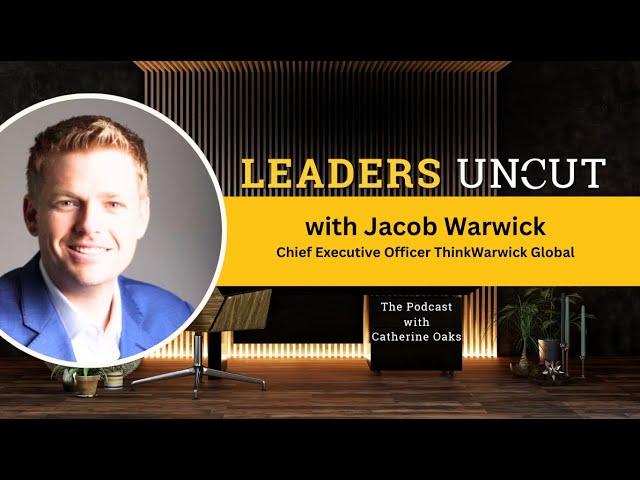
Jacob Warwick, CEO of Think Warwick Global, coaches executives on negotiation and career strategy. He argues that self-worth and confidence directly shape compensation, and that many successful leaders still battle insecurity. Warwick left corporate marketing after learning that profitable work can feel empty, and now teaches others through courses and free content.
Chapters
Hello everyone and welcome again to Leaders Uncut, and today it is my pleasure to have with us Jacob Warwick, who is the CEO of Think Warwick Global. Hello Jacob, how are you doing today?
I'm doing great. The, uh, the weather outside is very cold, so I'm happy to be inside on a podcast. Yes, trying to warm up with some velvety voice.
It's very cold here in Reno, so in Lake Tahoe I can imagine. Yes, you must have a lot of snow too.
Yeah, not, not too bad. We did get a couple inches yesterday or maybe the day before, but, uh, yeah, I think we got 40, 40-degree weather, which can't complain about that right now.
It could be worse, right? You always have to do the bright side. Good. So Jacob, you, you're known to be negotiation authority, and you excel at negotiating for others, having transformed the careers of about 3,500 leaders. With a keen insight in human behavior and apparently exceptional people skills, you say now it's time to command your worth. So I'm going to hand that over to you and explain what that means.
Well, I, uh, I work with a lot of very high-profile executives and in some cases celebrities and business owners and investors. And what's funny is, and there'll be folks that listen to this that can relate, the insecurities you have at the earlier part of your career, you still have at the later part of your career as well. And oftentimes even the most powerful people in the world will have some self-doubt on themselves, or sometimes you'll gaslight yourself, or sometimes you'll just think a little bit less, or you'll be looking at others for validation when they've built a life that maybe you don't align with personally. And so a lot of times my work is to help people find the power that they've had kind of within themselves and then be able to negotiate top dollar from that versus, say, listening to compensation benchmarks or what other people make. Instead of finding their validation in others and their success, it's really about creating their own. In articulating their value and driving that forward so that they can be the ones that break the benchmarks, not fall victim to, I call it, the mediocrity or the median of what everyone else is doing.
Mm-hmm. And that's so important, but it is also very difficult to— sometimes during our lives, we, we reach points of lack of confidence, uncertainty, or maybe disappointments too, or something happens, an event that has a tendency to, to keep us in the lowest spheres of possibilities. I'm sure you witness a lot of those cases too, don't you?
Oh, absolutely. I think it's also very easy to get caught in the circumstances of, say, a recent disappointment where that's all you can focus on. Like, why did this happen? What could I have done differently? And sometimes it can be as simple as a reframe by saying, look, Catherine, when you've— you made a mistake., right? Whether you were employed by, you know, the wrong opportunity, or maybe you made a mistake and got fired, or maybe you were the reason for being fired. But when you look back at your years and years of experience, have you historically made good decisions or bad decisions, right? When you look at where you are in your career today, and again, most of the folks that I, I speak with, I, I'll sometimes give them a hard time because it's a first world problem. We're dealing with, right? They don't have any hesitation on whether they can put gas in their car or whether it— whether or not there's a roof over their head or their children's head, or whether or not their kids can even go to college. Like, they are— they tend to be very affluent and well off. And what's interesting is there'll still be financial fear and frustration and just trying to accomplish something. And, and sometimes it's, it's a reminder that historically speaking, you've made better decisions than most, and you found yourself in this position because you are good at what you do and because you make sound decisions. And just because there's a blip on the radar doesn't mean that everything is crashing down and you were stupid, right? In fact, there's much more evidence to suggest that you're smarter than that than there is evidence to suggest that you're dumber than that. And sometimes that reminder is all it takes. And to get someone's confidence back and start to negotiate from a stronger position. And sometimes it's a reminder that how far would you really have to fall to be struggling? Like, you've moved from your $2 million house to an $800,000 house and that's so rough for you, right? It's really not like— you really got to screw up many, many times to be in a tough position. And let's just remind ourselves that we are in a position of typically a blessed position and a privileged position. And let's not take it for granted, but let's also not think that we're stupid and didn't earn it in those cases. And let's be— have an honest conversation about the skills we bring to the table and just keep that confidence moving forward.
Yes, that's true. But sometimes our perspective is not at the right place, and everything is about perspective in life. But like you say, you go from a $2 million home to an $800 million home and you feel like a complete failure. And it's important in most those moments, first of all, to develop a new perspective. Second of all, to realize that sometimes when we are forced to touch the bottom, there is a reason. And from what I have learned in life is the moments where I did touch the bottom, I had to be extremely creative and something completely new that I had never thought of. Some just came to me and I realized, oh my God, I mean, what an opportunity here. And that opportunity may never have occurred had I not touch the very bottom of the ground.
Yeah, and I would argue that living in an $800,000 house isn't the bottom.
No, it's not. No, it's not.
I get the point.
Yeah, but for that person, that could be— that's the feeling. It could be for certain people, right?
Well, and it also— it really depends on who you surround yourself with too. So if all of your friends are perceived as more accomplished than you, sometimes it feels a little demeaning Or like you're the bottom of the rung, like you're the stupidest in the group, which is absurd in the scheme of things, right? But yeah, occasionally that'll come up and it's just a subtle reminder that you tend to do pretty well or you wouldn't be a millionaire, right? I mean—
That is true, but I think it's not just about millionaire. Maybe you are working maybe with just high net worth personalities or business people because it's impacting everyone right now. We are all forced one way or the other to reinvent ourselves. The, the world is changing. The, the, um, look at all the technologies coming in that are really disrupting everything we have known up to now. So what—
it's always been like that. It's always been like that.
But, but people seem to perceive what's happening now as something that has never happened before.
Well, everything we head into in the future has never happened before, which is my point, in that Yeah, you know, in the early 1900s, and all of a sudden manufacturing lines started to become a thing and transportation started to expedite things, and all of a sudden everybody's working in factories. And then factory jobs got poo-pooed for a while during the, the dot-com bust and the tech bust, and then everyone moved to white-collar jobs. And, and so there's always something changing, and in the age of AI, things are going to be changing even faster. Like, every new technological advancement you have is going to increase, so you always have to adapt, or you you know, you rot on the vine, for lack of a better word. I mean, that's the human experience as a whole in general. You're constantly having to adapt to changing circumstances. And if you're not cut out for that adaptation— and keep in mind, I primarily work with executive leaders— if you're not caught up or adapted to that level of change and you can't have confidence during the chaos you don't have a sound mind or a strategy for that, you don't belong in leadership positions. You shouldn't be leading other people if you aren't expecting change, right? And so if you work for a company and you get blindsided by a layoff— oh, I never thought it could happen to me— that's just ignorance. Like, it happens to everybody. You're not special. Everybody gets laid off, and companies downsize every year 5 to 10%, and slough it off. That's capitalism. And if you don't have the understanding that that's how markets work and that's how capitalism works, then why are you leading a capitalist business, right? So that I'm looking for resilience and understanding. It's not to be pessimistic, it's just, just to understand this is the way the world works and this is how I choose to lead through that. And, you know, that's ideally the type of mindset I'd like most leaders to be in.
Okay, I understand. So how does that work if someone is interested in getting help? What's the process? Do you have a pre-selection? Can you discuss that?
Yeah, I guess you could say I have a pre-selection in that most of my clients come to me from other clients, and it's as simple as, hey, uh, don't let his pricing scare you, which is typically the first thing. Don't let the price scare you, he's worth it. Uh, and that's, that's typically the selection process where I tend to, uh, gravitate towards a relationship from a client. Because if I show up for a client's lead or a client's introduction, it makes the client look better too. So it's another way to continue serving them and support their relationships and continue to grow their network. So that tends to be the preferred path. Now, I have done more and more podcasts lately. I have quite a bit of followers on my blog and on LinkedIn, and mostly I'm just trying to share what I've learned. From these top conversations. It just so happens that by doing so, you naturally start to, I'd say, generate leads, or lack of a better word, generate interest. And in that case, I do have a bit of a selection process just to see kind of where someone's at and what makes sense to best use my time. As I'm now expecting a second child, and then I have all my clients as children, so to speak. I want to take care of them like they're my, my children. And then I have some other ambitions that I work with through the business, so I have to be very mindful about how I best use my time.
Yeah, yeah, I can understand.
But I think what you're asking is like, hey, what, what situation does somebody find themselves in when they need to talk to you, right? And I usually want to talk to people sooner rather than later if they are interested in upleveling their career, simply because they need to have access to more information. And oftentimes If people have already gone through an interview process or they're exploring new opportunities or they're sharing figures with recruiters, a lot of what they're doing is working against them naturally. So as soon as somebody says, I think I want to do something more in this, like I want to be a CEO someday or I want to be a chief whatever officer and I, or I have ambitions to make 7 figures, what's the path? That's typically when I want to talk to somebody is to support them almost like a The model is kind of like a financial advisor meets an attorney, but without the ability to be a financial advisor, not an attorney in terms of practice, right? So it's a similar go-between, like, hey, I want to consult with you and understand what the paths are here, but it's not charged hourly or nickled and dimed 15 minutes at a time like an attorney, and it's not taking every little bit of income you have like a financial advisor.
Yeah. Okay. So great. So, so that's a great segue to your background. You're well fit. I'm sure you're well fit. You're featured everywhere. You've worked with hundreds of executives. So can you tell us about what your background, what led you to doing what you're doing right now?
So I, I have a kind of an untraditional background in that I started working in Silicon Valley directly at 18. I didn't go to college. I, I was a journalist and the AV nerd in high school, and I built websites and social media stuff and, uh, encoded, coded websites back when I was like 10 and 12. Silly stuff. So it was kind of tech savvy, and because I had a journalist background and worked in video editing and all the AV kind of kid stuff, I had the backbone for marketing career because I could create content. So I started my career in content marketing, working in inbound marketing and HubSpot advertising, social media copy, moved into copywriting and ghostwriting for executives. Happened to work for an executive recruiter for a while, which is where I picked up some early tips for my own career. I was about 20, applied those to myself, and by 24 I was a director at a Fortune 500 and became a VP of marketing at 25, 26, something like that. Uh, and I'll be honest, I hated every minute of it. I I didn't like marketing. I was kind of in it and I told myself, hey, you're going to learn how to market so that when you are passionate about something, you'll be good at it. And what happened is, and I'm sure there's people that can relate to this, I started making more and more money and I couldn't switch my career at that point. Like, you couldn't go from— if you're a director at a Fortune 500 for marketing, you're not going to say, oh, I guess I want to do HR now, or I guess what I'm actually passionate about is sales. Like it's very hard to make those transitions because you'll go from a quarter million dollar a year value to $80,000 a year value, and you just can't take that step back, especially living in tier 1 cities or in California or expensive, uh, US-based areas.
Yeah.
So I never actually liked the work I was doing, which is frustrating because I didn't like the companies that I was marketing. But what I found is I learned how to use provocative messaging and rhetoric and kind of the neuromarketing tendencies that high-performance software companies use on you every day. But I applied them to individuals instead of companies because I— instead of seeing the change in a company that sold to Salesforce, I could see Catherine's development as a human, right? And that, that to me, I felt the change more because I I could see it, especially if you and I became friends. I could see the change in you and your family and your children or whatever it is you're like, I can see the evolution of a person. And that to me was much more meaningful than watching, you know, another $100 million go to Salesforce. Cause I'm so disconnected from it. I don't know what that means. And in fact, I think it actually makes the world a worse place because there's more people almost slaving away in a spreadsheet, spending their days filling out, you know, lead forms in Salesforce instead of getting fresh air with their children and finding a different lifestyle.
So that's so true.
So I felt like I was in Silicon Valley marketing, I felt like I was perpetuating a dystopian society. And when I instead focused those marketing tendencies and go-to-market strategies on individuals, I could see people change. And you might argue that you have more impact working with a Salesforce or a HubSpot or a big tech company, Apple, like you, you touch a lot of lives, but I also felt like I was too small of a cog in the wheel to really make an impact materially other than my own financial standing, which is kind of pointless.
Yeah.
Um, it was not that meaningful in my life to have a bunch of money.
Yeah.
Yeah.
That's a very rewarding, you're right. That's, it's what— when you get up in the morning and you know exactly what you're doing, it feels good, it feels right, it changes your life. And I think a lot of people are going through right now asking those questions. What's my purpose? Am I doing the right thing? Am I doing what I'm supposed to be doing? Is it, is it something that makes me happy every day? Do I have enough time for myself? And you realize you've been running around and, and at the end of the day, you never have enough time for yourself. And they are miserable. But see, but what's the What's the recipe for that? So you start a miserable help, right? Help me, Jacob. Where do I start? And I don't know if this is typically what happens with you.
I mean, of course, sometimes. So what you're suggesting here, I kind of categorize that as somebody seeking clarity, like career clarity. And I don't have as many clients like that anymore. I used to. What I have now is some— I typically work stronger with clients that have clarity and have like, hey, this is what I want to accomplish, let's build a strategy to get there. Okay. Whereas I enjoy the clarity, like how do I find clarity and do that? I'm a little biased because I don't feel comfortable working for anyone else, period. I just, I haven't found many leaders throughout my career where I would say man, that person has more integrity than I do. I would like to follow them. Like, they will be my mentor. Um, when I have gotten into those positions, they tend to disappoint me when chaos or some type of challenge erupts, right? Like, leading— I'm sure many people realize this during COVID when they saw how their bosses reacted to disaster. Some of them buried their heads in the sand, some of them just fired everybody, some of them just low-integrity plays or fired people through emails. And you go, wow, I had known that guy for 5 years and he couldn't even pick up the phone to call me, right? Yeah, you know, because of that. And so you, you learn a lot through that. But so I'm a little biased when it comes to Clarity because I, I think that it's much less risky to work for yourself than for someone else. And I feel that way because at any given time I might have, let's say, 10 clients. These days it's usually about 5, but let's say I had 10 clients and Catherine, you were my client, and Let's say you were an asshole and you made my life hell every single day. Well, I only have one egg in the Catherine basket and I have 10 other clients. So if you're that big of a pain in the ass and it's best for us, yeah, to part ways, guess what? I can still pay my mortgage, right?
I know.
Versus if you were my boss, right, and I had to kiss your ass all the time, otherwise I'd lose my mortgage and my family would be disrupted in some capacity, I might put on a mask to win your favor just for the sake of paying the bills.
Yeah, but don't you think, don't you think a lot of people have gone through that and now they are really working hard at having different income streams? I see that more and more. Is that something you—
yeah, yeah, I mean, I absolutely have witnessed that. And we're in a— we're at a phase in our society where it's a little easier than ever before to be entrepreneurial. That's a little less, uh, scary, right? But it's also still much easier said than done because it's— let's say you're going out to explore, oh, I want to create some side income and side hustle for myself, and then you go down the rabbit hole of researching it and you get sucked in by possibly a bunch of charlatans that are very good at marketing but not necessarily the actual business model itself.
Yeah.
And what they're marketing is your attention, and they're getting paid off of your attention And so it's provocative and it causes a bunch of strife, but it doesn't necessarily solve the problem of what you're looking for. It's like, I'm making money on your eyeballs, here's the model to make money on eyeballs, not necessarily how to make money in a fulfilling way for yourself, because the answer is typically a lot deeper than what will get a lot of attention online. It's much easier to be all in on one particular topic to get attention online than it would be to explore the depth that's required to become an entrepreneur and weigh the pros and cons and really help somebody through that. So it's much easier to have a 90-second TikTok. It's like, what, 5 side hustles that are rocking it this year? AI this, AI that. Like, you know, it's much easier to grab attention that way. So I think you got to be careful, and it's much easier said than done, and it starts with a lot of self-awareness and reflective work. And for me, the top questions I'd ask a client who is looking for clarity is You know what, you can describe what your perfect day looks like, or more simply, what actually puts a smile on your face. If you think back to all the work you did in 10 years, when was the last time you genuinely were happy or smiled? Um, I like, uh, I like to ask a little contrarian questions like, what if you could only solve your problems through subtraction? So what if you can only solve problems by doing less? Right? So let's say you're feeling chaotic in your career and you're also running a podcast and you're running a family and you're doing these things. And, and I said, well, what if you stopped doing the podcast? How much life would you have back?
Right?
And like, that might open an exploration. I'm not asking you to stop the podcast, right?
I'm just saying, right?
What if you could only solve through subtraction?
Yeah.
And so what if— what would your life what would it look like with less? That's one that they don't expect from a negotiation coach, right? Whereas they hire you for more and you're saying, what would it look like with less? That could also open up new negotiation lines because you realize, I don't need the extra couple hundred thousand you're throwing at me. I want to spend time with my family.
Yeah.
Or I don't want to move across the country. I will sacrifice that compensation to stay here and stay put. Or it just opens up different creative lines to come to a deal if what you're looking for is contrarian to what other people are expecting to give. So in a lot of ways, the first instinct we have in American society is, oh, uh, sweeten the deal for them, just add more money.
Yeah, right.
Like everybody's got a number, right? And I've learned that some people don't care about money, right? Sometimes it's it's different. Like sometimes you need to win a deal a different way. And I learned a lot of that through Hollywood where sometimes throwing an extra million dollars at someone doesn't do anything. But if you got a celebrity to apologize to a director, you can get a deal done. And that doesn't cost any money. Sometimes it's ego and reputation and saving face. And so there's some other things to consider.
So there's always a lot, of course, a lot of psychology in what you're doing. Why are you so good with psychology? Jacob Warwick?
There's a, there's a real answer to that, and then there's a bullshit answer to that. Which one do you want to hear?
Give me the real answer, and maybe you can mention the bullshit one afterwards.
So the bullshit one, I'll actually start with. I read a couple books and applied them to real-world scenarios, um, like influenced by Robert Cialdini, or Ethos, Pathos, and Logos, or Kairos training from Aristotle's Rhetoric. You can look back at— I've read some books on negotiations. You could say I read Chris Voss's book and Herb Cohen, and you can go back. I've probably read 50 books on negotiation just to get different perspectives. And then, uh, and then repeated it thousands of times, right? So there was a period in my life where 5 days a week for 5 years— I mean, in— and when I say 5 days a week, I mean 5 days a week, like every week, even Christmas weeks stuff. I talked to anywhere from 10 to 15 executives a day in 15 to 30-minute blocks and was the CEO of a company that we had 2,000 clients a year. So everything came across my desk. So I put the work in, um, and I still say that's kind of the bullshit answer because that was learned and trained out of necessity. Um, the subconscious pieces are just kind of like baked into my DNA from having a relatively difficult childhood growing up, um, where you needed to, I'd say, protect yourself from people that you should feel safe from. And, uh, that's probably like a politically correct way of saying it, right? And if you grow up in a situation where, you know, if the body language is a little bit off, you could be in physical danger. Or if, like, you're, you're paying attention to microaggressions and cues and tone for your own survival. Uh, I used to call it being a chameleon. Like, I'm very good at being a chameleon if I need to, and I think a lot of executives are. So I'll give you an example of this. So if I'm in, if I'm in a room with 5 CEOs, I can get along just fine. If I'm in a room with 5 dangerous felons that are doing crank and drugs, I can get along with them too, and I can survive. So you can put it in the worst of the worst. If you're in a bad neighborhood or a great neighborhood, like, I can adapt to whatever situation's in the room for my own survival. And I learned that at a young age. And then when I started studying it in the corporate world, you can start to pick up the signals earlier, right? And so there's a reason people do what they do. There's a reason that people will be two-faced at a job. And it's typically because the new survival of the fittest in our society is primarily financially driven.
Yeah.
And so the only real danger we have of hurting our families or running out of survival issues is if we run out of money. And so if our source of money is primarily in one basket, like working for someone, which most of our sources of income are from one person, we become beholden to them and we have to survive and keep that, that money coming, or our whole family gets cut off and we're in danger. And so if I need to manipulate you a little bit to keep my job, probably going to do that because I care about my wife and my kids more than I care about you. So I'll lie right to your face to do it. And like, all of corporate America is built on this. And I don't want to be overly pessimistic because certainly not everyone is like this, but it's very easy to see that when a decision is made to protect shareholder dollars or protect the integrity of their people, you go for the shareholder. Because if you don't have access to the money, then your family's in jeopardy. So I don't want to treat you like shit, but it's just business, not personal, right? And how many times do we hear that? It's business, not personal. Yeah, right. So like, I know that the right thing to do is to take care of you as a person, but it's business, not personal, right? So you— the obvious answer is that I'm going to take that million dollars and put your head on the chopping block, right, to protect my family over yours. And that is human nature, right, to a degree. So you— the long-winded answer to your question is I learned that from a young age, being in a survival mindset, that look out for these cues of manipulation or narcissism or, you know, you name it. Sometimes there's psychopathic or sociopathic tendencies. And I'm not saying I'm an expert at that by any means, but you can pick those up and you can recognize those pretty quickly as toxic and damaging.
Yeah, you have to be in tune with your environment and you learn this from a young age. It makes sense that you developed, inherently developed those qualities that are going to be critical in what you do. And then, you know, which is another part of what you're doing, very important, is analyzing your environment, being able to, to understand who you're speaking with, but also you have to be able to reflect with them on their needs and how to address the challenges they're going through. That takes another skill set.
And you can, if by asking the right questions, you can get there. Now I'm pretty careful with this line of questioning because you could, you start bordering on psychotherapy and And you can't— like, I'm never going to say I do that by any means. I don't charge people for that. I specifically in my contract, I'm not a psychotherapist. I don't have the training for that. It's also why I see that career coaches or just coaches in general can't— they're in an elevated position of power over individuals. And so there's a— their power of suggestion is greater because you're paying them for suggestion, right? And if you're irresponsible with that power, you could really hurt people. And I see that as a big flaw in the coaching industry where they almost prey on people in moments of vulnerability. Like, Catherine, you just lost your job. You've been out of work for 7 months. You might lose your house. If you give me $15,000, I'll teach you exactly how to get your life back in order.
Yeah, you see that a lot. You're right.
Yeah, you do see that a lot. But I mean, is the source of the pain for you the fact that you lost your job, or are you under pressure from a spouse, or are you worried because you're about to become an empty nester. Or usually my clients have this— they're— the average age of my client is probably 47 and a half, and their parents are in failing health, and their kids are becoming— like, they're becoming empty nesters. So for the first time, like, everything is isolated on them. Like, I don't have my parents to guide me anymore, at least they're not in the same state, and then my kids are like out from under my wing now, and now I need to do life for myself. Yeah, and it's very— like, this moment of realization that I've been putting stuff off for like 25 years while I raise kids.
Yeah, yeah.
And I'm gonna die anyway. So you're like faced with both mortality and the success of their kids leaving, and then all of a sudden it's like, what do I do for me? I've been living my life for others. I've been living for the approval of my parents, and I've been living for the betterment of my children, but what have I been doing for me? And that, that tends to be an interesting section to analyze. And with some clients, it's, you know, I've always tried to get some external validation because I was never good enough for my dad, right? Or it's some— and, and you can get that culturally too. Different cultures have that. Whereas it's not, uh, I'd say it's not hidden that Indian families and Chinese families are very hard on their children. Yeah, right. They expect a lot from them. Like, if you're not And I've had some Indian clients who have made $50 million in an exit and their parents are still disappointed in them because they weren't a doctor or a lawyer.
I know.
And so they're not making a good impact.
Yeah, right.
And then they're obviously— there are all kinds of cultures have different expectations of their children. And so my clients tend to be Type A, hard-charging. I'd almost say anal, not in a bad way, but in like a particular way. Like they're very control-oriented. And they want— sometimes they're trying to get validation, you know, somewhere beneath the, beneath the surface, like, oh, maybe Dad will be proud of me now, or Mom's going to care now. And so there's sometimes a big driver like that. Sometimes. Again, not always. I don't want to blanket statement everybody, but that's where the psychotherapy piece comes in. Yeah, it's like you can tell where— so I'm like, there's another question I saw that I think really hit me in the teeth, um, or just maybe as a statement, but it was, could it be that everything in your life right now is where it should be? Could it be that everything is actually fine? Right? So that's where like, I have a client in particular who has this immense sense of urgency and pressure on herself to be farther along in her career. Like, I should already have kids now. I should be promoted now. I should be doing this because her parents pushed her like that. And you'll often see this, like, it's baked into childhood, and then it goes to an Ivy League school, and then it gets the MBA, and it's like almost everything's been prescribed. And if you're not in the magna cum laude, 4.2, 4.3, you're shit. Like, you're just— you're always gaslighting yourself into thinking that you're not that good. And then when you look at society as a whole, you're in the top 10th of a percentile of a 10th of a percentile of earners in the country, and you still feel like shit.
But isn't that what happens when you are told— because it was the same with me, I was told I was never good enough. So you just push yourself and you push yourself, but you're never good enough. And, and that's something that's very hard to get rid of, right?
And I, I don't— I wouldn't say I know the answer to that. I think that's something that I even constantly struggle with, where I struggle— like, I have a unique opportunity to make this a $50 million business and license my ideas and really scale it out, and I know the type of work that it would take to do that. And then I also look back and say, maybe a million a year is enough. Like, seriously, like, seriously, do I really need more? Like, do I, why? Like, if I'm truly doing as well as I say I am, which, you know, take everything you hear on a podcast or from someone with a grain of salt. If I'm capable of earning a million dollars a year working 20, 30 hours a week, why do I need more? Why? Like, do I, do I say I love my kids out of the fact that I just say I love them, or am I going to make sacrifices to my business to show them that I would live for them versus just drive the bit? Like, what if I get $500 million for my business and I set my whole family up for life? Do I actually need to be the person to do that, or will my kids remember more Daddy was there? Uh, right. So those are, those are challenges we're faced with all the time. So Yeah, and, and value is so subjective. So when I say, you know, averaging $1 million a year in consulting, there's a lot of people that go, holy shit, that's a lot of money. And then there's a lot of— and then there's a lot of people are like, that's it? Yeah, like, yeah, I remember when I was that little, right? And then, so who do you listen to and why does it matter? Why do you have to listen to anybody?
But that's, that's the question I was going to ask you. Why does it matter? I mean, you don't have to— it shouldn't matter. You have to, to find your own satisfaction within your own peace. And frankly, for me, I don't care what others think. I don't need to be part of a social network. I don't care. It's unimportant. What's important is my mental sanity. And yes, I have to make enough money to survive, but my values are very different. So yeah, yeah, it's a very relative, and, and perspective is, is everything in those cases.
So yeah, If that's the case and somebody else is trying to ask you to do something you're not so fond of and they just offer you more money, is that going to win the deal with you?
No, not necessarily, right? It depends what it is.
But so that negotiation's dead, right? But the way we think as a society is just give her more money, give her a better title. It's up and to the right, like, oh, look at all that. Well, you could lead a team globally now. Screw that. You know how much harder that is?
Oh.
Like, you want me on the phone with Australia and Europe in the same day while living my own life and getting sleep and somehow exercising and being a parent? And no freaking way. Now, I commend the people that do it, right? Like, working globally is really hard. I also have this saying, like, when somebody says they want to be a CEO, I know they're not qualified.
Oh, that's interesting.
Because someone's like, oh, you know, I want to be a CEO someday. I'm like, no, you don't. Trust me, trust me. Nobody— like, you have to be a masochist to want to be a CEO.
Yeah, right. It's Elon Musk, right? It's Elon Musk who says you have to have a high threshold for pain, right, when you want to be—
Yeah, that's masochism, right? Oh yeah, twist it harder. Like, yeah, like drill those— drill into me. Like, I— no way. Like, I— okay, so being a CEO, very, very difficult. Being a CEO is kind of like being a parent. It's only difficult if you care, right?
I love it.
Like, if you care Right? Like, bad parents like, oh, parenting is easy. Yeah, parenting's always been easy. I'm like, well, you didn't give a shit enough, because if you felt like you needed to be a great parent, you'd feel like you're failing all the time, right? There's always more you can be doing. And like, I learned that having 25 employees as a CEO. I know why CEOs don't act with integrity. It's so much harder and less profitable to act with integrity, to take care of your team and to support them to get back on the— on their feet, because they've given you their soul. And their time to do the right thing for them, it is not profitable. In fact, it's time-consuming and the opposite of profitable, and it slows growth. And that doesn't serve shareholder values or most of our expectations of what we're trying to accomplish in business. And so, like, when I realized I didn't want my team to go any further than it had gone was during COVID because I could see that in order for this business to be highly financially stable, it needs to be highly transactional. And I'm not a transactional guy. I want to be more of a relational guy. So the needs of the business were misaligned with, with me as a leader, and I would self-sabotage that thing to failure anyway. And nobody on that team deserves a leader who's going to self-sabotage the vision, right? And so I made, I made that call, but I took, I want to say it was 13, 14 months to unwind the business. Where it's not that hard to fire 25 people. I just get on the phone, hey, you're not going to like this call, I got to let you go, I'm letting everybody go. Great. Like, not that hard to fire everybody. I took over a year and had my staff looking for work for themselves while supporting clients and paid them to do so, so that they can find a position that was better, and then help them negotiate into those new roles or help them interview, gave them recommendations. So it wasn't just, you know, you're all fired, but if you need help, call me. It was I'm gonna help you for a year to land on your feet, right?
It's beautiful. I've never seen anything like that. I really— that's very rare.
So are you saying that's why I don't want to be a CEO?
I know. So you're saying that most CEOs, successful CEOs, lack empathy?
I don't think they lack empathy. I think they are smart enough to choose to not. Okay, all for it. Okay, you can't— they operate within the bounds of what the legal system lets them operate within. And those that are the most cutthroat are the most successful.
So what type of—
in most cases, again, I think people will be able to find cases where that's not always true, right? But, uh, do you remember the Dan Price CEO by chance?
No, I don't.
You remember him? No. So he had a, um, some kind of— I was like a banking app or something in the financial services space. And, um, he, he used to brag that he had $70,000 minimum wage. Right? $70,000 a year minimum wage. And everybody, oh wow, that's so great, this is awesome. First of all, all of his employees were engineers, so it was actually underpaid engineers, right? But it sounds good to say $70,000. Yeah, some employees obviously did better than they normally would. Engineers did not, right? But anyway, everyone idolized this guy as like being the greatest CEO of all time. Like, oh, this is so sweet, like he's giving a damn about the, the the smaller person, right? And giving that higher, uh, a higher medium income. And then he got busted for sexually harassing all his female staff or assaulting them.
Wow.
And I was like, was this guy a good guy or not? Like, you got to be careful with what you see. These— in a lot of cases, like, people build false idols in their head. And you know what, for those that are religious, we know false idols are not not ideal, and all of our fellow humans are false idols. So I found that I can trust my own integrity more than others, and that's why I choose entrepreneurialism as an example. Now, it's not to say you're not going to find great people to work with, but I've— and maybe I'm biased because I hear about so many bad things that have happened. I've heard of C-suite leaders who've grown a company from $0 to $200 million and gotten fired before a vest, right? Think a week before all of their stock materializes, gone, because the new board came in and said, eh, let's cut that before that becomes an issue.
Oh yeah, not surprised.
Which is, which is clearly the right thing to do for the businesses and within their legal right to do so. But for that person, they got screwed. Yeah, right. They give up 5, 7 years of their life traveling 300,000 to 500,000 miles a year, not being with their kids, and then right before the payout they got fucked.
Yeah, yeah, that happens.
You're right, I've seen that. It happens all the time.
Yeah.
It does.
It does.
And when somebody with a lot of financial power over you does it, you're trapped. Like, who's going to take your word? You're either going to take the word of the bitching, you know, C-suite executive, or you're going to take the word of the guy who has a $100 million exit.
That makes sense. But don't you see, though, that a trend where because of situations like that, people want to become entrepreneurs, they want to control their own life. It seems to— I see that happening more and more, especially with the younger generation. Is that something that you have witnessed as well?
I have seen more of it. I also tend to be ahead of the curve on some of these things. So I've been an entrepreneur for about 10, 11 years now.
Mm-hmm.
And I was remote for the last 10 or 11 years too. So I, I felt the self-isolation and burnout of being an entrepreneur probably 3 to 4 years into it. And now we're about 3 to 4 years into the remote work burnout. Of people feeling isolated and alone and stuck in their phones and in the algorithm system.
Yeah.
Um, there's definitely an increase in desire to be an entrepreneur, and it's sexy to do so, but it still doesn't make it easy.
Yeah, right.
There's nothing easy about it. Um, and it's not— I think the way— it's simple, but it's not easy. So it's not like it's inherently difficult, like the things you have to do. Just like working out is not difficult when you break it down to the motions. Like, oh, I'm bench press, I'm going to push up 10 times. It doesn't mean it's easy to do it every single day for the rest of your life. So the things you have to do to succeed in entrepreneurialism is, is generally get— fail all the time.
Yeah.
And never lose confidence. Like, you almost have to be arrogant and say, like, I knew that was going to happen, but I fought through it, and this is what I learned. Like, you almost just have to not be self-aware and how much you're screwing up. No, I think you have to blindly go through it. And some, like, and sometimes you nail it right off the bat, great. But I mean, I've started 6 businesses, I've had 2 over a million, and I'd still consider 5 of them failures, right? And it's— failure is a different reason. And sometimes failure doesn't look like failure. Sometimes, like, the Discover Podium deal, we were doing over a million in revenue right away, and I still consider that a failure. Because I didn't want to keep doing it.
Yeah.
So like, that's— I think those are the hardest ones too. When I found— I saw this quote, uh, like, true success is when the money you turn down is sweeter than the money you earn. And so even though the company was making money, I turned it down. And I've started other businesses that were making a couple hundred grand a year. I'm like, yeah, I just don't want to keep operating this. I don't like it. Ghostwriting for others and Um, I had a marketing agency for a while. I had an executive community. I've tried a couple of different models, and for the most part, they've all been profitable. There's not a lot of overhead in consulting-type work, right? So they've all been profitable. It just didn't bring me joy. Yeah, so it's still a failure. Like, I can make $200,000, $300,000 a year ghostwriting for other people. It doesn't mean I'm happy doing it. And one of those big— like, I was doing we were doing over $1 million a year in just resume rewrites at Discover Podium. And I hate writing resumes.
I hate it.
Yeah, I get paid very well doing it. Yeah, I don't like it. So I much like— and it was hard because when, when, you know, a lion's share of your revenue is from a source that you don't like, and then we had about 40-50% of our revenue was from our retained coaching services and things. How do you walk away from two-thirds of your revenue? You have to also walk away from two-thirds of your staff. Yeah, right. Yeah. Or, you know, for that. So it was hard, but like, they teased it away and slowly said, like, I really don't want to do resumes, I really don't want to do resumes. And now I don't do resumes anymore.
Okay.
Yeah, but it took, it took 5, 6 years. But if I ever found a position where, you know, if you said, Jacob, how you doing? And I was like, about to miss my mortgage, I'd say, you know anybody that wants a resume?
That's right.
I'll write a resume.
It's, it's a balancing act, right? I mean, yeah, you, you have to measure everything, but doing something that's fulfilling, there's nothing better than that. Life's too short anyway.
And it's, it's like, it's only really happened a couple times in my life, but it's, you don't want to go to sleep no matter how tired you are. Like you your brain is going like it's just working and it's not really doing anything productive. It's just thinking, oh, I could do this and I can do that. And like, it's engaging and it's fun. And you lay down and it's 2:30 in the morning, you're like, God, is it 5 yet? I need to get up and go to the gym and get going.
Right, right.
Yeah, those moments don't happen very often, but there's a reason you're feeling that way. And in entrepreneurialism, if you're not feeling that way, you're gonna have a tough plow, like a tough road to plow. It's just there are a lot of times you get kicked down or you need to cross a bridge that you haven't seen before. Like, do I do LLC or S corp? Or why is the IRS asking about this? I didn't know I didn't do that right. Like, what am I supposed to— I have to do quarterly payments. Oh, I should pay myself W-2. Like, you just— you don't know the answers to those things until you're faced with them. And if you're not expecting it or you don't love what you're doing, like, that stuff can derail you.
It's— it can be very hard. You have to be agile. You have to be healthy, mentally healthy, physically healthy.
It requires a lot of Yeah, if you don't love those things, if you don't love your mission, the tedious stuff starts to eat you away. Like the writing resumes. Like, if I loved what I was doing and I was helping the person, like, I'll write that resume because it fits the passion, right? Or I gotta make payroll today, that which means I gotta go do this, or I gotta send a W-2 and a W-9 or whatever. Like, all those little nitty-gritty things that kind of slog you and slow you down, like, you have to work past those by yourself in the early days until you can forward for someone else to do them for you, right? But if you don't love what you're doing and you're not passionate about it, those things tend to derail you and make you question, like, maybe I should just go back to a job, right? And that's a tough balance to have.
Very true. It's a tough balance. So, well, I mean, we could speak about this forever. So, uh, Jacob, if someone wants to speak with you, what's the best way to get hold of you?
Well, I have like 5 websites, so you're probably going to find one of them. But, uh, LinkedIn tends to be the, the only social platform I'm on, and that's just looking for Jacob Warwick. You can't miss me. I also own jacobwarwick.com and thinkwarwick.com and execsinthecity.com, which is my weekly publication. And then, uh, we just put out our first course on executivepace.com. Oh, and basically I'm— I, I do the best I can to, to take everything that I've learned on what a client would normally spend $50,000, $60,000 on, and I condense it into a course for 6 hours of learning for about a grand. So I'm trying to democratize information and, and make it a little easier for folks to get a hold of.
Wonderful. That's great. So we'll publish that. And then one last thing I ask all my guests, if there's one thing, parting words, one thing that you would like to share, maybe something you overcame in life, um, or a story that would be inspirational, motivational to my audience, what would that be?
I know we've been on an entrepreneurial thread, uh, and we talked a little bit about risk and confidence and believing in yourself. And I, I tell this story a little bit. I'm hesitant to because it's become sensationalized a little bit, but there was a period in my 20s before I became an entrepreneur where I was homeless. And I was homeless out of pride, not necessity. So I make that distinction, meaning that if I did call up a friend, I would probably be able to sleep on their couch. If I called up my stepfather, he'd have been there for me, like those types of things. I just chose not to. So I was homeless out of pride. And so I slept in my car or on a park bench in Sacramento, California, a park called Maidu Park, if anyone knows the area. Kind of a luxury spot to be homeless, if I'm honest. Like beautiful park benches, good weather, those types of things. But I— there was a moment and I was, I was pretty disappointed in myself. I was actually pretty suicidal, if I'm honest. And I was laying at the skate park. I used to like skateboarding, but I just laid on the skate park. It's kind of smooth. And, and I stayed the night out there and I looked up at the stars and I just thought like, And I don't know why this, this happened. I was like, man, I'm so lucky. And I just felt that. And I don't know where I felt this gratitude. I'm not sure where it came from. Maybe God was looking out for me that day, but I felt grateful. I'm like, look, I'm in my 20s, I'm healthy, it's a beautiful night, like the sky is beautiful. Like, I don't know what's gonna happen to me. I was kind of torn between joining the military or just trying to find a job again, and I was just so exhausted of marketing shitty companies. Like, God, I just cannot picture the next 30 years of my life marketing tech companies I don't like. Or so maybe I joined the military and everything shakes up for me. But I just thought, like, if this is as far as I have to fall, like, I have a bunch of debt, a car that barely runs, and I'm sleeping in a park. Not that bad. Yeah, like, pretty blessed, youthful, have energy. Like, there's so many things to be grateful for. And that day, my, my life kind of turned around a little bit because nothing felt like a risk after that. Like, I ended up getting a job opportunity from Craigslist to make $12 an hour as a marketing assistant and get back on my feet. And I turned down the military, I was going to join the Army, did the MEPS and all that, and was getting ready to, to sign the paperwork. Um, and I started my career over, and it was a— they had a HubSpot tool, and I started figuring out how to use HubSpot, and that kind of got me back into getting paid more later. But, uh, I just didn't have fear after that. I was like, it's actually not having a lot of things— not for the minimalists out there, they'll appreciate this— like not having a bunch of shit to tote around and worry about paying for and keeping it places and all, like very liberating. And not having anybody depend on you, like as a parent now, not having anybody that's constantly like needing you, which is true again.
Yeah, right.
It's ultimately freedom. And so like if you lost everything are you comfortable in that place, right? And then you start to think, oh well, I, I could lose everything except for this. And then you'll know where your priorities are.
Yeah, yeah.
Like, then I was very fortunate to meet my wife just shortly after that, probably 2 years after that. And she was the first, like, consistent voice in my life that supported me and didn't care if I was rich or poor or whatever. She supported me through thick and thin, and that gave me this unbelievable confidence because I could be a fuck-up and she'll still love me.
Isn't that beautiful? Isn't that beautiful? That's amazing. Yes.
But so that, that constant, that constant was there.
Yeah.
For the first time. And then things started building and I thought like, as long as I focus on this relationship and I keep us strong, like, we'll be fine through these different adversities. And we've gotten our asses kicked several times. Like, there's been periods where I've had a quarter million in the bank or a quarter million in debt. And like, I can swing that wildly as I practice with new businesses and things because like, what, so I declare bankruptcy and I get to start over? Like, that's not that bad of a repercussion. Yeah, it's really not, especially if you've developed relationships and friends and you're so blessed to have people in your life. Like, you're not gonna fall as far as a park bench. In fact, if you fall into your best friend's guest room for 6 months while you get back on your feet, I would probably see that as one of the better experiences in your life. You're probably going to get closer to those people and really recreate your life. So I don't see risk in the same way.
Yeah, yeah.
As I think a lot of people do, because I'm just— I'm not really afraid of losing the material things too much because the— yeah, again, it sounds poetic, like, oh, you know, waking up and breathing every day.
No, but it is a beautiful story and that makes makes complete sense. When, when you have been there, you understand what values, what's most important. And I have another story myself. It's my, my grandfather was caught prisoner during the war, prisoner by the Nazis, and he, he was able to escape and almost died eating mice and roots, you know, for 2 years.
Yeah.
And when he came back, he— nothing scared him anymore, and he became hugely successful because nothing scared him anymore. He did not fear losing everything, and that was intense. That's intense, of course, you know. I was not— not there. Yeah.
And I— but yeah, I'll share. I was on another podcast. I'll share it with you if you're interested. It was about 2 hours, and we talked a little bit about this. Like, when you— I found that some of the best executives I know of have had some type of trauma or some type of, like, because they're fearless at that.
Yeah.
Like, if you're 8 years old hiding in your room trying to not get beat Like, do you think a CEO who's got a, you know, $50 million mandate is going to scare you? Like, what are you going to do, hurt me? I don't give a shit what happens to your money. Like, you're not going to hurt me. Yeah, I'm fine. I'm obviously going to do the best I can to not disappoint you, and I'm going to perform. But at the end of the day, like, this isn't that important in the scheme of things. Like, you making me stay up all night on a presentation for this— and again, I'm not suggesting you flake on your responsibilities, just just saying, like, it's not the end of the world.
It feels strength. It builds strength and resilience and a different view of life.
Yes. Yeah. Like, if you don't like what I have to say, I'm going to be honest and I'm going to be truthful with it. If you don't like it, then maybe we're not in alignment, and that's okay.
Yeah.
Yeah. Maybe that's okay. You don't have to be all things to all people. You have to learn who you are and be true to yourself. Otherwise, you're going to feel like you're masking up all the time, being someone you're not, and that's exhausting. And that's when people have regrets.
And that's when people very often end their lives too. We see that happen a lot where they are lost and they don't see the light and they don't know who they are anymore and they don't have a support system and they just decided to just get off.
Yeah, I, uh, I was asked that, that question. I, one of the visions that I have is I want to speak to who I was in that, that period. I want to speak to who I was at 16 when I wanted to kill myself, and I wanted to speak to myself when I was 23 and I wanted to kill myself too because I still hadn't figured it out. Like, I, I want to provide information to those that can affect them, like, when it matters most. We've never had more access to great information than we do now, right? There's just— it's very difficult to find the signal through the noise because there's a lot of repetitive, especially with AI, like, a lot of robotic sea of sameness going on. So I'm, I'm, I'm working to create the signal to reach who Jacob Warwick was in that moment when there was no one to turn to. And, you know, sometimes that's a young girl, sometimes that's a young boy, sometimes that's someone in college trying to figure it out, sometimes it's an executive trying to figure it out for the first time at 45. I just want to reach them in that moment to know that they're heard and that they have a friend that also happens to be smart when it comes to this other stuff. And it's also why I do my blog for free and just share everything that I've done. Like, there's— there are ways to make more money with it, especially writing 3,000-4,000-word articles every, every month. But, um, it's better to democratize that information for others and try to help the next up in line.
It's a beautiful way to be. And thank you, Jacob, for doing what you're doing. You're doing something important.
I hope so. I wrestle with it sometimes. Yeah, sometimes it could be perceived as helping the rich get richer. It could be perceived that way.
It could.
But that's not— those aren't the situations that bring the most fulfillment. But sometimes they pay the way for the others. So helpful too.
Well, if you don't try, you don't know, and you have to be there and you're there for people. So thank you for everything. Thank you for being here with me. What an amazing inspiration. What incredible energy you have, and people need to be able to expose to people like you more. So thank you, Jacob Warwick. Really.
Well, thank you, Catherine. I appreciate the kind words. I bet you say it for everybody though.
You know, I don't say everything for everybody. I thank everyone for their time because it's It's, it's something precious. Uh, you're very busy, everybody is busy, and I appreciate you spending time to share your story and impact other people's lives. Not everybody would do that.
Thank you, Catherine, appreciate it.
All right, thank you everyone for watching. I am sure you enjoyed my conversation with Jacob Warwick Warwick. Please share, please share on your networks. It's important to help each other and, and share stories. I'm trying to do the best I can growing my channel, but I need your help in order to do that so that we can expand our reach and have an influence on broader scale. And remember to subscribe to the channel, that's always very helpful. And we will see you next time.
Thanks everybody.
More from Jacob


How to Negotiate Your Salary Like a Fortune 500 Executive (Featuring Jacob Warwick)

Leaving LinkedIn and the Power of Professional Focus with Jacob Warwick - Damns Given 2.02

He's negotiated $1B+ in executive compensation. Here's his playbook. | Jacob Warwick






