The Recruiter's Career Roadmap - Scaling a Recruitment Agency
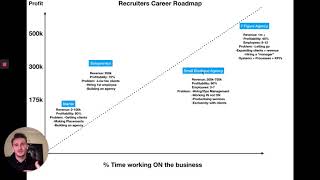
A recruiter walks through how to grow an agency from startup to seven figures, covering profitability, hiring, and operational challenges. The speaker offers coaching to help agency owners scale their business.
Session I am going to show you the recruiters career roadmap. So what I've done is I've put together and pieced together a roadmap that makes it clear if you are a recruiter or a recruitment agency owner and just started your agency where you could actually take your business and how to actually scale it to seven figures. Now when you first start making that leap to start your own agency, it can be quite daunting and scary and all of a sudden you see a lot of people that have got big successful agencies and you think, how am I actually going to get there? And sometimes you try and run before you can walk. So what I wanted to do was show you today the clear roadmap of each step and how long it will take you to get to each milestone. So on the left hand side here you'll see profit. So I'm a big believer in profit first. So when you started your own business and when I started my own agency, I wanted a few things. So I wanted freedom, I wanted to work when I want where I wanted, I wanted to be my own boss and I wanted to control how much money I could make. So as a recruiter, it's very meritorious. So the more you put in, the more really you can make either commission or in fees. But the next level for that is actually starting your own agency. So in the startup phase, which is in the bottom corner here, that's typically from 0 to 100, 120K. And that's really in year one. So if you're looking to start your own agency, you can be very, very profitable in the first year. So run about 80% on average. After I've studied a lot of different recruitment agencies and startups, 80% is pretty much how you could model your first year one. So let's say for instance you did 100k, that's on average maybe 8,000 per month in terms of fees. So that could be one or two placements. So it's quite easy to do that in year one. And I think having realistic goals to get you started in launch agency is quite realistic. Now some of the problems that those starter phase face are getting clients, getting candidates and actually learning how to build an agency. So there's a lot of different things operationally and systems and tools you need to understand when you start new business as well. But in the startup phase, like usually in year one, you can get anything from 100k maybe all the way up to 300k. So in our first year when I launched my agency, we managed to surpass the 300k mark. That's because I was like 100 miles an hour at the business. I put in a lot of key, key thoughts, process behind it and I put a lot of effort in. So depending on how much time you want to put into your agency, one, I think a realistic mark is easily achievable. 100k and then you can go on to a solopreneur. Now a solopreneur is around about 300,000 a year profit. So between 250k 300k. Now the profitability on that business is still really high. So the cool thing about a solopreneur business is once you've got established, once you've got your niche, once you know how to get clients on demand, get candidates on demand, start making placements and actually build out the fundamentals of the agency. The solopreneur mark is usually year two in the business and that's really, that can be really profitable so easily. If you do 250k in that year, you can do that by yourself. So you could do 250,000 of billings, whether it's dollars or pounds. And from that you should be able to keep around about 70% of that, which is what? Just around 200k I think it is. So again that's easily achievable. You're looking 250, 70%, so about 175k you get to keep for yourself. Now that's a lot of money when you're first getting started. So the problem that you're going to face when you're a solopreneur are usually low fee clients. Because to get yourself established, to get yourself through the front door to start building your client base, generally these clients might be lower fee, whether it's the percentage or the cost, which is fine to get started because you want cash through the door, you want to start making placements, building up your reputation, understanding the niche market, understanding how to deliver, and then the next challenge that you're going to face is hiring your first employee, which again can be costly at the start if you don't have the fundamentals in place, how to onboard, how to track the right type of employee, how to manage the work balance. Because usually solopreneurs either working from home or you might have a service office space and then it's all around building your agency again. So actually scaling it into a proper recruitment agency. Now solopreneur phases is a really exciting phase because you could really, you could keep being a solopreneur. So I Think most businesses that start up every year, the majority of them are one person owned companies and there's a lot of respect for people that can just deliver a fantastic service, carve out a real micro niche within your expertise and make 250k revenue, make 175k profit, what you're taking home, maybe 12 to 15amonth, it's pretty achievable in year two. That's as a solopreneur now going on to the small boutique agency. So obviously the more time you work on your business, you can start getting to that agency level and the boutique agency. Now this is a cool little sweet spot. So small boutique agencies I believe are the best part of running an agency. When you, when you get up to usually between year two and three, you'll have a tipping point where you've built enough cash, you've nailed your market, you've got the key fundamentals in place, you've got some good clients, you've delivered, you've made a good income and lifestyle. And then now it's all around keeping that lifestyle but also moving in and adjusting into a boutique agency. Now those boutique agencies generally on Average around about 300k Revenue to 750 Revenue Profitability goes down because obviously you have more overheads so you'll be having to take office space. You'll have all of the luxuries of the overheads that go with taking office space and having employees. So usually the boutique agency model is around about three employees to seven employees. Now it's still a really nice business to have. The main problems and challenges you're going to find once you get to a particular agency level stage is going to be your hiring. So how you actually hire the right employees and operational management. So I myself made a few fundamental errors when I started scaling up. Sometimes we made the wrong hires and over time I refined the process and what made a good hire, what made a good delivery consultant or recruiter. Now so your biggest problem is going to be hiring those right people. Are they going to be incentivized correctly? Do they have the right attitude? Do they fit into your culture? Because when it's a small particular agency, it's very still family feel you want. The whole reason why you got into business is to enjoy what you do and make a good living. The last thing you want is a lot of headaches in terms of employees. So you need to have the right people there. The next problem you're going to have is you're going to be working in your business a lot of the time. So as you're trying to get your foot on the ground, you're going out and meet clients, you're going to win clients, you're going to do deals, you're onboarding, you're training people up, you're dealing with a lot of the operational side as well. So a lot of that time where you should be working on your business, you're having to work in it. So the next shift is showing you how to work in your business, not on it. And then the next problem to overcome is productizing your services. So there's thousands and thousands of recruitment agencies out there. What differentiates you? So what I talk around in my program is how to productize a service so you're not just relying on contingency recruitment and fighting your way down the bottom with every other agency. 12 to 15% how you can make a more predictable income. So how you productize a service and coupled with that is exclusivity with clients. So as I grew my boutique agency, Ronald James, we really nailed down and getting exclusivity with clients. Now the only way you can really get exclusivity is one, to ask for it and pitch for it. But two, also deliver a fantastic service that is the candidate and to overco their problem. So as long as you're delivering great results with the client and you're actually asking for it exclusively is really, really important because that build helps you build the foundations. When you can go into retained model and monthly recurring models into a seven figure agency, it builds those strong foundations. Now as a small boutique agency owner, let's say you do on average maybe 600k a year at 60% profit, your you can at least take take home 60 times 60%, 360k. Again it's such a fantastic amount of money. So you don't really need to grow that big as an agency. So I know you see, you might see other agencies aren't they got 20, 30, 50, hundreds of stuff. There's a lot of stress and strain with that and the profitability always goes down because overheads walk on two legs, which are employees. But you need employees if you're going to increase the revenue. Unless you have productized services and you can deliver more revenue per head per employee, which is something I'll show you in the program. So moving on to boutique agency, once you get past and surpass the 750k model and you've got seven staff or so and you've got a nice little office, you've got good culture, you've Got a good brand reputation in the market. Typically these boutique agencies have been running for anything from two and a half, three years, all the way up to 10 years depending on how quickly you want to transition into being a seven figure agency owner. Because the dream, the sweet spot is really having a boutique agency. If you can have a boutique agency that's doing anything from 300,750k, you're still taking home net profit, a lot of money. And when you work backwards into your mindset and your goals, not everyone always wants to earn large figures of money. Sorry, I'll rephrase that. Everyone might want to earn large figures of money, but with the actual input that you put in the business, either percentage of time working on the business, if you can really refine that agency into not being dependent on you and actually sort of running without you a lot of those days, then you can take home a lot of cash and a lot of profit for obviously all the hard work that you put in for the particular agency. So after that phase we move into the seven figure agency. This is something that I built with my company. So we're four years in the business now. Well surpassed a seven figure a year agency in terms of perm revenue fees or net revenue fees. So that's a seven figure agency that does anything from a million pounds and above. The profitability does shrink though. So you revenue goes up, but your profitability goes down because again you increasing more employees, you've got more overheads and operational expenses. But again which is something else to show you is how to maintain a high percentage profit. So let's say you did a million pounds a year in your agency, you got 45% profitability, that's 440,000 net profit that you could take into your business. Now that will be on average between 8 to 12 employees as a sweet spot. Anything over 13 employees is usually the tipping point where it's very stressful in terms of the transition from 13 employees and up to 25, if you want to get to an eight figure agency, it's a lot more complex and you'll get a lot more challenges as you go. But the main challenges that you'll get with the seven figure agencies to overcome is actually letting go. So when I say letting go is making tons of decisions all of the time and the business solely relying on you to move forward now. So as an entrepreneur you like to control things and it's quite hard at the start to let go. But it's very, very important for your agency to thrive and being able to achieve the results you want while still having the freedom you need to learn to let go. The second part is expanding. So you'll be looking to expand into more clients or higher level clients or maybe an extra niche and obviously expanding that revenue as well. So once you get to a million, a million pounds, a million dollars revenue, if you've got 8 to 12 employees, we can get to 1.5 to 1.8, which is where I am at now with my business. Ronald James that's when the profitability is at its highest and you've got self managing employees or self managing company that gives you the option to hire a manager because your next challenge is going to be how do you get replaced? Because you don't want to potentially manage every single day with little decisions. So when you bring in an office manager and then you maybe bring in a sales manager looking after the recruitment side as well, and then as an agency owner you've got to put in systems, processes, manage the KPIs and it's all about managing those to make sure your profitability is right. Now this is a little bit of an overview behind the scenes on what I've been working on in our coaching business and actually giving recruiters a platform where I can take you from being a starter solopreneur to small boutique agency all the way to seven figure agency. So if you're interested in finding out more, click the link below and book in a call with myself. And obviously we can take you through step by step because honestly I believe recruiting is one of the best businesses to be in in 2020 to start and grow an agen. Now recruitment isn't going anywhere, we know that number one. Number two, you can work from anywhere in the world with a laptop and you can do this particularly as a starter and solopreneur for sure. Once you get a client and I show you how to productize your service, get exclusivity and then get retained once you're delivering for that client consistently, there's no reason why you can't be that client, can't be on board with you for three to four years and you only need a handful, maybe 10 clients to deliver a seven figure agency. So it's a really great opportunity. And if you become a niche expert within your area then you can charge higher fees. Anything from a 7,000 fee all the way up to $20,000 fee per placement if you're in the US and what we've offered is like a done with you, hands on six figure agency coaching program. So if you're interested in finding out more, click on the link below, book on a call, and then from there, obviously, I'll assess either your business that you've currently got or the business that you want to start. And I'll give you a direction and point and a roadmap on how to do that. And then I can tell you a little bit around how we can help further. So thanks for watching this video. If you've got any questions, please comment below. It's really important that you smash that like button, and if you haven't subscribed already to the channel, please do subscribe, because I'm going to be posting a lot more valuable content on agency owners and a bit behind the scenes in my lifestyle and how I'm running the agency, but also how to help you further your recruitment career as well. So thanks for watching and I'll catch you on the next one. Thanks.










