Are You Missing the Biggest Rally of 2026?
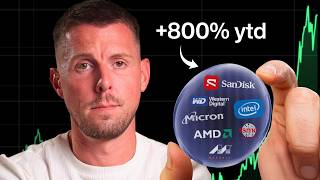
James Helliwell analyzes the 2026 tech rally, where stocks have jumped 600-800% year-to-date, using a 7-factor model to separate fundamentally sound companies from sentiment-driven bubbles. The Magnificent Seven stocks like Microsoft and Nvidia pass the test, while the newer AI-11 cohort mostly fails, signaling inflated valuations outside tech.
Chapters
There's a saying that the market is never wrong, only opinions are. But looking at returns like these, stocks up 600%, 700%, even 800% year to date, you're probably asking yourself, are people crazy for buying this high? Or do they see something that the rest of us are missing? And after 15 years of investing, I know that telling those apart is the whole game, guys, and that picking the wrong side sees you either buying the top or missing potentially the best returns of the decade. So in this video, I'll show you how I analyze stocks as a former pro, whether any of these companies are actually worth owning, and whether there are better ideas in other sectors that tech investors are overlooking right now. But first we need some context here, because that quote that I opened with came from Jesse Livermore, the man that famously shorted the 1929 crash and reportedly made over $100 million. But he was also the man who famously went bankrupt 5 years later, which is why not everyone agrees with him. I'm not a fan of Jesse Livermore. Take Howard Marks, one of the most respected hedge fund managers alive. Even Buffett apparently reads his memos. He put it far more bluntly, that the idea that the market is always right is just absolutely crazy. Because in his view, the price reflects the consensus, and the consensus is often very emotional and wildly wrong. And he gives a perfect example in the Nifty Fifty. These were the untouchable group of stocks back when he was starting out. Innovators in things like computing, healthcare, consumer goods, all of the hot technologies at the time. And the bank he worked for was all in on them. But if you bought them on the day he started his first job, 5 years later, you would have lost as much as 90% in the best companies in America. That's how wrong the consensus can be. And today— Today. The consensus is all in on tech. So are these names up hundreds of percent this year because they earned it or because the crowd has simply lost its mind? Well, the problem is that most people aren't looking at fundamentals in the right way, if at all. And unless you know what to look for, you won't be able to tell whether the rally is valid or whether you're staring right at a bubble. So let me show you the model I built as a pro to see whether the market does indeed know something that we don't. If we look through all of this list, what we'll find is that the majority of the Magnificent Seven ranks somewhere towards the top. So whether we're searching for, say, Microsoft, or we're looking at perhaps Tesla, albeit with a lower score, the Magnificent Seven are all included in here. So let's take Microsoft as an example. You can see the footprint here. And that it basically has a 4 out of 5 intelligence score, which is representing the 7 factors that we track. And if you look back over the very long term, of course, the stock has appreciated a load. And it's the same story as we scroll down. You look at the likes of Meta, certainly Nvidia here. It also has outstanding fundamentals, which is why it ranks towards the top of this list. And you can't argue with the price action. Mm-mm. When you know the truth behind it. But the problem with the AI-11 is that companies like SanDisk, for example, which is the one right at the top of the performance list, don't even feature in this universe to begin with. And the same is true for pretty much the remainder. The one notable exception here is ASML, which is within the AI-11, and in fact is the third highest ranking stock in the model. And scrolling down to the chart, you can see that the price action is supported by the fundamentals. So this is one exception to the idea that everything is in a bubble. And if we continue down here looking at the other stocks, Broadcom, for example, 84th in the ranking, so quite a long way from the top. And the rest of the 200%, 300%, 400% year-to-date crowd are nowhere to be seen in this list. So here's what that tells us. The majority of the Magnificent Seven are genuinely magnificent, which means for them at least, the whole rally was deserved. But the same can't be said for the AI 11, because barely any of them pass. And that's what magnifies the risk in the rally that we're seeing, because the new lot aren't running on fundamentals. It seems to be just pure sentiment. But nobody says we have to be tech investors. And now we understand the fundamentals, we can find quality stocks anywhere. So let's go back to the screener and see where the top names show up. Towards the top you've got Mastercard, we've already mentioned Fortinet and ASML which are of course in the midst of the tech rally, some of the ratings agencies like MSCI who of course license the MSCI World Index, and then companies like Vertex for example, a pharmaceutical name. So if we click into say S&P Global, you can see the footprint, you can see the ranking, And for a number of decades now, going all the way back to the '60s and '70s, it's produced an incredible trend. If we put it on a log scale, that's a 45-degree line up and to the right. And having a further scroll down here, there's companies like Texas Pacific Land. If we look at the chart over the long term since listing, that again is another 45-degree uptrend. But you might have noticed that there's a column with a red label here saying high risk. And that's bad news for the likes of Mastercard, Visa, and the ratings agencies that we've also looked at. Whilst it's hard to know exactly who the winners and losers will be with AI, you might buy a company that's led the market for years, it has that great fundamental profile that we've just seen, but if the business model is being threatened and potentially turned on its head overnight, those past numbers are suddenly going to be meaningless. And that's the trap that forced me to rethink my own strategy and how I'm investing for the long run here. So let me show you how you can also avoid that trap and build a portfolio that isn't threatened by AI and might even benefit from it. We'll scan back through this list, but this time I'm going to put all sectors apart from tech. The next thing that I'm going to do is actually set a minimum filter for each of the 7 factors, and I'm going to set this, uh, let's say 75%. It reduces your options to only 3 companies. You could lower this to perhaps 67 and you would get more results. So now we're looking at the companies that are consistently in the top third for all of these factors. So the one that I want to focus on is the next highest ranking result in Monster. This is in consumer staples, a sector that might actually be a beneficiary of AI automation. And as you can see, it excels across pretty much every category. So if we click into it, we can see the fundamentals here compared to the sector, so your typical consumer staples company, and it's well ahead of the game. When we scroll down to the chart, this is when it gets really interesting. Monster, I think, for some time held a record as like the best performing stock. If you look at some of the big podcasters out there, maybe Modern Wisdom, Chris Williamson, these guys are trying to emulate what Red Bull has done, going into a brand called NewTonic which is about optimizing or enhancing your mental performance. These brands are in a super hot area of the market, but you can't easily invest in Red Bull or necessarily NewTonic unless you're one of Williamson's pals. So Monster, with the track record that it has and the fundamental profile here, could actually be precisely the kind of company that keeps you away from tech whilst giving you a very credible investment profile. Mm-hmm. And if we head on over to TradingView, let's take a look at the charts. First of all, we'll begin with like a super long-term one, a monster. It's a little bit easier to see on this screen. There you go. That must have been the surge through the early 2000s, but this is just compounded at an incredible rate. Going on to candle chart just to see what it's been doing, say weekly. It has that durability even when the market is facing a wobble as it was back when the war was kicking off recently. But the more you zoom out on a log scale, the more you can see that this 45-degree uptrend is sustained. So we strip out tech, we set the quality bars high, and then we throw out anything with that AI risk flag. And what we're left with gives us a handful of results of companies like Monster, for example. This is not me telling you to go out and buy it, just to be absolutely clear. The point isn't the company itself, but rather the method that we've used to find it. There's a link below if you want to try out the tools I've built, including this one, for 7 days, and you'll also get access to everything else in there that I've features in all of my videos completely free. But buying the right stock at the wrong time could still see you lose. So watch this video next to see where the money's rotating before the consensus catches on.










