Is It Too Late to Start Investing At 35+?
James Helliwell argues that starting to invest at 35+ isn't too late if you avoid waiting for perfect timing and skip advisor fees (4% upfront, 2.25% yearly). His three-pillar approach uses a quality-stock model, concentrates in 15-20 stocks, and holds for 15-20 years to capture a modest 2% edge that compounds significantly.
Chapters
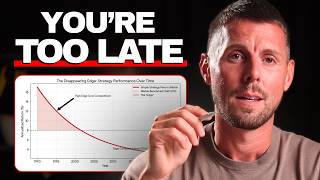
If you're a financially successful procrastinator, then listen up. You've probably got cash in the bank that you know you should have invested by now, but despite gold, the Nasdaq, other markets this year all making record highs, you're still waiting for the right time to get started. And I get it. Investing, like anything, for the first time can feel daunting, but deep down you know you should have done something about it a long time ago. I'm James Helliwell. I'm a former professional trader turned financial educator, and in this video I'll show you how to get started today with a proven plan whilst avoiding mistakes. Now, just to be clear, if you're new to investing but you don't already have a lump sum, there are plenty of other videos out there for beginners who are looking to start putting a couple of hundred bucks a month into an ETF. But that's not what this channel is about, because you can't save your way to wealth. And besides, if you're starting later than really you should have, then you need to make up for lost time here, which means you cannot afford to settle for average returns in passive funds that won't grow your money any faster than the market. Like most things, you might have got away with it when you're in your 20s, but now you need to accept some risk because the greater risk you're already facing comes with the cost of inaction. So people worry that the market will drop the moment they invest. So you probably sat there in cash deliberating the perfect time to do it, and that often proves more costly. And I think this quote by Peter Lynch sums it up: Far more money has been lost by investors preparing for corrections, or trying to anticipate them, than has been lost in corrections themselves. So what we're talking about here is market timing, and this goes to show that a buy and hold strategy in the S&P would have massively outperformed even missing just the 10 best days over a 20-year period. So really what we're talking about isn't so much the volatility of returns but actually something known as sequencing risk. And this is the idea of investing right before the timing of a crash rather than looking to buy after the correction has already happened. And what you can see here is that since 1950, there's only been 5 occasions where the market has corrected by 30% or more. So waiting for a big correction to happen before getting in, you're going to be waiting a long time because looking at the data, the average duration between these kind of episodes has been around 15 years. And all the while you're paying a cost of inflation. I'm going to take numbers from the US Inflation Calculator here, and I've broken them down across 5, 10, and 15-year intervals, which is roughly the period of time that we were looking at between those 30% declines just now. So over the last 5 years, inflation cumulatively would have cost you 20%. Over 10 years, it's more than one-third of the purchasing power that would have been lost. And over 15 years, which is you probably waiting between those market declines, that's what we're talking about. 45% loss to inflation. So in annualized terms, the tax, so to speak, or the cost of inaction is 3.1%. At the same time, there's also an opportunity cost. If you take the average for these periods, stocks have compounded at more than 14%. If we go back to that earlier example, just for those of you that are curious, $10,000 invested back then in 1950 today would've turned into $3 million in real terms. But unless you're out biohacking Bryan Johnson, the chances are you're not going to have 70 years of investing ahead of you. The problem is that most investing advice out there assumes that you started early, often in your 20s, contributing a small amount in ETFs each month and forgetting about it for 40 years. But late starters don't have that kind of runway. So there's this compounding gap that appears, and that means that you need to try and grow your money faster in that limited time. In order to catch up. And this is especially hard when you're just starting out. So the idea of maybe paying someone else to do it or bunging it in a low-cost index fund might seem like the obvious solution, but going down either of the obvious routes creates a problem. So in the first scenario, you could go via an advisor, so that's paying a professional to try and beat the market for you, in which case you're gambling on getting higher returns. Or alternatively, the passive ETF route sees you accept average in the pursuit of getting lower fees and trying to improve your net return that way. So let's take a look at both scenarios here, beginning with the advisor fees. What's likely to happen is that you'll face an initial fee of 4%. So if you had £100,000 to invest, you would actually only end up investing £96,000 to begin with because that product fee comes out right at the beginning, after which you're going to face annual charges in the form of a 0.5% typically advice fee for that advisor to pick up the phone to you once a year and yadda yadda you, and also a fee for the underlying investments, the funds that they've put you in, which on average runs at 1.75%. So in total, each year, in addition to this initial fee, you're going to be paying out 2.25% on that £96,000 investment. Now the problem is that the majority of investment managers don't deliver outperformance. In other words, they don't beat the market. So for those fees, you're not getting the better returns that you came for in the majority of cases. Over a 5-year period, less than one-third of advisors beat the market. That's for global equities. For US stocks, that number's actually lower. It's one in four managers. That managed to beat the market after fees. So that's an incredibly low number, but it continues to fall as we go out over a longer horizon. Towards 10 years, it drops in half for global managers, and over 20 years, well, it remains at 15% who succeed. But for US, look at that, 94% of them fail to beat the market over a 20-year period. And being kind, this is the reason why— it's the fee drag. So when you add together the fees, that 2.25% per year after the fee over 5 years, 10 years, and 20 years, the performance drag on your portfolio adds up to 14% over 5 years. That's quite a lot in such a short amount of time. Almost one quarter of your pot over 10 years, and over a 20-year period, which let's be honest, most of us are going to be investing for, you end up losing 40% of your final retirement pot or savings, whatever it is, to buy the Bentley or whatever it may be, because of the bloody advisor fees. So just to put this in perspective, your odds of actually getting higher returns via an advisor are like playing this perverse game of Russian roulette with 3 bullets in the chamber and spinning the barrel and pulling the trigger not once, not twice, not 3 times, but 4 times and somehow surviving. You're paying all of those fees relying on that vanishingly slim outcome. So it doesn't seem like we're going to get better returns. So moving to the alternative, which is looking to reduce our fees by investing in a supposedly low-cost ETF. Here you can see what's going on. There's no advisor involved here. We'll assume that you're doing this on a DIY basis. So there's no initial fee, there's no advice fee, but you're still going to have a relatively modest management fee of 0.24%. In the case of the MSCI World ETF I've used here as an example. Depending on your provider, you might also incur a platform fee, and people tend to overlook these, and they can end— often end up being more than the management fee itself on an ETF. So they're not quite as low cost as many people think, and this can really compound against you over a number of years. But nonetheless, these tend to be capped. In the likes of Hargreaves Lansdown, I think once you get beyond an investment of about £43,000— would be equivalent in dollars— the cap kicks in. So the total fee drag in the case of the low-cost option is 0.6%, so it's considerably lower even if it's still not perfect. So the two options we've seen, you either won't grow faster because of fees in the case of an advisor, or with ETFs you simply can't grow faster because they track the market, therefore meaning it's impossible to beat it. And when you're late to investing, you need to catch up You need both the performance and fee efficiency there to possibly stand a chance of growing your money faster than the market. So this annual drag, let's say it's 2% a year, can end up destroying a huge chunk of your portfolio. The way to overcome this, in my experience, is by doing it yourself, by investing in single stocks which don't have any of those management fees, by building a portfolio of high-quality companies that you can patiently hold over time. That's going to keep your costs low, but it's also going to give you, most importantly, a fighting chance of growing your money faster than either the two options we've seen. But most beginners who try to do this on their own will make the same predictable mistakes. So to solve this, I've come up with a simple framework built around three pillars: stock selection, portfolio construction, and time horizon. And if you get these right, then compounding will follow. But if you get them wrong, you can easily undo all of the benefits of trying to do it yourself. And starting late makes those mistakes way more costly. So the first one is stock selection. The problem here is that most people randomly buy stocks over the years without never having a real plan. And that leads to random returns, which is the opposite of the consistency that we need to make up for lost time here. And that will ultimately lead to more worry and eventually disappointment as well. So to address this, I want to introduce the Quality Factor. And as you can see here, it's improved performance by both lowering risk and improving returns in every major global equity market, whether it's in Europe, the US, even emerging markets, or worldwide. And you've probably seen this model in my other videos. It shows you the 7 factors that I look for to identify single stocks, and it evaluates the entire global universe to basically identify the strongest companies, which you can see with this radar chart here. The broader the footprint, the better the stocks. It's really easy to visualize, and it's as simple as prompting the AI bot that I've built to give me the top 20 companies. We'll look at an example here in a moment and begin to put together a pretty decent portfolio, or at least a watchlist for further research of these companies. We'll take ASML, for example, which is one of the best companies in Europe and arguably worldwide. It's a specialist in lithography, which is absolutely essential as a niche in the semiconductor supply chain. So in other words, chip production that goes into everything nowadays. You can see the growth profile here, just how consistent it is. And you might be thinking, well, okay, growth stock sounds great, but isn't it going to be really expensive? Well, whilst this isn't financial advice— none of this is— it's actually a lot closer to its historical median average than you might think. To put this in perspective, a £10,000 investment 10 years ago would have grown into £155k compared to, well, barely over £30,000 for the MSCI World ETF. If you'd like to get a copy of the watchlist report that I've put together, it's completely free, with the best company according to each of these factors in my model. Go ahead and check out the description. There's a link there. You'll begin to see how all of this works with the top companies doing significantly better than the market. So once you've identified the right stocks, concentration is actually what you should be aiming for, not diluting your best ideas and diminishing your edge. Contrary to popular belief, beyond about 20 stocks, there's very little marginal benefit to adding another stock to your portfolio for the sake of diversification. Where the risk really drops off is usually between about 15 to 20 stocks. And in the words of Warren Buffett, diversification is a protection against ignorance. So it makes very little sense for those who know what they're doing. Another good quote is from Peter Lynch, who says, know what you own and know why you own it. So you're probably beginning to see a theme here when it comes to diversification. Stan Druckenmiller, another legendary investor, agrees with what the other two have said, and he says that the majority of your returns are come from 2 or 3 positions each year. So rather than spreading yourself too thinly, you should focus on your best ideas and understand them very well, because those with more concentrated portfolios— it's technically high active share, which is how much your holdings differ from the benchmark— so those that are true stock pickers, not closet benchmarkers, outperformed by 2% per year. So that's the reward for doing this. Remember, when you start late, Every mistake is going to cost you more, and conviction is a far better form of risk management, in my opinion, than diversification, because all that'll do is see our stress and commissions rise and our performance suffer, which we just can't afford now. Which brings us to our third pillar, time horizon. You may not have 30 or 40 years of investing ahead of you, but you probably still have 20. And chasing short-term returns, if it's out of FOMO, thinking that they'll seemingly fix all your problems, inevitably it won't end well for you. Short-term edge no longer exists. It's been competed away by technology, whether it's high-frequency trading or simply having greater access to information through the internet. It'd be like following a moving average crossover or something like that compared to otherwise just buying and holding the S&P. And you can see how in this example, up until the millennium, there was an edge to be eroded. In other words, excess return up here. But ever since, it's been diminishing. And the reason for that It's been competed away. So instead, what we should be looking to do is invest over a multi-year horizon. This is where the excess return is, but this is the game that most people simply aren't willing or patient enough to play. And if I'm honest, as a professional, this is probably 90% of the game. It's having the right plan and then keeping your psyche in check and sticking to it. And when you're able to do that and stack these 3 sources of edge, over the market return, which we'll assume to be about 10.5% before inflation in the long run, you can easily add an edge. We'll just consider a conservative example of 2% here. So if we plug these numbers into our return calculator, this is available on the website, let's assume that, okay, you don't have 37 years to retire, but maybe 20 years. You're going to have at least 1 year's salary saved according to industry averages. Paying in £500 a month, which again is a typical amount, is half your age in percentage terms. That's going to see you grow that £40K into nearly half a million quid after inflation. That's twice as good as the advisor scenario because of the reasons that we looked at earlier, and it's considerably better as well than the index ETF option. But what if, I don't know, maybe you've got slightly less time, you've only got 15 years? Well, the chances are if you are later in life, you should have a bigger investment pot. So let's say you've got nearly £100K, contributing £500 a month over 15 years, you're still going to do pretty well out of this. You could realistically more than 5x your money according to these hypothetical assumptions, just to be very clear, after inflation, by adding a 2% edge over the market and most importantly eliminating fees at the same time doing it yourself. And if maybe you're in your late 30s like me, $50k paying in $500 a month, you will end up with a very nice figure. These are assumptions, they're of course not guarantees, and it's certainly not financial advice. But hopefully you can see the big difference between going via an advisor, otherwise trying to do it with an ETF and missing out on any upside, which you ultimately need to grow faster and make up for lost time, or getting your hands around this, investing with a proven edge and eliminating fees at the same time. So as you've seen, if you do this well, if you pick good companies, you build your portfolio properly, and you give it enough time to compound, then over the next couple of decades this should be enough to get you to retirement. But then another question usually comes up: what happens when I actually get there? Because getting that part wrong could undo all of our good work and potentially see us run out of money in retirement. So watch this video next, and I'll show you why the answer might completely change how much money you think you need to retire with. I'll offer a shiatsu.










