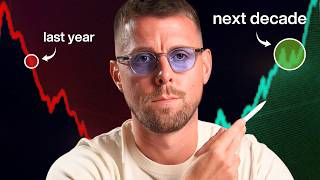
In this video James Helliwell argues that despite widespread concerns about war, inflation, and job losses, the U.S. economy is showing rising productivity driven by AI while job creation stalls—a phenomenon he calls the "Great Freeze." He notes that unemployment is low, the IMF has raised its 2026 growth forecast, and core PCE inflation remains above target, while the Fed is expected to keep rates high or even hike further. Helliwell presents a proprietary risk‑per‑sector tool that maps AI disruption winners (semiconductors, AI infrastructure) and losers (financials, data providers). He then unveils a contrarian, once‑in‑a‑decade wealth‑transfer trade: a focused allocation to natural‑resources commodities (metals, energy, agriculture) via the GNR ETF, which he says will benefit from both rising inflation expectations and the material demand of AI infrastructure build‑out. Citing 13D Research, he explains the structural demand gap between the S&P 500 and natural‑resources weighting. He outlines a barbell portfolio—equal split between AI‑infrastructure assets and natural‑resources assets—detailing how it performs under two macro scenarios: a recession that forces a rate cut and lowers inflation expectations, and a "Goldilocks" scenario where AI drives growth, raising inflation but still rewarding both sides of the barbell. He concludes by urging viewers to consider this trade as a high‑conviction, non‑ETF, sector‑specific play, while noting it is not financial advice.
Chapters
With all the worry about war, inflation, and job losses, you might well think that the economy was stalling and it was time to sell stocks. But new data shows the opposite. Productivity is in fact up, unemployment is only around 4%, and the IMF just raised its growth forecast for 2026. So in this video, I'm going to show you why millions of us don't feel any better off and the once in a decade wealth transfer that's happening below the surface that most investors will miss. Let's start with jobs, because Jerome Powell himself has acknowledged something extraordinary. For the first time in modern history, productivity is rising while virtually zero new jobs have been created in the last 6 months. His conclusion: AI is enabling firms to create more without hiring more workers, and this is leading to a problem that economists are calling the Great Freeze. You can't threaten to leave if nobody's hiring. You can't really push for a pay rise if software could just come in and do your job for less. So your income, in other words, is going nowhere. But now layer on top what's happening to prices, and this is the second crucial part that sets up the trade that we'll be going through in a minute. As you've probably seen, energy costs have surged with crude oil doubling, and core PCE, which is the Fed's preferred measure of inflation, was already well above the 2% target that they set. But despite this, JP Morgan has forecast zero rate cuts for the entirety of this year, and the chief economist actually thinks that the next move is going to be a hike. Despite the fact that more Americans are searching for help with the mortgage now than at any time since the financial crisis. So if the Fed can't cut rates, it seems we're headed for even more inflation. And it might be that Powell sees a recession as the only way to resolve it. So how do we invest if staying in cash is guaranteed to cost us with inflation and the US economy is about to face a major shakeup? Well, this tool I've built should hopefully show you. There's a link to it in the description so you can get hold of it free. Try it out. Let me know what you think. And essentially it shows you the risk per sector of AI disruption. So on the left-hand side, the beneficiaries, you've got, not surprisingly, semiconductor names, other beneficiaries of AI infrastructure. But looking more broadly at the S&P, financials are likely to be heavily affected. You can see the losers here. A lot of them are the index and data providers, but the likes of Visa and Mastercard could also come under threat. So this is the reason why we must be more selective. and we can't just put our money in an ETF and chill anymore, which has been the case for a number of years now. But there's an idea I want to talk about that most investors aren't looking at right now, and analysts think it could create this once-in-a-decade wealth transfer for those that see it coming and act on it. Now, here you can see inflation expectations in blue. This is actually the spread between inflation-protected bonds and nominal Treasury bonds. The difference is the demand for inflation protection. So as this rises, inflation expectations are increasing. In white, we have our mystery trade, which will be revealed in a moment. It's also a beneficiary of the AI theme, and this is why it's so interesting. But this is the key point. When you compare the sector weights in the S&P 500, there is a chasm between the two, 32% difference in weighting. So this is a catch-up opportunity for this sector. As analysts at 13D Research see it. And if you're not familiar with that paper, it costs tens of thousands of pounds a year and it's the hedge funds that have access to it. So these guys really know what they're talking about. So for the moment of truth, the trade is in natural resources and you might think, well, what the hell are they? They're just a bunch of commodities. In essence, they are, but we're looking at three sectors specifically: metals, energy, and then agriculture. Now, at various different times and for different reasons, each of these sectors can outperform, but broadly speaking, the basket of natural resources is a product of rising inflation expectations and also demand from the buildout of AI infrastructure, which is what we're looking ahead to now. So here you can see the ETF, which is GNR. By far the majority are categorized as materials, and it's about a 60-40 split between those and the energy sector. But I'm not saying go all in on mining stocks today. This is really important. Remember what I said earlier, the most likely thing to bring inflation down from here is another recession. And whilst that might seem like bad news in the short term, here's exactly how I build my portfolio around it. So we've got another overlay chart here, this time showing the business cycle in white compared to the natural resources ETF, which we've just seen. Just like the stock market, generally speaking, natural resources will tend to follow the same pattern. These are ultimately the most cyclical industries because they're the inputs for the majority of manufacturing and any kind of economic activity. But the reason I'm not overly concerned about that is because there's ultimately structural demand here. If it was just an outright inflation bet, you would have to be very much aware of what's going on with the business cycle. But because it also benefits from the AI infrastructure theme, Even if there is near-term volatility or a recession which resets inflation expectations somewhat, it's likely to see a reversion to the mean. And another reason I have confidence in this is owing to the divergence that we've seen between these sectors and the S&P 500 so far this year, which is again speaking to that structural demand. So the way I'm thinking about structuring this, and of course this is not financial advice, it's just for me, how I'm personally looking at it, is this kind of barbell strategy. So an equal split between AI infrastructure and natural resources. Let's assume that there is, in our base case, a recession scenario. We've just discussed that there would be volatility, but keeping in mind the longer-term picture, I would imagine that tech would remain resilient and resources would catch up. The only way realistically that we're going to get that recession is for AI productivity gains to continue, which is another way of saying AI putting people out of work. So the likelihood is, particularly at the rate it's going, AI stocks would be at a further point to where they are right now. And hence, if there was that correction, it's correcting from an even higher baseline. So I'm not too concerned about the left-hand side of this, but on the right-hand side, you need to be aware that you would be exposed to the business cycle in inflation expectations resetting, and then waiting for it to catch up to the continued rollout of the AI infrastructure theme. But there is also a scenario where we don't get a recession. I could be wrong and everybody could be wrong on the macro front. And you know what? Despite all the worries, everything's just cool. We've got this Goldilocks scenario where AI is just a really sweet productivity tool and nobody gets fired and the economy just grows and grows and grows. But with more growth, you're gonna have more inflation. We're already in an inflationary regime, and if you turbocharge economic growth on top of that, you're gonna get even more inflation. So in that scenario, AI would clearly win and natural resources would also win. So as the analyst at 13D Research put it, and I think this is probably one of the most important sentences in investing right now, we can't get to the AI-driven productivity paradise without more materials, of which the supply is limited, is costly, and it carries these long lead times. But if all this talk of recession scares you, then watch this video next where I show you exactly how to find the best inflation-proof stocks that you can hold for the long run without worrying about market timing. Frankly, it's exhausting. I need a drink of water.