1Q2020 State of the Market Webinar
James Nelson (Avison Young) presents a 1Q2020 NYC real estate market webinar (April 2020). Key points: citywide dollar volume dropped ~12% YoY (Q1 sales $5.86B; annualized ~$23.4B), with a projected full-year 2020 estimate near $15B given COVID-19. Boroughs outside Manhattan saw larger declines (Brooklyn, Queens, northern Manhattan) driven partly by rent-reform effects reducing regulated multifamily trades. Asset-class highlights: Manhattan multifamily averaged ~4.48% cap and $750/ft; Manhattan development-site volume ~ $0.5B; retail cap rates rose toward ~6% and $/ft fell; office dominated Q1 dollar volume (~$4.4B citywide, ~$3B office). Notable transactions cited (e.g., 424 Fifth Avenue ~$978M / $1,600/ft). Nelson discusses weekly closings drop after March 11, likely cap-rate expansion and tighter lending, expected distress (hotels, retail) and timing (loan workouts/foreclosures possibly within 6–9 months), and Q&A covering hotels, conversions, estates, taxes, rent regulation, and return-to-office timing.
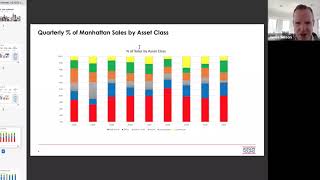
Okay, welcome everyone. This is James Nelson. I am head of Tri State Investment Sales for Davison Young. And thank you so much for joining us for our state of the market for the first quarter of 2020. First and foremost, I hope all is well with you and your families during this really challenging time. I know this is four weeks in that Avison Young has been working remotely and I know how challenging it has been to get through these times. But it's been fantastic staying connected with you all and sharing information. And that's what we want to do, is be a resource for you all. I think the first week or two at home was really trying to put out fires. And I know as many of you were working on transactions, I'm sure trying to salvaged those and now kind of getting used to the new norm. And so we do want to bring you our first quarter figures. We are going to be talking about sales that closed through the end of March. And as I always give as a caveat to these sales that by the time the transfers come in and reported, this really indicates more of what was taking place at the end of last year and even early this year. So this is not going to give us the full impact of what we are experiencing now. That being said, I think it is very helpful now, especially as we see closings that are occurring even in the last few weeks. The sheer fact that they did close, I think gives some reassurance because I'm sure right now everyone is trying to figure out where the market stands right now, where is pricing. And so hopefully looking at the stats today should give you a good indication. So with that, I'm going to. Oh, someone's telling me that I should try to hide the sidebar. I'm going to try to maximize this. So if this works for you. All right, I might not be able to get to that, but hopefully you all can work with me. Okay, so let's jump right into it, which is that the first quarter of 2020 we did, when looking at all of New York City, we do see that the amount of dollar volume did drop 12% year over year. So if you did annualize the 5.86 billion in sales, we would be looking at a year with a total of $23.4 billion. Now this is below the 10 year average of $36.1 billion. That being said, again, we are annualizing what took place in the first quarter and I think it's safe to say that the second and third quarters are going to be considerably off. So if I had to give a prediction on where this year could end up, I think we might finish the year somewhere in the ballpark of $15 billion in sales. That will give us a year more akin to 2010. Now if you look at where sales were already trending by borough and Manhattan miraculously had a slight uptick in dollar volume year over year. We're going to talk about why that had some key office building trail trades that happen. But in the boroughs you see pretty significant declines in dollar volume compared to last year, certainly in Brooklyn, Queens and northern Manhattan. And there those were markets that had a lot of rent regulated multifamily stock. And those sales were significantly declined. That was really a result of the rent reform that took place in June of last year. And there was a very sharp drop off in the amount of transactions of rent regulated housing as a result. So that should give you some indication. And again, looking back at 2015, which was the peak in New York city sales at $68.5 billion. Now I should add for you all, please feel free to ask your questions. And in the Q and A box, go ahead and add your questions. I'm going to go through the whole presentation first and then I will get back to all the questions. But just so you don't forget them or maybe I'll answer them as I go on. But please do add your questions and then I will review them once we conclude with the presentation. Okay, so looking at the next slide, as far as the number of sales that took place, you see that again across the board with the exception in this case buffer Manhattan, only a slight increase most the number of sales were declining significantly. Again, the outer boroughs getting hit harder, many of those with a large stock of rent regulated housing. So even in the peak of 2015 where there was 1,600 sales, we're looking like we're going to be best case at a third of that. Again that was really using these pre CORONA numbers. But if you look back to 2009, 2010, when sales really stalled, they were down as much as the 3, 400 sales. The 10 year average is 1029 sales. And again this year it looks like the average will be 536, which would be the, you know, the best case scenario. Okay, so we want to then take a look at what has been going on with the number of sales by asset class. And this is really by looking at the number of trades and you can see with multifamily, which is red back even towards the second quarter of 2019. Now this was before the Rent reform took place. Multifamily trades were accounting for 50% of the sales in New York City. Those have since dropped more to 35, 40%. And you're going to see on a later slide, the multifamily sales that are occurring are mostly fair market office although which is blue even though it might not indicate the most sales. When you look at the dollar volume of trades that are taking place, you can see they're much more significant. So here looking at the first quarter of 2020 for Manhattan and you're going to see in following slides that it was really the office market that has saved us over the last couple quarters as the amount of dollar volume for multifamily has significantly declined. Okay, now looking at each of the asset classes and looking where the pricing had been going in the first quarter, multifamily cap rates in Manhattan were at 4.48%, an average of $750 a foot. So if you look at the peak 2016 where average cap rates were 3.55%, they were also at an average high price per foot of 1,127 a foot. Looking back to 2011, cap rates at that point were above 5%. And unfortunately I think we're certainly be headed back in that direction. So in the first quarter this was over 26 sales, an average cap rate of 4.5%. Okay, looking at the number of multifamily sales and dollar volume, that's happening again. 2015, that was the peak year in Manhattan alone. There was 16 billion of sales. That included Stuytown. You see, in that case there was over almost 400 sales that took place this year. If you annualize, you're only looking at 100 sales with dollar volume below $4 billion. But I keep adding that caveat. This is really looking at first quarter numbers that many of these sales were negotiated earlier this year or late last year. Looking at the top transactions for each of these sales. So we have 10 East 29th street for 389. Excuse me, $381 million. This was 406 units for $935 a foot. The buyer was Global Holdings Management. The seller was Invesco at 741 Columbus. This was the Jonathan Rose companies that bought it. You might be looking at that price per square foot at $300 a foot and saying how can this be possible? Or maybe that's where you think pricing is headed today. The seller was Stark Corporation. These were affordable units, which exclusively explains that low price point. Lastly, 340 East 51st Street. The buyer was Stonehenge with a rod coming in for one of his investments. He's made a couple investments this year in New York. The seller was Ellen London. That went off at a four and a quarter cap, which was 115 units for $895 a foot. Now, looking at Manhattan development site sales, and in the first quarter there was a half a billion dollars in volume, which was an uptick. We saw a dozen sales totaling for about a million square feet. The average price per buildable did drop down to 514A buildable. So you can kind of see peak pricing going back to 16 where price per buildable was almost reaching 700 a buildable foot. Today it is settling in the 5 to 600 buildable range. What we are finding, and we are closing a sale right now on the Upper east side where the right condo projects in the right markets are still getting done, but certainly with a lot more equity to come in and get these done, the question still remains, what goes on with that ultra luxury segment on 57th street with apartments that are in that 4 or $5,000 price range? Will those, especially now with everything going on, will those ever resume? So, but right now there certainly still is some appetite for land. And we are seeing, especially in the boroughs, a lot of demand for rental. Looking at the historical development sites, sales for land going back to 2015, you see 10 billion in sales, over 150 trades. So this year we're going to have again less than probably 40 trades, less than $2 billion of activity. So I guess the good news is the pipeline. I know there's a lot of concern about oversupply and having too much on the market. You can really see that this is slowing down and there's going to be a lot less new development being produced and for developers to compete with. Looking at the top transactions here in this asset class, you have 417 Park Avenue, which sold for $184 million. This is a pretty interesting transaction because all the co op shareholders were bought out in their entirety. This site starts at 836 of buildable, but will clearly be blended down by using those Midtown east zoning rights that are sold within that district. I know the Catholic Church still has some and Grand Central has some of these air rights, but GDS's intention there is clearly to build a new office tower, which should be a welcome addition to that corridor. Meanwhile, at 320 W. 31st St. And this was a leasehold that Columbia Property Trust executed on, their plan is to Build for Truro College. Lastly, we have 42 to 46 Second Avenue. Gemini Rosemont bought this from Church Nativity at 590 A Buildable Foot. I believe they will further blend down by buying off site inclusionary housing. Okay, as far as Manhattan retail sales, and this was a story that we were already seeing before this last month and these current events is that cap rates were already on the rise at a low point in 2015. Unbelievable. Those cap rates were at 3.7% now up to almost 6%. Average price per square foot dropping from 3485 down to 1800 a four foot. And so you can see that this trend now with retail really hitting taking the brunt of this recent pandemic, certainly is going to be under a lot more stress. Looking at these top sales at 37 Green Street. Acadia bought from Thor and Premier Equities, 37 Green Street. 15.4 million, 4300 a foot. The same seller, same buyer on 45 Green Street. So package transaction at 45 Green Street. 3600 a foot. These were cap rates that were at 4.6 and 4.75 respectively. And then lastly, 351 Bowery, which was purchased by a private individual. This is the retail condo that was offered with 711 intact. Okay, looking at office sales and this was really what has been saving the market. Certainly when you look at the $4.4 billion in sales that took place in the first quarter, 3 billion of those happen from office. There was a total of 13 trades at an average of 4.5%. Cap rate dropping slightly to $1,060 a foot. Again, going back and looking at peak pricing in 2015 at 3.8%, growing now to 4.5% price per foot. Settling down as well. Looking at some of the top trades Here, certainly the 424 Fifth Avenue sale that Amazon purchased from WeWork at almost $1,600 a foot, 978 million. You have 330 Madison Avenue at $900 million. This was bought by Munich Re from the Abu Dhabi Investment Authority at a reported 4.95 cap, over a million square feet at 788 a square foot. And lastly at 530 Broadway for $382 million at 1800 a foot. Michael Schvo bought with his partners Sirdar, Bill Gilley and BBK from Wharton Properties and Thor equities at 1800. Okay, now that we have a little bit of framework, we want to start talking about where do we go from here? So we Used to track sales quarterly or report them quarterly. At least we're always on top of the transfers. But here we have weekly sales transactions. And so in Manhattan, you can see that the average amount of closings per week runs at about five sales per week. And even going back in early January, you see some of these sales spike. In one case, there was a week where there was over 10 sales, 8 sales. But since March 11, when this pandemic really began to set in, it's been on a steep decline. So in March 18th that week, there was four sales recorded, and then that cut in half. And then last week, there was no sales reported. So again, this is still a matter of sales that were in contract. Right now, sellers and buyers are trying to work through this. That might mean reduction in price. In one case, we closed an office building in Tribeca, a boutique office building. The buyer asked for a 15% decrease. We gave them a 7% decrease. We thought that was fair for all parties. And another development site that we're working on, we're working with the buyer to give them additional time and some pricing relief to get that close. So what's going to happen is some of these closings will be pushed off. And so I think that is what's happening now. I would not be surprised if there's still plenty of sales in contract in the pipeline that are going to get pushed out as well. And you read in the papers about certain buyers walking away from deposits, and they might be saying to themselves, well, they're making that decision of what is the property worth today? And if they can't get the proper relief, then they might say that it's cheaper to walk away from their deposit. So I think we'll see some of that. Unfortunately, I think the real time indicator of where the market is really has to do with when contracts are getting signed. And unfortunately, we've checked a lot of the. We get our data from a lot of different sources, whether it's CoStar, real capital, analytics, property IDX. The challenge is really to find reliable data on the number of contracts that are getting signed. Because everyone wants to know right now, are new deals getting done? Where are they getting signed? How are they happening? But for now, the best that we can offer you is what is actually happening, closed and recorded. So that should give you a snapshot there. Okay, so where could pricing actually go? Well, maybe what we should be looking at is the prior correction that we had in the last financial crisis that was going back to 2009, 2010. And what we wanted to show you is what the cap rate expansion was from 2009 to. Excuse me, from 2007 to 2009. So you see in this case for class A and B, cap rates expanded by 127 basis points. For Class C it was 139 basis points, retail 91 basis points and multifamily 85 basis points. So could we have a situation right now and just to remind you all looking at the far right side of the graph right now you have yellow, that's multifamily, that's trading at a 4.5 cap. You have class A and B office, that is at a 475 cap. You have retail right now that is hovering right around the 6 cap. And again this is New York City, not just Manhattan. I know our Manhattan cap rates were a little lower than these. And you have Multifamily, that's at 85 basis points. Excuse me, multifamily today is at 4.5% office. What I meant to say is just below 5.5 caps. So the question is, could based on all the distress that we're seeing in the market, challenges with collections, whether or not tenants will come back in place, challenges to get these financed, will we see cap rate expansion of 100 to 150 basis points? I don't think that it's off the table. I think it's very possible that you're going to see expansion. We were talking to our debt team this morning and although the 10 year treasury is still incredibly low at all time lows, the challenge is that because the banks have been inundated with requests, they're being taken a conservative approach looking for preservation of of capital. They are going to look for greater spreads when they make their loans. So unfortunately the days of borrowing money in the low 3% seem to be over. And certainly if the banks are going to be looking for another 150 basis points with lower loan to values, we all know that equity is more expensive than debt in these cases. And so I do believe that investors are going to be demanding higher returns. So I think this does give us some kind of indication of where we could be going here. So in summary, and then I want to turn it over to questions because I definitely want to have this be more interactive. What is the rest of this year going to look like? I think this is going to be a lot like what we saw in 2009 where the only sellers today, because let's face it, if you're a discretionary seller and you don't have to Sell, you're probably gonna wait a couple months. Certainly, as we think about and advise clients on whether or not they should be bringing out new listings to market today, we're telling them, look, if you can wait a couple weeks, a month or two, let's hope we are back to semi normal so we can actually get a good response. We can actually tour the property. Right now we're doing virtual tours like I know many other firms are doing. But right now we are really trying to focus on our clients who are must sells. Those could be estate sales, it could be a partnership dispute. And then ultimately I think it will be the banks and the special servicers. And I'll circle back to that a little bit later. But again, when are the debt markets going to begin to loosen up? Because right now CMBS has virtually been shut down. The life companies are lending a little bit, but the community banks are really sticking with their relationships. They're a lot more conservative on loan to values and very challenging right now because they're inundated with all these SBA loan requests, especially with the Triple P requests coming in. So a big driver to our capital markets is obviously if the debt markets are liquid. So I think as those open up, that will certainly encourage some of these transactions to happen again. But in the meantime, we're looking at buyers who are coming in all cash or very conservative leverage. And I think right now in this market, cash will be king. The next question is what happens to cities? Are people going to continue to work from home? Do the suburbs get a bounce? My personal view and you look at the future of office. Even before this all happened, New York had a record office leasing year. Last year, over 40 million square feet leased throughout the city. You had Facebook coming here with over a million and a half square feet. You had LinkedIn, you had Apple, you have all these companies, certainly Google, who after they've filled out Chelsea Meatpacking, now they're down in Hudson Square. They're here because we have the talent. I don't think that talent goes away. I think that people want to continue to live and work here. Sure, you'll have some who will office from home. You'll see some reduction. There are questions about the future of co working, but I think the city still certainly remains viable. We have the talent and I think that certainly continues. The future of retail becomes a lot more challenging because the question is, do these retailers come back and for food and beverage, which has been really the saving grace over the last couple years, it might take some time, certainly for them to come back even once they're open. What's the new protocol? Can people sit next to each other at a restaurant? How does that work? But certainly there's also been winners in the retail category for essential retail. So looking at drugstores, looking at grocery stores, citymd walk in clinics. So medical is doing really well right now. Those retailers will certainly stick around and if not expand and maybe fill some of the void. So the last thing I wanna say and just before we open it up to questions is when will this distress come? What's it going to look like? I know back to 2009 when again the number of sales from 2007 to 2009 dropped 90%. 9, 0. And I was at my desk every day, I didn't even know when the market was going to turn. And then it turned and it turned very quickly. And you had a lot of the big banks selling loans for busted condo deals. And so you saw a lot of these loan sell offs. I think this time the national banks became a lot smarter with the way they were lending. You see a lot more private lenders in the space. A lot of them are getting involved in the capacity as Mezz Preferred Equity. So I think that you're going to see a lot of these situations happen a lot faster because last time it took years to go through a lot of this distress here. You're going to have UCC foreclosures where the lender is going to step in, take back the property if it doesn't sell at auction. I think it's going to happen a lot faster. That being said, Avis and Young does a lot of work with special servicers with our Asset Resolution Group that we're a part of. And the special servicers right now are getting default notices every three minutes. And so I think what you all probably have been hearing is a lot of the lenders have been working with borrowers right now and giving them forbearance agreements, giving them three months, six months, giving them time, hoping that the tenant tenants are going to come back and start paying rent. Unfortunately, if some of them do not, I think there's going to come a point where the properties just are not going to be able to service the debt. And at that point you're going to see loan sales in a much more meaningful way. You'll see some of these real estate owned properties where banks are taking back property again, those take much longer, but my guess would be that's probably six to nine months before we start seeing that in a meaningful way. Now in the meantime, I know many of our clients are sharing, they are starting to see some loan sales directly from community banks, but those are usually reserved for their, you know, their best clients where there's a phone call or two. And a lot of these are not being sold at, you know, discounts. I know there's some publicly traded companies out there that have maybe some B pieces in the market that might even be technically performing right now. But again not seeing a discount right now in that department. But ultimately I think that will probably have to happen as certainly values come down. So that is the presentation. I'm going to go ahead and I'm going to click back out just so I can take some of your questions. And I'm seeing now that I am muted but let me go into the questions. So I'm going into the Q and A box right now. So Chris, is this multifamily or all asset classes? So you saw the multifamily slide that we had. So hopefully that answered your questions on multifamily. Thank you Roy for your comments. I appreciate your well wishes. Sama, as far as will we have a PDF or PowerPoint available? Yes, we're going to have a recording of this webinar that we are going to be sharing with you all. We will also post these slides on our website at Tri state investment sales avisonyoung tri stateinvestmentsales.com Mark Lawrence, great hearing from you. Please touch on the hotel market and the local likelihood of conversion of distressed hotel assets to other uses. So Mark, hotels are one thing. I mean our group does have some experience with hotels, but our group out of Atlanta, we have a specific group that handles hotel sales. So we don't get involved as much. We do handle some land sales where hotels are ultimately built. But yeah, I heard from one client that over 200 hotels are closed right now in New York. I've heard that over a third of the hotel loans right now have already defaulted. I mean clearly if you look at really the paradigm, the spectrum rather on the various asset classes, there is no question that hotels are going to be hitting the hardest. Okay, next is retail. And if you really think, if you look at what Jeff Blau from Related had to say in his interview, he said that 88% of relateds residential tenants paid rent, 92% of office tenants paid rent, retail only 26% and their hotels were completely closed. Okay. And if they had industrial and they probably do, they'd probably say that that is the best performing assets. So there's no doubt that. I mean, look, the city was already over hotel, right? We had 80, 90,000 hotel rooms about five years ago. We're now up to 120,000 rooms. We were unfortunately already having these issues with too many hotel rooms before this even happened. This will only of course exacerbate the situation. And so, yeah, I mean the question is, how can these hotels be converted to other uses? A lot of that has to do with zoning, right? So if it's in a manufacturing zone, you might not be able to do residential, but it might be better suited for a transient type use. I mean, maybe it is furnished rentals. You know, there's a lot of the co living that's out there. Although questions are, you know, after all this, are people going to want to be living in close quarters next to each other? I mean, it just adds so many questions. But I mean, even looking at user groups, whether it's dorms, whether it's medical. We sold a development site on the Upper east side earlier this year or late last year and we had a lot of residential developers who looked at it and ultimately Cornell Weill bought it to build housing for their med students. So I think we got to get creative in this market. We got to think about other types of uses to consider. Michael Rutter, great hearing from you. And if you all have not heard the interview I did with Michael on my radio show, Real Estate Investing live from New York, please do check that out. It was fantastic. And you can get that quick plug here. This is my commercial. I'll take Liberty. You can find that on the Voice America network, but it's syndicated on itunes and Spotify. And so it's a great time to catch up. And here's some of these interviews. So Michael's question is, what's the reduction of value from 2007 to 2009 on a percentage basis? 30%. Any expectation on what the discount can be this time around? So again, if you just look at the cap rate expansion and you talk about a four and a half cap becoming a six cap, I don't have my calculator handy, but I think you probably are looking at a 30% shift when you look at the price per foot and where pricing is going, we've already seen pretty significant discounts that have happened over the last year or two, certainly in multifamily with what was going on with rent reform. The days of 34 caps were already over. We were already trading in the 5 cap range, which would have resulted in 20% declines. But based on what's happened over the last month. I don't think the knee jerk reaction is all values are off 30%. I think it really depends. I think once things settle in, we're probably looking at more somewhere in the ballpark of 10 to 20%, depending on what kind of asset and what it is. Okay, Robert asking, are you seeing estate sale properties coming to market now? We were already in the works with one or are in the works with one right now. Estates are operating along their own timelines. They have estate taxes to pay. Those are usually pretty part of the motivation to sell. Also, you're typically getting family members who, whether there's multiple beneficiaries, they are looking for a capital event. Many times they're not real estate owners. They don't want to hold on. You are going to see some extensions there. You all probably saw that 1031s if they were due between April 15 and July 15, whether for identification or closing period, that they're now pushed off the same. Even though I'm not an accountant and please check this, the same thing I would assume would be for estate sales where if you have estate taxes to pay, that I would imagine there would be some leniency. But typically the estate sales are not market driven. And so that's why again, I think that you could have sales that still occur even in this type of environment. Okay, Joseph, where do I see the price of development going? Again, it really depends on what you're talking about. Are we talking luxury condo sites? Are we talking about rental? I think it's really a little tough to tell. I mean, the one question is I mentioned, do the debt markets come back? What happens with construction financing? But I always answer with development, it really depends what and where, because there's certain sub markets where, you know, if you take Chelsea, there's a lot of new development that has taken place there. Thousands of condo units, certainly 57th Street. There's other neighborhoods like the Upper east side where you don't see maybe an oversupply of inventory. So it really does depend what neighborhoods you're talking about. I still believe that we are so severely under housed, even with everything going on. And if you think about it, New York City over the last couple of years, we typically see 90 to 100,000 new jobs which are added every year. And yet there's only about 25,000 housing units added. So we have a vacancy rate of under 2%. So I think going back to this rent reform and what that did in that a lot of owners, developers are saying, well, I'M not sure if I want to build a new rental building now because what happens if what I build becomes fully regulated in perpetuity? So there was already a slowdown in development. There's certainly going to be a ton of demand for that product. But I think a lot of the rental development, even before this all happened was already going to New Jersey, Westchester and Connecticut and I think that trend will continue. Lev, great hearing from you. Glad you're well. Thank you for the well wishes. Adam, thank you for joining. What's my view on property taxes given the budget holes? I did not get into that and I really appreciate that. Real estate taxes have been a real challenge in that in some cases they've gone up to 25, 30% of EGI. There was already a shortfall and this is only going to really make it more severe. But the question is how are we going to pay for all these programs? How are we going to help dig ourselves out? And what was already being discussed was whether or not they're going to go back and look at the class 2Bs again where again they used to have the cap and increase at 8%. Are co ops getting a more favorable deal than condos? What about the one to four families? Now that's really the third rail in politics. If you tell single family owners that they're going to have to pay more money. But it has to come from somewhere. And unfortunately the city's budget has really ballooned since our current mayor has gotten into office under the Bloomberg administration. It was in the $80 billion range. We're now in the mid $90 billion range. The real estate community pays for 50% of the city's budget. And so we're going to have to find that. They're going to have to try to find that tax revenue somewhere. The other short term problem, and I'm on the board of revenue and we're trying to work through this is what about the tenants who take a lot of the pass through exposure? So they're paying a portion or many times all of the tax increases. And so what do we do about that? If a tenant is not in the space and they're not paying rent, I don't think they're going to be paying tax and that's going to fall back on the landlord. So one of the things that Rebny has proposed to the state is can there be an abatement, can there be a payment plan so we can all get through this? Yoko I have an international all cash investor who is ready and willing to Purchase distressed properties. Yes, reach out to us. We have properties on our site and we're happy to work with you on that. Joseph, asking about the impact on the boroughs, do I see a double digit cap rate from buyers? I don't. Based on the recent reform, we already started seeing cap rates available at 6%. I was at the National Multifamily Conference down in Orlando and talking to some of our brokers in the Southeast who were, they were selling properties at four and a half caps and there was like kids in the candy store who couldn't wait to get it. We were offering six caps in New York and people said, investors said, you know, we're a little concerned with your regulation and it all has to do with the upside. So. But look, I think real estate is a hard asset, right? There's going to be a flight to quality, a flight to safety. And you know, with the stock market bouncing up and down, you know, I got to think at the end of the day, certainly for multifamily people need a place to live. Once kind of get back to semi normal, you're going to have that demand. That's not going to go away for housing. So I can't see multifamily going to double digits. I mean, things would have to get really bad for that. Emmanuelle, great hearing from you. Can I talk about affordable and how that is being affected? I did speak to some of the largest affordable housing developers this week. I just want to check in and surprisingly, or maybe not surprisingly, their collections have been challenged more than some of the multifamily owners, again related said 88%. And clearly they have some affordable housing as well. But in some cases that, you know, the deeply affordable housing, the lower AMI housing, a lot of those tenants have not been paying rent. And look, there's a lot of confusion out there. You've got, you know, Senator Generis, you have that S8125 bill that they're proposing. The tenants shouldn't have to pay rent. And meanwhile Rebny said, we're not going to evict tenants for the next 90 days. So maybe some of these tenants are potentially, you know, taking advantage of the situation. And I was grateful to hear our governor say that, look, rent is an obligation. We're not going to interfere with private contracts. Yes, landlords work with your tenants, see if there's a way that you can have a plan. But you know, it's not like that rent obligation goes away, but the affordable space in the near term, they are having issues with collections now some of this is federally paid for. Whether it's Section eight, that's still coming in. But long term, look, there's going to be a lot more demand for affordable housing after this, especially for those who unfortunately are not paid for. Whether it's Section eight that's still coming in, but long term, look, there's going to be a lot more demand for affordable housing after this, especially for those who unfortunately are not going to be able to get back to work. Okay, so guidance asking a question. When do we think that everyone's going to get back to office, get back to work? You know that's a great question. You know, I got to think and again this is all coming through Rebny and figuring out a plan on how we can safely go back to work. You hear about, you know, how can we do social distancing with, you know, especially with public transportation. Is there going to be an A team, a B team. But it definitely seems that we're going to ease back into this. You know it sounds like there's talk now of mid June, but I could certainly see this unfortunately going into the summer. But I do hope we all get back soon. But no official word yet. We're waiting on the governor. There's obviously that power play also with our, our president as far as who's gonna make that determination I guess. But we're all watching that closely. Okay, I think let's see. Doing pretty good on questions here. Let's see here. I had a couple that came in earlier today. Yes. And we're at 142. I'll take another five, ten minutes of questions if you all want A couple of questions that came in before from Mark and thank you. What are you seeing about future opportunities that might arise in the investment sale market from the buy side? Where do you think they will be coming from in terms of property type situation, possible distress situation? So again right now I think the opportunities are coming from those must sells, the estates, the partnership disputes and then ultimately the distress, the servicers, the banks. And I think that's going to happen later this year. You're going to see very acute distress with hotel, with retail. That's where you're going to see some of the biggest discounts out there. What are you hearing on the state level on future rent regulations back in January with good cause eviction. We've been asked this a lot and I know Rebny does as well. Do we think that now the state with how hard, hard everyone has been hit the landlords to now push through good cause eviction and essentially control all rents. Do we think they're going to ease back? Is there going to be any rollback? That's really hard to speculate. I wish that was the case. I wish they could give landlords a little bit of flexibility during this challenging time. But you also have politicians right now are saying that tenants shouldn't pay rent at all. And does that ultimately fall back on the landlords? I will say that there was a welcome clarification, a rare victory from landlords with the landlord Tenant Court that you might want to check out. That has to do with how far back you have to keep records. And there's always been this issue, certainly at Stuytown where the DDHCR is giving one recommendation, but then the courts go back and change it and there was a concern whether or not you'd have exposure going years and years back if you didn't have the proper paperwork. So definitely check with your landlord tenant counsel. But it does seem like there was at least a favorable clarification that you might only have to keep, you know, rely on four years of records when talking about overcharges. That would be a welcome change. But as far as good cause eviction and whether or not that happens, last time I checked, there was 23 or 24 supporters in the state assembly, and I think they only needed a half a dozen more. Then of course, the question is, would Governor Cuomo actually repeal at this time? Last time with the rent reform, he was not so compelled to do it if there was good cause eviction. For those of you who just need a quick refresher, what that would say is if you try to raise a fair market rent more than 150% above CPI, call it 3%, the tenant could say that this was an unconscionable increase and ask for relief. And then the burden would be on the landlord to show why they need to show that increase. Now, I guess the good news is if you have a vacant fair market unit, then you would be able to charge a market rent. But again, this has to do with the existing tenants, so we'll have to continue to watch that closely. Lastly, what are you hearing at the city, state level pertaining to budget issues and the real estate impact on the prior rent reforms last year? And yeah, I mean, if you look at that report that Scott Stringer put out, and whether or not there's going to be a $6 billion shortfall or more, we're going to have a real issue. And again, looking at especially the city's budget. And I just said a little bit earlier about how much that's ballooned over this last term. Our elected officials are going to have to make some real decisions where they're going to have to look at expenses. And before, the assumption was the market was just always going to continue to go up and property values were always going to go up and tax revenue was always going to go up. And now this is a brutal wake up call. But it is not sustainable. The budget, both the city and the state levels, they're not sustainable. They're going to have to make some tough cuts to some of these expenses because you can't tax your way out of it. So sorry if that sounds a little political or getting on my soapbox here, but why not? Okay, so I think let's see if there's any other questions that came in. I think that is everything. So look, I really appreciate you all tuning in. I know there's a ton of these webinars, but we want to stay in front of you. We want really relevant information. You can now see we're tracking sales by the week. So we want to keep you posted. As soon as we get this information, you know, do not hesitate to, you know, email jamesperiodnelsonvisonyoung.com check out our website, aytristateinvestmentsales.com whatever you need, we're here for you. We want to get you information and help navigate everyone through this and most importantly, just hope you and your families stay safe and wish you nothing but the best. So thank you again, everyone.









