4Q2022 State of the Market
Webinar (Jan 2023) presenting a 4Q2022 New York City commercial real estate market update. Speakers (James Nelson, Brandon Polakoff, Ashley Cole) review citywide investment sales (by borough and asset class), document a year-over-year dollar-volume increase driven by large early-2022 transactions, and report a Q4 drop in sales and activity (e.g., 32% decline in Manhattan Q4 sales vs trailing four-quarter average). They analyze multifamily trends (cap-rate expansion, price-per-foot shifts, buyer profiles, rent-cycle seasonality), comment on land/retail/office pricing and notable top sales, and summarize the New New York policy plan including relaxed conversion eligibility (1961→Dec 1990), potential tax incentives, and a stated goal of creating 500,000 new housing units. The session closes with audience Q&A on buyers, loan sales, and investment ideas (retail and multifamily highlighted).
All right. Good afternoon, everybody. Happy New Year. Apparently, over the last couple weeks, I've forgotten how to start a zoom. You would think after doing, you know, hundreds of these that we know how to do this by now. But happy to have with us Brandon Polakoff, fellow principal here and our executive director of Tri State Investment Sales, and Ashley Cole, our senior analysts joining today to present our state of the market. So we will jump right into this because I want to make sure that we have time to answer questions as well. And we do want this to be interactive and we'll certainly share copies of this report with you after. There will also be a recording. But if you have any questions, just go ahead and put that in the Q and A and happy to answer them along the way or afterwards. Okay, so let's go ahead and jump into the state of the market for the fourth quarter. Okay, perfect. So hopefully you all can see that I already did introductions and let's jump right into our investment sales figures for 2022. Okay, so we are looking at fourth quarter sales here for New York City. These are all asset classes, predominantly multifamily, retail, office and development. And we break them out by borough. So when we report the fourth quarter, we compare it to the previous four quarters. So unfortunately, you do see a drop across the board in sales volume. I don't think that's going to surprise any of you all. We have a 32% drop in Manhattan sales at $3.3 billion. We have a 6% drop of 1.1 billion for Brooklyn, 45% for Queens, 77% for the Bronx, 72% for upper Manhattan. So if you look at how the fourth quarter performed, we're down 31% over the average. So we look at where that amounts to at $23 billion and you can see off certainly the 10 year average. Now, that being said, there was a pickup in the amount of dollar volume from 2021 to 2022. And so New York City, there was almost a 50% increase in the dollar volume from 21 to 2022. But we'll see that was really driven by large transactions that took place in the first half of last year before rates started going up. So we'll now look at what happened with the number of sales that took place. So Manhattan dropped 12% less sales in the fourth quarter compared to the trailing four. Brooklyn was the only one that showed a marginal uptick with 2%. Queens down 10%, the Bronx down 65%, upper Manhattan down 63%. So if you look at the annual average of 1,000 sales per year in the city, we were just above half that. Again, we did see an uptick in 2021-2022, going from 502 sales to 574 sales. But no doubt, again, that was really driven by the sales that took place in large part at the beginning of the year. Okay, so now we will jump into multifamily sales. And Brandon, I'm going to go ahead and pass this over to you if you want to talk about your observations with the multifamily sector. Brandon, I'm not sure if we can hear you. Ashley, are you having trouble hearing Brandon as well? Okay, I, I see Brandon. You know what, we might, for whatever reason, he's coming into my office, so we'll, we'll have him join me in here. That's, that's fine. That's right. We'll, we'll roll with it. You can see that we're actually in the office. We're together. So everybody welcome. Brandon Polakoff. That's all right. Have a seat. And that's, that's fine. Let's go ahead and talk to these numbers. So.
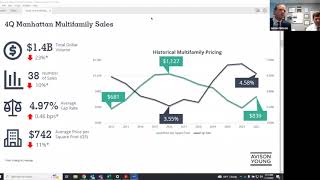
Sure. Sorry about that. Yeah, so I think generally speaking, I guess we can back backtrack a little bit into early 2022 and then kind of see how we progress into the later portion of the year. So in early 2022, we saw sale sales volume pick up. And as you can see in the overall numbers from the historical multifamily pricing section, you know, we saw cap rates come down and we saw price per foot jump up. The reason for this was there was a lot of optimism in the multifamily space. Rents were climbing at rapid clips. Interest rates were very low. You could borrow money in the threes. And we saw a huge drive of demand towards this. I think also, you know, if people Forget that in 2020 there was all this talk of good cause eviction, that kind of started to grow fear amongst investors. And I think in last January, state of her state address, Governor Hochul really calmed down that, that sentiment and that she, she wasn't supportive of it. So I think that also gave investors a lot of confidence as we progressed through the year, really we started to see it in June. Interest rates started to tick up. Now there was some offsetting of, of what was happening with the interest rate environment because last summer, if you looked, look at rent rolls day in, day out, and what you saw a lot of was the new rents that were being signed were still substantially higher than even prior months and especially 2021. So investors were still able to offset a little bit of this rent mortgage rate increases by the increase in rents projected. What you eventually saw is the rental market. Not that it cooled off, but it plateaued a little bit. And I think one thing that I think is overlooked by a lot of people that I speak to today is they're saying, hey look, the rental market's softer. I think they forget that the COVID year or years I should say was kind of an enigma. The rental cycles were thrown into flux. So yeah, last year we were seeing rents in December signed higher than call it the summertime, but we were also in a new world. Now right now it's the winter time. Look, historically that is when rents are soft. It's just, it is part of the rental cycle. We're back into more of a normal cycle. And I think a lot of people are overlooking that fact. But putting that aside, rates started to climb dramatically, as we all know. Again, just to make it clear that the Fed rate is not the rate charged to borrowers on mortgages. But that's a whole other conversation. With that being said, those rates also climbed though over the last few months they've kind of leveled out a little bit. And what you saw was in the fourth quarter as rates climbed and people started becoming uncertain of the future again. Underwriting is just a prediction of the future. And really what happened was buyers thought, Tom, or think still that things are going to get worse before they get better. So no one wants to catch a falling knife. They say, look, I don't need to invest right now. Let me wait a little bit. What happened? There was less sales. So because pricing started to dip and people started to wait. There's, you know, as you can see, there's 38 less sales. Cap rates started to rise again. The price per foot came down and total dollar volume came down. Especially, you know, these large scale transactions that involve a lot of debt. They were the, they got hit the hardest because these rely so much on, on those extra dollars that you can borrow and the cost that it cost that you're charged to borrow it. So I can say anecdotally, you know, and this isn't reflected in this chart, there was a lot of sales. Now I think if you were to ask James or myself or anyone on our team, you know how we're seeing things today, I think we would say from a contract signing standpoint, it has definitely gotten more challenging. We definitely needed to have more competition than we ever have to ensure that we can get sales over the finish line. If we're negotiating in a vacuum, it's just difficult because right now we're just in this market where buyers feel that they have all the leverage. Not to mention there's just less borrowers because there's less equity chasing deals right now. With that being said, a lot of sales that were taking place in Q4, you know, they were signed in Q3, Q2, there was long closing periods as people tried to figure out what was going on in the lending environment, especially the banks were taking their time. So we, you know, ourselves had sales close in December, where we signed a contract in June, I mean, and the sale, you know, the closing got delayed a little bit. We got them over the finish line and you know, we were successful. But we also had hard deposits in the seller's escrow account. So that definitely helped. As we move into 2023, again, anecdotally can say we are still signing contracts. That's the positive news. It's not just a completely frozen market, but pricing has been adjusted. There's a lot of property on the market right now in the multifamily space. So there's a lot of competition amongst sellers chasing, you know, a small pool of outlier buyers that are willing to pay a premium, especially for renovated product. And on the value add side, again, I know a lot of sponsors are out there looking for equity. You know, who's going to dive in here with me seeing this opportunity? To me personally, and I'm sure to our team in general, you know, a lot of us were here. If you look at this historical multifamily pricing chart, we were here in 2012, we saw, you know, and you can see it's a. It's a peak, it's a trough, it's a peak. And we're sitting here today and we're scratching our heads again. If you're a believer in New York City long term, even with the higher cost of capital, you know, you might have bought a property in 2015 with a lower cost of capital. But guess what, you know, you're probably under. Not necessarily, but you're probably pretty close to break even right now after you spent a lot of time and money. So I think just the value proposition, I think people need to recognize it and people have short memories. You know, Covid was quick and I think this rate environment, who knows how long it's going to last. But if you see a good opportunity, you have to keep betting Tom on New York if you're interested in buying. So again, Pick and choose. But there's definitely opportunities coming in 2023.
Thanks Brandon. So wanted to ask you because one thing that is pretty telling you see the cap rate expansion that is now taking place and I know we've all been feeling this on the brokerage front and certainly hearing this from investors, but you finally see cap rates expand up to close to 5%. Now that's just for the fourth quarter over these 38 sales. Whereas the four and a half percent that you're seeing on the right side of the screen, this is the average over the years. So clearly you're seeing cap rate expansion. Now. This is just a barometer, right. So this is going to include rent regulated and fair market. So I'll go ahead and ask the question because if not, I'm sure we're going to get it anyways. But Brandon, what is the difference in the cap rate if it's all fair market, if it's fully regulated or if it's 50? 50.
Sure. So I think if you're looking at, I think the general one thing I would definitely mention, and I want to quickly just preface this, is that when you're selling multi family product, I can just say anecdotally, I always say, but there is just far more buyers looking for fair market product than there are rent stabilized products. So what does that do? There is a, there's almost like a doubling effect on the cap rate where for the few group, for the small group of buyers that'll buy 50% rent stabilized or fully rent stabilized. The challenge that you have with those buildings is that, you know, when we sell fair market value add building, there's an exit strategy to these operators that we're selling to. They want to go in, they want to renovate and they want to sell. They also are sophisticated enough to know that when you're selling renovated product, the buyers of that product are generally high net worth individuals, foreign investors, 1031 buyers, they don't want to touch rent stabilized. So it's really hard to exit 50% rent stabilized, fully rent stabilized. With that being said, that's where the value is. So you know, we've seen, you know, 100 basis points, 200 basis points in spread between the two products. And it's just a different pool of investors. I think in the rent stabilized, 50% rent stabilized space, it's going to be more long term investors, someone that's going to hold it on generational, maybe the politics change and it's a good basis. Whereas the fully fair market stuff, that is something where an investor is looking for 100 basis points spread when they exit. So there today, seeing that renovated product, let's say on average trades for a five and a half cap in, in Manhattan per se or Brooklyn, maybe five and a half to six. So what do they need to do? They're building, they're taking that. The going in cap rate is almost irrelevant because it's a metric of, it's not really a metric of the upside. So they're determining how much upsides in the building. Can I build this to a 6 1/2% yield on cost? And if I can, what's my price? Because I'm expecting that I'm going to sell it at a five and a half. Again, if you were to ask me this question six months ago in May or I guess June now at that time we were selling finished product at a four and a half cap. So buyers were trying to build to a five and a half cap. And that's been the shift in the value add. Pricing is the yield on cost that buyers are solving for. And again, they might also feel more bullish, but they need an equity partner that will go into the deal with them. And this is what the equity partners are requiring right now. Unless it's your own money, you know that you have to, you have to follow the lead of the money.
So that, no, it's very, very helpful. That's certainly important to make the distinction. So we did have someone who raised their hand in the audience. But just if you don't mind, send us a question in the Q and A or the chat. We'll keep moving here. Let's talk about some of the top multifamily sales that happened this past quarter. So Brandon.
Yeah, and I know I've been long, so I'll rip through these. So the, the properties on East 61st York Avenue, East 72nd Street. I've actually personally been to them. Gorgeous properties. You walk in, there's three people holding the door for you. I have a friend that lives in one of the properties. Very nicely renovated units. This was purchased by Josh Gottlieb, Mayor Orbach and plenty of investors. One thing to note here, you know, I don't know, I think generally speaking there's, there's an opportunity here based on how these properties were being run to increase rents and decrease expenses. And I think that's the vision for those properties. It's, there's no, no one's going in and doing substantial work there. 298 Mulberry Street. This was purchased actually by Empire State Realty trust with a 1031 exchange. You know, and I tell you that they really wanted something that was cash flowing. They bought this with no debt. It was a very low cap rate. It was in the low fours. It was a higher price per foot. But look, you know, it's an irreplaceable location. You're always going to have tenants there. You have CVS on the ground floor. My sister actually used to live in this building probably 15 years ago and they had a billiards hall on the ground floor. But yeah, it just, it's almost a coupon clipper. It's irreplaceable. Great location, great asset. And then 138 E. 12th St. This one was a good sign of the times. I mean, this one was purchased a few years back. It's got west side Market on the ground floor. I would say it's probably the highest rents in the East Village. I have to double check, but I'm 90% sure that or Cooper Square, which is also on a ground FL lease. Highest rents. This is the Nathaniel. This was purchased again on a ground lease. There was a substantial loss. I forget exactly what it sold for a handful like in maybe 2017. But this was actually, if you look at the numbers on, on the ground lease, I mean there, this was like a six and a half gap. So again, I think that goes to show, I think the ground lease aspect of it definitely adds another 50 or so basis points to the spread, maybe a little bit more, you know, that that's what it took to get this sale done in this rate environment. So yeah, great.
So one of the questions we did receive Was does your Q4 cap rates include the solo portfolio, which seemed like a 3 cap? So yes, this is the solo portfolio here. If you have information that this was a 3 cap, I don't know if we were able to verify that or not. That would seem like a pretty tight rate to me.
It would seem pretty tight. We can definitely double check there. Again, there was a plan to substantially reduce expenses and increase the rent roll. Again, you know, underwriting is a basis of assumption. So even if it was a going in three cap, if someone sees upside, however that may look again, they're looking to build to something. And also we would need to really understand when that contract got signed, which again is homework that I need to do because they might have been able to lock in a much lower interest rate at the time. And there was a period of time where these properties were selling to build into the low fours to get to that. I mean, that's where these properties were trading a year ago. It was, let's get this to a low poor cap. So if they saw a path to getting there and they had the right debt in place, it actually would make sense.
So this was one of the. I mentioned initially, there was the top 10 transactions. It's our belief that nine of those were all signed before rates began to go up. So this was the one sale that took place in November, presumably contracted after rates began to go up. So if that was a 3 cap, that would be a pretty good impressive sale result, all things considered. I've got to imagine. Yeah. Basis quality of assets. So. And Zach, we'll get to your question on the development as soon as we. We cover that asset class. So.
And I'll quickly rip through this because I know Ashley has some great, you know, things to share on the. On the future of New York City. But effectively this is just showing. And this kind of ties to the question we just got asked about 421A. Why do we believe that rents are going to keep climbing and that there's an opportunity? There is no product, there's no supply of apartments, as we all know. It's, you know, you don't have to read. You can read the news and you'll read exactly what we're reading. We have a serious supply issue in New York City and affordability issue. Until we can solve for that, which, by the way, even if we sell for that, it doesn't gonna. It's not happening overnight. Right. So even if everything goes through the legislative process and we're able to figure out ways to create housing, you know, you don't just create housing by, you know, snapping your fingers. It takes time to get that through legislation. And then you actually have to buy it and you have to build it. So for the foreseeable future, there is an extreme lack of supply in apartments. And as we all know, people want to live here and the demand is high, and that is what's gonna keep rent steady. I beg people to continue to watch the rental numbers and stop telling us it's a soft market. Again, it's December, it's January. This is exactly what happens year in, year out. And it's just a cyclical rental cycle. And I think that people forget that. Again, it goes back to short memories. Let's think of 2019, 2018. This is very standard. So I'll be interested to see where rents start to look like in May, June, July, August, as we do every year when they climb again.
So great point. And I know Ashley is going to get to our mayor's moonshot plan. And Rebny has also said that they expect we're going to need over 500,000 new housing units by 2030. And if you can see now, this is just Manhattan. This is not looking at all New York City. And we can certainly bring that information to you for the city next time. But just as it relates to Manhattan, you can see back in 2014, over 12,000 new units were brought to market. And you know, since COVID while 2021, you know, that was kind of maybe the tail end of trying to get the 421. Yeah. But other than that, you know, 3,000 units, 2,000 units. So.
And by the way, 2016 was when is no. 1 for 21. I originally expired with 2016. Right. It was five, six years ago. I mean, and you see how quick, how long that the number zapped, you know, after when the 421 was originally in flux back in 2016.
So here's the filings, just so you see on the number of units in this. Okay, so we do have New York City. Great. I'm glad we included this one. So you can see, you know, at a peak bringing 45,000, 33,000 units. And in the last few years, yeah, it's been in the mid 20,000. So that's certainly if that's. If we're only adding that many units per year, there's no way we're going to get to the 500,000 needed. Okay, so let's talk about land sales. With that, you see that land prices in Manhattan have gone down from really a peak of 681 to 409 a foot. Only eight sales for an average in the fourth quarter of 330 available foot. The average for the year was 409 a foot. You look at the kind of sales that are taking place, certainly the one on the Lower east side with Clinton, you're seeing these are more rental sites. You are still seeing some examples of condo development on the Upper east side. But in large part, the type of land that's being sold right now is either going to be going for affordable condos or rental, which is again, without the 421A. So we have some developers who are willing to do that.
Again, it comes back to price for buildable. Yeah, it all, it all comes back to base. I mean, the Upper east side and you know, that was obviously a family that purchased this. For what it's worth, I spoke with them they had offered $20 million more a couple of years ago. So just to give again that sense of where we are. But again when you're looking at these rental sites, I can say in the last quarter a lot of these sales were actually happening. You know, sub$400 of buildable foot, which I think if we have like the historical dollar per buildable, we're just seeing a slowdown in that market. I think a lot of that's the construction financing costs and the prohibitions on what you can do there for sure.
Okay, so now we'll look at retail and retail we've seen the most dramatic expansion on cap rates at 6.3% for the year that the average, or excuse me, the last quarter was 6.58% the average of the year at 6.3. Price per foot. You know, the price per foot really depends on where these assets sold. So when you start mixing in side streets with, you know, prime soho, Midtown. But I think the cap rate is pretty telling that finally and we are going to look at a comparison with the various asset classes and what cap rates are doing, you're starting to see some differentiation because retail again in theory has more risk than multifamily. So it should offer a higher yield. So I think this is a very attractive space to consider right now. And if you look at the type of retail that's trading right now, certainly we're seeing some interesting transactions opportunities down on Green Street. This one or two Green street if I'm not mistaken, this was leased by Cartier, brand new 10 year lease at a six and a half cap. And I think when investors hear that, that is really, if we're talking about credit fashion, SoHo, six and a half cap, new lease, that really.
That was eye opening.
Yeah, eye opening for a lot of people for sure. That being said, it was kind of a pseudo off market deal in that it was part of a larger portfolio. That's the value attributed but still pretty impressive. And then the corner here on the Upper west side on Broadway. Yeah, and short term lease with Staples. But the buyer there is confident that they be able to relocate them and free up some additional space. So excited about that. And then some more kind of neighborhood retail that sold on the 86th Street. And I did speak to some retail brokers last week and you know, some of these corridors, retail has really bounced back and in some cases is now even at levels that were pre Covid. So that is a reason for optimism when it comes to retail rents. Okay, so last but not least, office sales which is one that continues to. When you look at this cap rate, it's really been pretty stable and hanging in there. And when I gave my interview to BizNow, the one thing I asked them, I said, well, look, you can obviously print this, but you really have to add the disclaimer here. When we see that the average price per foot in the fourth quarter dropped 53% from the trailing four quarters, I said, look, that is really not a fair statement to make because here we have. This is only over 8 sales. And what you're doing is you're blending, you know, you're averaging class A, B, C and trophy. So if this was just a result of in this case, you'd say, well, James, these addresses look, you know, pretty good. I mean, 1330 Avenue of the Americas. Now, if I'm not mistaken, this was a 6 cap even though it was only 60%.
Yeah, got 225th Avenue. That was a lease of an option to buy struck years ago. The option was exercised and then 175 water. Don't want to talk too much about this, but this was taken back by the mezz lender. They resold this and this is going. This was AIG's headquarters. It was 50%. They were originally going to do 50% resi with 50% office abandoned the plans. But that's going to be a residential conversion now, which is right next to 180 Water street, which is residential conversion. You've got 20 broad down there. You know, obviously you have a couple things in the pipeline with, with Nathan Berman Downtown and his partners.
So GFP's purchase.
GFP with Nathan. Yeah, and Silverstein on.
And some of those were sub 400, even sub 300 very cheap bricks. So. So that, that's where you start seeing the, the dip in average. But that's not to say that the trophy is worth in the mid-400 a foot. That that would be. This is for.
That would be misleading. Yeah, exactly.
Okay, so these are the top sales for 2022 again, all but one of them being negotiated in the first half of the year with Google's purchase of 550 Washington St. St. John's for almost $2 billion. 8 Spruce, which was Brookfield's sale to Blackstone. You've got the Disney Campus which was purchased by xtel. You have the American Copper buildings again bought by Josh Gottlieb and Mayor Orbach. They are on certainly a tear. You've got the rest of the solo properties that we discussed and then looking at some other multifamily downtown that was bought by. Yes. 450 Park Avenue and then Riverside Boulevard, another solo property, and then a development site to round it out. So those are your top 10 sales for the year. Okay. So looking at the five year historical pricing and just asset by asset again, what amazes us is how certainly office has held in there. It's kind of held its ground. If you even look where it was priced on average, 2018 until today, you're not seeing much difference. Whereas, you know, retail has been volatile to say the least. And you could say that's because there's not enough sales and you have these huge swings. Whereas multifamily compressed and is actually showing some signs of strength. And again, that goes to what type of assets are selling? Are these regulated assets? Are these more fair market, trophy type assets? And land seeming to stabilize. So that just kind of gives you a sense as you compare these together. Okay. And then cap rate again, same kind of story where multifamily and office, certainly we saw some compression and now we're starting to see some expansion and it's really been retail again, which is starting to really show some significant cap rate expansion. So with that, Ashley, we'll, we'll turn it over to you.
Thanks. So switching gears here a little bit, I'm going to cover the new New York plan, which was a joint city and state proposal that was published at the end of last year. And this three part action plan is comprised of 40 different initiatives outlying all the goals of the city and state over the next decade or so. So the first major goal that they outline is reimagining New York's business districts as vibrant 247 destinations. And the major strategy under this goal is to create flexibility to repurpose space and fill vacancies with a variety of uses. So, you know, it's no surprise to anyone that the office market was hit particularly hard by Covid. And it seemed that the pandemic really revealed the rigidness of the existing zoning code. And so the goal here is really to make it more flexible for business districts to continue evolving and become more dynamic neighborhoods. And so in order for this to happen, there needs to be a modernization of outdated regulations and a reduction of the current barriers to entry in order to allow this housing growth to really happen. So specifically as it relates to conversions in midtown today, as the zoning code is written, office buildings have to have been built before 1961 to be eligible for conversion. And so the goal here is to refresh this the way this is written. So the cutoff Threshold actually is extended to December 1990. And just that one change alone would bring over 120 million square feet of office space, unlock that potential for those conversions, which would be really, really massive. There's also discussion of potential tax incentives to help these, these conversions really be able to pencil, you know, with the increased NOI and increased tax rate that come with converting from office to residential, as well as the inability to pass through some of that tax, you know, liability like you can in a commercial building. The government recognizes that in order for these to be really feasible, there likely needs to be some sort of tax incentive there as well.
Ashley, not to stop you there, but just to underscore that point, and first of all, you know, it's really great to know that this, you know, office to residential conversion is a top priority at the city and the state level. That being said, they do allude to the need for a tax abatement, but we are still waiting clearly for a new 421A for ground up, let alone an abatement for a conversion. And by our estimation, out of the 78 office buildings which have sold since COVID to our knowledge, only three of them have been converted to residential. Okay. And we could talk about why have only three buildings been converted to residential when the availability rate in the city is 20%, constituting 100 million square feet. And first you could say, well, zoning, clearly. So you can't convert a building if it does not have residential zoning unless if you do a spot rezoning. So it's good to hear that the plan certainly addresses that. The next is the floor plate, where again, if you have a large floor plate, you might not have the proper light and air. You might have to core out the property. Clearly this plan will talk about some flexibility in that regard, but in my mind, last and most importantly is the financial benefit, unless it makes sense financially to do this, meaning you have to buy the property for the right price. And no doubt an abatement can help facilitate and make that possible. The fact that we have not had a program yet like a 421G, which was really cited as what saved downtown, is probably a big reason why, again, we've only seen three of these conversions to date. So I just wanted to point that out, but keep going, please.
Thanks. So just the three other main strategies under this first goal here are continuing to invest in beautiful and permanent public space, as well as sharpening up what does exist now in New York City and really making those spaces more world class, improving quality of life issues. And this includes cleanliness and sustainability, as well as offering new reasons to go to business districts. So jumping to the next slide here, James. Oh, here we go. The second major goal is to make it easier for New Yorkers to get to work. And the first strategy here is increasing the supply of mass transit options. There are a variety of different initiatives under this first strategy, but some of the main ones are creating a sustainable operating budget for the mta, maintaining peak subway service and also improving the frequency and reliability of off hour subway service, increasing bus speeds and investing in more protected bike infrastructure. Across the city. There will be a push to reduce the demand for cars and trucks, including congestion fines and things like that. And another effort to strengthen employment hubs and workspaces all across the five boroughs through investing in employment hubs as well as modernizing libraries to, to support remote work. And the last goal here on the next slide is to generate, to generate inclusive future focused growth, firstly by establishing New York City as a hub for future industries and innovations. Secondly, and James sort of touched on this earlier, but they established for themselves a moonshot goal of creating 500,000 new units over the next decade to really address the housing crisis that the city is facing. So as the, as the law currently is written there, no development in New York City can, can exceed 12x far. But so if the state were, this is a state level cap. And so if that state cap were to be lifted, then city officials would be able to go in and you know, pick and choose which areas make sense for there to be an increased density of residential development. So for instance, in, in Midtown where many commercial developments far exceed that 12 far, you know, having larger residential projects would actually probably fit very nicely in with the neighborhood fabric and would make a lot of sense. And this, this goal also targets office conversions, especially the ones that James was mentioning earlier, where larger floor plates limit access to windows and, and, and light and air and really make it hard to, to convert. So removing this cap rate would, would allow developers to be able to tear down underutilized offices and build back larger projects than what are currently currently allowed. And again, there is talk here about a program to replace the expired 421A. So you know, last year Governor Hochul had proposed the 485W plan, which didn't make it through the budget discussions. But she has mentioned that, you know, they're working on some sort of revised proposal here that we're yet to see the detail on. But hopefully, you know, there is some, some sort of program that would further incentivize this sort of development, especially those requiring or, sorry, containing affordable housing. Excuse me. And this goal also outlines the need for larger fars for affordable housing projects, amending of low density districts to enable for more production of units and removing and reducing parking requirements across the city. And the last strategy here under this goal is to ensure that growth and access to opportunity is fair and equitable. And in the initiatives under this one, there is a lot of talk around affordable child care and potentially having some sort of tax benefit for developers if there is some sort of child care facility included in their projects.
Yeah, thank you, Ashley. Yeah, go ahead.
I was going to say I think it would be helpful for you to explain what was in the 485W proposal that was rejected. Just so that our people understand like what was put forth and maybe gives them a sense of what to expect.
Right. So the last 421A program that we knew, the Affordable New York, there were five potentially six different options on different affordability requirements based on the location. But for the bulk of rental housing that was built, option C prevailed. And that was although there was a 30% requirement for, for affordable that was at 130% of AMI. And I guess the opposition said that doesn't constitute as affordable because in many cases that produces a 45, $50 foot rent. What we need is deeper affordability. So what our governor put forth with 45W was really an attempt to provide deeper levels of affordability. Reaching to make sure that providing for 60% AMI so rents that were, you know, half or less than what the Affordable New York program did. So which we agree is very important, we need all types of housing. Again, if we're going to need over 500,000 units, we need fair market, market rate housing. We need all bands of ami. So we certainly support the deeper levels of affordability. However, when you consider that based on land prices and where you can accomplish that, because when you based on construction costs. Today we've seen several developer models and we've worked closely with REBNY on this. When you are generating, when you are delivering affordable units at 60% AMI levels or less, you are having to clearly subsidize because that is not a profitable endeavor. So as a result, and we looked at one site that we sold in East Harlem and back under the old Affordable New York and we ran it through the same model and we sold that site at 250 a buildable foot. And once we ran it with the new rental requirements, it actually cut the land value in half and Some might say, well, you know, these landowners, you know, they're plenty wealthy and, you know, it's still, you know, why can't they still sell? And again, the fear, I think, is if you can't achieve a reasonable price for your land, you just won't sell and you'll wait for the next, for the future. And, you know, so, so alternative sell.
To a condo to build.
Right. Or do condos. So I think with the 485, it was proposed, we could see that working, but not in, certainly not in Manhattan, not in downtown Brooklyn, you know, Long Island City, maybe further out in the boroughs, but. And that was rejected. And that was rejected. Yeah. So, you know, we'll see. You know, Ashley, one question I was going to ask you is just kind of the give and take between, you know, the city and the state. And, you know, when I saw, when I listened to the broadcast that association for Better New York put on, it was really great to see the mayor and our governor up there on the podium together. I mean, they are definitely lockstep barrel on this. We've got the same goals, but just so everybody understands kind of who's handling what. I mean, maybe talk a little bit what's under the city's purview and what's under the state's purview for this to happen?
Yeah, so I think that a lot of this starts with the legislature at the state level and, you know, the, the far left group in that, in that body of government makes it hard for a lot of these real estate initiatives to really come to fruition. So, you know, that's why this is very much a proposal and not, you know, set in stone that these changes are going to happen. I know, for example, the, the far cap that, that's really a big push to, to lift that is, starts at the state level and would require the state to remove that cap before the city can then, you know, do what they will with that, with that information and hand pick, like I was saying before, which neighborhoods they think would make sense for the city to increase the density. So I think it probably depends on, you know, which initiative that we're looking at. But I do think that a lot of this starts at the state level and we'll have to see what happens with, you know, the upcoming proposals of these bills and if any of this actually comes to fruition.
Perfect. So in closing, and then we do have a couple questions here I want to get to. But the first question is, when are we going to see a slowdown in the frequency of rate hikes. So look, I wish we all knew. What I will say in speaking to many of you is the consensus is that, look, rates are going to continue to go up this year and then they're going to come down in 2024. I believe that's kind of a dangerous mindset to be putting out there if you are basing your investment decisions on rates coming down in 2024. First of all, none of us have a crystal ball. We don't know where this is headed except for what we've heard our Fed chairman say, that it would seem that rates are going to continue to go up this year. And so I think we could see maybe two smaller increases. @ least that's what seems to be the consensus. But as far as what happens, and again, that really to me starts becoming dangerous territory. I think one thing that we are starting to pay attention to and surprisingly has not received a lot of coverage is this debt ceiling discussion in Congress. And I'm going to just leave it at that because I would encourage you all to just take a look and tell me what your thoughts are on that. But there's some major, major implication if Congress cannot get on the same page with that or, or even potentially exceed that debt ceiling or allow that to happen, because that could have major implications on rates that I think would take a long time to play out. So I am certainly not an economist, but I also know that sometimes we all go with this consensus. And speaking to sellers, buyers who are just waiting to make decisions based on 2024 when things are going to miraculously turn around, it seems to be a lot more complicated to me.
By the way, if you think you're going to miraculously turn around in 2024, right now is probably the time to buy.
True. Good point. So the other thing we're looking at, and this is a big theme in this month's white paper, we talked about eight investment ideas for the new year and a lot of these loans who are coming due. And forget about cash out refis, we're talking about cash in refi. So what happens to all these owners who do not have the ability to pay down and they may very well have equity in these deals, I think we're going to see a lot of opportunities there on the sale front. Whether owners are forced to sell or we get a call, you know, three calls a day from funds saying, hey, we're we've got a rescue fund that putting together meds. I mean, we're going to see a lot of that and there's going to be a big need for it, especially in the office space as many of these lenders are now starting to pull back in that category. So the last thing, and we've spent a lot of time on this office to residential conversion so I don't think we need to, you know, spend more time on that one. But we'll, with that we'll go ahead and we'll go through a couple of questions here. So I'll pull this up. So Brandon, maybe you can feel this one asking about the profile of buyers today. Now I know that really depends on, you know, the type of assets, but let's just talk about the multifamily space right now. Has it been the institutions? Has it been private buyers? Has it been, you know, the 1031? Just, you know, maybe tell us, you know, who are the buyers? Who are, who are active today?
Sure. I mean we can even look at our, you know, going back to our recent sales. So on the value add side, it's been predominantly dominated actually by I would say operators that are also have, you know, let's say 100 plus buildings or a large portfolio. They have capital ready to go at their side. It's not that they have to go raise it on a deal by deal basis. I think a lot of the groups that have to go raise capital on a deal by deal basis as opposed to having the equity, you know, ready to go if they see a good opportunity. That has been the dominant buyer of value add product in the rent stabilized space, that would be more long term holders or someone that, you know, is just going to buy it and hold and clip a coupon. They have a good management team in place to operate these properties. And then on the renovated assets it continues the institutions obviously up until call it Q4. I mean this is for almost entirely foreign high net worth 1031. I mean I think that's a pretty consistent theme throughout any cycle. But you're really seeing it to a dramatic effect where unless it's what we call the unicorn buyer, so many groups have pulled out and these people also are coming in with a lot of cash and they're usually buying properties between call it 5 and $15 million, a little bit smaller of a check, but it's their own, up to 25 million, but it's really their own money. And, and again it takes a lot of work on our end to find these buyers, a lot of follow up, a lot of, you know, networking within different pools of advisors who represent these groups. But it's definitely Been driving the market in the multifamily space and it's something we have to keep doing.
Yeah, I definitely agree with all that. And it never ceases to amaze me also with the amount of foreign interests, especially when there's times of uncertainty and where we see opportunity, you would think that would be the time that the local operators would jump in, but they're the first ones who say we know too much. This doesn't look good. Where sometimes the foreigners say, hey, it's still New York. Right. And I'm taking a long view, so see the forest? Yes, that's right. So I will, I'll take the next question asking if we are seeing any loan sales. Yes. Now that being said, and I think back to 2009 in the depths of the, you know, the financial crisis and we were representing a lot of the big banks selling, you know, loans for busted condo deals. You know, we are not seeing a lot of that this go around. It seems like many of them learned their lesson. And you know, what we do see is a lot of these private lenders who came in and. But these are not just first mortgages. And I think kind of the difference of what we saw back in oh nine compared today is this is going to happen a lot faster because a lot of these private lenders, they said, no, we're not just going to sit here in a first mortgage position. We're going to also come and sit in, you know, a mez position where we have the ability to UCC foreclose, step into the, you know, the borrower's shoes and take the properties a lot quicker. So I mean, the discussions that we've had with lenders out there about loan sales, you know, they don't, they don't really volunteer much of a discount off of par. So, you know, I think, you know, the bigger question again will be with office in some these cases where the building is obsolete and there's really, you know, no ability to pretend and extend there. So we'll continue to inform you. But you know, the other thing is we call a lot of these community banks. No, we don't have any loans. We're selling. And then we call, you know, we call you all our clients and say, you know, what have you been up to? Well, I just bought three loans from my lender and that's, that's what you should be doing. If you are not calling your lender right now, asking them what loans they have to sell, if you borrow from them, you are going to have a much better chance than we are, because these lenders are not interested in, you know. Yeah, they don't want to air their dirty laundry, so to speak. I mean, obviously, it's a different thing. We do a lot of work with special servicers, cmbs, and if they've got to sell, there has to be a process. But with a lot of the community banks, sometimes your best bet is to go to them directly. Okay, so in the interest of time, I think we're going to just field one last question, which is what is your favorite asset class to invest in? So. Well, look, I gave eight investment ideas, so I'll think about, you know, what is something. And I'm going to double down on retail and wrote a white paper on this last year. And we've already seen retail rents recover. In some case, it's doubled from the trough. In some cases, I said we've already reached rents that are back to where they were. And meanwhile, you know, we're seeing some great cap rates out there. So some of these corridors, you're seeing very low vacancy, certainly SoHo, even Madison Avenue for a while, which had a lot of vacant stores. So that would be my pick. Brandon, I know you're a multi guy.
So I think just on the retail, what I think is interesting is, and I do this when my wife wants to go out for the day, go into the stores. I think it's really interesting to see kind of how they've redesigned, like they're repurposing, like, what retail is. And that's kind of been one. One of my cool takeaways is that they don't necessarily maybe look for the last dollar, but they're saying this is an affordable rent, this is good marketing exposure, and this is a new way that we could sell our product. So I think that's been really interesting. And you've seen success. I love multifamily. Why? I think. I think if anything, the politics are starting to head back in the right direction. And I think that buyers have almost. They've almost scared themselves away in some regards and not just seeing value. And we saw. I think we almost have the benefit of we just finished Covid, where, you know, every conversation in Covid, it was exhausting. Where it's like, oh, the rental market won't come back for three years. And then next thing you know, one person buys and the next person buys, and then people start coming back and prices shoot up. And it's like, I told you so. And it feels like the same thing again where everyone's saying, no, this Time's different. And I understand interest rates, but, like, this isn't the first time that the US Economy's had inflation. It's not the first time that rates have gone up. Like, go look back at the 80s. Go look back at the 90s. This has happened before. The economy goes in cycles, and the people who buy low and sell high do the best. And the people who kind of follow the herd, they bought a lot of property in 2015-2016-2017-2014, probably didn't do that well. And I think it's like, you almost. It's, again, I understand it's hard to invest when there's fear in the air, but it almost becomes. It's like just look historically. And I think people have very short memories, and I think it would be beneficial to kind of, again, try to see the forest through the trees.
Perfect. Yeah. And I know we both cited Warren Buffett in that regard before about this environment where. Yes, the good news for you buyers out there is that a lot of the competition's on the sidelines. So there will no doubt be opportunities this year. We're handling several estate sales, partnership disputes, distress. They are going to trade. And so when everybody comes back into the market, you know, next year, 2024, when the hope is that things are going to, again get a lot better, you'll also have a lot of competition. So with that, we really appreciate you all joining, as always. And yes, we get the question. We will be providing you a recording of this. Happy to share the deck with you. I want to thank Ashley for all your work summarizing. I know this was not just a matter of, you know, just writing down a couple bullet points. I mean, these documents are, you know, in the hundreds of pages with these plans, very detailed. So thank you for keeping tabs on that, and we look forward to being in touch with you all soon. Thank you and have a great day.
Thank you.









