An Overview of the City & State Budgets and the Future of Property Taxes
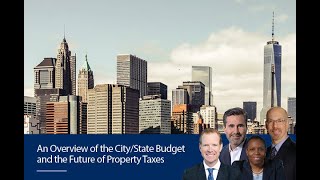
Panel discussion (June 2020 webinar) on New York City and State budgets amid the COVID-19 crisis. Panelists (Andrew Ryan, Martha Stark, Ari Shalom) review large projected revenue shortfalls (city: initially $7.4B over 16 months, updated toward ~$9B; state: an estimated $13.5B current-year gap and roughly $60–61B over multiple years), the central role of real-estate-related taxes for NYC revenues (property + transfer + mortgage recording + commercial rent ≈56% of tax receipts), rising reserve assumptions for property-tax delinquencies (city reserving ~7.7% of a ~$33B levy for FY21 vs prior ~6.4%), and policy options including spending restraint, workforce/management changes, use (and limits) of federal aid, possible borrowing constraints, and legal/policy reform of the property tax system (lawsuit argues inequitable links between assessed tax burdens and market value). The conversation also covers investor reactions, landlord liquidity/forbearance, and audience Q&A on technical points (debt rules, interest rates on unpaid taxes).
But really appreciate, as always, everyone making time today. And I'm going to give Andrew, Martha and Ari their proper introductions. But again, really, really grateful that you could join us for today's discussion on the city and state budgets, the shortfalls and how property tax fits into this. So we were just saying before many of you join that Andrew, it was really Ari who had brought this to my attention, this topic months ago about what would happen if there was ever a crisis, an issue. How is the city financially and the state prepared to deal with this? Little did we know and we were just saying we thought that conversation was in February that this would happen. So very, very timely to be discussing this. So appreciate you all making the time. So before we get into it and discuss our cities and state's financial future, I really, I feel like I have to address our most current pressing issues that are going on right now in the city and the country would be wrong not to. And so not that this could be addressed in one comment. So I know. But I did want to share with you all a comment from Rebni, which I think gives us at least something really to consider right now and to think about which is and I just want to read it. Our industry will not ignore the sadness, pain and understandable frustration the black community in particular continues to experience. We must focus on how we can all come together to provide real solutions and not just lip service to address these issues. I just invite you all to really think about what these solutions are as we come together these really, really challenging times. But I just wanted to share with you that statement and want to make sure that we have that dialogue in the future. But with that I want to welcome and I'll introduce them. I've got Andrew Ryan, who is president of the Citizen Budget Commission. Andrew has over 25 years experience catalyzing constructive change in public and social finances and services as a leader and premier not for profit and public organizations. Andrew served as the Associate Director of the U.S. centers for Disease Control and Prevention and he led the development of the US's first ever national prevention strategy and the health reform portfolio. So I'd love to be asking you a lot of questions about that today, but I know it's not immediately our topic, but I'm sure that there's a big piece of that related to the budget. But you spent time also as COO of NYC Health's department where you oversaw $1.6 billion budget. So I know you started your career at the cbc, so and I know they're thrilled to have you back there with you. Next we have Martha Stark, who joined NYU's Robert Wagner graduate School of Public Service. Previously. Also she serves as a lecturer at Baruch College. Martha is a tax policy expert and serves as the policy director of a coalition of groups that has sued New York State and city claiming that the property tax structure violates the Constitution and various tax laws. She's also helped craft an alternative to a proposed pied a terre tax system and has a law firm that challenges property taxes on behalf of owners in court. Previously, Martha served as the commissioner of the New York City's Department of Finance, a 2,400 person tax agency responsible for collecting more than 22 billion. I guess that was at the time in revenue to fund and support local services including education, police, fire, sanitation and libraries. Her many accomplishments include administering a tax amnesty program responsible for collecting $80 million in additional revenue and removing bad debt from the city's books. So Martha, thank you so much for joining us and all the work that you've done on that front. Lastly, from the owner's perspective, Ari Shalom is founder and managing partner of RWN Real Estate Partners in New York City based middle markets real estate private equity investment platform. RWN targets direct and controlled JV investments and focuses mostly on value add properties in New York City, Texas, North Carolina and Miami. Since 2011, RWN has acquired nearly 800 million of real estate with approximately $350 million of equity across 25 transactions. Formerly you were the president of Enterprise Asset Management, also director of acquisitions at Taconic as well as at the Kaufman Organization. And you're also on the advisory board of the Institute of urban research at UPenn and also a frequent visiting lecturer at the Wharton School. So we've got a really great panel for you all lined up today and so I think we'll jump right into it. So Andrew, if you can help us set the stage. This pandemic has required unprecedented stimulus. You know, at the same time city tax collections have gone down maybe because I've heard estimates across the board for how much is the shortfall going to be for the city today? The future sand same question for the state. I've heard the estimates of the city are seven and a half billion. I've heard at the state over the next couple years it could be well in excess of a $30 billion shortfall. But what are we really looking at here?
First of all, thanks James, for having me and I get to spend time with Ari and Martha and you. That's wonderful. As it is, we have spin back to January, when the mayor put out in the halcyon days his preliminary budget. Those were the good times. Many of us warned, hold on, the good times won't last forever. As you said. The three of us had this conversation and lo and behold, they didn't. We often don't know what's going to be the trigger, as we have in different recessions. Here we have a pandemic that in order to control it, we basically have to shut down the economy. You control the pandemic, you shut down the economy, you dropped the bottom out of your revenues. This is what happened. Spin forward to April. If you look from the city perspective, the mayor identified a $7.4 billion shortfall over 16 months from March 1 through June 30 in 2021. Spin forward to last week, the mayor's office has updated that and said there's another 1.6 billion in those years that we're going to be short. So that's $9 billion shortfall we're dealing with in revenues. And he has not updated the out year numbers, 22, 23, 24, which was 2 to 3 billion dollars short. When we looked at the April numbers, we think that that might be another 751 billion, 1.5 billion short again. So we're really talking about some steep revenue shortfalls on the state. The governor, the state legislature, in fact, adopted a budget with a $10 billion gap, which I'm not sure you can call a budget, because I kind of think they should be balanced, at least on paper, and has updated that forecast to say that there's a $13.5 billion shortfall in the current fiscal year and over four years, a $60 billion shortfall, $61 billion shortfall from projections. Those are huge shortfalls, significant issues to deal with. And I just want to put a finer point on what underlies those projections, which is what the belief of what the economy is going to do. We have seen the bottom drop out in ways on purpose, so quickly, so broad, so deep. And the question is, how long do you stay near that bottom, whatever that bottom is, how, when do you start to recover and what is the trajectory of that recovery? There's a lot of fragility and a lot of unknowns in that. The underlying economics was not so bad. I mean, there were issues in the fundamentals, but was not so bad. So will we spring back or will those fragile supply chain relationships and demand side relationships not be able to come back that quickly because of what has gone on? And so there's more risk when you look at those shortfalls. There's risk on the downside. There's a little optimism that could happen, but those might prove to be optimistic when we look at it in the long run.
I really appreciate your setting the stage. And it's a pretty bleak outlook. And not the pile on, but also looking at what the Independent Budget Office, they estimated if the city loses 475,000 jobs from this, it could be an additional $10 billion loss. Are we just assuming that the number of jobs in the city kind of stay at a neutral level or how are you factoring that into the equation?
If you look at the mayor's budget office, the Independent Budget Office, the city controller, they all started to see in their economic projections employment start to return in the fourth quarter, maybe the first quarter of next. The mayor hasn't updated the economics, at least publicized that. So I'm not sure with this additional $1.6 billion estimated revenue loss, what that means on the underlying economics, it's between 350 and 500,000 jobs estimates to be lost at those points. But it could be worse than that. We've seen obviously, you know, statewide 2 million unemployment claims. Now, they're not necessarily the same numbers. And the question fundamentally is what is temporary and what is longer run? How do those jobs come back? And that's as I said, the vagaries and the different models estimate. But people are really challenged with estimating because all models look to history and say what are those relationships and how do we adjust those historical relationships to today? But of course, we're not looking at a normal recession. We're more looking at like a Hurricane Katrina that's not only local, regional, national, global. People don't know how to model that as well. So there is some vagary.
I appreciate that. No, thank you. So Martha, as far as what pays for this budget and property taxes, historically in New York City has been a really large component. Can you talk about that percentage and the real estate industry's contribution to the city's budget?
Sure. And I want to join Andrew in thanking you for organizing this and what a pleasure it's been to talk with and meet Ari. And also wanted to second the comments that you made earlier, you know, citing Rebny's comments about what's going on in the city right now. As a sort of born and bred New Yorker, it's, you know, really amazing to watch as we were emerging from the pandemic to have black lives not matter somewhere else. And we're Seeing a lot of the outrage kind of about that and hoping that it can be targeted in a way that really leads to change, to some fundamental changes in the way that we interact with police as well as with each other. So looking forward to that. So to your question, how much does the city rely on the real estate industry significantly? Essentially, you know, if you add up property taxes and transfer tax to mortgage recording tax, commercial rent taxes, about 56% of the city's budget is actually coming from those taxes. That doesn't even include the corporate taxes that the real estate industry industry pays. If you combine the unincorporated business tax, the general corporation tax, and Those taxes, about 10.6%, 11% of those revenues also feed in. So the real estate industry is significantly important to the city's budget. And a lot of times, as goes real estate, so goes the city. And so the numbers that Andrew talked about earlier significantly are impacted by what's happening in the real estate sort of sector. You know, the one thing that I will say, and we'll talk a little bit more about this later, is that the property tax is kind of everyone thinks of it as the budget stabilizer. It is the place where the city can go to get revenue without any approval from Albany. Even though that is true, there are some restrictions on how much revenue the city can raise from the property tax. The Constitution limits how much you can raise for operating expenses. And over the last few years, the city has been bumping up against that operating expense limit. So it's going to be very interesting to see if that's the pot that the city opts to go to, whether or not they actually have the room to, in fact, raise property taxes. But again, we can talk about that more. The real estate tax significantly, I mean, sorry, the real estate industry significantly important to the city's finances.
You know, I always learn something on these as well. The fact that you just said that there's a constitutional cap on how much you can raise real estate taxes, I think you just made the couple hundred people who are tuned in right now listening very happy. So if we just ended the webinar right now and said, okay, there's going to be a cap, I think our job would be done. But I know there's a lot more to discuss. And the figure I had and Andrew, I don't know if this was the CBCs, but I had 51.1% of the city's budget is from the real estate industry, and that's property tax, but it's also the mortgage recording tax. So, yeah, I mean, it's clearly a driver. And as Martha pointed, also the additional income that comes from the income tax, that comes from the segment.
And if I just may, I believe that's a proportion of the whole budget. We remember that we have state and federal revenue of the own source revenue. And Martha's nodding because she knows this better than I ever will. Of the own source revenue. It's much more important of the stuff. We control ourselves, relatively control ourselves. It's really, you know, in the. In the more like the two thirds realm and just addition to what Martha said, it's not only an amount, it's stable stability from a budget point. Budgeteer's point of view is a very beautiful thing.
Great, great point. So, Martha, how much of a. I mean, is there any way to predict what type of delinquencies that we're going to see? I mean, there's going to be real challenges for landlords now in some cases to pay their taxes. I mean, I know the OMB already set aside, I think it's 2%. They're expecting delinquencies. Do you think that's right? Is that enough?
So, again, really, really good question there. So the city of New York traditionally sets aside a bunch of revenue, if you will, for what won't be collected because people can't pay or they pay a little bit later. And in fact, traditionally, I mean, I kind of just ran some numbers before we got on the call. Traditionally, I'm just pulling up my numbers right now. But the percent of revenue. So, you know, the property tax levy is the total levy, and then it's usually offset by how much people won't pay, you know, how much might need to be refunded, as well as what you might collect from prior years. And that reserve rate has been around 6.5% a year. And this year, at least in April, the budget director said that she was going to increase how much. She was expecting delinquencies to go up. She said she thought that there'd be about $180 million more in delinquencies. Just important to remember that when she says $180 million more, it's already on a base, a substantial base of withholdings for actual property taxes. So again, this year for fiscal 2021, she's assuming that she needs to reserve about 7.7% of a $33 billion levy in order to cover uncollectible taxes. Just by contrast, in fiscal year 2020, this current fiscal year, which ends on June 30, my birthday the reserve rate was 6.4% and the total reserve was about $2 billion. And so that reserve is definitely going up. Will it be enough? I think time will tell. I think the combination of factors where folks are not paying rent on the residential rental side as well as retail having a very difficult time and are they going to be able to pay on the commercial side? Time will tell. I will say this one other aside is typically the amount that is reserved is more than is needed. That has actually been traditionally true over the years. It's a good place to see over the course of the fiscal year, typically the reserve is much more generous than it needs to be. And that's one of the ways that the city has ended up with more revenue on the property tax side than they originally anticipated. And the lien sale has been somewhat successful as well, so bringing in more revenues. But time will tell whether or not we're going to be okay from a reserve perspective.
All right. Well, another potential bright spot there and I do start seeing some questions popping up. And yes, please feel free to ask your questions in the Q and A box. We'll certainly try to answer them when we get to them. And we want this to be interactive. So Ari, that's a great segue. Martha just said about the challenge for owners to stay to pay property tax here in the city. And there's been a lot of talk about forbearance on loans, but I would imagine that the property taxes are also a huge part of the expense equation. And if a lot of these taxes, especially in mixed use buildings, get passed along to the tenants, if the retail tenants aren't paying their rent, they're certainly not going to pay the tax pass through. So, you know, how significant is the burden of property taxes here in the city kind of relative to the income? And then, you know, maybe you can talk to it relative to some of the other states that you're. You've chosen to invest in over the last couple of years.
Well, the tax burden is, is big and it's growing and it's, that's a problem that more and more investors are having in underwriting and doing business in New York. You know, New York's an old city. The buildings are old and the opportunity comes every year when people look at properties that are run down or tired and the owners don't want to invest and they buy them and then they invest a lot of money in them and they enjoy the value add, so to speak, of their efforts. But very quickly the value add gets eroded by the Property taxes, which seem to be accelerating in how quickly they come and sort of eat the returns up from the bottom and, and especially when, you know, some of the ways that the taxes get reassessed when you file for permits and the like. So taxes are becoming a bigger problem. I always laugh when I get a model from someone showing me a deal and they're just projecting the in place taxes going 3% a year. There's a handful of brokers I know that sort of tend to do that and we all know that that's like baloney. And it's a common pitfall in investing in New York. So you have to underwrite it. It's a risk. And the reason why we were speaking two, three months ago before this started is because like I'm paid and a lot of the investment professionals on this phone, on this call are paid to sort of think about the future and where the opportunity is. And I have been a real budget watcher in the city because I think ultimately this stuff comes to roost pretty badly. And you know, we had a $6 billion state budget hole before this started. And that was a problem because we had, we have salt, we have high income taxes, we have high sales taxes. You go down the list, everything's expensive. And so I was trying to figure out how the city was going to deal with the speed bump. Well, boy, did we get hit with a speed bump. It's much bigger than that. And so this just corroborates the thesis that New York is going to be a tricky place to invest in. Now, to answer your specific question, I do think in the near term landlords are, most investment oriented landlords are going to pay their July taxes because multifamily rents have been pretty good. In terms of collections, the pandemic did not hit until March, so we were already halfway through or close to halfway through the first half of 2020. And most loans have escrows in them where the money is being set aside with the debt service. So the lenders are making the payments, not the borrowers. So I think, and most loans have, most lenders have abated debt service. If you've gone to them and asked them, they have like, they put, they've deferred principal, they've deferred interest and they still want you to pay your e grows. And most landlords that I talk to are making those payments. So I think July 1, aside from the mom and pop small guys and maybe in the boroughs or the, you know, those types of owners, I think most people are going to make their payments. But I am concerned long term because I think that the city is going to stand on real estate taxes to balance its budget, and that's the only thing they don't have to go to Albany for, for approval. And we're going to. It's going to come fast and furious and that's going to be a problem.
Andrew or Martha, do you want to just respond to that? You know, that last piece about, you know, again, the fact that the city, because that is one of the levers they have access to. I mean, do you have any thoughts on that? Because I think that is, you know, when we talk about the overall picture, property taxes do seem like the easy solution.
I just wanted to actually pick up on something that Ari said that I think is important, which is that the financial institutions, for the most part, are responsible for the taxes for a significant number of people. And what's interesting about that is that at least on when you're talking about the kind of homeowner side or small property owner side, you know, the people without a mortgage, you know, those are the folks who are most at risk to not be able to pay their property tax. And there's no bank that's picking up that amount. So I do think that that's sort of an interesting component. Just one other thing is that, of course, the interest rate that's being charged on taxes, if you are delayed, is significant, especially for commercial properties, apartment buildings, commercial owners, it's 18%. And there certainly has been some efforts to get the city to low that interest rate. For homeowners, small homeowners, it's a 7% rate. But I do think that that's some other factors to kind of keep in, keep in mind.
Appreciate that. And Martha, I definitely want to circle back and talk about some of the disparity in the different asset classes and homeowners versus investment. But Andrew, hopefully you've got the magic wand here on how we're going to plug this gap. And I know a lot of the hope is that we're going to get another big federal bailout. And when you look back at after 9 11, the city, I believe, received $20 billion of support from the Fed after the Great Recession. Nine billion. So although on one hand our governor has been down to the White House, but, you know, as of late, I know there's been some tension as well, and not that that, you know, should influence this, but what do you think the likelihood is that the Fed is going to come in in a big way and help plug this Gap.
Well, you know, stepping back, as you said, there's a history of the federal government assisting, and we need to step back and think the federal government has a role in countercyclical economic spending, which the state and locals really don't do and shouldn't do much of, as well as stabilizing state and local finance, which helps a safety net, helps stabilize the economy. And so as you look at the 911 figures, we need to think about both what is the new spending that was in response to the emergency as well as what stabilized the finances. I think there is hope, maybe not as large as some people would hope. And the question is both size and timing. The state, of course, makes a budget and school districts want to know how much money they're getting. So there's. They're chomping at the bit of knowing what kind of cut, and the governor's talking about 20% cut. The mayor and the city council supposed to adopt a budget by the end of this month, and they'd like to know. But the reality is this hope for federal aid right now is stopping both the state and the city from making the hard choices they need to. So there will be some money there, most likely, but they're not making the hard choices. And the longer you delay the hard choices, the worst impact they have. If you cut $500 million over six months or over 12 months, it hurts twice as much. It's just how it works. So we shouldn't delay that. And there are choices now. The city is hoping for $7 billion from the Fed. The state has talked about $60 billion, both relative to revenue shortfalls, whether it be the short term or the long term. Short term, city, long term, state. Pelosi has a $3 trillion stimulus package, including a trillion for state and locals. I think that's a target and part of the discussion, but that's not where we end up. But there is some bipartisan movement on this front. The question is when it comes, how big it comes and what strings might be attached to that. So in the meantime, the state and the city need to make the budgeting choices they need to make, because if not, they're going to be much worse and they're going to be sorely disappointed when the federal money comes in, not where they want it to be.
Yeah.
And Andrew, I think it's important, you know, for a lot of the people on this phone to understand that, you know, the city has to balance its budget by, by law. The state kind of just at least needs to start the year with this balanced budget. But the city comes from the 1970s and that the federal government, like can do whatever they want. They're the only ones who can print money. So, you know, they are the natural source for us. But the problem is that the state and city are really like nonprofit organizations. They have zero fat, one day of lost revenue and they're in the red sort of conceptually. So, you know, it's like, it's really, it's not like, you know, by for profit landlords, like we can make our property taxes maybe in July because we, you know, we save some money. We have money. Cities, they can't do that. They got to keep running. And especially with the cost lately, that's a problem.
They do. But we should also point out that there are some reserves, not close to enough as they should have. And we've been advocating for that for years. But there is some reserves and there is, as you say, the money's going somewhere. It doesn't sit around and there's someone who's benefiting from that spending, no question. But when you look at those budgets and you sharpen the pencils and we've done it, we can talk a little more about it if James wants to. Whenever you sharpen those pencils and you look at what's happened historically, there is room to restrain spending so we don't have to, whether it be raise taxes, borrowing, whatever those other hard choices are. So you're right, we're in the worst fiscal crisis in generations, but there are choices that aren't being made yet and they need to be great.
Yeah. And we are going to absolutely get to that. That's the budget cuts and how we. Because I think taxing our way out of this, I think we can all agree, might not be a good approach. So, Martha, the city council has proposed delaying tax payments for small landlords and covering the loss with prepayments from large ones. Where does this stand and do you think that's a good idea?
Well, I think that. I think the large landlords are not having an easy time either. So, you know, some of the proposals that are out there might have worked under different scenarios than the one that we might be in right now. Again, sort of this the way that the banking Commission that sets or proposes the rates on what you should do with delinquent taxes, the way that their report reads that they usually refer to, it's clear that the 18% interest rate on late charges more than paid for itself, whereas the 7% rate did not. And so I think this sort of idea of having commercial or large landlords as you described them, James, subsidizing the smaller ones is an interesting idea. I just don't know that anyone has the wherewithal to be able to do that. And sort of, especially since there's a huge kind of subsidy already which our lawsuit speaks to for owners of apartment buildings, really kind of subsidizing some of the more expensive condominiums and co ops. And similarly, Whether or not 1, 2, 3 family homeowners are paying a share, a correct share relative to what their value is compared to again, high end co ops and condos. So there's so many fundamental problems in our current structure that part of the reason why we brought our lawsuit was because we thought before this pandemic the city relies on the property tax, they're going to need to rely on it more. And it should not be a broken foundation. And it is a broken foundation. It continues to be. And so the notion of actually raising additional taxes or passing on burden to others on this fundamentally broken system is just exacerbating the problem for those folks who are paying more than their fair share. And so it would have been, you know, I just want to piggyback on what Andrew said. You know, the time for us to have taken care of these things and tried to fix these things was when we had the time and the energy to do it. And now we're in a crisis and the one tax that we can rely on, we can't. I actually would argue we cannot because it's so fundamentally broken that it will just exacerbate all of the existing problems.
Thank you for saying that. And you make a lot of great points there. And I want to get back to. We'll circle back with the lawsuit that you have underway. And Ari, this will be kind of the last question about kind of short term in the present because I think kind of again, the long term implications are really important here. But. So maybe this is just a band aid again or just kind of in the present. But there is a landlord group out there called property tax relief or tax strike. They already have 1400 signatures saying they're not going to pay their taxes if they don't get relief. Chip and Rebny have asked for the removal of late fees, interest fees. They want them down to 3%, Martha, instead of 18% and you know, allow for monthly payments if needed. I mean, do you think this is helpful or is this again just kind of a band aid and that there's more pressing issues?
There are a handful of things that like, I haven't really I've discounted pretty heavily and I, and I think rent strikes was one of them. I mean, I know it's kind of affecting certain landlords out there, but for the most part, like, you know, our collections, at least on the residential side, have been close to 100% or 90%. The problem is not the collections. The problem, which I'm going to shift gears on you here on the question is really like occupancy. We're collecting a shrinking ice cube and that's going to be the financial implication. But to your question, no, I don't think so. It's the same way, like, I don't think office is dead. I think, you know, once FOMO starts kicking in pretty hard and people want to be back in the city and going out to bars and landlords come, I mean, company owners come back in September and they're like, I want my employees back. I think that's going to kick in. And I don't think like the office market's dead, but what I do think is right now is I think we're in for a rough short term patch. I think if you are any anywhere between like 25 and 35 and your lease is up this summer, which is probably all of you or all of everybody, because, you know, most people are on that summer cycle. Like you're taking the summer off, you're going to go anywhere you possibly can and pocket the rent for the next few months, leave your building and then you'll come back when you have to come back or when your friends are back. And that is going to be a problem. So we're seeing top line billings dropping April to May to June, and that's going to continue until like I think August. Now I'm talking about city rents, free market rents, and I do think that. But the only silver lining is a barring like a really bad second wave. I do think that the traditional summer leasing season is going to extend into the fall. Fall, September and October are going to be pretty busy when bosses come back and companies start to get going and summer's over. But I think we're in for a lot of vacancy. And if the retailers aren't paying at the same time at the bottoms, a lot of these buildings, you're going to have some pain. I think the lenders are going to do what they did. I mean, we modified most of our loans. I think all the banks, you know, signature New York Community bank, all the local big multifamily lenders, all gave everybody three month abatements. They're going to do it for another three months and then hopefully we can start to see things over the near term pick up a little bit. But the retail is not going to come back. I mean that's, and that's just a shame because it was dying before this crisis.
No question, no question. So thank you for everyone who's sending in questions. I think we're just, I want to get through some of the topics that we definitely want to cover and then I'm going to really try to leave at least 15 minutes for questions because we got a lot of questions that are coming in. So people are very interested in the topic, which is great to hear. So Andrew, you already alluded it to before, but what are the budget cuts that are needed? Let's start with the city. I believe under our current mayor that the budget has gone from maybe 60 billion under Mayor Bloomberg in 2007 to up to now. Is it 89 or 98 billion? He's proposed to start with a $2 billion cut. Where does that stand? Is it enough and where could we potentially be making more cuts?
Yeah, no, I think you start with the gap you have to close, as we said, revenue shortfall. We have another 1.6 billion this year. We have gaps that were originally in April looking at 5 to 6 billion dollars in the out years and now those are probably 6 to 7 to 8 billion dollars in the out years as long as things don't get worse. So you have significant hard choices to make. And I keep saying that, hard choices because we need to realize that we are in the biggest fiscal crisis in generations and no one is going to get off scot free. We've all got to come together and it's going to be a challenge. And I think if we do that, we'll be successful. If we don't do that, it is disproportionately hurt and we will come out in a weaker fiscal position, a weaker economic position and a weaker social safety net. So specifically, the mayor balanced his budget in April with using some reserves, some federally that was already in hand, as well as a modest savings program. Now the mayor's savings programs historically have been very modest. This was less modest. It was a little better than normal. $1.5 billion of savings in the next year and then in the what we call out years, another 800 million or so in the out years. The bottom line is that is not close to the task at hand. It needs to be much more bold. We need another Maybe billion and a half in the next year and then $2 billion in those future years. And that can be a component. Those could be components of plans that actually solve this problem without making the worst choices, which hurt the future, hurt our competitiveness. We're trying to stave that off. So what do you do? First you try to increase efficiencies managerially. What you could do, you then work with labor, try to change the work rules and workforce and job titles to be more efficient. And then you to make some service cuts, lower priority programs, priority programs that don't affect as many people that aren't as essential to their lives. If you prioritize, you do those three strategies, you can get there. And it is possible. Our sanitation routes could be longer and our trucks could be filled. Procurement could be more efficient. Our fleet management could be more efficient. Our space management could be more efficient. There are places all over and I know space management, these releases for your members. But all these efficiencies are necessary to do that. And many you have to work with labor. We can also have contributions for we have a non contributory health insurance plan for employees and for retirees. Modest changes in that, yes they will come out of people's pockets. But in the guise of shared sacrifice and better than layoffs, we can contribute those to a package. And it's possible, as you said, the budget's growing. We have to realize we have 15,000 more city employees than we had at the peak before the last recession. 15.
I had 34,100. Maybe this was your report. But you said 34,171 new city employees since 2014 for a total of 2.5 billion in personal cost and 521 million in long term liability.
You're exactly right. So imagine a 2000, right?
It was your numbers.
No, no, no, you're exactly. It's you're at the peak of 2008. Then you go to the trough, 17,000 down and then you come up 33,000 to where we are today. 33 and change. But imagine right now we have a city plan in the worst fiscal crisis in generation that keeps headcount virtually flat. Imagine if it went down to the peak pre recession 15,000. And even accounting for the 6,000 that are pre K, that would be 9,000 employees. We could save a lot of money, find efficiencies to do that. You can do it with attrition. We around 15, 20,000 employees leave city service every year. You do that over two years. You're pretty aggressive, but you don't refill every position. It is possible. And I just want to have one more historical perspective, which is in prior recessions, our savings plans in those first couple of years were 8 to 12% of city funded spending. That's what our savings plan. And we're in the 2 to. We're in the 2% range. Now at the most bold plan that this administration's done, there is more room and we have to do it because the alternatives, whether they be layoffs, whether they be counterproductive tax increases, whether they be making our children pay our bills, are all worse.
Well, the problem we have is we have a leadership, most of which have not been in office in a financial crisis, and most of them have not really had to deal with this. And it's a very progressive leadership and we are a progressive town. But the disposition is sort of like spend, not save and not think about these things. And that was the concern that everybody had. When Bloomberg went out of power and de Blasio came in, everyone was half joking, like, will he take us back to the 70s? Well, I don't know. Yesterday the number one topic on our phone call was, are we in 1968 or 1977? Right now it feels like 70s, like we're on the verge of a boarded up city that's going to slide. Now, I hope we don't go there, but we were joking around that when de Blasio came to power. There's nothing. I don't think they're ready. We have the right type of people to make the tough business decisions that the city needs and to sell it. More importantly to sell it to the constituencies because all they want to do is pander. I mean, I was just arguing with my state senator about the eviction moratorium. No problem with an eviction moratorium, but it should be. Shouldn't the words be due to the. You have financial difficulty due to the crisis? Not during the crisis. During the crisis is a free for like everybody to just not pay their rent. Those are the kind of stupid things that they do that hurts the city. And they're defending it because they want to pander to their voters. We need a change in mentality to really sort of get the world to get excited about this city, to back this city, to come together to pay more. Yeah, we're going to pay more in taxes, but to feel good about it and to put our effort into it instead of taking our dollars out of the city.
Before you respond to that, because I just want to get your feedback on this or Maybe Mark, Martha's. But when we talk about job cuts, I mean, a lot of the city workers, I mean, these are civil servants with pensions. I mean, you can't just, I mean, how would you even go about cutting jobs if that's a big piece of the budget?
I think it's always important to look at the context, the fiscal, economic, social context within which you're making these budgets. And that's why I brought up the attrition rate, because layoffs are always painful. Listen, I managed a 7,000 person agency during the last recession and I laid people off and I made those decisions and I hated making those decisions. And I know some of these people, and they were, you know, people making city employees making $45,000 a year at that time with a family of four. I mean, these are hard decisions. But if you look, if you're aggressive about your attrition because people do leave, people retire, people do leave for a variety of reasons. And during recessions it slows down, but not as much as you would think. We'll see about now, but it slows down. That's why you make those choices early and you manage them well and you prioritize because then you can manage the budget, you can focus on progressive priorities. You have to make those choices. And that's where management matters even more. And yes, I don't think this administration has focused on that. It's focused and it's been an additive, not an efficiency oriented administration. Now is the time that change will actually protect New Yorkers, not only today, but tomorrow. That's what we need.
Martha, do you want to respond to that? Do you want to talk a little bit about the possibility for budget cuts?
So I agree mostly with everything that Ari and Andrew sort of said. I mean, the only thing that I would kind of add to the mix is that there are these new employees, but the city also has an aging workforce. And so I do think that looking at, you know, Andrew talked about attrition and the attrition rate, but, you know, looking to see whether or not there's any possible, you know, leverage in terms of also early retirements or, you know, adding a couple of years for people who are very close to retirement age and the like, that those are some possibilities. But I do believe that, you know, the city's management needs to be improved. I mean, there, we have said this for a number of years. You know, it's an office of Management and Budget that's really an office of budget and that there's been really not a lot of looking at how to manage the city in ways that are creative, that utilize technology. You know, since we've talked about real estate, I'll just say this for a minute and then give you the time that you want so people can ask questions. You know, one of the ways that you can challenge the city's property taxes is through the tax commission. And the tax commission has, you know, been doing a lot to try to have hearings, but it's all paper driven in an environment that need not be paper driven. You know, the way that the city arrives at what your taxes are is based on income and expenses and a cap rate and why that can't be fed into a computer and figure out and triage who's really paying taxes that are 25 to 30% of their gross income and prioritize those hearings. Instead, the tax commission is saying they're likely to not be able to finish hearings till the end of the year, which then adds how much you're going to refund, but also negatively affects small taxpayers who were counting on having a fairer tax going into the fiscal year. So that's just one example of management that's not happening. That could be happening really easily in the city of New York. And that is true agency by agency by agency.
So, Martha, you already started talking about changes that could happen to the property tax system. And I know our mayor was already trying to bring together a task force to tackle this, but maybe you can just tell with our audience, and again, I'll ask this question then, one last one, and then I promise I'll open it up to, to the Q and a. But your lawsuit on behalf of tax equity, now, what is the premise and how do we solve our property tax system?
So, yeah, thank you for that. So, Tenney, Tax equity, now, New York came together, It's a coalition of different people. Some civil rights organized, civil justice organizations, owners of real estate, mostly, though on rental real estate, not so much all of the commercial real estate guys. The basic premise of our lawsuit is our state constitution actually says that your taxes are supposed to be rational or at least related in some way to what the market value of your property is. That's kind of what it fundamentally says. New York City has had a tax system that has four different tax classes with lots of different complicated rules. I mean, absolutely insane. That system was put in Place in 1981 when the city looked really very different than it does now. So our lawsuit basically says, you know, there are instances where many instances where taxes and values bear no relationship to their real market value. And also there are inequities within different tax classes. And some of the analysis that we've done show especially for small homes, there's also some racial dynamics to it. So, you know, if you live in a majority minority neighborhood, your taxes as a percent of your value significantly higher than if you actually live in a majority white sort of neighborhood. And I should just add, because Staten Islanders pay a significantly high sort of tax, it seems to break also based on the value of your property. So the higher the value of the property, the, the lower the taxes you pay. And if you're in that modest or moderate range, you're paying significantly higher taxes. So the Bronx and Staten island is a borough paying very, very much more than Manhattan. And, you know, not because I want to pick on the mayor. He lives in Park Slope, I live in Park Slope, Andrew lives in Parkslow. But our neighborhoods pay significantly lower taxes as a percent of value than a place, say for example, in Brooklyn like Canarsie, or again, significant parts of the Bronx and Staten Island. And so that's kind of the fundamental part of our suit. We also believe owners of rental properties are paying significantly higher taxes as a percent of their income. That's problematic. And that there might be some Fair Housing act violations because, you know, we're really, you know, perpetuating segregation in the city. Because if you have higher taxes in a neighborhood that's my, you know, minority led, it's hard for you to save and move out of that. And so we shouldn't be actually perpetuating segregation in any event. That's the lawsuit in a nutshell. Happy to talk about it more. I could talk about it for days.
Thank you. Thank you for sharing that and all that you're doing there. Okay, so, Ari, last question before we break the question. So you've already started investing in other states. You were a big buyer investor in New York in the last, I guess, five years ago, 10 years ago. But the last couple years you've been choosing to invest elsewhere. So does that trend now continue with everything else where you're just finding better opportunities elsewhere? Maybe you think those states, local governments, have better long term financial health? Or do you see, I mean, at some point, do values come down to a certain point in New York where you jump back in like 100%?
Like, you know, like this is a crisis that's going to be more fun to watch from the bleachers than on the playing field. I mean, I get it. I live here, but like, I don't have to invest Here and the sentiment was already moving in that direction. The rent regulation, you know, the rent laws that changed were very, very one sided and they were. There's a lot of reform that was needed and there were some abuses, but it caught a lot of people in a way that it's going to really hurt the city because you can't raise rents, you can't raise your taxes and that's going to be, and that's going to squeeze a lot of owners. Half the questions on the Q and A are sort of related to that. And so you know, when you draw, if you take, if you just like take a piece of paper and you write on the right side and the left side, what are the benefits of a place like Raleigh or Charlotte or Austin, you know, New York, you know, those are high growth, like low growth, high taxes in New York, lower taxes there or no taxes, a lot of unions in New York and a very politicized electorate that panders to voters, not so much there. Keep going down the list. Good infrastructure, good weather, big universities, good drivers, like stop me anytime you want. And so when you start to compare, you really have to be very picky with your deals. In New York they have to earn a significantly better return than those other markets which are high growth, directionally moving in the right way. And it's not the city's fault the city's 300 years old. All those markets like not even 100 years old. So they don't have the legacy of the pensions and the employees and the stuff and the infrastructure. But the fact of the matter is we are where we are and it's going to be a lot, it's a lot better to invest in I think in those markets. But keep a foot in New York because there are deals every once in a while there's an off market, really interesting deal that you know, you can, you can make some money on. But it's harder because over time the tax trajectory, the SALT taxes, all the stuff, it just eats you up. And there's too much also political uncertainty here. This city, you know, everything from rent laws to minimum wage to pay time off, I mean all this stuff kind of finds its way back to real estate and it's problem. So you know, I mean, I think we're focusing, we did it, we called the Red DAC, we stopped buying multi in 2015. We, we did not call retail as well as we could have. Retail is going to crush the city because what's been offsetting these rent regulated apartments is the retail downstairs. But now you don't have that. You don't have MCIs, you don't have rent growth. The RGB is totally politicized. It's a no win. And the worst part is people are victimized. High net worth people are leaving. I mentioned to you earlier, I'm very friendly with the top jurisdictional tax lawyer in the city and he has never been busier with people leaving. These are real data points, you know. And I mean, you know, so, you know, it's not a good fact pattern for the city and it's not. And I get paid to invest people's money.
I can't.
I just can't take that risk here, you know, except if it's a very interesting, selectively good deal.
Fair enough. Fair enough. All right, so we're going to, now we've got about 10 minutes left. We're going to go to kind of rapid fire questions here. Mike Happel, great hearing from you. Glad you're well. Thank you for your question. Which is does New York City or New York State have the ability to issue debt to pay operating expenses? Any plan to change the rules on this? Andrew, you want to field that or Martha?
Sure, sure. After the city's fiscal crisis, there was set up a balanced budget amendment which Ari so kindly introduced. Introduced a balanced budget requirement, introduced us to earlier in the program. The city cannot borrow for operating expenses unless the state legislature authorizes it. The mayor went to the state to ask for it. We have argued vehemently that it's one of the worst choices to make. It might be one we get to given how bad things are, but we are not there yet and that should not be authorized now. The governor spoke about fiscal responsibility. The council speaker spoke about making cuts. Before that the legislature hesitated on. Debt is not moving forward right now, but that's a risk. The state authorized itself and its budget to borrow $11 billion of short term money for operating, which given the change in the PIT filing date, made some sense, not necessarily to that amount, but that is convertible for long term. So they legally gave themselves authorization to do it. They should not, they do not have to now because again, that is one of the worst choices that should be at or near the bottom of the list.
Thank you. Next question in from John Macropoulos. I think this one is for Martha. Any plans to stop increases for 20, 21, 22, real estate taxes. He also asked about water and sewer, if you have any thoughts on that. But any way to kind of freeze future increases.
So a lot of the industry has been asking about that. Question. And I don't want to make this more complicated, complicated than it is, but when they say a freeze, I have no idea what they mean. Do you mean, you know, if I paid $1,000 last year, I want to pay $1,000 this year, or do they mean the tax rate? Because people are under the illusion that the tax rate is frozen. I really have no idea what it means, but I don't. You know, the assessment roll, the final assessment roll was released last week or two weeks ago and it already has built in. Increases for tax rate were to stay the same for all four tax classes. So I am not optimistic at all that, you know, whatever. I'm not quite sure what this freeze means, but it certainly will only worsen the gap that we just talked about, the budget gap that we just talked about. I mean, I am hopeful that maybe we can figure out a way to be like the rest of the state and we could have our levy not increase at six and a half percent a year as opposed to 2% a year everywhere else in the state. You cannot increase your property tax levy. That's the total amount you're raising from property taxes, more than 2% a year. And meanwhile, we have here consistently raised at six and a half to seven percent every year. It's estimated to go up something like four and a half or five percent right now. So I don't know where that's going to end up, but lots of people are advocating for it. And I keep saying what's a freeze mean? Because it would be nice to know my taxes will be the same as they are right now. That is not happening. That's not in the picture.
So sorry for the spoiler there, but yes, that makes sense. Next question. Great hearing from you, Ross Millhiser. I think, Ari, maybe this is for you. You said that 3% growth in taxes isn't sufficient. So what is the growth rate when you're underwriting deals? Where do you think taxes are going to go? Is it 30% of EGI at this point?
Point, yeah, it's, I mean, you know, it's like it's got to be 30%. You know, you can't. If a deal doesn't pencil at 30 or in some cases more, then you don't do the deal because you can't sit here and delude yourself that you can do it. You know, the taxes are just going to be benign. It's, again, it's the single biggest risk other than predicting the rent you're going to get for whatever project you're going to finish the taxes are the single biggest risk in underwriting a transaction here. And if we had a cap, I mean, even if they said taxes are capped at 5% or 3% or 4%, you just a dollar amount of taxes isn't going to go up by more than that year over year. You would bring a lot of more investment dollars to New York because at least you could now box. It's not a great box to be in, but at least you could box the problem. But it's too much of an unknown.
It's a problem and it shouldn't be. It shouldn't be. It should be somewhat predictable. I mean, you should be able to say I had a mentor, a woman by the name of Eda Spivak, who did a lot on the property taxes, was working at the law department from 1934, kept her own name. And she said it's not because she was a feminist, it was because her parents made her who she was. And she would say to me all the time, if taxes as a percent of gross income are greater than 25%, that the city and state are your partner in that property. It's confiscatory. That's what she said.
We always say that like Uncle Sam, when I'm going to and I'll expand that they're a 50% partner in your deal. They put no money in and they, you know, and there's no prep. So I'm talking sort of investment speak here, but like you've got this 50% free ride partner with you. And the city is the same way with the real estate taxes. I mean, that's why it's so hard to do business sometimes. That's what I always say.
So this next question is anonymous. Maybe. Yeah, I could definitely see a little politically charged, but fair enough. The federal government has major shortfalls. Why should they be bailing out the state and the city if they refuse to do reforms, reduce programs, headcount salaries, benefits, pensions. So is there, Andrew, is there kind of like that push and pull where the Fed could say, okay, we're gonna give you this bailout, but only if certain things happen or should there be accountability, so to speak.
There are different ways to enforce accountability. There's been a lot of discussion these days, whether it be discussions at the federal level or discussions at the state level about a financial control board like there was, you know, after the 70s fiscal crisis where decisions are made. On the other hand, there are accountability with all sorts of federal grants for what you can or cannot use. It for or constraints. Imagine if the money came with constraint that your budget could only increase X percent. Therefore you couldn't just use it to have profligate spending. You'd have to have some control. There are ways to do this. Now, we like to control our own budgets. So too many strings is not only inefficient management, which it often causes, but it also takes away the local control. And there should be, whatever it is, fairness around the country. What's safe for New York should be safe for Kentucky. That seems reasonable.
Let me just say that, you know, you have to look at it from the perspective of some of these Republican states. The city, the budget for the entire state of Florida, it was less than or equal to the budget of New York City before this crisis. Like, just stop and think about that for a second. And that's like the way of. And that's not even including New York state, which is like another 150 billion on top of that. So, you know, and I actually think, like, behind closed doors, a lot of our leadership would welcome some third party restraint because they then don't look like the bad guys. And that's why Cuomo is the one who said, I'm going to keep the ability to cut my budget at different measurement times, because he's trying to. Everybody else doesn't want to do the hard decisions. I think there's a balance there that can be found.
And I have to agree very much with Ari. I'm sorry, Martha, once again, I have to agree with Ari. But we also have to realize this is an overblown, both statistic and justification. But in New York in 2018, the last year data available, you know, sent 22 billion more to the feds than it got back. We're one of the. We're the worst debtor state. It's $1,100 a person. So it's not like we don't support the country as we should, and it shouldn't be zero. I think this is an overblown argument, but it is in part real. When people say, oh, well, we can't let you do this. You know, when we know that, you know, according to the Governor, we sent $2 billion of our pension funds to people who live in Florida and help that state, which is exactly right. People should get to retire and get their pensions. But so, you know, it's a complicated argument. There are ways to do it outside of a political realm and a substantive realm, which would actually help people and the economy.
So thank you for all of that and sorry that there's so many great questions here. I wish we could get to them them all, but we are past one. I've got one last question and one of the comments from our guests was thank God. I watched a motivational speaker prior to this. This is depressing. So, you know, as the broker, part of my job description is the glass is half full. If I'm not an optimist, I'm in the wrong business. So, Sarah Thompson, great to hear from you. Thank you for your question. But how can the city get creative? You know, what are ways that we can help the city improve? And I'll tack my 2 cents on to talked about is it new sources of income revenue? Is that before we were doing things with the film industry to try to encourage them to come in? Andrew, Martha, Ari, what potential is there out there to save the city and really make a good case to drive the job growth that we're going to need to recover from this?
So she should speak.
Yeah, I was going to say I'm going to jump in, but with some sage stuff that I think I learned from the Citizens Budget Commission under Andrew's leadership, doing this, you know, sages for the ages stuff. And you know, I'm just going to say sort of two, I guess, two quick things. One is, you know, are there creative things that we can do? Absolutely. Because we're New York City and we're going to bounce back. So I'm optimistic about that. We are. We're the greatest city in the world and we're going to do really well. I think we have to realize. And you started with this question, James. The real estate industry in the city of New York is incredibly important. And part of the reason why they're important is that they're here. Right. And what was interesting that I learned during our sort of session is that, you know, it used to be in the 1970s that a bank owned their own property. And so they came around the table and said, we can't have New York City fail. That's kind of what they said. A lot more banks now are renting and doing all that sort of stuff. And so the people, the real estate people who are here, we want to keep them. We really want to keep them and we have to stop treating them like they are devil worshippers because they pay a significant part of the tax revenue. That 55.6% number is of all tax revenue. And as Andrew pointed out, if we did, you know, ran those numbers differently, it's significant. And we've got to figure out who's going to lead us and bring together the people who are invested, really invested in New York City. And it does start with the real estate community. And so I think we gotta. I think we gotta remember that.
Yeah, can I, can I add to that? Or. Andrew, you want to go?
No, no, please.
I was just going to say it starts with attitude, and it starts with kind of cultivating people to sort of feel that this is their city, they need to support it. These are tough times. And to not kick them and sort of. I mean, the politicalization or how, like the way the real estate is treated by politicians and the way that they just go out of their way to just cross crap on the business, crap on owners, when every barrel of apples has a bad apple. But that doesn't mean they're all bad. And there's a lot of people who are trying really hard and are not aggressively, like, ripping tenants out of their places and harassing them. We've got to stop and start cultivating the industry to be on the team, to feel good about this city, to support this city. And we need to start to work together. And when they don't do that, you start to look down at the bill and you're like, you know what? Bill's kind of high. I'm going to go, you know, and so like, but when, when, when they, when they are really, like, treat you fairly, you don't even look at the bill. You stick your credit card in, you push it off to the side. Thank you very much. You know, I'm here to stay. We need more of that. And that's not the political leadership we have. It's too easy to just scapegoat the industry and scapegoat owners, and that's not good for the city long term.
And I do want to just add to this. There is leadership in all sectors, and I think there are exogenous forces in the economy, as Martha had said, and the owners, you know, people are renters and not owners and all this kind of thing. Business has been more global. There are opportunities, political leadership, as it was on the other side. All sectors, if they realize that we all have an investment in the future of New York, we want to help people today, help people tomorrow. We want to protect New Yorkers tomorrow. We want to protect our competitiveness and promote our competitiveness tomorrow. If we all realize that we're in this together and we just accept that, and maybe it's not, not always the bottom line, but we accept that it will help us. If we all do things together and realize there's shared sacrifice, we can get there. And that's where I get the optimism. And James, I want to come back to where you started on the Rebny piece, lip service. What happens is people have parochial interests and then give lip service. What we need now is leadership, not lip service from all sectors. And that's, as Martha said in our sages of the ages, what Dick Rabbit says. Where's the civic community, where's the business community? Everyone steps up from all the different communities. We can get there. And I'm optimistic because there are good people, including in the city administration, including in the state administration. There are leaders, there are great people. If they step forward and we work together, we're there.
That's a wonderful way to end. So thank you so much. This has been an incredible discussion. Andrew, Martha, Ari, really appreciate all that you're doing to get New York back on track and I want to thank all of our listeners. Again, sorry we didn't get to all the questions. I mean this was really weird, covered a lot of ground. But really appreciate it. And you know, feel free to shoot me an email if you have follow up questions. You know, I'm sure Andrew, Martha, Ari would be happy to answer some of these questions offline. We want to keep the conversation going. So wishing you all the best. Thank you again for joining today.
Thank you, thank you, thank you.









