Brokerage and Investing with Stephen Palmese
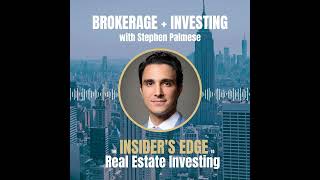
A long-form YouTube interview (episode 213) where James Nelson interviews Stephen Palmese about his progression from top Brooklyn investment-sales broker (Massey Nackel era) to principal investor and CEO of Integra Capital. The conversation covers how brokerage trained Palmese’s market intuition, the firm’s opportunistic private-equity and credit strategies, specific origination wins (including a $53M industrial loan), and business-building topics (team, branding, investor alignment). Several numeric milestones are stated and used to illustrate scale and strategy.
Questions this video answers
Over $1.5 billion in total capitalization.
$400 million of originations in the year referenced.
About $70 million average origination.
A $53 million loan on a large industrial/waterfront site.
Episode number 213.
Welcome. This is the Insider's Edge to Real Estate Investing with James Nelson, the principal and head of Avis and Young's Tri State Investment Sales Group. In this program you'll learn game changing strategies to outperform the market. James will teach you how to source, execute and capitalize on the best real estate opportunities in New York and around the world. Now here's your host. Welcome to episode number 213 of the Insider's Edge to Real Estate Investing. With us today we have my good friend and former partner, partner Steven Palmesi. Stephen and I worked together back in the day, Massie Nackle. This goes back over 20 years ago where Massie Nackle was one of the pioneers not just in the Queens market, but Brooklyn. Stephen was a prolific producer broker, transitioned into the investment space having acquired multiple multifamily buildings. And now he talks about what he has been doing on the lending side. So Stephen is now CEO of Integra Capital, a private equity platform specializing in real estate and credit investments. This background that Steven has first as a broker, as an owner, now in a lender, you're really going to see how he has been able to establish credibility leveraging his market insights and building trust as he talks about and this is such a reoccurring theme with our guests, the importance of trust and the people in this business. And so he's going to be talking about his firm's focus on opportunistic investments in these credit strategies, along with the value of showing up and maintaining consistency. So I know you're going to get a lot out of this episode. As always, you can go to james nelson.com this site is not about me. I built this site for you to help you gain the insider's edge to real estate investing. That is where you can find the show notes to this episode. You can see how to connect with Steven. A whole lot of helpful content there as well. We are, along with my writing partner Rachel Hartman, co author of my book the Insider's Edge of Real Estate Investing. We also post articles weekly on Forbes, so you're going to want to see those as well. So we'll have a brief word from our sponsor. We'll get into the interview with Steven Palmesi.
A different approach to putting our clients first. Avis & Young's US investment sales group oversees multifamily office, retail development and specialty sales across the country. We give you direct access to our 60 US offices to source the best acquisition opportunities or to advise on dispositions. Our principally led teams leverage the best research and data analytics to provide you with tailor made strategies to achieve superior results. Please visit Avis and Young or follow James Nelson NYC to learn more.
Welcome everyone. Thrilled to have with us today my good friend and former partner Steven Palmecy, who is CEO of Integrity's Capital, a real estate private equity firm with strategies, opportunistic equity transactions, loan originations and credit investments. Since inception, the firm has completed over $1.5 billion in total capitalization. Stephen awesome to have you with us here today.
James, thank you so much to be here. Longtime listener, first time, There you go.
Wonderful. I've been after you for for a while, so I'm glad we could do this. And we've got we share so much of the history and going back to our early Massey Nackel days, you were instrumental in building out the Brooklyn office. Amazing that at that time Brooklyn was the new frontier. Now if you looked at Brooklyn sales, it would be a top 10 city for if it was just its own city. So you all were obviously onto something early.
I would describe that as better being lucky than smart.
I'm trying to think and remember how that even came to be. So tell us how. Maybe that's a good place to start. In your story, how did you end up getting to Massey Nakal, getting into the world of sales brokerage? What were you doing before and how did you get there?
I'm laughing because in hindsight I didn't apply for one one. I didn't apply for one job. Coming out of college I always knew in the back of my mind that I wanted to in real estate development. And I would have memories being with my father and we'd be at the time before Hudson Yards was developed, looking over the landscape and talking about projects and what the skyline would look like. And some of the favorite things my father and I would do would be walk around New York with our heads up and just look at the different architecture and landscapes. But coming out of school and where did you go again? I went to Georgetown.
Okay, I remember that. Yeah.
So I came out of school in 2004 in a combination of being the youngest of four children. Also with the reluctance to let go of my youth, I just rode through senior year. Most of my peers were focusing on traditional private equity or sort of some sort of finance related job. And I ended up getting to the company Massey Nackle because John Hageman was Bob Nackles or one of his hand. And so my brother started dating my sister in law. So she had said hey, if you want to be in Real estate, which it sounds like you do. You may want to meet John and Bob. Wow. And so I don't know if I.
Ever knew how that connection happened, so. And so you could always explore that network. You never know that. Second degree of. Third degree of separation. Right.
What's funny is that she had just started dating my brother. And for some reason I like possessive mind of my brother. And I was like, who is this girl my brother's bringing over? So I was trying really hard to dissuade her from liking me, but she was just.
And this is your brother who's a real estate attorney or a different brother?
No, I have three siblings.
Right.
My sister is a PhD. My older brother is a corporate lawyer. The general counsel for Shake Shack took them public however many years ago that took place. And then my. The brother just above me works in. What's our family business. Okay.
What's the family business, by the way?
The story is about almost 90 years ago, my father, my grandfather had started building homes with Bob Toll senior. And so they were building homes in the northeast. And then faced with a particularly harsh winter up in the Massachusetts area, my grandfather had idea, I guess lumber pricing had started to spike. And so my grandfather had the idea of instead of managing the volatility of materials, what if we just start moving to an asset light business, which was like, let's start heating these properties so we become a service provider and we don't have to worry about costs. So.
And that's still the. You still do the business.
An iteration of that 90 years later exists. My grandfather and Bob Toll amicably part ways, and Bob Toll went on to start Toll Brothers.
I worked out okay, but we.
My family business ended up bec a domestic business and for a period of time had international component in Asia. And I never wanted to go into that business, but always admired the fact that my father and brother were able to really drive the growth of that company over the last 30 years.
So I got to ask you about that because obviously doing very well as a family business. Right. I'm sure. And I don't know if your father was trying to court you and all of your siblings to join and help out in the family business. But you said you knew you didn't want to do that, so is there any reason why you chose to take a different path?
I did always have an inexplicable desire to be in real estate development. And I think being in New York, it's hard not to be caught up and wanting to be a part of New York's landscape. Bear in mind, we grew up in the boroughs, and every special occasion we had, we did celebrate in Manhattan. And so we were constantly Manhattan. Special occasions, sweet sixteens, things of that nature. So I just had this compulsion to want to be there.
But this is Roots from Staten island or.
No, my family's from Brooklyn, and then we grew up on Staten Island.
Okay, good.
And. But the piece of advice that my father gave me, which is part of the reason why I'd apply for jobs, my dad was a quiet guy. His two pieces of advice were only work for yourself and never have partners. Which couldn't be more contrarian to being in real estate, which is a collaborative business.
Right. Although you could make the case. And we get, in addition to a lot of investors, we get a lot of brokers who listen to this show as well. And sure, you're affiliated with a larger firm, you're working alongside, I think, the best real estate brokerage firms. And certainly this is the case of Massie Nakal. Very collaborative, but you're still an independent contractor. You're still out there with your own P and L, so to speak. So there is a little bit of that.
The parallels exist.
Yeah.
And. And that's part of the reason why he. He would tell me, and he meant that working for a larger company, I was desirous to climb the. The ladder, so to speak. And he had said, you're not going to really get promoted if you're working for a larger entity. And yes, I did fall into brokerage.
And did you start as a. In. As a partner, or were you working with some of the senior partners there at the time?
It was a hot August, a hot day in August. And it was my first day. And the then office was on 86th street between 4th and 5th.
I remember that. Second floor, right?
Correct.
I remember that.
And it eventually moved to downtown Brooklyn to a class A building. But then it was the second floor. The elevator was out, maybe even the air conditioning was out. But maybe my mind is telling me that and I just sobbed a little bit. I just said, where am I going? But yes, I worked for the manager of the office, who was Tim King, and his partner, Carlos Matos.
Brian Larry was there back.
Brian Larry was there back then, too. And they just. Carlos and Tim in particular took me under sort of their wing, and I would be driving around parts of Brooklyn I didn't fully know existed.
Right. So. So it's interesting because we have had a lot of successful investors, developers on the show, who started as brokers and we also get a lot of advice for those looking to get into the business. Hey, start as a broker because and curious, now that you've built out your own investment platform, looking back and thinking about how much your brokerage career helped you first of all get ramped up, would you agree that brokerage is a great way to ramp up your real estate IQ and then make that transition into investing?
Having two children of my own, I fully acknowledge the merits and benefits of working in a brokerage firm, whether or not that's a sales firm or a finance firm or corporate leasing firm. But. Right. All of the elements that help grow a business on the principal side are foundational to both or shared both between brokerage and on the principal side. So unequivocally I agree that the work ethic, the learned experience about the nuts and bolts of real estate, the analytics component to it, are definitely derived from the brokerage business.
And I want to give you the proper credit due because you weren't just a broker, you were a partner in the firm. You rose to the ranks very quickly and for good reason. One of certainly the top sales brokers in Brooklyn, if not right up there company wide. So what was it about your approach again, operating exclusively, focusing in Brooklyn and not that you wouldn't end up doing business around the city, but like you dominated downtown Brooklyn and the area. What was it about your approach that made you such a successful broker?
I think much of the success has to do with Massie Nackles and commitment to being exclusive in Brooklyn and having a dedicated resources in Brooklyn. And at the time no one had given it that level of attention. And you had all the larger New York firms that were just sending people out on their employees out on special missions to say, hey, this person's going to do New York, but also try to cherry pick from Brooklyn. And I think it was the fact that we planted a flag there, built an office there and really just consistently tried to grow a platform is what helped us gain the most recognition.
There's still something and sometimes it can be hard to quantify or characterize because when you think of the most successful investment sales brokers out there, I don't think they necessarily have to be the type a salesperson who's out there, but there is that kind of quality that sometimes again, it could be hard to explain what that is. But I think across, and this applies to residential too, you see this 8020 principle where you get 20% of the brokers who are doing 80% of the business business and Just observing, working on deals with you the way earned, I was going to say commanded but really earned your clients respect and just your knowledge and your deal making abilities. That's not just. I don't know if that's something that's learned. Right. But as far as your ability to not only convince an owner and sometimes I get asked, you know what's the toughest part about brokerage and you know, making the sale on this and that like sometimes landing that exclusive in the first place, convincing someone to trust in you to here's my property, I'm entrusting you to sell this incredibly valuable asset. Do right buy it and then obviously figure out the deal and get it done.
I have an expression that 90% of life is showing up. And the fact that we, I think collectively Massey and Ackl folks consistently showed up on time earns a lot of credibility unto itself. And then Bob always has an expression. If you always tell the truth, you never have to worry about what you're lying about or some form.
I thought you were going to say real estate brokerage is only a part time job. You only have to show up half the day, 1212 hours a day. Right. There was. It was funny because we, I was telling at our firm's holiday party last night that I've gotten soft because there's one guy in the office, he's still on the desk at 7am I said I used to get there at 6:46, 36:45 and if the rest of the team wasn't in at 7 I was like half day. But yeah, no, you certainly had that drive and that hustle and that consistency I think of showing up.
I agree.
Yeah. So how many years was it then that you were. Because from Massey Nackle we successfully sold to Cushman that was out there that, that was really a landmark sale. And again it was years of building that up. But yeah, three plus great years at Cushman and then JLL.
Yeah the. So I took a mitigated risk in 2012 and at the time real estate private equity was really moving into multifamily in New York for the first time. And so a lot of my now contemporaries bought significant portfolios in multifamily. And so having been at Massey Naccol I said we're going to take, we're going to buy on balance sheet multifamily. What's really popular today. I don't want to say it's a credit for it but the tax class to be strategy of buying small cap assets that have limitations on their tax increases. We built out a portfolio of about 20 buildings over a five year period, set up a management office. So we had dedicated resources and that did really well for us, leading into the rent laws changing in 2018, 2019. And that's when the industry took a different turn. And so what I should have done in hindsight, but don't be mo in the past was I should have bought 200 buildings. But since we didn't have the application of other people's capital institutions or otherwise, we just took a on balance sheet approach, bought the assets, brought them into our platform and managed them.
But you also had a full time job at the time. Since you're out there brokering, you're not just brokering one or two deals on the side. You had a team actively out there and at the same time you're building up this investment platform, which, I mean, I've got a lot of questions, questions about this and I'm sure our audience would love to hear about this as well, especially the brokers out there who want to get involved in investing. Because there's a lot of questions when you're, oh, it's a broker, but they're also buying, okay, conflict of interest, right? So how do you do that in the right way? How do you do that in the right way?
That was my focus was on Brooklyn and Queens. And so I always bought from my competitors. And so it was very easy for me not to have a conflict because I was always, I don't think I bought one transaction directly from a principal.
It's. That is the correct answer. And I think the best way to do it, because again, and where it can definitely become gray is if you're a broker and you're buying from a principal direct off market. And if that acquisition was ever questioned, like here you have a professional where they take an advantage of the situation. The firm might say, hey, what Stephen, why weren't you trying to go get the listing? And so that you're using our platform to go buy. When you're buying from another broker that that seller has representation, they are being professionally advised and there's no opportunity for you as the broker because the listing's already been awarded to me. I don't know if you made that conscientious decision at the time, but that was really the cleanest way to do that.
It was the cleanest way to do it, but it was also the best way to see deals. Because I would tell brokers, I'm sure you have a short list of Primary investors. You go to put me at the bottom of that list. Make me your last call. And so I ended up. But bear in mind, Brooklyn was still so new and what are now primary markets, but were secondary markets back then, Crown Heights and surrounding areas. Nobody wanted to sell multifamily or buy multifamily. So brokers were quickly calling me saying, I have this new listing in Boreham Hill in 2012, was an unknown neighborhood. Hey, do you want to buy this multifamily? All of my top buyers won't buy it. I said, I know the block, I'm there every day will buy the assets.
So they were worried that you're going to start running around with it on the brokerage fund especially, that's where.
So with some folks, it took some time to build trust, even among my competitors, which helped me on the brokerage side. I deliberately set out to build a reputation of what I say and I say what I mean. And so signing a contract, doing it diligently, signing within the time frame you're going to sell, funding it, and having a seamless execution on the buy side, a lot of credibility as a buyer and then as a broker. My, over time, my, my sort of competitors always just said nice things about me. They may have gripes that I beat them out on a listing, but no one could ever say that I didn't do it in a manner whereby, like, I fought hard and I fought honestly. When you're a broker off. And so I think that goes towards your question earlier. The translation between a principal being a broker was. Was between a broker being a principal, rather is what is your message being consistent? When I was trying to win business at Massey and aco, I only represented the seller and I only represented their best interest. And doing that helped people to realize that we were actually out there for the best of their ability. On the principal side, today we're investors and we're lenders and we have a very specific box in which we do those two things. And that helps folks really stay on message.
So one of the beauties of brokerage and understanding the market as a broker, you're seeing hundreds of transactions a year, right? So you're seeing the market, you're seeing the trades. I mean, your job, if you're doing your job properly, is to understand each of the trades. Why did it sell for this cap rate? So you have that information, you're seeing the whole picture. And what I, you know, and talk about in the book is an inefficient marketplace. I mean, that is One of the beauties when we talk about gaining the insider's edge is that you can go into this if inefficient marketplace, right. And gain advantage. Right. But you probably had the best advantage there was because you see the whole market right? Now, that being said, as a broker, you're only an inch deep, maybe a mile wide, right? So you're not actually going in and doing the transaction. On the other end of the spectrum principle, you are going deep. You're understanding everything that it takes to get a deal done. So I've got to imagine that being a great broker made you, you know, helped you in your investing. But I've got to also imagine that being a great investor also made you a better broker. What do you think of that?
I couldn't have said it better. The inch seat, mile wide. Love that expression. And that was just the Ying to the yang of the principal versus brokerage business. Because once you start being, you know, into the transaction, you really get to see some of the elements you might have missed on the principal side, on the brokerage side. But yeah, I think unequivocally that that works well in this dynamic between how the push and the pull help one another and being deep into transactions and then learning about the nuances of the transactions and seeing why many times transactions fall apart. Whether or not that's a nuance or just specialization in DHCR or the elements helps you on the brokerage side. Because then I was able to say as a brokerage, especially early in your years, you want to jump at every transaction. You're like a puppy, right? It's just like you want to play with everyone who wants to play with you. You're full of energy and you're eager, but when you're sort of balancing being a broker and being a principal, it's, hey, maybe this isn't the right opportunity to try to spend my energy representing this owner because their financials aren't great or the building, right. All the elements I learned that might have or potentially killed the deal on the principal side I was seeing on the brokerage side, right? So it's. Their paperwork isn't clean, the rent laws changed, no one's buying these assets. It's a low probability for execution. I'm going to put my energies elsewhere.
Got it. So you finally retired the jersey, so to speak, on brokerage. What was the year and at what point I would imagine that the principal business became full time and consuming that. Did you finally say, okay, I can't, as much as I'd like to keep one foot in brokerage. It's just I need to focus all my attention investing.
The 20, 21, 22 and 23 calendar years were arguably some of my best years in the brokerage business.
You'd probably be alone into that. I've heard a lot of people say that and go out on a high. Was it it Sampras who went out on a high or trying to remember? He did, he did. Good. Okay, good.
And, and so it was that transition and really what a difference a year makes. So I left about a year ago formally or resigned a year ago. And so I just needed to make the decision on where my long term growth was coming from and really where I wanted the next challenge. And that was deeply in the principal business. And so where we are today, legacy still exists, but we've been rebranded as a company called Integrity Capital. And so we're a private equity firm with the specialization in commercial real estate and private credit strategies. On the debt origination side, the private credit Strategy, we did $400 million originations this year. That is a meaningful size debt fund. Their average origination was about $70 million. And my efforts spent. The new challenge I wanted to take on was spending 2025 building awareness about who we are and what we're doing, growing our investor base towards more of an institutional platform and really starting to do the things we did well on the principal side, but on the brokerage, on the brokerage side and the principal side.
Tell me about the decision because I know you certainly do equity as well. The focus is seems to be on credit right now. So why did you choose that path? I mean, you continue to do both. It's an interesting parallel. On one hand we're talking about how being a broker makes you a better investor. I would imagine, you know, still being on the principal and on the equity side probably also makes you a better lender.
So being a broker unequivocally made me a better lender. And so being a new lender in the market, the you had to have an insider's edge. And so there's just, it's such a stock commodity in some respects. Being a lender, the angle we had to take was we're looking for these are bridge loans, these are short term bridge loans, widespreads. But we needed a unique situation whereby we either had a good borrower with a bad piece of real estate or we had a bad piece of real estate with a good borrower.
Right.
I needed an angle for why we were lending. And because of my knowledge in the brokerage business, what I thought land values were. For example, we made an over $50 million loan on a large industrial site earlier this year. And if you look up the borrower, there was a judgment against the borrower for dumping by the dep. For dumping into the water. There are elements about the project whereby we weren't able to have a full phase two, by and large, great piece of real estate, waterfront, many acres, but a borrower who was unbankable. I thought, I know what this value of this land is worth. We did our own due diligence of what we thought the underlying potential was for contamination. We made a $53 million loan when others wouldn't. But only I do have to say, because of my knowledge in that marketplace, we made that loan and we were rewarded for it. We were able to get a widespread on a loan that others I don't think were willing to touch.
So I've got to ask to quantify the risk because environmental issues can be. Sometimes it's the unknown. So I'm just curious, were you able to insure against that? How are you able to clearly quantify it where you felt that it was at least not unlimited exposure?
We were able to quantify that because a lot of the elements you learn a brokerage are listening to the person on the side of the table, your potential client, what their needs are. And I think we did that really well. Going back to Massey and Aco, whether it was a timing issue or a family issue or things that they wanted and that you were able to project as you're representing them in this case. I sat down with the borrower. I learned about the history of the property. I learned that it was mostly Brooklyn fill and that 100. It was owned for 100 years by the state and then it was owned, transferred by the state to the mta. And so the history of the site didn't really have much.
It was a major issue, probably that would have come out, right? It was, yeah. So, so you've done, you said last year, $400 million of loans. Okay, so. And now you're building out this fund. So was the 400 million, was that done out of a dedicated vehicle or when you go do this $50 million loan, do you already have your, Is it deal specific? Is it loan specific where you've got investors that you bring together for these opportunities?
We have. I think I'm uniquely positioned in the market today because it's a single source of capital. And so I'm 50% of the decision making ability.
Okay.
So it's our ability to move quickly and execute on transactions that are meaningful in size is helping us win awareness. I'm receiving phone calls from other New York debt funds called a month of $5 billion debt funds that are saying, hey, we're in between funds moving into 2025. We have a couple of loans. We'd like to participate and bring you in. And so suddenly I'm now potentially being paired up with some of the larger names in New York because our ability to write checks and because of the, the speed in which we work.
And do you ever play when you go into something like that? Is it Perry Pursu? Are you structuring the deal where you're taking a different slice of the capital stack?
So in these instances with the potential debt funds, we're control oriented and so we will only be parry pursue interest with control. And these are conversations that have been building over the last year. And now it's at a critical point whereby one, that fund called me particularly, they said, hey, can you do something in three weeks? And I know you've been telling me that you're a control oriented lender. We'll do this 5050 parry with you. And now finally in a position to drive some of these transactions and hopefully next year we'll print some of them.
Is the focus entirely on credit now or is do you still look at what's going on the equity side?
We do look at equities investments, but one of the things going back to the brokerage business is that you'd meet, let me say differently. A common overused and not oftentimes appropriately applied expression was opportunistic. And our definition of opportunistic exceeds that exists in writing. Most people say, hey, I'm getting a 20 IRR and a 2X. That's an opportunistic return. And that's not the requirements for our capital. We're looking to put out $1 to make five. So we're really looking for things that are mispriced or distressed.
So I got to ask how, how you do that on the debt side because usually you're not seeing those kinds.
Of that's on the multiples side that would not be on the credit track.
Okay, got it.
Okay. So we are looking, but we're looking very carefully and we are bidding on large assets.
So it really seems like there and maybe this has always been an approach, but certainly over the last couple of years where pricing was, you have a lot of these developers saying I can't compete on this on the where the acquisition is but I'd lend on it. And so what they're basically saying is I'm not where the. But I'd own it at 85. So I'm happy to. To take that kind of leverage. So is that was that kind of another reason why you made this shift is you just. You didn't like where pricing was and you just felt more comfortable being at a lower basis.
It's all about basis for us and detachment point. We originated a loan in January that was the basis. This loan I'm talking about. The basis was something we were comfortable with that we had a unique position on given sort of our. My experience in the brokerage business. And so for us to be able to lend out that number and in this case it was probably higher than most people thought it was where we were comfortable lending at. So yeah, we're basis driven lenders got it.
So I'm sure we probably have a lot of people watching this now listening to this show who are thinking I've always thought about getting into real estate investing on the equity side. I'm going to go buy a property, I'm going to go do a value add, raise money. That's the traditional way. You don't get a lot of investors who go straight into. But walk us through that because I'm sure your first deal was not just on your first loan ever was putting out $50 million. I'm sure there was a couple steps in the process to gain that trust of whoever you're. You said you have one single source of capital. Yeah. So I think it'd be helpful to the audience to talk about about maybe how you made your first loan or two, how you built that credibility where all of a sudden you're able to show that obviously you can find these great opportunities and you can execute on them.
To the contrary, that the $53 million loan was really the first loan. The source of capital had been lending previously to being committed with me. And that capital has made loans over time. So they had a system in place and view on the market.
So they were already lending. This is interesting because we talk about in the book especially when you're starting off on a new venture platform, whatever it is, finding the opportunity. Right. So was the real value that you've been able to bring is obviously the knowledge but the deal. Right. So is this you approach them obviously it was with a specific opportunity. Was that helpful in getting that done?
In this instance the famous expression is that a good deal finds capital. I do think that's appropriate unless lends itself towards credit lending. In my particular instance, it was really having a shared vision with a source of capital that was looking to grow a credit platform instead of doing it on an ad hoc basis. We really had a shared thought in how we saw the market. And while I think I am a middle aged man, they are older than I am. For them, they still look at me with a ton of youth and ability to help grow a platform for them. And this kind of just came up. I couldn't have designed it to say, hey, you know what would your first deal be? A $53 million deal? They likely would have said no, but just the way the circumstances played out.
It sounds like you had a thesis that you brought to their attention. So you clearly saw an opportunity and there's a plethora of bridge lenders out there. So what was your. And not that you have to give your, your secret sauce away, but what was your take on the market or the opportunity that maybe was new different to align yourself with this group.
They're vertically integrated and so for them they've built a significant portfolio with their bare hands. They self perform. They've got dedicated capabilities, architecture. The former head or one of the former heads of the Department of Buildings is their chief of staff, so to speak. So anyone who knows real estate in New York on the development side, in order to have a sign off on something like International Grid, which normally takes 12 months, they were able to achieve in 90 days. So I saw a source of capital that had deep capabilities and by pairing with them to be able to leverage that and grow is how we were able to I think do what we did in really the first year on the lending side because we give comfort to the buyers and saying to the borrowers and saying hey, we know what you're experiencing here as you're building this asset. We've done this before. And so a we may have capabilities that could help you feel free to use an extension of what we do for you. Or also if it's, if it in the off chance it doesn't go well, we could step in and help you. And I think that sort of gives a lot of borrowers comfort and it's, hey, for example, there's a loan and it's called a will supply, like will supply water, right? For example, this developer is building a project and he doesn't have what's a will Will serve, rather will serve and he doesn't have this will serve letter. For most lenders it's a threshold issue and they won't lend it all. We're talking about $100 million loan they won't fund at all. We've been there. We know what it's like dealing with municipalities and governments towards getting the water. And we're funding a loan where most people wouldn't. Because there's a risk that we think we've been able to mitigate.
For example, that makes a ton of sense. But the it can also cut both ways. Right. And sometimes bridge lenders get the reputation certainly some of them. Are they really just loan to own? Hey, we know how to do this ourselves. If I'm the borrower, great, that's accretive. It's helpful. But if things don't go, you're not just dealing with some bank that has no interest in taking over operations. Really, you could step in. I'm sure that's not the kind of conversation that comes up. But there's gotta. I think if people want to borrow from you, they want to know that you're there to work with them. And as things come up, but not to the extent where you're sitting there and if it doesn't work out, you're happy to take the property back.
Sure. We're not in a position where we're lending to the related companies. For example, our cost of capital is more expensive than that. So we tend to be working with development firms that are new or mid in their career, midstream through their career. And it's actually the opposite in this case. A work to our benefit where they see that we've got capabilities and they say, hey, great, this is our third, fifth project. We still don't have the rich experience you have and they find it complimentary.
Okay, that makes sense. So talk about building out a team. Because if you're going to go out and building out this credit platform, there's a lot of components to that. Right. So I mean sourcing, it's not too dissimilar if you're going to go out and be on the equity side. Acquisitions, is it, you know, as far as how you underwrite deals, what is, what does that look like? What is your platform? And bringing the right people to the table to do this.
That is, you know, that is what you and I do on a daily basis. Have a team, find and win business, grow the team that exists between brokerage and principal. It's the same elements and it's how do you manage a team and it's how do you divide and conquer your businesses? In this case, we do have A team of folks behind us. The credit business is a little bit different because the underwriting side is the same. There's not going to be a conflict in that they're going to want to originate. And I being the face of the company and having been in brokerage, the benefit that I have is that I could pretty much get to anything, anyone in New York within one phone call, maybe two. And any person who I'm seeking to call, I've either dealt with in the past. So they say, hey, great, I had a good experience with Stephen in the past, or I might not have worked with them, but they know who I, who I was in brokerage. And they say, you know what, he had a strong reputation. I'm happy to take his phone call. So I find that the sourcing has been probably to my benefit, given my relationship in brokerage.
Yeah. And again, this is just one other way that being a successful broker has led to being a successful investor and your ability to build a team. Right. And it's not just being able to bring in the talent, it's then how to keep it and how to get the team to really collaborate, work well together. And compensation is a piece also. So you sell some brokerage teams, investment shops, you see this revolving door where people come and go. Senses you always had, certainly on the brokerage side, you had your team loyal that. And clearly you understood how to keep everybody motivated.
Listen, it was also in brokerage. It was also, at least from our experience or my experience, it was the salaries weren't high, but the carrot for the individuals was, hey, participate in or originate your own deals and you get greater thresholds of those commissions. Not quite the same in, particularly in underwriters. So there is going to be looking.
For a salary bonus. They're not. Yeah, it's. Commission would be foreign to them.
Yeah, correct. So there is a. There is a threshold to how much startup capital you need for the business. But it's, it's incredible the amount of deals that you'll see and underwrite.
Maybe it's.
Maybe our execution rate is on 1%, meaning we'll look at. Get 100 deals and we'll actually put term sheets out on one or two.
Right. So you need. That takes a team to do that. Yeah. Now, what about. So. So you've just undergone a. I don't know if it's a rebranding. I mean, does legacy equity holding still exist and this is just a new platform. But I want to talk to you about how you establish a name, how you get it out there. Is this just word of mouth and how you're finding deals? Yeah.
Started Legacy in 2012 when we bought our multifamily and the credit business really required a new name and a new platform and so we created Integritus. But my goals for next year are to build awareness and that comes down to what you do really well. It's social media branding. It's not just social media though, but it's public speaking engagements. You have a book you've written, two books you've written. So it's being able to become a thought leader in your space, in your capacity. And I really need to work on that for next year.
Yeah. I'll go back to the topic of team. I get a lot of help to do this, so it's. I wish I could tell you that I'm producing and putting this all on. I want to take a minute to thank my, my producer Nick as well. He's been awesome. He's in the background clapping, making us look good. But yeah, no, you. I think when you're looking to build. We were even talking a little bit about this before. It's still your vision and content. You that piece. I don't believe you can. Can outsource. Right. It's really your expertise in the market and what you're doing now. A team can really help how to package that and how to get it out there. But it's a, it's an important piece of the equation. The.
No. When I left brokerage, I didn't bring any, didn't ask anybody who I left with. But I also would tell you that my past partners and colleagues, I are wonderful people and incredibly smart. I wouldn't be working. I don't think that they were right for the credit side. And so I had to be very careful with who I chose for the team. But I think that's the lesson I learned. It's met a lot of people and it was finding the right people with alignment of thought, right interest, knowing the business, knowing how long it takes to create a credit business. And that's how we helped build out the folks that we're working with.
Have you. Is there a whole business plan on where this new platform is going in five to 10 years? How much are you thinking about where this is going?
The credit business at the credit business is at the moment, it's very point. Moment in time. Right. You've got traditional lenders who are on the side. You've got new entities of capital and that's family, office, foreign or hedge funds or other opportunistic groups that are moving into credit because spreads are wide. But I'm consciously aware of, and I think, think the market is as well, that there's going to come a moment when credit spreads change or the risk reward opportunity for credit markets versus public markets is going to require a reallocation of capital. And so where I think we're still uniquely poised, that we're still single source of capital, we're still focused on credit and I think groups may come in the market and come out of the market and I think that it's going to be hopefully our sort of long term focus on building a large scale credit business with a real estate investment arm will hopefully help us to continue to grow for the next decade.
Awesome. I want to take a little step back. I want to talk because and certainly, certainly the time we were partners and just working together over the years. You're a driven individual, right. And what is it with the way you're wired, the way that you approach the day, the week that just keeps you on it?
Going back to the brokerage business, one of my biggest competitors who is a dear friend of mine would tell me, I don't know how you do it given the background you've had. You're hungry, quote like a poor boy is what he would say. I just don't get where your hunger comes from.
Yeah.
And my father worked 100 hour weeks and he helped me put on my tie in the morning when I would go to school at 7. But he wouldn't arrive home until many nights when I'm sleeping. And I don't know if there is some sort of that his work ethic and providing for the family translated into me or maybe I'm just built the way he's built, but I don't know how. I'm sorry, why I'm driven the way I am. I'm neurotic and I'm, you know, it's just personality traits. And so I'm, you know, still trying to figure out why I'm doing what I'm, you know, why I am the way I am. Yeah, that's what happens.
Yeah. The successful people, whether they're investors, brokers. Think of our friend Ryan Sirhant, who people, whether they see him on his Netflix show or whatever it is like, oh, is this just all Hollywood? It's real. You could text him at 10, 11 o' clock at night, he's up at 4:30 in the morning. I don't know if the guy ever sleeps, but he's on it. And it's not just smoke and mirrors. Like it's really rolling up the sleeves and doing that work. There's no substitute for it, trust me.
I've messaged Ryan. I don't know him well and so I might have met him once and then I texted him maybe six months later, not realizing he was in Europe up, and he responded back right away to say, hey, listen, yeah, we, I have. So I do acknowledge that he's, he is on it. But I can say though that there is a reason why people who have these shared traits are, are tend to be the more successful ones in the brokerage business. I have often said though, maybe if I had a little bit of me that was not so much softer, maybe less singularly, it's like the definition of insanity. Doing the same thing over looking for different, different result. I think if some of, some of you didn't have that in me, maybe I would have had, you know, a different set of skills to help be more successful. It's like sometimes trying to solve the one seller you spend so much time on trying to find their business and win their business and spend so much time with them, then they go in a different direction. It's like crushing. It's really gut wrenching to not win that business. But what you realize looking back is that there were definitely moments in the interactions with, with the potential client where you're like, you know what? I wasn't going to be, I wasn't winning this business. And I missed this cue or I missed that cue from them because I was so focused on doing the thing. Just a little bit of a review from hindsight.
Yeah. Sometimes it's like, why do we not know how to take our foot off the accelerator? And it almost doesn't even matter what's going on with the market. It's just we just keep showing up. I remember there was mornings in 2000 depths the financial crisis. This, this was after sales volume in New York city was down 90%. Nine zero. There's a point. There was literally nothing going on, but we were still showing up. It's like we didn't know what else to do. You keep showing up and then when things change, like you're ready, you know, it's hard to jump in and jump out.
So all about how you're positioned in the market.
So, Stephen, we get a lot of students who listen to the show as well, whether they're in college, whether getting their masters right now and, you know, just getting your advice to them on the path to take if they do want to get into investing. Obviously it worked out really well for you to start in brokerage. Did some work on the equity side. Now obviously very active on debt. And I don't correct me if I'm wrong on the principal side. You never worked with a big institutional shop. What's the advice for someone to get in the game?
Looking at where we are today with the market and the difficulties of the market, I do think the hard times of the market are going to teach good lessons to young people today. Because looking back on the market, I call it the 4, 5, 4 buyer. You'd buy at a 4 cap. You try to drive the revenue to a 5 cap and then try to sell it at a 4 cap. That was a very easy, dare I say lazy not to offend anyone way to make money. And it was like rhythmic. Hey, I could buy this asset at a 4. It was almost like a trick. I know if I could push rent and then sell it, I'd profit from it. It's very hard to find good opportunities today and it's very hard to make money, which is why I think the investors today could be better investors than investors when the market was more positioned for easier execution. So I do think they'll be saying, hey, wait a minute, why do I want to put all these effort forth? Considering where we are from a capitalization perspective, whether or not that is equity markets or debt markets, why would I want to do all this effort to build this thing for this modest return? I think it's going to help people to realize their value of their worth, how hard it is to actually build an asset, especially in a market like New York. Listen, zoning in New York is apparent. And you could open a book or go online and say, hey, this property on this corner is zoning as X and that's why people bid on it. But where the difficulties become are getting out of the ground. You have access agreements, you have neighbors, you have nuances that will sometimes prevent people. We looked at a deal, it took him eight years to get out of the ground because he was in lawsuits with neighbors. So going back to advice for young folks, it's. It sounds so old saying that, but look with the discerning eye. See you knowing how hard it was to make money for yourself at a young age, when you're finally ready to write a check is when you'll know that there's a good investment for you. That's the only thing I could look at because I say the same thing. Is this something I Want to write my own personal check into and if it's not, we're going to pass.
Yeah, no, I think and that's really, that's what gives you the longevity that get, you know, don't just do a deal because there's the capital there. You have to have that conviction. I'm going to now take that advice. Question. I feel like, like we're always asking for advice. Is the aspiring investor getting in the game? I'm going to go completely opposite end of the spectrum and now ask you to give advice to that, that family office that's own property. Maybe they've been in the game, have a substantial portfolio for decades, but they haven't made an acquisition in 10 years. We know there's plenty of them, right. And it's just, they just watch the market completely pass them by and look, look, maybe they don't have to do anything like they've got low debt, they're cash flowing, it's comfortable. But what's interesting, and I don't know if that's the profile of the, your single source of capital, but the fact that the idea to partner with someone who's out there, who can energize it and take it into the next.
I think the lesson for those family offices, it's to have an identity. You're either in wealth preservation or you're either in wealth growth. And oftentimes what I see is the disconnect whereby you have a family office when you're looking back at their current portfolio and the decisions they've made over the last 24, 36 months, they are not in wealth growth mode, they are in wealth preservation mode. And but you have this misidentity maybe from younger, from the younger generation who's saying, hey, we've built all this wealth. I want to go out and build a nation for myself and I want to go and buy opportunities. But it's this sort of disparity between the two, but it's making sure you have an investor who. What I found is this is a first generation family made the capital on their own, they made it the hard way that they're looking at taking their capital and continuing to grow it. And it's their ability to write checks quickly and fast for the next generation is what they're still building for. And so it's having that alignment of approach.
Stephen, this has been amazing. It's been awesome, you know, all these years, the friendship and having a lot of fun along the way.
I tell you what though, chasing you has been especially in the brokerage side, watching you show up every day, watching you have been the leader in the office, the first partner. Your efforts are what helped inspire me and I was like this James Nelson guy. If he's there at 6:45, we've got to be there earlier. So I thank you for many respects for all you've done to help grow my business. Wow.
Awesome. Wonderful to hear and I want to thank everybody who's listening and I've been saying lately and I don't know how you couldn't get a tremendous amount of value out of this conversation. Share Share this with a friend. There's got to be someone out there that you've listened to this. Say this would help for I listened to a lot of podcasts I forwarded on. It's a great way to spread the word. We're here to help you gain the Insider's Edge to Real estate Investing and you can go to james nelson.com Again, this site is not about me. I built this site for you. There's a lot of helpful in addition to the show notes today, figure out how to connect with Steven. Learn about all the great stuff that he's doing. But there's videos on there. There's the white papers. I write a column weekly at Forbes again with tips that are really designed for you to give you that advantage. Really appreciate your support in this. And until next week, thank you again.
This podcast is for educational purposes only and should not be relied upon for investment decisions. The opinions expressed are those of the guests and not their companies. Listeners should not act upon the information without first seeking appropriate advice from an accountant, lawyer or other professional.
Thank you for listening to the Insider's Edge to Real Estate Investing. We appreciate your subscribing and sharing with your friends. If you haven't already, please connect with James at James Nelson NYC on LinkedIn, Instagram and Twitter. Please also visit jamesnelson.com where you can find the show notes and other episodes along with an exclusive video series and other helpful resources so you can gain the Insider's Edge to Real Estate Investing. Until next week.









