Capital Management with G. David Bednar
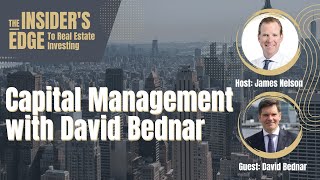
David Bednar, founder of Devotio Capital Management, discusses launching a tax-efficient private real estate platform for ultra-high-net-worth investors. He covers sponsor vetting, crystallizing carried interest while holding long-term, and Devotio's focus on Sun Belt industrial and multifamily deals with fiduciary oversight.
Welcome. This is the Insider's Edge to Real Estate Investing with James Nelson, the principal and head of Avis and Young's Tri State Investment Sales Group. In this program you'll learn game changing strategies to outperform the market. James will teach you how to source, execute and capitalize on the best real estate opportunities in New York and around the world. Now here's your host.
This podcast is for educational purposes only and should not be relied upon for investment decisions. The opinions expressed are those of the guests and not their companies. Listeners should not act upon the information without first seeking appropriate advice from an accountant, lawyer or other professional.
Welcome to show number 179 of the Insider's Edge to Real Estate Investing. This is your host, James Nelson. Thanks. Thank you as always for joining. Thanks to those of you who have followed once again on Apple. I was told that on itunes, I know this happened to me personally, that they changed the way their interface and so means that many of you will have to follow the show again. If that's assuming that you like this and you want to continue to gain that insider's edge to real estate investing, we are here to help you gain the advantage to outperform the market. And today's show is going to do just that. We're going to have with us my friend Dave Bednar. He's in neighbor of mine and I think we met. We're part of this crazy workout group at 5am if you're ever in Old Greenwich, Connecticut and you want to stop by the Dunkin Donuts, that's where we meet up and do all kinds of crazy workouts. And Dave's got an incredible background having played football for Harvard and also spending time in military services. But we're going to be talking a lot today about leadership skills and solving problems. David Bednar is principal and founder of Devotio Capital Capital Management, the real estate private bank. His company serves as an investment advisor and fiduciary, providing bespoke private real estate investing solutions to ultra high net worth individuals and families. That's a lot you might be asking. Okay, well James, what does that really mean? Well, think of Dave as an outsourced family office. There's plenty of ultra high net worth individuals. They want diversification to real estate, but they don't know how to do it. This is an avenue for you all to think about. Dave has really built out this platform. Platform. Prior to creating his own capital management platform, he spent time at some of these incredible companies including Ladder Capital, J.P. morgan, you might have heard of them Goldman Sachs and Morgan Stanley. So we will be talking about how Dave's military service can be applied to real estate leadership, how to draw on your experiences to provide more value to clients. David also explains about having strong mentors and how this can help you develop your skills you'll need for long term success. So as always you can go to jamesnelson.com where you can also sign up for our monthly newsletter. I built this newsletter for you to be most helpful where we aggregate the white papers podcasts so you can sign up there but you can also find the show notes for the podcast. That's where you can figure out how to connect with David. So we're gonna have a brief word from our sponsor and we'll get right into that interview with David Bednar.
A different approach to putting our clients first Avis and Young's Tri State Investment Sales Group sells multi family, office, retail development and specialty sales throughout the New York metro area area. As experienced thought leaders in our industry, our 35 member group is available to help you make informed investment decisions by advising you on your current holdings or identifying new opportunities in the marketplace. Our one unified team is built on an industry unique platform which promotes unparalleled collaboration and teamwork. We share core values of hard work, integrity and expertise. We put our clients first providing tailor made strategies to achieve superior results. Please Visit us at aytristateinvestmentsales.com and follow us on Twitter LinkedIn and Instagram amesnelsonnyc to learn more.
Okay, welcome everyone. Thrilled to have with us today my good friend David Bednar who is principal and founder of Devotio Capital Management. Dave, welcome. Thank you so much for coming today.
Thank you, James.
Good. So why don't we start off. I wanted to ask you about your service in the Marine Corps and thank you for your service. I know you served during Operation Desert Shield and Desert Storm. When I asked you about that, you said that that also was part of the connection to real estate. So would love to hear about your time in the military and then how you found your way to real estate.
Okay, well again, thanks for having me. I was in college, was getting ready to graduate and my parents who had kindly paid for paid for my education for four years, were a little bit surprised to hear that I wanted to. Instead of getting a job like all my classmates, I wanted to become an officer in the Marine Corps. And to be fair, I had given them some warning on that. I had told them I was thinking about it and they told me just, you know, keep it in the back burner. And they did something very smart. After my mom stopped crying because we had no military history in our family, they suggested, all right, we'll Support your decision 100%, but you owe us this. We want you to go through recruiting at college and turn down a job like a regular job that you normally, if the military didn't exist, you would take. So what it forced me to do was really think long and hard about what I wanted to do. And I decided at the time, and you'll, you'll probably remember this, this is a sign of, of experience, if not age. This was in the late 80s and real estate was humming and probably better than, you know, the equivalent of a Google. The Google job or the, the great private equity job for kids getting out of college today at that time was Trammell Crow, development associate. You go down to Dallas, you work for the famous Trammell Crow. You spend two years leasing, and when you're done leasing, they give you a balance sheet. You go develop deals when you're 26 years old. And so I said, all right, if there's any job I would, I would take. This is it. So I was, I ended up going through recruiting, flying down to Dallas, and they made me an offer, and I ended up saying, flying home, going home and see my parents, and basically saying, I think I still want to go in the military. But what I had done was really learned a lot about real estate as part of that process. So when I got done with the military, done with business school, I was very focused on real estate. And interestingly, if I had started back in 1987, 88, I would have been right into the SNL crisis and the huge real estate crash. When I actually got done three and a half years in the military and business school, I ended up coming out and being part of the early distress business. And I started at Morgan Stanley, ended up working in the Morgan Stanley Real Estate Fund, which was one of the very first distressed real estate vehicles, which you probably know. And then from the, from, from there, I've, I've been a real estate guy.
My whole career, so I definitely want to get to that. But I have to go back because one thing that I did not know about you was that you were the first person from your family to serve. And I believe you have at least two sons that, that serve. Now. I'm, I'm curious, what drew you to the military and service at the time?
Yeah, I think it was just the, the challenge of it. I had read a lot of history and you know, the military and war fighting has been an elemental part of human society for as long as people have been keeping records. And you know, maybe it's still true, but for all of recorded history, warriors were the people that drove the society and everybody talked about. And I had a lot of respect for the warrior stories I knew and it was an experience that I wanted to have. Even though at that time this was again, for most of your listeners, they're, they're younger. But you know, post the first Gulf War that I was in and then post some of the conflicts that happened after that, the military, I think, rose significantly as a vehicle. After 9, 11, a lot more people were going in. When I went in, it was relatively not a lot of people were going in the military at that time. But I, it was an experience I wanted to have, I think for the.
Challenge, whether leadership skills or the way that preparation, organization. What type of skills do you think that you took from your military military career into the workplace?
I would say it's funny, after my time in the military and I just, I spent, I had intended just to spend three and a half years. I was, I was a Marine Corps infantry officer. So one of the great experiences and I, I highly recommend. I'll just, I hate to digress a little bit, but when I was doing this recruiting thing, which I've already set up out of college, I was in a final interview in New York City for an investment banking job at the old First Boston. And the very first person I was, this was the final round of interviews, like the Super Saturday thing. My first interview was this big, tall, burly looking guy who was a former Navy SEAL who fought in Vietnam. And I saw all of his military pictures on the wall and I said, hey, you know, I'll be honest with you. I'm thinking about going to the military. And this isn't a job interview. He sort of did a brief 1 second double take and said, you should do it. And we spent the rest of the interview him trying to, telling me that I should try to go in the seals. Wow. If it was possible. The only and subsequent to going in the military, I worked for Morgan Stanley and Goldman Sachs and a bunch of big, you know, big firms, never my own firm. To answer your question, when I started devotio Capital Management three and a half, four years ago, it was the first time since I had been a platoon commander in the Marines when I first started working that I felt that feeling of being in charge and having all the decisions roll up to me and Having real authority over an endeavor. I didn't feel like I had that at any of the other places I worked, even though, you know, there were. I had teams working for me at various times, but it was never the same. So you, you really, I think, learn what it is to have the gravity of being in charge. That's what they teach you. I mean, my sons, you alluded to, I have three sons. One of them's in the Marines now, and two of them are ROTC and are headed in that direction. And one of the greatest experiences you can have as a young person is, you know, when. When my son, my oldest son graduates from his school, he's in now in the military, you know, he's going to go and they're going to assign him command of a platoon and he's going to have 35 people. He's in charge. He's in charge of. It's his job, it's his authority, and he stands up in front of them and, you know, he has to take charge. And it's a great experience, but it's also, you know, it can be daunting at the same time.
So for us civilians who are listening, how would you characterize that leadership style?
Well, one of the things that a lot of people say, and maybe this is, I can use this forum to correct this. A lot of people say, well, I actually heard someone say this recently, and it's totally false, which is, well, leading in the military, it's not really that applicable to the civilian world because in the military, everybody has to do what you tell them. And you can just order people around. You don't really have to be a leader because there's this firm structure. You can just tell everybody what to do. Nothing could be further from the truth. Human beings are human beings. And if your charges in the military don't want to do, it's the same as you here at Avis and Young. I mean, you could theoretically fire people. You know, you've got some command authority also. But if people don't like you and people don't believe in you as a leader, it's not going to work. And that is absolutely true in the military. It's the leadership is leadership, period, anywhere. And it's the same in the military.
No, I think it's great to clear that up, because that's what I had understood. And also that leadership has evolved in the way that maybe your reports as far as intelligence and the way information is gathered, instead of just waiting for it to roll all the way to the Top kind of, in more modern day times there's more of an emphasis of letting the front line, so to speak, make decisions.
Yeah, and that's, that's an interesting point. You bring up the Marine Corps. When I was in there was, there was actually a large intellectual movement going on to try to instill this idea of this. They call it distributed tactics. Pushing power down and allowing junior people to make decisions. And I think the Marine Corps was, you know, made a real effort at that and I think they've done, they've done a good job. And it's, it's again true of every organization. If you, if you have a rigid command structure and people don't feel like they have the authority to use their judgment, your organization is not going to be as effective as if everybody is using their judgment. You're trusting people to use their judgment, you know, within a, a construct of people being trained and understanding what you're looking for. By far the best organization. I mean and it's particularly, it's true of again of any human activity. But in, in warfare there's, you know, the fog of war. Communications always breaks down as soon as the shooting starts. And you have to have the most effective military units are always, not sometimes always the ones where people that are closest to what's happening can make decisions and execute those decisions.
Well, some might be thinking that we're digressing a little bit from real estate investing. But I think for anyone who is a leader, who is building a company, a unit, I think learning from your experience is incredibly helpful. So from there you already had a taste of real estate from before and at Harvard, I know you played football there, but remind us, what did you study there and then you went back for a master's?
Yeah, I was government major, kind of political science. And then I, after the Marines I went to business school.
And at that point were, were you learning more about real estate use cases? I mean what was that Master's really?
I mean I was there was. They didn't have a specific, was just one degree and they didn't have specializations. I don't even know if they, if they, maybe they do now, but I didn't specialize in real estate or anything. We had some real estate cases. They have case method at Harvard. So we studied some real estate cases. A couple well known professors, but I just, just the standard business degree and.
That business school by then you did have a couple years experience under your, your built in the private sector as well, or was it right at the military?
I just Went. I went straight to business school. So I was, When I, when I was coming out of business school, I had never had a real job.
And so how much of what you learned from business school was immediately applicable to the workplace? I mean, did it give you a better background, having spent some time overseas and then jumping back into the work place? Is that a good place to.
I think, I mean, that's kind of a. Maybe a. A question about the case method. You know, Harvard has a very specific way that they teach, and I actually thought it was pretty useful. You know, if you're, if people are not familiar with it, they don't sort of pedagogically stand up there and just lecture. What happens is you read a case, an actual business case that's based on a real situation, and then you get all the facts, you hear about what the different parties did, and then at the end, you, they, you have to make a decision, what would you do? And then. And then you discuss, you know, what your answers were relative to what. What really happened. Whether what really happened was, was positive or negative. So I thought that was useful. I really did. I mean, I wouldn't say that I was the hardest studier at business school.
Did you make great connections, though? Because oftentimes you hear the business school is a great place to make connections. Business partners.
Yeah.
Maybe next job.
Yeah. AB. I mean, this is. When people ask me, I know this is a big part of your podcast. When young people ask me, should I go to business school? My answer is always the same. And I, I don't think it's. It's. It's really changed much, which is if you can go to a top 10 business school or even a top five business school because of the people you're going to meet there, that can be very, very valuable as far as I'm concerned. The network of people that I met there is by far was the most valuable piece of that experience. Not to say that the education wasn't good, but the people that you meet, very interesting people that are in all different businesses now around the world. It's an amazing group of people.
Was that the connection for Morgan Stanley? That was your first job?
Yeah, my first job was. Was Morgan Stanley. Yep.
Yeah. And you said you were working on a lot of the distress deals. So what did it. Do you start off as an analyst? What was.
No, because I was out of business school. I started as an associate.
Okay.
Which was, you know, I was a little bit behind the curve when. Because some, some of the people that had been Analysts and come back, had had, you know, a couple years of that experience, but it wasn't a big deal. And I was immediately went into the real estate group. You know, a lot of very successful real estate people were in that group. And you know, like Owen Thomas for instance was a, I think he's a VP when I started Jay Mance, I mean a lot of, a lot of well known real estate folks and it was a good group and it was a group where you could, you did sort of investment banking, but you could also. The principal effort was inside of that group and that's what I wanted to do. So I went into that group and ended up moving into the, into Mesra full time.
And was it a steep learning curve? Were you learning as you went along? How did that work?
Yeah, I'd say so. I mean you're as a junior analyst or associate, you're just, you're learning by doing and you're doing a lot of doing, right? You're spending a lot of time looking at models, reading through things. So that's absolutely the case.
Did you find your work ethic, whether it was being on the football team, being a scholar athlete, whether being in the military, did you feel like you had an advantage at the time as far as your discipline or was everyone kind of doing the same thing?
I would say that the people that they hired, you know, and it's probably still true, I mean they're getting a pretty disciplined, hard working group of people.
So as far as some of the other positions you held, the special situations group. I always love the names of the special situations groups because when you hear it, they kind of are willing to tackle anything. So when you moved over to JP Morgan, I don't know if that was because I know you spent some time at Ladders Goldman. So maybe give us kind of a quick rundown of kind of the steps in your career and were the moves that you were making because you could always kind of get a leg up in the next position, you just saw a better opportunity.
I mean, I would say one of the interesting things about my background that I find really, really valuable in what I'm doing now is I've had broad experience across different types of capital commitment. Real estate MEZREF was primarily, it was distressed non performing loans and traditional JV equity structured deals. Goldman was also distressed. But structured finance also, you know, we did, we did a lot of mezz lending and then at Ladder Capital I did a lot of bridge lending as well as some, you know, some net lease Real estate stuff as well and some cmb, cmbs. So I've, it really is valuable that I've sort of matriculated through all these different elements of the capital structure. And I use that now when we're looking at deals and people say, you know, here's this, I think we can get CMBS debt on, on this. And this is what's going to look like. A lot of times I look at that and I say that's not happening.
Right, right.
It's not going to happen. Or, or this, this structure, you're not going to get that structure. It's going to look like this or that exit's not going to work for this reason.
So did you make those moves at the time to get exposure to different things or just kind of opportunistic?
Well, each, I think each one is, is a story. I mean I came, I left Morgan Stanley to effectively to get back to the United States. I was at the time I was running the non Japan Asia investing business for Morgan Stanley and SARS hit. And it's sort of a long story, but I had sort of an open offer to go to Goldman back in New York. So I took that. It was a good group. It was an interesting group. It allowed me to do asset investing outside of real estate also, which I thought was interesting. So that's the reason I did that. And then the opportunity to go work for Brian Harris, who I worked for in between Dylan Reed Capital Management and Ladder capital for almost 12 years. That was just initially, Dylan Reed was a great. Dylan Reed ubs Dylan Reed was a great opportunity, phenomenal platform. Just that whole thing came together right before the gfc.
Right.
It was a great platform. It just, you know, that whole thing got started at the wrong time. And then I ended up continuing to work with, with Brian at Ladder Capital for a long time. He's, you know, I say this all the time. Probably the smartest person that I've worked for in real estate. I think the best overall real estate investor, real estate person that I've worked for.
And what makes you say that?
He just has, you know, people say about the really good investors, people say this about Barry Sternlich, people say this about Paul Caslonis that they just, you come in and you talk about a deal and somehow hearing you're only talked about it for 10 or 15 minutes or less and they immediately somehow see through all the talking you've done and they basically say what about this issue? And that turns out to be the critical issue.
I think taking a complicated situation and.
Just, and just boiling it down to what really is the most important element, whether it's a risk, whether it's a piece of upside, the thing that makes the key decision point. I mean, that's. Brian was very good at that.
At what point did you decide that you wanted to go out on your own? And then maybe we could talk about now what Devotio Capital Management is. So maybe the premise behind it and the decision to launch your own.
So I had, I always. And it wasn't, I didn't really connect the dots between what I said about being a platoon commander in the Marine Corps and that feeling of being in charge. I didn't expect, I didn't think about that coming back, but that, that was a offshoot of doing what I was doing. But I had always wanted to be an entrepreneur. I never had an idea, you know, I always had good jobs and I never had an idea that would cause me to leave my job and go actually start a business. And over this long career in real estate that I've described, one thing kept recurring, which is the premise behind our entire business, which is that the private equity structure, the private equity fund structure, whether it's used in deals or whether it's used in funds, it's the way almost every taxable investor in the United States gets exposure to real estate. It's fundamentally misaligned with the interests of taxable investors. Real estate is the most tax efficient asset class there is. It's a great generational asset for taxable U.S. investors. But if you're investing in a typical real estate fund or even a typical real estate deal, that's a pass the hat private equity, real estate deal, you're not getting those benefits.
Now, can you elaborate on that?
Because I'll try to tell anecdotes because they're more interesting. So I was on the phone, we were introduced to this group in London that knows these very wealthy investors. And just for your, for your audience, I mean, what we do is act as an outsourced family office real estate team. So as a little predicate, and we were introduced to this, these folks in London who had a bunch of wealthy clients in London and they're, you know, they're English, they live in London, they don't, they don't know anything about the U.S. tax code really, or U.S. real estate. And I was describing to them, I said, this is the way real estate works in the United States. If you're a taxable investor, so you get a depreciation shield. So our typical investor Just a normal deal. We're going to get a cost segregation study which allows you to maximize depreciation. And whatever the current cash coupon is on that deal is going to be almost 100% shielded, probably for 10 years. So if it's a 6 or 7% coupon or a 5% coupon, you're not like, if that was a bond yield and you're our investors or a typical investor, half of that's going in your pocket and half of it's going to the IRS. In our case, it's 100% shielded and all of that's going in your pocket. Interesting. And then we said there's also this thing called a 1031 exchange. It allows you to, if you take an asset that you have a basis in, you can actually trade out of that asset and shift your basis into another asset and not pay tax. Interesting. And then we said, then there's also this concept of tax or debt funded distributions where you accumulate a bunch of value in an asset that you're holding. Instead of selling it and paying taxes, you can refinance it and all the proceeds over your debt basis can be distributed on a tax deferred basis to the investor. And, and if, oh, by the way, if you never sell the asset, if you tell your accountant you're going to step up the basis of death, you never pay the tax. And literally their response after I got done was, why doesn't everyone do that? That's insane. And that's, that's exactly. And that's the question I was asking to get back to your question. Like I'm sitting here saying, all right, increasingly I'm hearing people complain about, yeah, these guys in this fund, they did a great job for me and it's a 20 IRR. And now they're going to sell all the assets, but I'm just going to get, I'm going to get my money back. I'm going to pay them a big promote, I'm going to have to pay taxes. I know the smarter people are about how real estate works. They say to themselves, all right, then there's all the brokers, title fees, lawyers fees to get in and out of an illiquid asset. I'm paying all that. And then I have reinvestment risk and I've got J Curve downtime on my money. It's just, I wish I could just hold it right. So there are a lot of really smart people who understand what I'm saying and what they do. If they can't do this themselves if they're not real estate experts themselves, which the great majority of ultra high net worth, high net worth investors are not, they hire a private equity family office real estate team. Bill Gates, Steve Case, Eric Schmidt. They hire me and the people that work at my company and they give them a computer screen and a health care plan and they say, come in, invest in real estate that I control. I want you to manage it on an after tax basis. And it's my real estate. I'm not an lp, I'm an owner. I control this. I can you guys work with my accountants to maximize it. So that's what they do. But that's hiring me and everybody that works at my company or hiring the people that the people I just mentioned hire is very expensive. And it's also, it's a hassle. You've got to find the people, motivate the people. What we do effectively is provide real estate on an optimized after tax basis to our ultra high net worth and family office clients. Like they had an institutional size, you know, family office real estate team. We work for them on a bespoke basis. We design and execute programs for them to invest in real estate the right way.
So it's really interesting because we had Moses Kagan here last week with us. And for those of you watching on, on live stream, you might have seen that that recording will be out in a couple weeks, we promise. Interestingly, Moses, his investment horizon is forever. He says, my goal is to never sell for the reasons that you just mentioned, the challenge, and I'm sure we have a lot of people listening to this right now who are syndicators who are going out raising money is for them to really tap into a promote. There needs to be a capital event, right? So most of the holding periods and also has to be within a period of time where the investors say, well, my money's not locked up. So you have both sides of the equation. You've got sponsor who says, I want to hit my promote, get some returns so I can go move on, do something else. Investors are saying, well, I'm not sure if I want to lock my capital up for the foreseeable future. So how do you navigate both of those sides to the equation?
Yeah, that's a great question. And there's no perfect answer. I mean, that's one of the reasons that these, these large fund structures, the traditional fund structure exists because it's a very efficient way for the manager to accumulate a lot of capital and to manage an exit. The sooner the exit makes it Easy for everybody. You tell everybody we're getting out early. You don't have to deal with it. What we do, and there's two parts to your question. There's the investor liquidity and there's the promote really in your question. So the promote part is easy. It's not rocket science. This technology existed before us and has become a lot more popular because of the QOZ statute. But all we do, we have a very refined structure for doing this now we crystallize our carrot interest and we also require that to the extent that there's an operating partner that we bring into a deal for our investor, we also provide crystallization for the operating partner so that neither we nor the underlying sponsor, which is totally different from the way it works on almost every other deal. No one tells our clients when they're going to pay tax. They decide when they're going to pay tax. The way we manage through the exit, we've done two kinds of deals thus far. We've done deals where we're truly the outsourced family office real estate team. We have one investor and one investor only. We work with them. They are the sole lp. Their decisions are the decisions that matter. We've also done deals where we've put a small group of like minded investors in the same deal. If they're working with us, they, they understand the benefits of long term after tax managed holds. So they're long term oriented. But whenever you have more than one investor, you can have different horizons. So there, what we do is our bias is to the long term hold. So we provide. Typically if somebody says all right, I get the long term benefit, but it's been 10 years, something's you know, I need the liquidity. What we typically try to do is have them, we try to buy out their interests and allow the other investors, if they don't want to sell at the same time, to, to stay in long term. So we will provide them liquidity.
So Dave, I want to go back to what you're talking about, crystallizing your promote because there's a lot of people listening right now who are saying, okay, I'm used to underwriting the deal. It's a five to seven year hold. That's when we're going to sell and that's when there's going to be the capital event. I take my promote. But what you're saying is there's a way for you to crystallize your incentive while still holding the asset. Can you get more specific on how you actually accomplish that?
Yeah, I Think you mean from the standpoint of the operator.
Yes.
So I'll, I'll take. It's pretty much the same for us, but basically what we do and we've had, and I spent a lot of time thinking about this before I left to start the business, you know, thinking about what's the right way to do this, what's the way that's going to be effective in the market. Because the best sponsors aren't going to want to work for us unless this works. And so what we, the way we typically do it is we basically say, look, you, in a normal private equity structure, you decide when you're getting out of the asset. You're the gp, you decide. That's the same here. You decide when you want to crystallize. Obviously, just like you wouldn't sell the asset normally unless you had created value. We're assuming you're not going to make a decision to crystallize until you've created value. At that point you try to agree on a value before we get third parties involved. If we can't agree on a value, we do a typical kind of. We get outside experts involved and get an average of what outside experts think of the value of the asset we run. The waterfall creates a number that is owed to the sponsor and then we have a mechanism for multiple mechanisms for paying them their carried interest promptly. Typically, again, everybody's working together on this. Our assumption is that in a normal situation the sponsor decides to sell the asset, a lot of value has been created. What that means is there's probably a lot of room for a refinancing, right, which is going to create a lot of the cash to get them out. And if there's not enough cash there are other sources that we can, you know, that we can tap. But that's usually going to be the. What's going on.
Is there ever a situation where a sale could be the way to do it with a buy sell agreement where you and your LP investors would stay in the transaction post sale?
Yeah, I mean, yes, but again I'd say we've, I've been doing this for a long time. So one of the things I, maybe you consider this a nuance, but because I've been doing this for such a long time, we don't love the operator sponsor having the ability to hit us with a buy sell. Not that we don't trust our operators and sponsors. We do. We only work with people that we typically have known for a long time and we trust but they always know more about the asset than we do. So we, generally speaking, try to keep it at a market valuation and running of the waterfall and not a buy sell. Okay, that's better for, we think that's better for our clients.
Now I want to talk about where you advise your clients to invest. Talking asset class, geography, business plan. So whether or not you want to take. You're mentioning some ultra high net worth from the uk they say, okay, you've convinced me, I want to invest in US Real estate. So now what are you walking them through the different types of asset classes?
Is it.
You have a deal in hand?
How do you talk in process?
Yes.
Yeah. So, and again, this isn't a commercial for our company. But what I'll say is what we do, the more you talk about what we do, the more you realize how different it is from the traditional approach. The traditional ultra high net worth individual family office is used to people coming to them and selling them a deal or selling them a fund. We turn that whole process around, we walk in and say, what, what do you want to do? We've got the ability to execute across property types in the United States. What do you want to do? And we sit down and we, we just went through this process with, with a very wealthy private equity person who likes to invest a lot of his net worth that comes out of his business directly into real estate. It's gotten too big for him and his immediate family to manage, so he's asked us to do it. So we do say, all right, how much do you want to invest? Because again, everyone's used to. In traditional real estate, like this is the amount of money I want you to wire, sign the subscription agreement and wire me this amount in the next month. Our approach is how much do you want to invest over the next five years? In each year, what's the total amount? Because we're your family office real estate team and you don't, you don't, you know, you don't. You're going to have money you want to invest over a period of time. So how much do you want to invest over what period of time? What do you, do you have any, do you want cash flow? Do you want opportunity zones? Do you want capital appreciation? Do you have any particular aversion to an asset class? And then we devise a program for them and we execute it. And specifically, I mean, we, we've executed. One of the questions we got early on was, well, you know, you're a small team. How can you execute across property types across the United States? And we Said, well, given our experience, I think we can do it. And subsequently we've done self storage deals, we've done multifamily deals, we've done office deals, we've done retail deals in all different places and in many different styles. Some are value add, some are core, some are development. So we've, we've shown the ability to, you know, to do that.
And as important as finding the opportunity is really finding the sponsor. Right? Because for the most part you're not GP in this yourself. You're not running, you're actually going finding the sponsor who has the opportunity.
Correct.
So how do you then find the sponsor? How do you vet them?
Again, it's not really a question because of how long we've been doing this. I, it's, it's, I've got a lot of experience doing this. Some of the other folks that work with us have a lot of experience. So it's not finding anybody. I mean, it's people we've know, we know over our careers. So I already know a lot of, a lot of really good sponsors that I've known, you know, met over met and got to know over my career all around the country and all different property types. So we work with those people. And not to say we don't work with some new people that we're meeting, we do do that, but it's a lot of sponsors that we've already known. So we do that and we're pretty much able to execute across property types properly risk adjusted. So would we do an office deal? Yeah, we would do an office deal, but the bar would be so immensely high. Right now we see a bunch of them and it's very, very difficult for us to get too excited about those. I'd say the single biggest specific investing strategy filter that we have. And it comes back to how different we are from the traditional approach. One of the things that we said early on was, okay, we're actually doing something that's very different than the traditional real estate investor. What implications does this have for what we're doing? And one of the conclusions we drew was we're creating options, not obligations for our investors to hold real estate after tax, long term, efficiently, generationally. So this, we're creating this option. Where's the option valuable? The option is valuable where the number one driver of long term commercial real estate value is most in play. And that is, you probably know this, it's employment growth over the long term. The number one statistical R squared correlation between long term commercial real estate value is employment Growth. So we said, all right, we should really be focusing on places where that option's valuable. And that's certain cities in Florida, certain cities in Texas, the Carolinas, Utah, places like that, Phoenix.
Can I challenge you a little bit on that analysis? Because post Covid, in this hybrid world where you might have people who live in Salt Lake City, but maybe their job is headquartered in New York. So how are you actually determining? Because if your driver, if you're doing a multifamily deals, obviously you want people moving to town and working there. How much has your interpretation of that data changed since COVID Well, actually, and.
This is not, obviously we couldn't have predicted this, but our view was the place you want to be is all the places I just mentioned before COVID And Covid has only accelerated the growth of those places. I mean, more people ended up ending up moving to those places because of COVID So while there might be some people remote working from New York, you know, I guess in a company that's based in Utah, I think there's a lot more of people leaving. Maybe their job is in New York and they're really sitting in Salt Lake City or somewhere in Florida or somewhere in Texas or somewhere in the Carolina.
Good point. So I want to dig a little bit deeper. As far as you said most of the sponsors you're working with, you have experience, long term relations. I think it'd be helpful for our audience to know what do you look for in that sponsor? So someone's listening to this right now. Maybe they've been in the business for five years, but they found an incredible opportunity. Maybe they've done some smaller 10, 20 unit projects, they've landed on 100 units, whatever your kind of minimum transaction sizes. So for that, that person who's listening right now, who thinks they have a great opportunity and the idea of having an ultra high net worth whose investment horizon is forever, I mean, that's kind of the holy grail for a lot of investors who say, hey, I'd like to join forces with that investor to hold real estate for the long term as well. So how would you go about qualifying that sponsor? If you're meeting them for the first time or if you haven't done business with them, it's just, you know, sorry, but I mean, you need to have that experience.
Usually if we, I mean, we, we can. I'm trying to think of if there are people that were. Yeah, there are a couple people. We haven't closed the deal with anybody that, that we haven't known Beforehand, but we're certainly talking to people and the best fit is all. It's often somebody that's not so much. It's not, it's not. Even if we didn't know them, we typically know them through somebody else. They're a referral, you know, they're one step removed from people that we trust and actually the best people for us because we're not, you know, we're not Blackstone, we're not, you know, Westbrook or some of these Brookfield in terms of the amount of capital we have. So we're looking for ideal candidates for us are really good, experienced sponsors that, that are sort of cut their teeth already with somebody else and are now kind of out on the, out on their own. And they've, and they've sort of really smart folks who know what they're doing and they're earlier in their life cycle. Those tend to be really good fits for us. And again, it's people that operate in the geographies that we like to operate in. But you know, you made a really important point trying to emphasize all sort of these ways that we're different. Early on, before I left to start the business, I asked these really good sponsors that I know. I said, you know, you guys have tons of access to capital. You've been doing this forever. If I start this business and come to you, would you guys work with us? And they said, absolutely, because what. And you alluded to this. The capital you bring is totally differentiating, right? There are a large group of deals. Everybody's got five year fix and flip capital. I mean, not now, but normally everybody. There's a lot of that money out there. But what do you do? And we use this as an advantage. So we give you a specific example. We're spending a lot of time now focusing on high quality industrial distribution deals that have single tenant typically or maybe two tenants where weighted average lease term is at least five or six years and your lease rate is materially below market like at least 25%. And if you've got that situation, you've got a real seller that has to sell. Because the first question is, well, are they really going to sell? Once you determine they're going to sell, that's a great situation for us because all the typical capital is like, well, I'm not going to sit around and look at my watch for six years waiting for this thing to be a value add opportunity, so I'm out. But if you've got patient capital, you can get paid decently to hold that and you're buying because of where the lease rate is, you're buying that asset an intrinsically lower basis. You know, we're looking at something right now where it's actually more than 10 years and it's 35% below market. And we would be buying this warehouse for 95 bucks a foot, where everything around it's been trading for 140, 150.
The way that you've approached the business is from a capital allocation standpoint as opposed to saying, okay, I'm going to be the gp, I'm going to go do deals and raise capital. So here you're really providing the capital in these instances. So that decision to kind of sit in that role as opposed to the more traditional gp, was that just kind of based on your experience? And then I guess the follow up question to that is also, it sounds like the majority of what you're doing is on the equity side, although you've had a lot of experience on, on the debt side. So did you think about doing that as well?
Yeah. Let me start with the second question. Obviously now everybody's talking about pref and mez. We are generally speaking not doing that for reasons you might guess. It's not tax efficient and it's not long term. It can be attractive from a risk adjusted basis. But it's actually a great short sort of generic case study in what we do. And your last guest spoke about this, like in general, investors shouldn't be chasing irr, they should be chasing multiple. And we would argue they should be chasing after tax multiple. Right. That's what they should really be after. And so you take a piece of mez or prefer mez that if it's not structured to be non taxable, everybody gets all excited because it's 17% deal level and then after all the fees come out it's a 14% IRR. But when you get done, it's in 14% IRR. You get paid off in a year and a half and then you pay taxes. It's like a 16 multiple. Like that's, that's to us, that's not exciting. A lot of people burned a lot of calories for not a lot of actual money in the taxable investor's pocket.
And then your decision to go in the capital allocator role as opposed to being a more traditional gp.
You mean like, like an operator?
Yes.
Well, for one I'm not, I don't know, I don't have any skills. So I'm, I always say I'm A Wall Street, I'm a Wall street real estate guy, so I don't have a tool belt. I've never, I've never told, you know, except for my own contractor, I've never, I've never managed a contractor. So I just, I don't, you know, we don't, we don't have that capability and we don't advertise that. We're always looking out for the best interests of our investors. So whenever we can cut out a layer of cost, we do that. But, you know, as, you know, really good operators and sponsors, they pay for themselves. Deal sourcing, addition of value management. I mean, we work with people that really add value. But net lease deals, like the industrial net lease deals, there's, we don't need a partner on this, right? Like, we, we've, I've done a ton of net lease stuff in my career. We can buy that, hire a manager and, and do, do all the asset management on that that's necessary and just, you know that no, no additional parties are involved.
And what other services do you have in house? What, what does your team look like?
Well, we, again, we thought a lot long and hard about designing this product, you know, before, before we, we launched it. And so we have, you know, we have a good, have a institutional quality online reporting portal. So investors get institutional quality online reporting. We made the decision early on, even though we were small. We. Apex is our fund administrator, the biggest fund administrator in the world. We have a fund administrator. So any.
Someone's watching what you're doing.
Someone's. We wanted to be able to say that, you know, we're, and anytime money moves in any client account, the fund administrator gives us the number and tells us it's authorized.
Wow.
So we're, you know, well thought out product. And what we try to do, we really try to, we want people to feel like they own the real estate. It's theirs. You're not, you're not, you didn't sign. I mean, when you, when you're in these big funds, you get the fund report, but you don't, you know, you don't own the real estate. Our investors, whenever we go on an asset management trip, we invite the investors to come with us. They almost never do. But we say, hey, we're going out to see the asset. Here's our itinerary. Do you want to come and see it? That's open to them. A couple times what we've done when they couldn't make it was we've actually done a zoom tour on the iPhone so they could live participate in the asset tour from their home office. Because it's, you know, we want, it's their real estate, you know, we're working for them. The other thing we do just structure wise is we're not, we're not a broker, a consultant, we're a registered investment advisor. We have a fiduciary legal responsibility to our clients. We've invested our own money, the principal's money, next to our investors in every deal. So we were very thoughtful about the way we designed it. You know, we said we want the smartest, ultra high net worth individual or family office to sort of be able to pressure test this and say yeah, that makes, that makes sense. Okay, they thought about this, that's fantastic.
So Dave, with only a couple minutes left, just advice that you would give to someone looking to get into the real estate business. And again you had a, I don't say a non traditional route, but spent a lot of time, the debt side, the stress, special situations. But what advice would you give to that person coming out of school right now?
I mean, you may agree with this, I think it's a good time. You and I have seen many cycles and there's always an argument like is it best to start now when things are sort of, is it best to see it at its peak and then see it fall or see it where it is now? In a lot of ways it's not a bad time to be starting now. It's going to be tough to find jobs in real estate now, but that'll change and it'll be interesting for those people to watch how people react to us coming out of this thing and just specific advice that isn't, this is beyond real estate. But the thing I think I learned in my career and I'd be interested in your opinion, but I think people that have really been successful in any sort of particularly corporate environment, typically they got connected to a mentor early in their career, somebody that really taught them but also pulled them on their coattails a little bit. And real estate is very much an apprenticeship business. You know, it's, it's your, if you're, if you're a genius and you graduate from school, you can go write code and maybe be a billionaire in Silicon Valley. But real estate is a, is a very human relations oriented business. Not only you have to know people to get the deals from, you have to be a good judge of character on your operating partners. Right? There's, you have to be, you have to have people skills to do that. It's, and, and it really helps. There's that, all that debate that's been going on, you know, do you want experience or do you want, you know, sort of genius or raw intelligence? And I think in real estate there's, there's a lot of value to just having been around a long time and seen a lot of different deals, good and bad, seeing how people have behaved, you know, that's, that's, that's my impression.
Yeah, no, I would certainly agree with that. And we have talked a lot about mentorship on this program. And the thing I always like to say is mentorship is all about being a two way street. I think a lot of people who are starting off, they're always looking for mentorship from someone like, what can I get from this person? And really the mentality, the mindset has to flip of what can you bring to that person? And even if you're starting off, I mean, maybe it's just your time and maybe it's, you know, sometimes when we say looking for that first job, it's not just about the salary, but what is the opportunity. I've seen plenty of situations and people who I've interviewed on this show who said, I started off as an apprentice making nothing, but I knew that this was the place where I could learn.
Well, there's never been a time, I don't think over my entire career where what you just said is more relevant because the younger people, not just young, younger people. Technology's moving so quickly. There's a lot of things happening and having. I've gotten a lot of really good input on that as it relates to our business from some of the junior people that we work with.
Dave, just last question. The name of the show, the Insider's Edge to Real Estate Investing. In just a couple words. What would you say has been your insider's edge?
I mean, I would say that we, I looked at something that was happening in the market. This, this disconnect between. Because it's because the benefit to investing in real estate, the way we do it, it is in a couple. It isn't 50 basis points, it's hundreds and hundreds of basis points. And so I think what we did is look at the evidence on this. We made the case to ourselves and then we designed a business around it. And I'm actually shocked at how few people are doing what we're doing given the benefits, the enormous return and multiple benefits that exist for investors.
Well, it's really impressive that you saw the need and then built the business around that need. I also love the approach that you take with your investors which instead of just trying to sell them something, you're really looking to solve for their needs. So you said so many good things today. I know our audience got a ton out of this, so just really appreciate your coming in and sharing your story with us.
Well, thanks for having me. Of course, appreciate it.
And thank you to all as always for joining. This is your host, James Nelson of the Insider's Edge to Real Estate Investing. And if you like the show, please go ahead and subscribe. If you have not already, leave comments. That's how other people find the show because we're here to help you gain the advantage so you can outperform the market. So until next week, thank you again for for joining.
Thank you for listening to the Insider's Edge to Real Estate Investing. We appreciate your subscribing and sharing with your friends. If you haven't already, please connect with James at James Nelson NYC on LinkedIn, Instagram and Twitter. Please also visit James Nelson.com where you can find the show notes and other episodes along with an exclusive video series and other helpful resources so you can gain the Insider's Edge to Real Estate Investing. Until next week.









