Purpose Built with Ron Beit
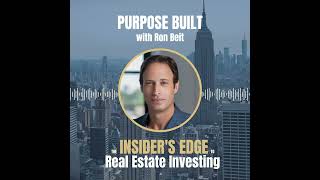
Ron Beit, CEO of RBH Group, discusses how public-private partnerships fund workforce housing. Teachers Village in Newark and AeroFarms show how tax-exempt bonds and Opportunity Zones finance projects that serve communities while generating returns for investors.
Chapters
Welcome. This is the Insider's Edge to Real Estate Investing with James Nelson, the principal and head of Avison Young's US Investment Sales Group and his co host Kim Troller from his investment sales team. In this program you'll learn game changing strategies to outperform the market. James will teach you how to source, execute and capitalize on the best real estate opportunities in New York and around the world. Now here are your hosts.
Welcome to episode number 231 of the Insider's Edge to Real Estate Investing. This is your co host James Nelson.
This is Kim Troller, also your co host.
And today we are with Ron Bate and we're going to be talking about Purpose Built and you're going to learn how to combine social impact with investing in this conversation. Ron is founding partner and CEO of RBH Group. His firm is known for developing large scale public private partnerships that revitalize communities including the acclaimed Teachers Village Project in Newark, New Jersey.
Ron shares how our RBH Group structures complex financing for workplace housing and how to use tools like tax exempt bonds and qualified Opportunity Zone investments to create risk managed tax advantage returns. You'll hear how his team balances financial performance with placemaking, ensuring that developers serve local residents through education, engagement and long term community partnerships. My, my favorite thing about our conversation with Ron James was hearing him stressed the importance of public private collaboration, particularly when using these tax credits and incentive programs that really help the economics pencil but also have a positive social impact. He's so in tune with what Newark wants and needs and showed us that local insight is usually very different from what you read in the headlines in terms of things like safety, neighborhood feel and growth potential.
Totally. And I also love the fact that he's been doing this for decades. This is not, you know, and this was very pioneering when he, when he was doing this. And now he's starting to roll out this type of program for obtainable housing again for teachers, not just here but across the country. So we're going to get into it today. So as always you can go to james nelson.com that's where you can find the show notes how to connect with us While you're at it, please subscribe to the show if you haven't already. That just helps us get the word out on what we're doing. We appreciate any comments are so greatly appreciated and we're happy to respond to those as well. So we're going to have a brief word from our sponsor. We'll get right into that interview with Ron Bate.
Avis and Young's United States Investment Sales platform executes on multifamily office retail development and specialty asset transactions across top US Markets. As experienced leaders in the industry, our integrated national team is here to help you make informed investment decisions. Whether advising on your current holdings or identifying new opportunities nationwide. Our one unified platform is built on unparalleled collaboration and connectivity across 120 full service offices around the world, giving clients direct access to the deepest pools of capital. We put our clients first, delivering tailor made strategies to achieve superior results.
We are thrilled to have with us today Ron Bate who is the founding partner and CEO of RBH Group llc. Ron, welcome. So glad you could be here with us.
Yeah, great to be here this morning.
Wonderful. So to kick things off and we definitely want to get into your history, you've got quite the story and our Scott Singer, our mutual friend, was kind enough to make the introduction so he did give us a little bit of background. So. But we're going to, we're going to get into it, but I think before we start it would be helpful to know about RBH Group. Maybe just give the audience a sense of your platform, kind of your holdings. That would be great.
Yeah, high level. RBH Group since its inception has been a developer, but sort of unique certainly in that regard. We, everything we've done since the inception of the business has been public private partnerships, which is to say everything we do as some piece of public investment or some sort of structured finance. And so, so it's really where we excel in financing these projects. And one of the projects that we've come become known for was a, was a project called Teachers Village, which was a workforce housing project about 17 years ago at this, so at this point, so we're way ahead of the curve in workforce housing and we've been doing it a much larger scale than most and sort of really been on the front end of trying to figure out how to finance these types of projects. You know there's, there's this large scale businesses in the affordable housing world and there's obviously large scale developers on the market rate side. But in the workforce housing where you need the skill set of both, not a whole lot of people doing it at scale and so been an evolution and a journey in that regard. But we are based in Newark, New Jersey where we sort of pilot all of our ideas and we've done besides Teachers Village there, built the largest indoor vertical farm in the world there. We did a really interesting project with Rutgers University that created, you know, housing and Educational spaces and social spaces for a cohort of students at the university that were recruited out of urban areas in New Jersey and out of the community colleges. And we were proud to be selected from a national slate of student housing developers to build that project because of our bend towards understanding how to finance with public financing, but also because of our sort of city of Newark credentials. And so that was an interesting project, but Teachers Village has been sort of the labor of love for us and the project we're traveling across the country with.
Great.
So Ron, on that note, you've described RBH as offering investors access to risk managed tax advantaged returns through social impact investing. How do you define social impact investing and to what extent do you see your mission as being about like place making and community, Community revitalization versus just property level returns, like how do you balance the two?
So it's interesting. Yeah, so yeah, I mean it is, it's something we struggle with and question every day. I think at its simplest form, when you are restricting rents, you're already at a point where there's a significant community benefit. So we start there. So that sort of definitely helped. We have these unique unit mixes so you know, where we'll have significant amounts of restricted rent. So not just at, like I said, we're workforce housing. So it's really a middle income product where we have higher amis. In other words, people can make more money to be able and qualify to live in our apartment. So that's why Teachers Village, because teachers are, you can sort of imagine that sort of middle income workforce that can benefit from the units we produce. So starting there, just the deed restrictions that we put on our properties and the unit mixes, unit mixes we create, there's certainly a social impact and from a performance standpoint, we're solving for market rate returns to our investors. And so, and then the, all the public investments we do and the way we structure it becomes tax efficient. So that's where we start. But we really do see ourselves as a. Often like in Newark, New Jersey, we're the first ones to, to move into a community. So Teachers Village Newark was built on what was like 97% surface parking lot. So creating place is not only really important to be able to secure the public investments in the, on the front end, but we're also long term holders of this stuff. So to be, to be great, you know, community partners on the. We got to make sure we're creating places that not only help our investment succeed but also, you know, ingratiate us with the communities that we're going to be part of for a long time. So, so that's where the place making, you know, comes in and that. But as an organization, because we've been doing this for a long time, because even when we're not asking for public investments, we're before communities, we're always looking to push the envelope on impact. And so, you know, there's a lot of quantitative stuff, but there's also a lot of qualitative stuff. And quite frankly, as an organization, we're asking ourselves this every day and we're pushing the envelope on that. So what that looks like is, you know, continuing education offerings in our developments and our amenity spaces. Instead of a billiards room, we'll have classrooms and sort of. And then sort of what do we fill that classroom with? And that's where. That's where we're still evolving. And that's where what's so exciting about the next generation of teachers, villages to come.
So, on the qualitative front, on that note, how do you go about evaluating what the community actually wants and needs? Do you survey them? Do you attend town hall meetings? What groups are you engaging with?
Yeah, so we are. It's, it's mostly surveying and community town halls of our teachers, village residents. That sort of really defines what we do in the individual communities, in the location, because, you know, every community is different. So, you know, so there's, there's sort upfront surveying and upfront understanding what the community wants. And then there's sort of ongoing surveying, and then they're surveying it across various assets. And then, and so the, and the vision is, is that we'll have these projects across the country and programs that succeed in Stockton, California, for example, will bring to Newark and Hartford and Atlanta and so forth.
So, Ron, when Scott talked about you, he said that you're a real visionary because you clearly saw something in Newark that many people did not see back in 1999. You could even argue maybe today with everything's changed. So, but take us back to kind of what you did see and what gave you conviction. Scott told me about the first acquisition, I believe was 89 Market street, which is what, a couple blocks from the train station? And he said that, you know, part, you know, helped you end up financing and acquire essentially the whole block. But, but before you did that, what was it about Newark that gave you a conviction that you could pull this off?
First of all, I was young and dumb, so let's just start there. Right? Right. I was, I had the benefit of not Having experience, which is like, insane now that I'm thinking about it. But the, but the, but the. The thesis, the investment thesis remains true today. And what I saw there was the, the. All the assets. Everyone talks about the assets in Newark, right? You have, you know, big corporate sponsorships and anchors, that community that have been there for hundred, even hundreds of years. When you think about sort of prudential over 100 years, and you got, you know, Panasonic and you got Audible and you have these big corporate anchor sponsors. You also have a tremendous university system there with over 50,000 college students, faculty and staff. You also have, you know, mass transit and you have, you know, all of the assets of a large city because it was a large city back in the 40s and 50s. And, and so all of those assets and location, you know, just outside New York City. And I would argue you everything that made Jersey City develop, and we love Jersey City and we're actually purchasing an asset now in Jersey City. But Newark was really developed with a sort of downtown, vibrant, urban feel to it that really felt very easily developable. And so for all of those reasons, you know, I was very attracted to it. I was a property manager here in New York City. I was managing an asset in still one of the toughest neighborhoods in Newark today. And I was walking through, as you know, in my late 20s, walking through all of Newark, and. And, you know, sort of not understanding why this hadn't been developed. Now understanding, you know, and even then, though understood as a property manager that when you went in the downtown, literally every building was owned by a different person. And some of it, most of it talking about the block that Scott Singer and I sort of worked on and assembled. That's where we started. It was this block on Market street between University in Washington, between Washington University, which was up against the universities there. So really the next block to get developed from, and you had government. You have government offices and your university offices. It made the most sense in the world. Every building was owned by a different group. They were generational, so they had zero basis in the properties. So they didn't care about fixing up the properties. Most of them didn't like each other because they're all in the furniture business competing against each other. Three years. So this grandfather didn't like this father, so they didn't even get along. And they were really still relics of the heyday in Newark. So they were really New Jersey centric businesses and not really Newark centric businesses. So I. The thesis was, is that you would buy these assets Individually and assemble them across and assemble them so that you can get large scale development that would change the streetscapes in meaningful increments at a basis in land that you couldn't compete with anywhere in the region. So it was, it was a very cheap thesis and that if you were successful in assembling this stuff, you could create large scale development.
But Ron, can we talk a little bit about the safety aspect? I had just came back from a conference in LA and Ethan Penner, who's now running for governor of California and a big part of his platform is restoring public safety. Right. He said it is the number one criteria for a successful real estate investment. So I gotta imagine, and not to say that New York City didn't have issues back in 1999, but you know, Newark again has reputation for, for crime and some of the challenges they face. So was that a consideration when you went into this? And if so, what was it that kind of gave you the confidence that maybe that piece would improve because you don't have control over that there. You have to rely on government and the police department to make sure that, that, that the laws are enforced.
Yeah. So I mean, that's where my, you know, my experience as a property manager walking through this city really helped. You know, there, there's a perception of crime which is, which is bad enough. Right. But, and, and, and the perception of crime and the crime that occurred in the city were really isolated to certain neighborhoods in the city, in the downtown, relative to even neighborhoods in New York City. It's virtually safe. It's not without any, it's not without incident. Exactly. It's a city, but relatively safe. The, the, the. What was the perception of crime with the fact that there wasn't development in the downtown was sort of compounding the perception in the downtown. And I really felt if we did create housing in the downtown in meaningful increments and at a large scale, that over time that just having people on the ground there would change that perception. So I really didn't feel like, and I really, even till today, you know, Mayor Baraka, he's really doing such a great job job with crime. And they've been way ahead. Even if you look at what was going on during COVID with crime and even just sort of the relationship of the community with police and government with police there, they've been on the forefront of all of this. It's taken time and Newark has been, you know, sort of. Newark's been working at this for two decades now. But I always, even then, even before we've made all the progress that we've made in community policing, I always felt like it was more of a perception and that if we can get the development going, it would, it would, it would. That we'd be able to take care of that perception and it could be very. And we'd have very successful neighborhoods.
So RBH has clearly played an integral role in revitalizing Newark. Back when I was in school, we talked a lot about revitalization versus gentrification. So bringing life to what's already there and making it better for the existing community versus bringing something entirely new in and changing the fabric. What is your take on that and how have you thought about these notions with your development projects in Newark and other cities as well?
Quite frankly, that's why I'm in Newark also. One of the other huge advantages to Newark that I felt like when I started buying there was that you were building. It was a historic commercial corridor, all of the buildings. And you know, if the buildings were occupied, they were occupied on the ground floor and not on the upstairs. And so, and so there was an unbelievable fabric to sort of build new without displacing residents. So there was this large scale opportunity to create this new neighborhood without having to relocate, to relocate residents, which was such an advantage. At the same time that we were buying in Newark, Ratner was fighting at Atlantic Yards Communities to move people and this and that. I'm like, just come to Newark. You can have as much development in downtown Newark with all the fighting and where they're welcoming you. So it was always part of why we were there that you could do this in a large scale way and not. And not displace folks at Newark. We have a different. We have a different matter, though. We gotta make sure that what we're developing in the downtown actually attracts all the Newarkers that actually live there. So it's a little bit different of, it's not a displacement question. It's a question of how do the residents that stuck it out in Newark, that live there, that raise their families there, that are generational in Newark, can partake in what's going on in Newark. And that's where the mayor has done a phenomenal job, you know, ensuring that there's affordable housing, ensuring that we hire locally and, and so forth and so on. And so that's where, you know, Newark's actually leading the way in that conversation. How do we develop respons responsibly and, and so to the. The equation's a little bit different, but we're able to think about these issues because we have the wonderful advantage of having sort of a landscape that we can actually build less large scale without, without displacement.
So on that note of responsible development, as you mentioned, how do you, who are your main investors in these projects and do they share the same goals or are they purely chasing returns?
Yeah, so it's interesting. So the answer is you can't just be chasing returns. Right. And the reason for that is these are complicated deals. Right. So even just underwriting a deal like most folks won't even spend two minutes. That's where Scott Singer, poor Scott Singer has been spending so much time with me on all this stuff. And he throws up his hands sometimes at me too. But this is complicated stuff. So it's really, first of all, it's for the most sophisticated investors, that's number one. But number two, to spend the time they have to be really looking to make a difference, look to do something different. And so in that regard, I've had phenomenal partners. I have a gentleman, Nicholas Berguerun has been my partner since that 89 Market street building that you're talking about that Scott Singer brought me. That was sort of, we worked with Scott singer. That's literally January 2005. Nicholas Berggruen, high net worth individual he's been doing this certainly for a greater purpose and sort of a greater impact, not only socially, but sort of for urban fabrics. He loves place making, as you put it. We have a gentleman, Warren Lichtenstein from Steel Partners, also from a place of wanting to do more with his capital than sort of all, you know, the day to day investments. But since then and across the country we have several investors. The Opportunity Zone program, not coincidentally was co sponsored by former mayor Cory Booker of the city of Newark. Right. He's the, he's the state, he's the state senator of New Jersey now. He was the co sponsor of the opportunities, the Opportunity Zone bill. It was a sort of an ecosystem of the folks in New Jersey that helped create the public investments led to Teachers Village, Newark. But the, but that that ecosystem sort of influenced and inspired him on the Opportunity Zone bill. And that bill sort of widened the, the sort of network of investors that were willing to start to take a look at these types of developments. So it started as a few group of, you know, really high net worth individuals with a real passion for this stuff into sort of is a next round of folks that are high net worth individuals also socially minded looking for tax efficiency and so willing to spend the time to look at these Pro formas. And so that's been sort of so far and then, and then the institutions that, that have that bend, right, The Goldman Sachs Urban Investment Group, Prudential Social Investment. Right. The CRA departments of these banks. So it is, it has been an ecosystem of folks that, that really are sophisticated and understand how to execute on these projects and understand how you get to the returns of these projects, but that also have a sort of bend towards social impact which is what sort of keeps them at the table to understand this stuff.
So I'm glad you brought up qozs qualified Opportunity Zones. For our listeners who are not familiar, do you mind just explaining what qozs are and then kind of the typical size, structure and hold period of a fund investment that you would pursue through like in the QOZ context.
And I would tack on just one more piece of that which is there's going to be now an Opportunity Zone 2.0. So maybe for those who are aware of the program, talk about kind of what the new iteration will look like.
Yeah. So yes, they just renewed the program, which is great. And you know, so from the beginning, Opportunity Zone, the Opportunity Zone legislation, each state had the ability to designate it was either 20% or 25% of their distressed census tracts as qualified opportunity zones. So there was a designation in each state and there were these distressed census tracts that were designated as Opportunity zones. That was particularly helpful for groups like us who had always been following the distressed census tracts. It's a larger concentric circle than the qozs. The qozs are a portion of the distress census tracts. But we were always tracking the distress census tracts for all kinds of programs like the New Market tax credit programs. You know, even on the low income housing tax credit card programs, you get all kinds of, you know, boosters in terms of the credit and the efficiency of the credit if you're in certain locations. But the qualified ozs sort of, sort of tapped into that. You had, you had qualified zones in all 50 states. They were designated by the governors of each of the states and it created an interesting tax efficient program. So what it was, the purpose of the program was to get all of those. And actually the founder of Napster was, actually came up with the idea and he brought it to Washington D.C. and then they started. You know, Cory Booker ran with it and Governor Scott ran with it and but the idea was, is that all these embedded capital gains in these, in these, you know, stock portfolios, how do you get them to sort of take some of those gains and reinvest them into these communities. So that was sort of the mission of the program and it did it quite successfully insofar as, and the program itself, very simply, if you took those gains, you could defer your capital gain up to about 6. It was at the time it was like 2018 that it came out about 2018 and you could defer till December 26. And the quicker you invested it, the more discount you actually got on the gain. So not only did you have a deferral of the gain, you got a discount on the gain depending on when you invested it. But the real true benefit was if you held that investment, whatever you invested in for 10 years, then after the 10 year mark that investment would grow tax free. So you could, so for tax, for generational planning and for, you know, so portfolio planning and for diversification purposes, you had all these high net worth individuals that had capital gains that could reinvest the gains, get a discount on the gain, defer it and get this own real estate, you know, for long term and by definition you're in these qualified opportunity zones. So there's going to be significant growth over time, whether it be 10 years or 15 years. They were long term holders there, you know, them and their families would benefit from not having any capital gain treatment on those underlying investments. So it was a great tax program that attracted a whole different universe of investors into the program and for that it was very successful. We got all kinds of groups investing that would have otherwise not looked at these projects and you know, but the gains in terms of the size you were, you know, sort of the gains were, you know, could be, you know, 500,000 to, you know, I think the largest gain we had was maybe 5 or 6 million dollars in gains and stuff. But, but, but very sophisticated individuals with very diverse holdings that had a long term view towards your real estate. So that was great for groups like us. There was some criticism with the program in terms of, you know, some of the census tracts that got designated were otherwise going to be gentrified anywhere anyway. That's a natural consequence of doing these large scale bills. It's going to happen. But what I can say is like all of downtown Newark was designated and it's been a six. It's been a significant portion of the equity that's invested in these projects coming from opportunity zones. And certainly for our projects in downtown Atlanta and other locations, we were able to attract a universe of equity investors that otherwise never looked at this stuff. And so in that regard it's been successful and thank goodness it's been extended.
Right? Yeah, I know QOZ funds are very popular with the financial advisory like RIA broker dealer channels like the people that are representing high net worth individuals. Did you ever utilize those channels when you were raising the capital or did you go direct to the high net worth individual?
Yeah, I, I, most of my investments are direct to the high net worth individuals. They, and it was through word of mouth, through folks, our network of folks that knew about it. There's a large accounting firm, Novogradac that specializes in what we do in all the tax credit stuff that we do. And they, and, and so they're sort of our accountants in general, but they're also very deep into the policy pieces of this and, and very big into sort of reporting on the success of the programs and quantifying all of that stuff. And so Novogradac sort of, you know, listening with Nova Gradic, but mostly really through you know, contacts in the high net worth individual world for us.
So one last question about qozs. We've, we've talked about all the benefits. What are some of the risks associated with them?
Listen, you are investing in distressed census tracts, right? So you need to be with developers that understand how to develop in distress census tracts, right? Which means by definition that they're, you know, the projects have other risk mitigation factors. And so that's why you, that's why sort of it has to be a sophisticated sort of investor that can wrap their arms around these projects. There have been OZ funds that do that for you, right? So you can go to a big firm and you can invest in the, in the, sort of, in the firm and they do all of that, that work, which is sort of been, which has been sort of very helpful, attracted those investors. Not my world. And so I'm not so sure how they did and how successful they did, how successful they were because you know, those firms, while they were very good at raising capital, had to chase pipeline. Also we were a little bit different. We had embedded pipeline into our project because it's everything we did. So we always had a project that we could take Ozzy investors. So we came at it from sort of a different perspective and so those guys had to chase pipeline. So I quite frankly, I'm not sure how they did. I'm sure they did very well, but I just don't know what projects they invested in or not. But it was very helpful for us that we had an embedded pipeline of all our projects that when there were investors that had gains, we could match it to the pipeline, as opposed to trying to search for those pipelines.
Yeah. And then the other consideration for the investors is that this is a long term investment. If you want to get the stepped up basis, you have to hold it for 10 years. So it's not a great vehicle for those who want to be liquid. Yeah, that so. So Ron, maybe talk a little bit about the capitalization of a typical one of your deals and maybe OZ funds play into it because we, we've had some affordable developers on the show before have said look, this is really a fee based business. Right. Because if you look at the cost to build these buildings, you know, the rents that you're able to secure. Although I'd be interested to hear about, you know, the workforce, the teachers village housing rents that, that does in fact, you know, substantiate new development. But I guess the question is, is this a fee based business? You talk about this as public private partnership. What does a typical capital stack look like here?
So we really are a hybrid between the affordable world and the market rate world. So there are fees, but there's also smaller equity slugs than a sort of market rate development. But there are these quote unquote equity slugs that come in. And so the typical structure. Now today we issue tax exempt bonds is the greatest piece of public investment that we get today. Historically we're layering 11 different pieces of financing together which takes a long time, makes it harder to scale. But today we're mostly issuing tax exempt bonds on the bond markets through independent 501C3s. So we cut our equity stake generally comes in as a subordinate bond. And so, but still equity like returns significant tax efficiency because of that. So if we have enough basis it could be a tax exempt, some of that coupon. And so we're very sort of, sort of that equity slug is, comes in as subordinate bonds, comes in, participates in the fees. But also we generally are putting in ground leases as well. So there's generally a long term ground lease. We get financing for that and the financing gets contributed dollar for dollar to the 501c3's execution. But what that allows us to do is allows us to get opportunity zone investors or other investors in as equity typical equity investors. And then they become later then sort of restructure to get taxes and bond coupons and fee and fee income, but really to get the residual values in the properties. So the, the equity. So we have a, so it's a complicated structure. We do retain residual value in the land unlike most low income housing tax credit Investors, we do have equity type returns and cash on cash returns, unlike LI Tech investors. And so it really is a hybrid between those two worlds.
So complicated for sure. Now I noticed and maybe we were just talking about UW before and I don't know if you studied. We were an econ major. But then you went to law school. How did you figure this all out? I mean this is pretty complicated stuff. Were you learning on the job or.
It really was necessity? Yeah, you know, we sitting in Newark, New Jersey, our offices in Newark, New Jersey we're always thinking about how to finance these projects. We worked on the initial like you know, today they're talking about New Jersey Aspire Tax Credit. The original Aspire was urban Transit up tax credit and there was a residential urban Transit up tax credit that was literally created for Teachers Village Newark. So we've, we've been working in these communities since the inception of the business and to make developments work where either you artificially putting rent restriction in rent restrictions in or the market only generates a certain amount.
Yeah, I was going to ask you about that because for Teachers Village did you go in and say this is what the teachers can support in rent or did you actually cap the rents? Is it in fact technically regulated?
So it's so funny you're saying that because we're actually recapitalizing Teachers Village Newark now. We're actually implementing the sort of the affordability now. But originally it was an 8020 deal. So there was a 20% affordability based on the public investments we're doing. But it was like 80% market rate. And basically the lenders there said you're going to. We like your concept. It's beautiful to try to. To K through 12 teachers. But you're going to lease to anyone who comes to this project. It was the first ground up multifamily buildings in downtown Newark in 40, 50 years. So there were no restrictions. So all of the. And so we were just. So we were marking to market which was artificially lower than the surrounding towns. Surrounding cities and so forth have the same construction costs and the same operating costs. And so there's a. So by definition you have what we call a gas gap. And so we were always solving the gaps for the public investments. And so but then, but so we were self imposed. All the restrictions we imposed in Newark, Teachers Village, we wanted to make sure we had 70, at least 70% K through 12 teachers, which we've maintained since inception of the program by the way. Everyone who was afraid that we were going to not be Able to lease up these buildings. We were all, we're 85 to 100% leased before even delivering the building. And these were, these are rental projects. But so the. Yes, so.
So yeah, you had to figure it out as you were thinking. We were figuring out necessity, Right. Is the mother of invention.
Exactly. So every capital stack that we were looking at had these sort of gaps and then we had to. And each time we had to figure it out and, and then we had to execute and then we learned from the execution. So it's been a journey of sort of refining the program and evolving over time, which hasn't been easy, for sure. And yes. And I wish there was some class or someone said, don't be stupid.
Well, maybe you'll have to teach it. I don't know.
Ron, when. When baking all of these tax credits and subsidies into your underwriting, do you view them more as like a core driver of value or more of an enhancer? Because obviously in an ideal world, the deal would pencil without all of these programs, but that's not always possible. How do you view that process?
It's both. Right? It's. You are creating value because. And you're creating value in markets that need it, right? So in markets that otherwise, you know, or in markets, or creating affordabilities that otherwise wouldn't exist, you have to create the value in the capital stack. And so you really are. So it's a function of creating value not only for the investors and the capital stack, but, but, but at the same. But because we need to create value in what we're trying to do, right? So whether it be in Newark that you couldn't afford the rent, you couldn't, you can charge more or you're artificially charging less, you know, the value proposition you want to bring to the community requires you to create value in the capital stack. And then ultimately, though, I do think that we create really great streams of long term value value again for the investors and for the community. And so I think that, yeah, so it is, it's a value proposition across the board. And quite frankly, what makes it interesting and what makes it fun and you know what sort of, I guess why we've been fighting the fight the whole, to sort of make this stuff work and sort of carve this path.
So Ron, you. I don't know if Atlanta was the second city for teachers village, but I'm curious, what is it about Atlanta? And if the goal is to have this whole national network of teachers villages, how are you deciding which cities might need a Teachers Village. Right. And then. Yeah, what is it about those cities where, you know, the opportunities. Right, right.
So Atlanta, interestingly enough, we got there because there was a cohort of teachers at a Spelman College that were, that was recruited by a national charter school network that had charter schools across the country. And this cohort wanted to, decided to come to Newark. Because of Newark Teachers Villages. Because of Newark Teachers Village. One of the mothers of one of these young ladies worked at Invest Atlanta and she approached us, she goes, why is my daughter going to Newark, New Jersey? Why doesn't Atlanta have a teacher's village? And they approached me to come down there. And so the answer to your question is we've been responding to opportunities, but Atlanta is an interesting case for us because we got into it, we got very focused on Atlanta as sort of Invest Atlanta, which is a quasi development. It's a quasi, quasi.
Like the NYC edc.
Exactly right. It's a good quasi governmental entity that's responsible for retracting, for attracting development into their city. So there are very fine development corporations like edc, like njeda. There's a bunch across the country that know how to do this stuff. And that's sort of number one what attracts us. So we come down there because, because you know, you have a group that knows how to execute these things. Interestingly enough, in Atlanta, we came down there doing what we normally did, which is like layering capital on capital. We went to Invest Atlanta. We were over Covid. It was during COVID we did everything by Zoom. What an amazing city that we had community meetings. They all got behind Teachers Village, like literally unanimous consents by Zoom. At the time. If you remember, the mayor of Atlanta was on CNN all the time. We get to this, we get to this Invest Atlanta meeting where they approved us for a. It was four or five million dollars in this grant, this TAD grant that was very coveted in Atlanta. But they approved an outsider to come in and they saw the merits of the project, approved this 4 or 5 million dollar TAD grant they were gonna, they approved being the issuer of the tax exempt bonds for the LI Tex in the project. So even though we, so we played with LI Tex because it was sort of a known entity was where we started. It was tail wagging the truck dog for us. But we knew how to do it. And every, every city you went to knew how to do it. So we, that's where we sort of started our capital stack. And so they approved us to be the, to issue the taxes and bonds in, in Georgia, you have to get the, the volume cap. That's how you get your taxes and bonds. You have to get the volume cap from the state of Georgia. State of Georgia. So we were up and coming up to these meetings and they were saying, listen, it's going to take six months till the teller opens up again. So all over Covid, six months till you get the buy that seal. You can submit your cap application. Suffice to say, just after we got the. We. We received our approvals in Atlanta, The. The wait time had become two years. So we were sitting there. This is a tail wagging the dog for us. We need. It's a big piece of the financing, but like waiting two years for low income housing tax credits, which is not what. Which is not what we do, led us to sort of, sort of, we sort of rethought how we do all of this. And when we looked at Atlanta now, we saw that buying issue, issuing tax exempt bonds and sort of an environment with either a pilot program, right, you know, payment in lieu of taxes for the property taxes where you can control your property taxes over time, or states like Georgia and other states where you. Where a 501C3 benefits from property tax abatements. We. We felt like between the property tax abatements or the pilots and issuing tax exempt bonds and some other little things that we, that we got almost all the way there without needing actual public investments from the municipality we're dealing with. And so that's what led us to, you know, finding an independent 501c3 that would apply to the IRS to be able to get approval to issue these tax exempt bonds. And so. And then. And from there we sort of literally pivoted from Invest Atlanta to another. That's the beauty of Atlanta. They have all these great agencies. We pivoted from Invest Atlanta who, who they were there only to help Invest Atlanta. They were gonna issue new market tax credit. They had new market tax credit allocations they want. And then sort of we came up with this new financial model and they were so supportive of us going to the Fulton County Development Authority to issue these tax exempt bonds. And the Fulton County Development Authority, actually we had Jeffries as underwriter on these bonds. They wound up changing their rules because they had an archaic rule on the, on the books and really to. To really approve this bond issuance. And so Atlanta, in a lot of ways, sort of is the exact example of what we look for in a location. A location, you know, great government entity that wants us, great tax, property tax regime and an agency that can issue bonds for us.
So when pursuing these public private partnerships, especially when you're entering a new market, how early do you need to involve these public entities?
So now with this new model, it's actually so fast. So New York City is a great example. Example. There's a project in Mott Haven, Bronx. 450 units New multifamily residential building that was going to go otherwise to market rate. Residents pre TCO just finishing construction. We submitted an application to build nyc, a division of edc. Build NYC in March. They approved us in July. So in four months we located the agency in New York City. Again, they're conduit issuers. They're not providing, they're not providing financing, but they're conduit issuer and they have their, you know, criteria. Right. They don't. They're putting their names on this stuff. And so went through the underwriting process and approved us in July for this. For this. And so all of a sudden we used to take us years now in a city like New York City can take four months. The other attractive part about New York City is with it and we were talking about this 485X. There's a lot of, you know, complaints about 485, 485X. Not perfect. But from our standpoint is a pilot program which we take for granted here in New York City. We had a great 421A program and maybe we need to get closer to that in terms of some of the rules. But having a as of right, if you will, pilot program is game changing. Very few municipalities across the country have that. And for us, when you have an issue, an agency that can issue and then you have this pilot regime, it can be really quick. So it can literally four months, you know, on a, on a building that was already built. So we're not going through all the signing, zoning and entitlement processes. And we really just need an issue where we can really react a lot faster than we used to be able to. And that's part of sort of the lessons we've learned over time. Yeah.
On that note, and looking at how government can help incentivize development, we just did a study on which cities have been most successful at converting office to residential. And total square footage. I mean New York by far was 17 million square feet, but we also have 500 million square feet of office. But if you look at the percentage of the most office buildings converted to residential, Northern Virginia is actually number one. And then D.C. and then New York and Dallas tied. And what all those cities have in common is there, there is a tax abatement. They fast tracked. They did rezonings, conversions. So you know, a lot of the times and you can see by comparison LA, where they've only converted 0.3% of their stock, they haven't. You know, there's no programs to do that. So you know, again, this just kind of emphasizes that when you can find a local city, state government that's willing to help partner, you can really end up seeing a lot more development. So look, as we start to wind things down the interview, I think we have to ask you about AeroFarms because you said you kind of let this kind of slip by in the intro, but you said you built, Was it the largest vertical indoor farm? Was this in New Jersey in the country? Is it. What are we talking about here?
At the time, the largest indoor farm in the world at the time it was in, it was in Newark, New Jersey.
How, how tall are we talking about here?
So we went, we, the last phase of it was like 40 stories high, you know, high bay. They had like 12 layers of growing and so forth. And, and so we brought them, attracted them and this is sort of again, sort policy. We attracted them to New Jersey, to Newark. They got a whole bunch of public investments from njeda. They created way exceeded the jobs that we create, wanted to create their groups like Goldman Sachs Investment Group and Prudential Social Investment. We came in, we built that thing together and quite frankly exited the investment very successfully. We sort of built them three phases, brought them in, they grew, they were raising, they raised like I think half a billion dollars, you know, in, in venture capital from the west coast. And it was like a great success for Newark. A great.
How much produce does this put? Because I got to just think that, I mean you would think that farming, you know, horizontally and you know, out where land is cheap as opposed to constructing something, you know, 40 stories. But, but what's the, so that I.
So the, the, the business plan was, is that they, that it was, you know, they could control the, they had all this technology. It was really a technology company. They had all this technology that can grow the, the plant more efficiently, more efficient. They could sort of with the wind speeds affect the, the texture and the taste. And it was like incredible and it was like 90 something percent less water and so forth. I will say though, we exited the investment and it did not work out for them. I don't think. I, yeah, I, I think they, I, I don't know exactly what the status of the business is, quite frankly. Okay. But I haven't actually tracked it, though, since we. We exited. But it was a home run for Newark. They created the jobs. It was an amazing technology. I've lost track of.
Hopefully some produce as well. I hope, I hope so.
Ron, as we sort of wind things down, can you tell the audience why you do what you do? Clearly, you're very passionate about your work in the social impact space. Like, how did you get here and what keeps you going?
Yeah, how do I get here? I have no idea. I don't recommend it for the faint of heart, but yeah, certainly no regrets. Right. We learn from everything, all our challenges, and we grow from all of it. And so it's been a labor of love and a journey personally. And I mean, I love what I do and I love my team and I love going to work every day. I mean, so, and, and, but a good part of that is what we do. It's just, it's not, it's not easy. Right. It's not debt equity. Now building a. Building in and of itself is very fulfilling. Executing these capital stacks, figuring out, figuring them out is, you know, really what I wake up in the morning thinking about. And so it's challenging. And, and so really. And I really think the best of our minds need to go here. And quite frankly, I don't, I don't think AI is going to replace this anytime soon. And so I do think we're going to get the best of our minds focusing on this stuff. Right. Because every time there's something a little bit different, it does every, all the time require thinking outside the box. And every, you know, every I say is like a human. We each have our own little idiosyncrasies. So, you know, there's always something that's a little bit different that you got to solve for. And so that's why I think the sort of predictive nature is going to be very difficult for AI, although there's a lot of efficiencies we'll gain from that also in our industry. But I think it really requires the best of our minds solving problems and solving problems for a purpose and a meaning. And it really is, you know, I think the best of minds are, you know, feel challenged by this and excited by it. And so I think that's certainly inherently what sort of motivates me ultimately. And. Yeah, and then you really, you know, ultimately creating a mark, your fingerprints on communities for, you know, you know, significant periods of time. And so it's fulfilling in that regard too. And so yeah, I think you get the best of all worlds when you think about what we do. So you really have the build aspect and the placemaking aspect of it while you have the complicated finance that folks are chasing on Wall street and so forth. Forth. And I really do think ultimately this is global, right? Wherever we have a divide, you know, sort of wealth gap, which is most countries around the world today, there's going to be a need for this middle income housing and there's going to be, and there's, there's been such woefully inadequate creation of supply because the capital markets just haven't supported it. So we have decades to rebuild this, this stock. And so I just, you know, I think even globally this is going to be, be a space that, you know, sort of the next generation focuses on.
The industry, needs more people like you.
Totally agree, Ron. This is awesome. You know, the, the passion, the, the, the love for what you're doing. I mean it definitely it's, it's so apparent. So we really appreciate you coming on the show and sharing your story.
Yeah, thank you for having me.
This was fun and we want to thank all of you for joining. As always, this has been an incredible conversation. The best thing you could do is share this with a friend. I, I don't know how you couldn't get benefit from this conversation. And so, so find someone you think would enjoy this. Forward it on, we appreciate it. And always go to james nelson.com Again, this site is not about me. We built the site for you. That's where you can find the show notes. That's how you can find out how to connect with Ron. There's also a lot of helpful articles as well as some instructional videos. We're also going to be rolling out a new educational course, so look out for news on that shortly. So again, until next week, this is your co host James Nelson here with Kim Troy. Thank you again for joining.
Thanks Ron.
Thank you.
Thank you for listening to the insider's edge to real estate investing. We appreciate your subscribing and sharing with your friends. If you haven't already, please connect with james@jamesnelsonnyc on LinkedIn, Instagram and Twitter. Please also visit jamesnelson.com where you can sign up for our monthly newsletter, find the show notes, other episodes, exclusive video series and other helpful resources so you can gain the insider's edge to real estate investing.
Until next week, this podcast is for educational purposes only and should not be relied upon for investment decisions. The opinions expressed are those of the guests and not their companies. Listeners should not act upon the information without first seeking appropriate advice from an accountant, lawyer, or other professional.









