Q1 2022 State of the Market
Quarterly market update (May 2022) for New York City real estate covering Q1 2022 sales activity and financing outlook. James Nelson (Tri State Investment Sales) reports strong dollar volume (Manhattan $5.4B; NYC on pace for $28.8B) and rising rents, tightening multifamily cap rates (average ~4.32%, down ~55 bps) and select large transactions. Scott Singer (Tri State Debt & Equity) provides historical context on Treasury rates, refinancing dynamics (flattening yield curve creating short-term prepayment arbitrage), and lender liquidity/market appetite. Discussion includes land/development (uncertainty around 421a/485W), retail/office sales, buyer profiles (domestic/local buyers active), and Q&A on industrial and rent-regulated product.
Questions this video answers
$5.4 billion.
On pace for $28.8 billion.
Approximately 4.32% (down ~55 basis points).
About $839 per square foot (up ~21% vs trailing four quarters).
$837 million.
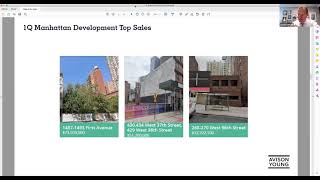
Welcome. Thank you everybody for joining. I'm James Nelson, I'm principal head of Tri State Investment Sales here with my fellow principal Scott Singer, who's the co lead of the Tri State Debt and equity team here at Avis and Young. We are thrilled to be here and have another quarterly report for you with a lot of momentum, a lot of exciting updates to report. So we want to really appreciate you all joining, taking the time and we're starting to get back to the in person presentations as well. So we're hoping that one of the future ones will be able to invite you to our new offices here at 530 Fifth Avenue so but with that I guess we'll go ahead and get right into this because we want to keep these, you know, on schedule and we've got a lot of content to cover. So I'm going to start off by going over the first quarter of 2022 sales and love green arrows. We are on the way up here. The fourth quarter sales activity dollar wise was 126% above the trailing four quarters. So exceptional dollar volume in all the boroughs with Manhattan leading the way with $5.4 billion in sales. That was a 60% increase over the trailing four quarters. But certainly the boroughs as well had strong performances as well. So right now we are on pace for $28.8 billion in sales for all of New York City which is below the 10 year average of the 35.4 billion but above interestingly we're on pace to exceed the amount of sales in 2019 which was clearly pre Covid. So we could not be happier with this activity. We talked about the fourth quarter last time we all we presented and talked about that record activity and that momentum has continued. So another very strong first quarter. The other thing I just wanted to point out is that we really now can put the bookends on the, on the COVID era of sales. And thank you Erica Dean, our director of operations for pointing this out was that when you look at the fourth quarter there were 46 sales that were multi family alone out of 100 sales. And we're going to be getting to that. But I think when you look at the overall picture, the average between Q2 2020 and Q3 2021, average dollar volume is 1.3 billion. Average amount of sales was only 39 per quarter. And again we're talking about all multifamily retail, office and land sales above 5 million. With exception of retail, we include over a million. Now the last fourth quarter, 100 sales, first quarter this year 87 sales. So we are far eclipsing what was happening during that Covid era. We're also starting to see some pretty large exciting institutional sales, Tom, and really seems like we've got some strong momentum coming here out of Labor Day. So we'll go to the next page here. As far as the number of sales, again increases across the board, with the exception of Brooklyn down 23%, but Manhattan number of sales up 45%. We are on pace for 628 sales this year. Again off the thousand seven average over the last ten years, but still a very strong activity. And I always say whether the market, even after the last year or two where you could make the case that it was a buyer's market, there's still not a lot of sales that are taking place here. So in a market as big as New York City, if not the top market in the world right now, certainly a top three. There's still only 628 properties that trade, you know, that'll trade roughly this year. So if you bought one or more of them, congratulations. Okay, well, we'll keep moving here. We'll go on to multifamily sales. A lot of questions I'm sure we're going to be getting from you all is the impact of current cap rates based on what's going on with interest rates. And Scott's going to talk about that and then we can circle back. But you can see right now that the cap rates are still tightening. And you kind of look at the historical pricing. But the average cap rate in the first multifamily sales, 4.32%. That was down 55 basis points. Now, again, this is an average of fully regulated fair market. Although I would say in Manhattan, the majority of the property sales here are mostly fair market. But there was a lot of sales activity. About a billion six worth 47 sales. Average price per foot went up 21% over the trailing four quarters at 839 a foot. So let's go in and talk about these sales. So we've got the American copper sale at 626 First Avenue. That sold for $837 million, almost a million square feet. So over 900 a foot. Purchased by Black Spruce. The Property consists of 761 residential units and 3 retail spaces. The residential portion was 97% occupied, and 2 of the retail spaces are occupied by Bright Horizons and A Hole in the Wall Cafe. Property benefits from a 421, a tax abatement that expires in 2038354 E. 91st St. The coal sold for $128.2 million. 125,000ft, 1032 a foot. This was purchased by Stonehenge from Carmel partners. Consists of 163 free market units and 2 retail spaces. Stonehenge has been an active buyer over at least the last two decades planning to upgrade these apartments. And, you know, we'll talk about this incredible rent growth. And as of this morning, Erica Dean again shared with us the Jonathan Miller report, which said that the median Manhattan rent is now 5% higher than 2019, and the increase since 2020 has been up 33%. So we're hearing just explosive residential rent growth, which is certainly aiding in this 2481 Broadway. $60 million sale. 132,000ft. Only $451 a square foot. Purchased by Lightstone. The Property consists of 86 units, 5 retail spaces, 70% rent stabilized, and 4 out of the 5 retail spaces are currently leased. I was told that some of these leases were also over market. That probably is why we're yielding, you know, the type of price that you're, you're seeing here. Okay, so we'll continue to move on. Talk about land sales. Number of sales have doubled over the average. Still not a lot to write home about. Average price per foot at 383A buildable. We're kind of seeing the last of these rental sales that are happening until we figure out what is going on with the 421A, which is expiring in June. If foundations are not in the ground. Albany could not come to terms with a new program that was proposed by our governor as 485W. The word is that, that, that unfortunately, our current program will expire, and it may be some time before we can put a new program back together. So we'll look at the impact and what that's done with land sales. You can see the total amount of buildable square footage that these land sales have accounted for in Manhattan is only about 2 to 3 million square feet over the last year or two. Whereas go back to 2014, 2015, there's also almost 10 million square feet of new development. That's just for the base site. That doesn't even include additional air rights that can be acquired, zoning bonuses. I mean, don't forget in Hudson Yards, you buy a site that's 10 times far, you can bonus it up to 33 times. So again, these are just the base square footage that's sold. And then there's this multiplier fact that happens on top of it with bonuses in many cases. So we unfortunately have a real void of development that is going to further exacerbate the issues of having enough apartments to keep up with our population growth. And yes, the population in New York City did increase from 2020 to 2021. There's kind of this fallacy out there that everybody's left at one point. I think that narrative now is changing once people are realizing what the rents are. But yes, we are severely under housed and we need to continue to build more housing. So really hope that Albany can figure that out to incentivize developers to continue on and build. Okay, so let's talk about some of these top land sales. We have 1487 93rd 1st Avenue for $73.5 million, 153,000ft of buildable. So that's 480 a buildable foot purchased by Carmel Partners. They will build rental looking to acquire even more air rights. And actually I'm hearing they might even entertain condos here. Carmel, typically a rental shop might consider condos here. So we'll get back to you on that. Next. 43034 West 37429 West 36 block through site. $51.7 million, $434 a foot purchased by Jasper Realty from Xtel in 2018. They had an outline that was planned for a 32 story project with 470 units. Last we have 268 to 70 West 96th Street. $32.9 million. 150 buildable square feet only 214 a buildable foot fetner purchases from the settlement housing fund but will need to incorporate 40% deeply affordable units. So that probably explains the price per foot there. Okay, next, moving right along. And yes I can. If you have questions, if you want to put them in the chat or the Q and A, I'm happy to answer as we go along. But as you can see, I'm just trying to fly through this information because I know Scott's got a lot to talk about as well. So next we're talking about retail sales. We're also seeing some compression and cap rates here. Low 5% on average price per square foot going up to almost $2,000 a foot. But still not a lot of sales here to glean too much information from. So we will keep going here and we'll look at some of the examples of some of these retail sales. Okay, we've got 121 Spring street that sold for 39.4 million. That was $10,000 a foot. Wow. These, these high price point transactions are happening again in Soho. Acadia Realty Trust bought this. It was sold earlier via foreclosure for $33.6 million. So a slight uptick in value here for that seller was sold vacant and suitable for dry use. You have 277 Fifth Avenue which sold for $23 million. 2600 a foot. Sponsor Victor Homes sold to Florham USA will use the space for their showroom for its tile and home goods business. 20 foot high ceilings, 116ft of frontage. Lastly we have 34 East 14th Street 10.5 million freestanding building, 1350 a foot which was delivered vacant. We are told that a franchise or franchisee of Popeyes is buying this for a new restaurant concept. Okay, so let's keep moving here. Office sales has been very solid. We've got an average price per foot that's actually gone up as a result of some of these big ticket sales at 1159 a foot. Cap rates holding in the mid 4% range. Total dollar volume up 184 over the trailing four quarters for a total 3.3 billion. We'll look on the next page and we'll show you why. You've got Google's closing on St. John's Terminal at 550 Washington Street. It was reported at $2.1 billion. It hit the transfers at $1.97 billion. $1,500 a foot. Huge vote of confidence for Google to signif to signify their continued investment in New York and their expansion. Next we have the Disney campus portfolio for $927 million. Wow. Almost a million square feet. Close to 1,000 a foot. Purchased by Xtel. They've been on a tear. Sold by Silverstein. The properties are occupied by Disney and ABC Studios. This is on Columbus Avenue between 66 and 67. So we will see what materializes there last. We have, I'm sorry, on the last page we had 375 West Broadway which was a sale for $130 million. 1700 a foot bought by the Macquarie Group, 100% lease with an average lease term of more than five years. Gucci is the retail tenant. And then you've got top floor, four floors of office occupied by title and a crypto exchange company. So I think we're going to be hearing a lot more about these types of tenants and uses for the future. So that's the overview on the sales. I'm going to punt on this question about the rising interest rates and how that'll impact sales. Because I want to hear what Scott has to say first. Yes, we are looking about the increased cost and you know, supply logistics and you know that is the challenge. There's certainly going to be demand now for new developments, certainly for new condo product. Tom, if I didn't mention and if you didn't see there was a record number of luxury condo contracts signed in Manhattan ever. So there's definitely demand for this and you saw in our previous slide that there wasn't a lot of land being sold. We're going to have a huge shortage but offsetting that is this increase in hard cost. And yes, we're looking at the future of 45W. Even if it happens. Developers, you have to keep in mind the requirements. There's no longer going to be this option C that was very popular where 30% of that project could be 130% of AMI which produced a lot of this kind of middle income type housing. Now they're going to be looking for much deeper affordability which consists of 10% of the housing being at 40% of AMI, 10% at 60% AMI and the last 5% at 80%. But, but again this is all up for discussion. I think we finally dropped the bullet point. A good cause eviction but that is certainly has not been forgotten either up in Albany. Neither of these will happen in this current legislative session that ends in June. We're going to have to wait to see what happens with the midterm elections and I think there's going to be certainly more discussion there. So with that let me turn it over to Scott and would love to hear about what's going on in the debt and equity markets.
Great. Thanks James, appreciate it. Hard to follow but I'll see what I can do. Look, I think that on the Interestingly I look up at the TV screen or CNBC and I constantly hear terrible headlines about interest rates and how high they are and zombie here and the squeeze. And yes it is unpleasant that rates have risen dramatically in the last 60 days plus but the real question is is it that bad? How bad is it and have we been here before? So if we go to the next screen, here's what 10 year treasuries have looked like in my career. So this goes back to 94 and I remember a very, very experienced, sophisticated, smart client. On my first significant closing we had the opportunity to rate lock the deal and Treasuries had dropped that day and they had dropped to 6.9 and I called them and I said, all right, the treasury is below 7%. They said, oh, lock, lock, that's great. That's, you know, that's the first time and in years that I've had that opportunity and that was to lock and at a rate of 8.3%. And we can see the steady trajectory down. And the one reality of my career is that we have always counseled clients in thinking about whether to lock a rate and how long to lock a rate to not to play the interest rate game, to focus on the real estate game and to match their interest rate hedging with their hold periods for the transactions. And with almost every loan that we've placed over the last 25 years during the term of the loan, the owner can look back and say we were wrong. But I think that because as you could see from this chart, rates for the most part have just kept going down. But I don't think that that has been incorrect advice because the downside of not fixing a rate for a period of time if rates rise can be catastrophic or difficult. And the downside when rates have dropped has been a decrease in profits, which nobody likes, but is not catastrophic. The questions that when we look at a market where and if we move this slide one forward, where there has been a meaningful increase in the last 60 to 90 days are the questions that are here. Can I refinance at an attractive rate? Well, perspective really matters there, because here, you know, I've said here, is 5% a high rate or a low rate? I think the reality is that most participants in the market whose careers started in the last 15 years would say 5% is a very high rate. That's high yield for anyone who was involved longer than that. 5%, 4%, 475% or 8.3% at the beginning of my career, but certainly rates below 5% or in the fours have from an long historical perspective really been low borrowing rates. Pre haven penalties are very interesting right now and I think this may have been overlooked. It's been the case that for the last several years when rates were extraordinarily low or when there was movement, we've looked at many, many properties to refinance at the time time when there were two to three and a half or four years remaining and the prepayment penalties have been extraordinarily high when rates moved up. If we go to the next slide, when rates have moved up historically, typically rates have moved in tandem, both up and down, meaning short term rates and long term rates. The yield curve generally is relatively parallel or the curve remains the same. And when there's been a movement in interest rates that has caused borrowers to think, should I do an early refinance? When short term rates move up, that decreases prepayment penalties. When the yield curve is parallel, as it typically is, the benefit that a borrower gets from the lower prepayment penalty is substantially offset by the increase in the long term rate that they're going to borrow at. Basically that is prepayment penalties working the way that they should. They're doing their job and they're disincentivizing early prepayments. In today's market, meaning the last 60, 90 days, we've seen something different and that's a flattening of the yield curve on the next slide. Matt. So this is not exact, but it's a very good graphic representation showing that in this case, short term treasuries, which I've used two years, have risen significantly more than long term treasuries have. And that creates this arbitrage. The arbitrage is that prepayment penalties on loans with one to three years remaining have dropped very dramatically in the last 60 days. And although borrowing rates are higher than they would have been 60 days ago, the borrowing rates have not risen as much. So there is an arbitrage opportunity. And for the first time in many years, when we look at the benefits to a borrower of refinancing a loan that has more than a year left, we are finding positive opportunities. Now those positive opportunities are happening at higher rates than they would have 60 days ago. But, and nobody likes that, but that led us to look at, on the next slide is another view of that interest rate curve during my career. So this, the jagged line is the same as on the prior. This is 10 year treasury rates from 1994 until now. The treasury today, actually right now, I think the, I think the treasury, at least a half hour ago it was at 287, which is exactly the average from 2006 until the beginning of the pandemic. So while it is easy to quickly forget and to get used to the very right side of this curve, the pandemic period rates that were so incredibly low, that period has been the outlier and even within a fairly low or dramatically low rates that we've had since, let's say, the beginning of the significant recovery from the Great Recession across the period of time that started with the heyday of 2006 and includes the depths of the financial crisis and then the recovery and the back and forth to the pandemic we are today at exactly the average 10 year treasury over that period. When we look at the whole again of my career going back to 1994, the average Treasury 10 year treasury rate over that period was 100 basis points higher than it is today. So it's this really shows that perspective of if you joined the business 0608 2010, the last five years during the pandemic, then your expectation is that treasury rates are always below 3% and usually below 2% and sometimes they're, they're way, way down. But even going back to the beginning of my career and there are a lot of people who've been around even longer than I have, we're still low from a historical perspective. So how do we decide as we put on this last slide, look for anyone who believes that we're going back to 1% treasuries and, and this rise is an anomaly then early refinancing isn't going to make sense now. Similarly for when we look at the other headlines that we are all seeing are about inflation which is extremely high now and there are certainly lots of risks going forward. If you are convinced that we are heading back to the much higher rates that averaged 5.5% and that's the treasury rate, not the borrowing rate, the spread would be added on top, then let's go. It's obvious and you'd want to lock in today's rates now wishing that it had been done 60 days ago. Yes. But a no brainer decision to go. I think the reality that we see in conversations is somewhere in between. If we go back one page to this curve, where do we go next? I don't know. But I know that the advice that we've been giving in my mind still remains which is that if borrowing the money is available now and the deal works and protects ownership going forward, then our advice is to remain focused on the real estate game, not the interest rate game. So James, that's what I wanted to focus on and it's what all of my conversations all day seem to be about.
Right. That was very helpful and I love how you looked at this in historical context and yeah, we all do have short memories. Looking historically these rates are still very attractive. So just looking at the questions Scott, this one looks like for you, who are the active lenders in the market? I'm sure that's really specific to the kind of asset class but maybe just kind of give a flyby what banks are doing and life companies and cmbs.
Yeah, Happily, there is still an extraordinary amount of liquidity in the debt and equity markets for transactions in New York City and in other areas. That makes sense. And by makes sense I mean developers, owners, borrowers who are working on projects that they have experience doing and a size range that's in line with what they've done before. And where the capital stack is set up in a way that can withstand challenges. There it is. Deals that rely on substantial decreases in cap rate in order to be viable, or where there is, where the coverage just doesn't exist, then there are certainly challenges in this market. But for transactions that make sense, the liquidity is very, very strong. And it is across the board. We are still getting CMBS quotes and executing CMBS deals. In fact, in some cases we're choosing CMBS because of the speed at which we can get to closing, which may even be faster in some cases than where we can rate lock with an insurance company. On the other hand, we're also rate locking quickly with insurance companies. Banks are active and the investment funds are out there. And what we've found is that for deals that make sense, there is still we can drive substantial competition for deals that can bring pricing, execution pricing down significantly below the initial proposals.
That's fantastic. Okay, next question about the correlation between the rise in interest rates and cap rates. So you know, and maybe again we look at your historical chart, it would be interesting to layer on the cap rates versus the 10 year Treasury. But what was amazing, I think me thinking back in 0607 where we were in a, you know, 3, 4 cap environment, but I'm talking multifamily now and investors were still borrowing at, you know, 6, 7% in some cases. I mean Scott, you probably remember that, but you had a situation where there was actually negative leverage. And so, you know, I think the question, and look, this goes back to what we were stating before about, you know, these increase in rates. What is this going to do to cap rates? What is this going to do to pricing? I mean, you know, obviously it's going to put upwards pressure on cap rates, but I don't think it goes lockstep because you know, there's really two levers when you're valuing property. I mean, one is obviously the cap rate, but also what's happening to your bottom line. And you know, the rental growth that we talked about has been incredibly strong. So again, residential rents in Manhattan up 5% from pre Covid, up 33% over last year. I mean just exceptional rent growth. So I look at that and say, okay, even if you're borrowing money, you know, five, ten year money, and even if that rate has moved up, you know, 50, 75, even 100 basis points, you know, is that rent growth going to make up for that? So I mean, Scott, I don't know if you have any thoughts on that.
Well, yeah, yeah, James, I was just when I'm looking at this chart and I'd be really interested to not try to put you on the spot for the answer, but look at what happened to cap rates between let's say 2013 and the 2014, 2015 peak.
Right.
And then again, you know, let's say from 2017 to 2019. Right. Because you had similar increases in treasury rates during those periods of time as we've seen similar so far here. So that's something for us to examine. Obviously borrowing rates are driven by both the index and the spread. And so we have seen an uptick in spreads not across the board and very much affected by competition and the attractiveness of the deal. And I think that, you know, Those periods of time, 20, if we really were looking at 2012-2013 spreads were probably coming down because there was a belief that we were out of the, out of the financial crisis. But I do think we should layer that on.
Absolutely. We'll have that for the first half report that we'll do in three months. Okay, next question. What is the profile of buyers today? Certainly in the first quarter we've continued this was really, we saw this also in the fourth quarter, very strong demand from domestic buyers. You see a lot of these local sponsored developers, the Xtels of the world, Carmel, a fund out of California, Black Spruce, local operator taking down almost a billion dollar multifamily acquisition. And then of course Google. So it's interesting. I mean there's certainly still foreign demand, but I think a lot of that was taking place in 2020 when there's very few transactions. Interestingly, it was actually a lot of the foreign buyers who first came back into the market. And now I think these local operators who can move a lot faster now, they see what's happening with the rent growth that's out there and so, and jumping on a lot of these opportunities. Okay, I'm seeing only one other question. What about industrial. Look, we don't even track it as a separate asset class because unfortunately there's so few of these industrial trades. But what we can tell you is that the appetite for these are just voracious. And I think you all have been hearing the narrative now that we're now looking at multi story industrial. We closed on five story, really six levels when you include the lower level out in Jamaica, Queens. And the buyer is going to be looking to activate those floors above as well for distribution and logistics. It's just become so challenging to find these larger sites. We are watching talking about micro distribution, what's happening in the city and the city council is concerned about a lot of this delivery services kind of on demand and what is that doing to our storefronts and traffic on the streets? So that's probably for a separate conversation. But we are seeing very strong demand for industrial space and so I think that that's certainly something to continue to, to look for. So.
Well, I would say, James, I would say that it's, it is a darling of the finance business as well. So spreads for industrial, you know, might be the lowest across all the, all the asset classes and both within New York City and outside. So you know, it's an asset class that was semi forgotten for a very long time and certainly thought of as the lowest cost, lowest, you know, lowest and worst use of, you know, of real estate for a very long period of time. And that's entirely flipped on its head.
Got it. Okay, we've got one last question that came in that we'll answer which is what are you seeing for the sale of rent stabilized properties, cap rates in Manhattan and Queensland? So look, I mean if you're talking about fully regulated product, we just sold one of these on Queens Boulevard which was a 5 cap, there was a little bit of fair market. But look, I mean if property is fully regulated, mostly regulated, you are really at the mercy of the RGB. Now I don't know if you all saw, but it did seem like the proposals for the increases this year, 1%, excuse me, for the one year renewals it was going to be 2.7 to I believe 4% and for a two year increase, four and a half to 9%. So it's probably going to settle somewhere in between. I mean remember last year, you know, it was all of, you know, I think 1%. When you kind of averaged it out, it was a very small increase and going back before that it was frozen for a couple of years. So there is a new RGB board. Our mayor has said that he will look to, you know, he will look to the recommendation of the RGB for increases. So I think that's positive. So, but most of the demand has been for mostly fair market where there can still be some value add, where you still can increase and kind of, you know I think a consideration there is again with good cause eviction if that happens. If you were limited to increase by only 3% or 150% of CPI which was actually a big number for this year but clearly not not a great precedent for the for the future. That is why our cap rates are still greater than say the Southeast where a lot of these multi deals are still at 3% or less. So the fact that you saw our average in Manhattan was in the low 4% range and in the boroughs that we can even see cap rates that are still well into the fours or even 5% ranges. So do believe that the regulatory risk is priced into the cap rate so well this is great. Thank you everyone for joining. Scott, thank you for all the great information as well. We'll put this recording up. We also have a property sales report that you can find if you go to ay tristateinvestmentsales.com that's where you can find these reports and we're always here as a resource if you all ever have any questions. Scott is an incredible sounding board also if you're thinking about how to finance recapitalize a project, always happy to jump on the line with you and share his thoughts. So thank you again for joining everybody. Have a great day.









