Q1 2025 State of the Market
Quarterly market briefing (Q1 2025) focused on New York City and Manhattan real estate. Key themes: immediate business impacts from newly announced tariffs (price pressure on restaurants and retail; tourism risk), Q1 transaction activity (dollar volume down ~23% but unit counts up), strong land/development activity and rising conversions of office to residential, changing buyer composition with increased domestic/private activity and reduced foreign share, and a liquid but volatile financing environment with large swings in Treasury yields creating short‑term uncertainty.
Questions this video answers
129,000 businesses in Manhattan.
67 million visitors (target for the year).
Dollar volume was down 23% in Q1 2025 (NYC/Manhattan aggregate referenced).
Number of sales was up 9% citywide; Brooklyn had the largest uptick at 21% and Manhattan recorded 84 closings.
Approximately 23 million square feet of office sold for conversion to residential or for end users (since the pandemic).
Welcome, everyone. This is James Nelson, principal and head of US Investment Sales now at Avis and Young, but still coming to you, based here in New York, still a very important market here for New York. And that's what we are here to talk to you about today. With us, we have this is a special guest. We had Jessica Walker in our office this morning. And I'll have us come off the screen share right now so we can see everybody. Yes. And we were talking about the topic, among other things, on everybody's mind. It begins with a T. I think you all can guess what that is. But Jessica does a whole lot more than talk about tariffs. She's the president and CEO of the Manhattan Chamber of Commerce, an incredible organization that I had the privilege of being on the board with, and they do so much for Jessica. Remind me the number of businesses in Manhattan. And before we jump into the tariff discussion to kick things off, just give them a little sense of your membership and maybe some of the high points that you covered this morning before we address some of the challenging news that's out there. So, Jessica, thanks for joining on short notice.
Of course. Good morning. The Manhattan Chamber of Commerce, we're a business Association. There are 129,000 businesses in Manhattan. And as you can imagine, there's both small businesses, large businesses and everything in between. And our, our membership app actually really is strongest on the smaller side. So we actually do a lot of work supporting small businesses and storefront retail businesses.
Wonderful. And I know there has been, again, some positive themes with job growth in the city. There's definitely been some activity that you shared about some of the high points on some of the businesses and things that have been happening with the city thus far.
Yeah, I mean, lots of good news in terms of we now have more jobs than ever in the city. We have more businesses than ever in the city, almost 300,000 businesses. So there's a lot going right. This morning I did talk about public policies that are kind of hurting us. Certainly we hear a lot of people talking about the affordability crisis in the city and the need to address our public safety concerns. But there is a lot going right before we start talking about the tariffs.
Got it. Well, it was very timely again that you were scheduled to come speak to our office this morning because I saw that you put out a really compreh of white paper on the impact of tariffs. And again, this is unfolding, you know, as we speak. And so but, but just really kind of focusing on the immediate impact with businesses here in New York So maybe you could share kind of some. Some of the immediate takeaways that you're seeing.
Yeah, well, I mean, the first thing is that, that the rollout of this has been, you know, unfortunate and that it's just caused a lot of panic. Even businesses that are not subject to the tariffs directly are panicking because they just didn't know the details. This is very confusing. So that's the first thing we were trying to bring clarity to the situation so people can try to get a little bit of certainty here. But what we do see is that as the tariffs, as you know, the big tariffs started today, what we're going to start to see is food prices are the first ones that we'll start to feel. And that means that our restaurants are going to be the ones who are really going to start feeling that, as I said this morning, how much can you charge for a bowl of spaghetti? At some point, you do have to start making some tough decisions. You can only raise your prices so much. And same with our retail stores. Prices for clothing, handbags, jewelry, wine, all of those are expected to go up in the next few weeks and coming months. So we're really pushing for a resolution. Hopefully a lot of the countries that have been reaching out to the White House, we'll get those resolved quickly and then we can sort of move beyond this tariff crisis.
Yeah. One of the other points I know under the good news column in New York City is that I believe our tourism numbers were expected surpass even pre Covid levels this year. Is that I don't know if I have the exact number on that, if you have that up the top of your head. But obviously we don't want this to impact foreign travelers coming to New York as well.
Yeah, you're absolutely right. I think 67 million was the target for this year, which would be a record. And we are afraid, unfortunately, that this tariff crisis could hurt that. We know that Canadians are boycotting American goods and starting to boycott American, you know, travel to American destinations as well, which is bad news for New York City. And certainly if. If other countries follow suit, it could really harm our tourism here in the short term.
Yeah, I mean, it's. It's really hard to get a handle on. Everything is, again, it's, it's. It's happening real time. I was frankly surprised that we've have. I've got a call with Canadian investors later today, and it's again, in some cases, we're having some Canadian investors tell us that they want to park in hard assets right if there's concerns about future costs and goods that may be existing could be more valuable. So you see the influx there, but obviously a lot. Still a lot of unknowns. Jessica, is there any. If the tariffs were to stay anywhere close to where they are today, is there any positive in the sense. I know one of the big objectives was to bring onshore a lot of business. And not that New York City has traditionally been a big industrial provider, but certainly it does exist. And the idea of companies who want to produce their goods here, certainly companies based here focus more of their business here in the U.S. i mean, do you. Is there any positivity that you could see on that side for actually bringing businesses or companies expanding their presence in light of this?
Possibly it'd be more probably in the region than necessarily in the five boroughs, but you never know. I mean, there's a lot of uncertainty around this, but, yeah, there's probably going to be some good things that will come out of the negotiations and resetting of our trade with different countries. But, yeah, it's just a very painful way to go about it.
Yeah. Well, Jessica, we appreciate your jumping on. On short notice. And I just, again, you've been, you know, on top of this, and we appreciate everything you're doing for the businesses in New York, which is really what drives the real estate market. You know, the occupiers, you know, companies showing up, tenants and, you know, everything that touches, you know, the tourism. So we just. We appreciate everything you're doing for advocating for businesses here in Manhattan and for New York. So we appreciate that. We're going to jump into the sales portion. But again, for any of you who are looking for a resource for, you know, for business help, Jessica was also sharing that you're a great place to help connect with business, and your membership is a wide range of mom and pops up to the Facebooks and the Amazons of the world. So think of Jessica as a great point of contact for anything business related. So, Jessica, thank you again for James.
I just want to mention one thing that Jessica said in the meeting also, is that they have delegations that come in from various countries to learn about doing business in New York, and that those are essentially open meetings or at least available. Jessica has the ability to open them to people who reach out to her and try and wanna take advantage of that. So I recommend that.
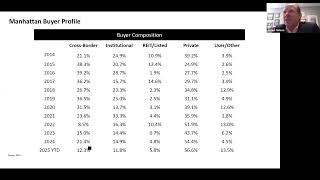
Perfect. Awesome. All right, well, thank you, Jessica. We're gonna get on with the program, but a lot going on again with tariffs. So we just. We wanted to make sure to address that, and we'll certainly be referring back to this in parts of the presentation. But let's go ahead and jump into the state of the market for the first quarter of 2025. So again we are looking at the top major asset classes, I.e. multifamily, retail, office development and now conversion we've also added into its own separate bucket. And so we're adding up the dollar volume of all these sales north of $5 million in New York City and then Manhattan. So you could see that for the first quarter dollar volume was actually down 23%. I always say at this point this is a rear view mirror indicator because deals that closed from January 1st to March 31st were likely negotiated in the fourth quarter of last year, if not the third quarter. So it does show that there was a dollar volume decline. I think part of that was there were some very large scale office transactions that closed in the fourth quarter. And that being said, we did go back and look since 2019 and there was only one time that actually 1Q dollar volume surpassed 4Q. This might be a little bit of closings that were scheduled to happen for year end for tax reasons and a little bit of a more sluggish start to the year. If buyers and sellers are focused on closing deals, maybe they're not as focused on signing new deals. Again, completely unusual that we would see a dip from 4q to 1q. But again, if you annualize what's happening so far this year, this puts US at sub $15 billion, which is again only about half the 10 year average. Now when you look at the number of sales, there was actually an uptick in New York City up 9%. Here we're doing a lot better. Historically the 10 year average is 778 and the annualized number is at 656 with the largest uptick in sales in Brooklyn with 21%. But look at Manhattan, 84 closings, that is the best quarter, you know, the best number of sales in Manhattan since 2019. So there were a lot of deals that closed. They just again, if you look at, you know, the dollar volume that was produced, you know, we're talking about smaller to mid sized sales that were really most active in the first quarter. When you annualize these, and I'm always nervous a little bit to annualize first quarter numbers, but you see that yes, there is a dollar volume decline 24 to stabilizing this year, New York City 10% whereas Manhattan only 5%. But the number of sales, if you do that, then you're getting Double digit increases. So again, we like to see these transactions and of course the question now with these tariffs and maybe buyers, investors, sellers, waiting to see the implications, does that kind of cool down activity where investors take a wait and see approach? That's going to be the question, the big question moving forward. So if we look at the dollar volume, what's selling? You can look back to 2018 where you had almost $15 billion sales alone coming from this office category. Office is really what drives the market. Certainly the institutions, REITs, when they're active, that can really move the needle. Here you can see it's very evenly dispersed amongst the various asset classes with actually development leading the way with the most dollar volume in the first quarter. When you look at the number of transactions again here, multifamily traditionally has been a good portion of the sales, a lot more of that bread and butter. 20 families with the store, 50 units, 100 units that still remains active. But look at retail taking on a very active share as well. A lot of ground floor retail and freestanding retail changing hands this past quarter. And especially as mentioned before the development. So this is going to be very interesting to track is the seller composition. And you look at what we saw in this first quarter was a third of the sellers, over a third of the sellers were foreign. So could this be because some of the foreign owners were already starting to get nervous at the end of last year? Maybe with all this tariff talk saying maybe we want to repay, repatriate some of this capital, you could see that in 24 last year they only accounted for about 12% of the sellers. So again, don't want to read too much into one quarter's worth of information, but here you see foreign selling activity almost triple. So we'll be watching this closely. Meanwhile, private sellers still being active certainly. And really the institutions that look back in 2015, the peak of this last cycle, a third of the sellers, big trophy assets were obviously coming from the institutional space. So we're still a lot of room for institutions and REITs to get off the sidelines to transact. Now, when you look at the buyer composition, this is also pretty interesting here you see foreign investment dropping Quite significantly in 23, 35% of the sales volume in New York City was purchased by foreign. And now again, we're down to 12%. Private domestic investors really filling the void and driving the activity here, whereas the institutions are still waiting for the time to strike. We're eagerly watching the headlines and hoping that Blackstone there was rumors of a billion dollar Office acquisition. Those typ headlines certainly help move the market and also help other peer investors get off the sidelines and transact as well. But we'll be very interested to see what happens in this next quarter or 2 in 25 to see if this foreign investment continues to retreat. Now, getting into the multifamily sales. And Brandon Polakoff, who is now Avison Young's head of New York City Investment Sales, who's been incredibly active in this space, will give us an overview of the multifamily and then talk about some of the individual transactions, the top sales in each of these asset classes.
Sure. Thank you. So I think in terms of total dollar volume, a lot to take away from these numbers. But at the same time, anecdotally, it's felt pretty status quo. There's definitely a demand to purchase apartment buildings that are, you know, fair market in New York City and even rent stabilized at the right pricing. So everything just comes down to price. With that being said, there's plenty of buyers in the market and it's just trying to find, you know, what is that, you know, cross section between where buyers and sellers are willing to transact. And I think what you're seeing now is there's more eagerness for buyers to, to capitalize on where they think pricing has gone and where they think the future will. We'll see pricing. So again, I don't want to read too much into the numbers just because it depends on what exactly was sold. But in general, you're seeing, you know, cap rates come down a bit, which I think high level is a nice thing to see.
Wonderful. So let's look at some of the top trades that took place. If I can get my cursor over there. Okay, yes.
Sure. So 395 Leonard Street. This was in Brooklyn, Leonard Point. This was previously developed by Rabsky, sold to UDR in 2019 for 130 million and just resold for 127,000 or, sorry, 127,500,000. The big talking points here, it was a 5.75 abated cap rate. This was a 15 year tax abatement. Seven thousand and thirty building that expires in 2032. On the unabated taxes, it's a 4.85%. So if you were to assume the full taxes, which will eventually phase in, the building will be entirely fair market once that abatement expires. It was 188 units. 501 East 87th Street. This was purchased at $576 a foot by A E from the Solio family. It's 21 rent regulated. There is a light value add business plan that can happen here. So the cap rate was at a 4.45 cap. Usually for the larger sales you'll see a tighter cap rate and you'll see a lower price per foot just because the loss factor given hallways, elevators, etc. Lobby, you know, creates a lower NOI but great piece of real estate. And then the Pinchnik portfolio, this was very retail heavy. 47% of the income came from the retail taxes. Here were 7% of EGI. So it was tax class protected buildings which would explain the $891 a foot that these were purchased for. So it was a 4.9 cap, sorry, a 5.9 cap with some upside. So. And it was 100% fair market, so pretty good buy. It was purchased actually by a private family from a private family that had owned the buildings for a very long time.
Wonderful. Now we look at land sales. I mentioned this was the most active asset class for the quarter. 16 trades over $700 million. And this looks to be at the high point over the last 10 plus years. I mean could be the highest land sale price ever recorded in a quarter at 686. I think a big part of this is we're seeing some very high profile land sales that are happening that are really focused on condo. So you can see that when you talk about rental that finally it does look like there's some more buildable square footage that's being accounted for here. The ten year average is there's about three and a half million square feet of far sold per year. And obviously we are above that. So we know that 45x is helping in some capacity. But I think that this, you know, this time it was really more a matter of some of these condo executions as well as office. But while we're on the multifamily topic, I mean this is the need that we're still trying to solve and why likely why residential rents are still staying so high. If you believe the city's numbers that we need 500,000 housing units or the mayor's number that we need 530,000 housing units to keep up with population increase. You know, we are not producing anywhere near the amount of units needed. I mean look back to 2014 when there was close to 50,000 units created, you know, 23, 24, 12,000, 15,000 units. And you know, so far, you know, what we've seen this year is only about 6,800. So you know, if you annualize this definitely it seems to be, you know, helping, you know, the new 45X. But we've got a long way to go. So Brandon, talk us through some of these development deals that took place.
Yeah, and just to echo what you had said, I mean for the larger scale development sites in Manhattan, you know, speaking of Manhattan, particularly Without city of yes 45x it became very challenging to sell those sites because it was a lot of condos in more rental driven locations. So now for example, we have a site around the corner from our office. Historically would have been, you know, 200, 300,000ft. Historically would have been a lot of condos to sell in Midtown. But as a rental project there was huge demand to build because there's still an appetite for apartments in Manhattan. So to rent quickly going to these 576 Fifth Avenue that was purchased actually for $100 million not very long ago by a user. XTEL repurchased this from that buyer for $175 million. They paid about 2,300 a buildable. Sounds like a big number. They do have Ikea in their back pocket as the future tenant here. They recognize that they paid a big number. But the corner was very important for them. As part of this assemblage that they were putting together on 46th Street 35 to 39 East 60th Street. Also an assemblage also X tells the purchaser also have a tenant in their back pocket with Chanel coming in to take the retail at Madison and or sorry, this would be at Parkin 60th or Madison 60th. And they purchased that from the Goldman family, which historically doesn't sell. They bought that for 89 available and then 24 West 57th Street. This was an office building that was owned by apf. Obviously Covid had an impact there. This is now being sold as an assemblage piece of a development. So that pricing comes out to 669 of buildable which you know, again just going to show for well located office assets and condo locations. You're seeing in a lot of cases the highest and best use is actually demolishing the building and building up. So these are three conversions. I'll go through these quickly. 235 is 42nd. That's the Pfizer piece that's being converted to apartments. 511 to 541 was 25th. This is an area of the office market that has started to struggle a bit. This is like by the High Line, a little bit west, actually. Great office product, but it's actually being converted to self storage. And then 341 to 345 7th and 167 West 29th. This was purchased actually as like a discounted office play right after Covid. Even still, the basis was not low enough to sustain itself at around 400 to 500 a foot. So the building was taken back by the lender and resold. What's interesting here is that this actually is not. It was sold and the buyer intends to do a residential conversion and development on the corner. What's interesting is that Midtown south rezoning hasn't taken place yet. So they're making a bet that that's going to pass and they can convert this building.
Great. Okay. As far as retail, you can see the pricing has really bounced around. You know, we provide averages, but we also give ranges because you can see, you know, these averages of say, 1600 a foot is really just kind of, you know, a barometer. You look at the range. It's from $367 a foot to 20,000 a foot, which is a Fifth Avenue sale that Brandon will speak about momentarily. But look at the cap rates ranging four and a half all the way up to over 9%. So look, I mean, these spreads. And by the way, the uncertainty that we're seeing in the market right now is going to create opportunities. And when you see this great of spreads, you know, there's. And obviously that speaks to the different types of retail credit location, all these things that go into it. But there's also, you know, big variance in price, you know, based on, you know, the situation of that sale. Was it distressed, was it off market, Was it marketed? I mean, that. That's definitely, we think, has a big role in some of these. These trades as well. So, Brandon, take us through these top retail sales.
Sure.
666 Fifth Avenue. This was the Uniqlo sale that James referenced. It was the final piece of a sale from Vornado. They're a user here, obviously a very big number. 106 Spring Street. I thought this one was really interesting. So it was 8,000 a foot. It was a retail co op. Acadia bought it. This was a 4.55 cap, which feels, you know, on the lower end historically in, or I guess in. In more recent history, even in SoHo. But, you know, this is. Vuori just signed a new lease. They're going to be there for a long time. There was some recent sales in SoHo that were also low cap rates or low relative to recent history. But you know, the, the buyers like Blackstone felt there was upside in the rents here. You're buying long term retail at 4 or 5, 5, so you just feel it's a good investment with Fiori there. And then 200 East 59th, this contract was signed years ago and the buyer had the opportunity to try to lease up the space. Still was unable to by closing, but eventually had to close on this years later. So this, this has been in the works for, for quite some time.
Okay. As far as the office sales, again, huge range. 15 trades for over 600 million. Price per foot range 255 to 1866 a foot. You know, cap rates obviously are expanding here. It looks like, you know, the price per foot is on an upswing here. But again, with such a range, I think it's really difficult to speak to averages. I think what is going to be interesting for you all to hear is our analysis of the last five years of office sales. But before we do that, Brandon, you want to speak to some of these office trades.
Yeah. And something we didn't touch on. But just thinking out loud, just as we've gone through the different asset classes, I'm sure a lot of people are looking at this and saying, wow, it's kind of all over the place. And James and Brandon are saying, oh, this is up, this is down. I think that's the reality right now. There is definitely a huge appetite to buy. As you can see, the sales numbers are up. What's pricing well and how it's getting priced. It's really an asset by asset, case by case basis. So there's definitely a flight to quality. And then so I think there's, there's probably a two sides of, of the market and that's why you're seeing such, you know, discrepancies in terms of cap rates and price per foot and all that. So I think to understand value is really looking at a building on a case by case basis. But putting that aside. Yeah. 333 West 34th street, that was bought by B and H from Brookfield in the low 500s a foot range. 430 West 15th street, that was the rock nation. This is the leasehold position. And then 500 Park Avenue, that was just like a good, you know, office piece. And they're gonna just own that and operate it as is.
So great. Okay, so the historical pricing, I mean you can see retail has really been bouncing around. It would be seem that, I mean, certainly development as we said, there's an upwards trajectory here. Multifamily, it seems to be leveling off and maybe even a bit of recovery on the office side. And cap rates again, seeming to flatten out in the high five range, which Scott's going to be talking about, where you can obtain financing right now. But you know, even seemingly, you know, maybe neutral in this situation, maybe even a little accretive in some examples, and retail cap rates on average tightening a little bit, but still at, in this last cycle, near term highs. So we're going to be talking, as I kind of take you through this office study of the last five years about this prevalence of office to resi conversions and end users stepping up. We'll see if development in light of these tariffs will continue to continue to be as active as it has been. And again, you know, all these provisions that were put forth under City of Yes, and making more office buildings eligible for resi conversion, Midtown south rezoning around the corner, you know, how are all these things going to help, I guess continue for the development market to grow? But let's talk about the. We looked at all the Manhattan office building sales since the pandemic, 184 of them. And what's interesting here is there was 23 million square feet of office that was sold for either conversion to residential or for end users. This is a good thing because it actually shrinks the denominator. So if you take 23 million square feet off of the 512 million square feet of available office space for rent, we are now actually shrinking the office stock by 4.5%. Now, of course, you can make the point that these end users that are buying buildings, they would be potential tenants. But we do see this as a big positive trend that companies want to establish permanent routes. Here in New York, we see that 28% of the buyers again were purchased by end users. Pretty unbelievable. And this is pretty wild. 44% of the office stock sold has been slated for residential conversions. So you have a lot of these larger scale office buildings that are creating thousands of units. And again, these are helpful things because it also tightens up the existing office market when you have this much of the office stock that's either converted or now owned long term. So if you look at the actual sales volume of office, you can see we were really starting to grow in 22 as interest rates began to rise, uncertainty, there was a drop and it looked like we were having a really nice recovery. In fact, we know that office buildings in Manhattan, dollar volume doubled from 23 to 24 across the board, trophy office quadrupled. So we were seeing a really big upswing in value. We'll now see if that trend continues on into this year with everything going on. But look at the number of trades. So you know, you have certainly more than half the office trades accounting for just, you know, keeping office. But you do have 53 user sales. You have 25 conversions. But then when you look at the percentage of square footage, it's almost, it's almost even between traditional office staying office and the conversions and end user purchases. This slide I think is really interesting. And by the way, if you all have questions, feel free to put them in the Q and A portion. And I know one of those questions we've already gotten is we're going to share. If we're going to share the deck, we absolutely will. But here we show the range of office sales per square foot and then the median. So here on conversion sales, you see that these trades for the most part are happening at $250 a foot or under. Right? That's, that's the median. But in some cases, you know, upwards of 500. I would say at these, at that price point you probably see a lot of the condo conversions as opposed to rental. But then traditional office sales staying office huge range from, you know, into the hundreds of foot on up to close to 1500 a foot, you know, with the average, you know, in the three hundreds. Right. This shows where the, you know, the average trade is, excuse me, closer in the seven hundreds. And then you have user sales where it's a gigantic range from 300 a foot to 4700 foot, thanks to Bloomberg in his purchase on Madison Avenue. But look at the. So again, I think the lesson learned here is if you have a mostly vacant office building, looking for that end user opens up a lot of bandwidth there. And then also even on a median basis, it tends to perform better than just the office investor purchases or the conversions are really the heavily discounted office. And that obviously has to factor in the construction cost to convert now more than ever with these tariffs. So you see that conversions really ramped up with a billion and a half of sales last year slated for resi conversion. It looks like we're on the same trajectory now. I think the big thing is that a lot of these sales that happened in 23 were without the help of, of the 467m, the tax abatement, which really only went into effect at the end of last year. So that is hopefully that'll be helpful in offsetting some of the challenges and the added costs with these potential, you know, with these tariffs. But this is you know, a trend again office to reside that we really like to see for a lot of reasons. Number one being that you know, there's still housing crisis here as people want to still live and work here and we need more housing units. So if you look at where the bulk of office sales are happening right now, it's in the, you know, over half the sales are almost entirely vacant and then you've got which account for 30% of the sales and then 90 to 100%. So it's really kind of the far ends of the spectrum where end users, converters buying mostly vacant investors buying well leased office. It's really kind of the product in the middle that is not becomes a little more challenging and you don't see as much of the activity there. So with that Scott, I'll let you jump into it.
Well James, I appreciate it and you know I am generally tasked with looking forward and providing some clarity around borrowing rates. And I would say James, if you go to the next slide you can show you know, a little bit of what I'm feeling today. So James.
Yeah, but yeah, yeah, our comedy timing.
Is off a little bit. But you know when Jessica was was talking before, you know she talked about I guess the CEO of Delta came out last night and said they can't forecast going forward. I actually saw the stock was up 8% this morning. So maybe mine will be too. But you know, why the question mark and this is what when we put this slide together at 4:30 yesterday afternoon, I was focused on the fact that we've had a 30, had had a 35 basis point swing in the 10 year yield over the last week and a 50 almost 50 basis point swing in the, in the five year. And obviously that creates some challenges. Then on the train this morning, James, if you can go to the next one, I just checked rates to make sure there hadn't been any anything significant that happened overnight. And this is what I saw. So you know, this is just overnight a 20 basis point swing up to over four and a half percent and then by the time I was looking at it back down to to 435. So on my other screen here I've got it up in the 10 year treasury is 440 or 441 right now. So you know we have these sort of wild fluctuations if we look at back to the last one of these and James, if you could go to the next slide. You know, way, way back In January of 25 we were in a very engaging opportunistic or optimistic real estate finance environment where Treasuries which were about where they are today were. What we were focusing on was that was historically normal or below the historical averages. Credit spreads have been quite attractive. The lowest spread proposal that we have right now is in the 80s over treasuries. That's a very, very low leverage, you know, market rate. There's not a lot of spreads at that, at that level. But it's, but, but we've been in a very engaging market. So you know, so now what, what slide do we put up for today? You know, James, if you go to the next one it's you know, what do we do do, do we panic? And I at this point have been through a lot of cycles and at a lot of Black swan events. I wrote them down on the train today. The 90s depression in New York Real estate, Long term Capital Management, the Russian ruble crisis.coms 911 to GFC Covid. You know, we seem to have these, you know, once in a lifetime Black swan events every few years now. So you know, that changes your perspective over time. And so one of the things that I focus on are what are big groups doing now? And when I look back at this week, which seems like it's taken a lot more than four days, Monday morning when rates were, were really seemed like they had moved up significantly. We had a major developers investment committee approve a contract to buy a site to develop luxury condos. Then Tuesday, middle of the day when Treasuries were way down, we had two life insurance companies who greenlighted formal term sheets without adjusting their spreads. We had yesterday morning a family office at a large fund who both said they want to go ahead with meetings to discuss programmatic equity investments in garden apartments around the country with a client of ours. And yesterday afternoon I had two clients who are long term New York City low leverage borrowers with very low rates, fixed rates with a year left, say let's move now, it's time to go. So as of this morning, what we're existing in is a market that has tremendous liquidity for both debt and equity from a wide variety of sources and that can withstand pullbacks from various groups. Whether that's, there's a lot of talk in our in person meeting about Canadian investors and the you know, sort of anti, you know, anti American rhetoric in, in Canada now. And I saw a headline just come across about you know, travelers who are pulling back and, you know, buy anything but America. I think that these are troubling trends. But on the other hand, for looking solely at the liquidity available for New York focused US Real estate, we're still in a situation that's very liquid and where, if a project makes sense and a developer has experience, that there is money that we can bring to the table and we're actively doing it. So, you know, that that's where we stand as of 11:40 on Thursday.
Perfect. Okay, so we want to make sure and leave time for questions. Let's see here. Go ahead and hear. Okay. Do we. Thank you, Woody. Do we track the number of units slated for conversion and delivery, timing thereof? You know, it's a great question because, you know, when we put them in the bucket of conversion, you know, usually maybe that's announced in the paper. We know the developer's intent, but as far as when those plans get approved and how long, you know, that delivery happens, it can be hard to determine. And as you know, part of that also can be that, you know, if you have existing tenants in these buildings, maybe you have to wait, you know, a year or two or a couple years for. To negotiate and clear out tenants. You know, that can also add to the timeline. So it's a little more difficult to quantify, you know, the number of units, the timing of these conversions, you know, the ground up. You know, we see the plans, we, you know, we see what's filed. I think it's. It's a lot easier to, you know, to estimate. But right now, the conversions we're really kind of just doing, based on what we're reading, what we know and kind of the bulk square footage that we know is converted. Scott, did you have thoughts on that, too?
No, I mean, not, not, not, not to add to that. Sorry.
Yeah. I mean, one thing, one thing to add, too, is it's. It's a little tricky unless, you know, the building's 100 vacant. You need to know what the term is on some of these leases, if there's going to be buyouts, et cetera, so. Or if the, you know, so when those tenants actually vacate, when you can start the project would be another factor to consider.
We have another question on do we have a breakout of the office stats by class? We do. We only showed you like four or five pages of our office sales report. We did. You know, you would think that the trophy office sales are all, you know, hovering up around 1500 a foot or higher, and then class C is down at 250. There's certainly or less and there's certainly examples of that. But when we plotted it out, the class C was just scattered all across the board. We couldn't believe it. Like there was class C office buildings that had sold, you know, for even $1,500 a foot. And what we found was it was some of these end users that, you know, maybe it's an old loft building without any services or whatever, but it happens to be in the heart of soho or tribeca and you've got some end user paying a huge premium. So, you know, I think the idea of trying to give averages price per foot, you know, comparing the building classes trophy to A to B to C, you know, they definitely averaged out the way you would think. But when you see them scattered on a graph, it really didn't, you know, it wasn't as consistent as we, you know, as we had thought.
James, I was just looking at, we had a question whether the drop in Treasuries, I'm sorry, the drop in stocks, how big an effect will that have an effect on like the denominator effect on funds and, and other investors that causing them to be overweight in real estate and how big an effect will that be? And I think my, my sense is that it's only a portion of the groups that lend and invest in real estate who think in that way and they tend to be large institutions that don't change direction all that quickly. And so we're helped in that by both the wide number, the large number and wide variety of sources for real estate capital now. And I think also the fact that we're early in the year, many of those decisions are made on a calendar basis. And so it's unlikely, likely that allocations dry up, dry up immediately in responses.
Yeah, I mean the question of the impact, and I think it was see a question here on residential values. And again we're, you know, we're focused here on the commercial side of the equation. But just anecdotally and meeting with a residential broker yesterday and hearing some of the feedback, like when you have investors who are looking at their stock portfolio and that value up and down, it can be very challenging again to try to make decisions. And so I think unfortunately a lot of this, and this is true for commercial as well, is that when there is uncertainty, sometimes investors certainly will take a wait and see approach.
On the other hand, I'd say real estate is the one investment that you can make and you can live in it.
So it's very True. And you know, will there be, you know, we see investors flock to hard assets. Right. So that, that's interesting. Brandon, I see this question. It's probably too early to answer this, but just the impact of the tariffs on hard costs.
Yeah, I guess, obviously I think you can expect them to be elevated, but I guess we'll see what deal making happens in the next few weeks to see if these tariffs sold and what they look like and what the world looks like at that point. So I think it's a little early.
To say, but I would say from a financing perspective, it's an issue, it's, it's very similar to the issues faced during the, you know, rapidly rising inflation. And so developers have already had to get used to building in large contingencies and finding sites that have substantial profit margins. So. Yes. Is it more acute right now, given the announcements of this week? Yes. But is it an issue that has essentially been faced by developers in projects, you know, forever and recently? I, I, I, it's just not as big a departure as it seems.
I mean, James, you probably agree it's been interesting because we're selling a lot of land right now, candidly signing a lot of contracts, and it's been great. It hasn't really come up, you know, in terms of at least my conversations with buyers of land. Like they've talked about it, but it hasn't turned away the interest. And I'm a realist, you know, I, I call it what it is, but like we still have the same, no one's retrading us based on the tariff announcement. So for whatever that's worth, you know, in the short term, we're not feeling it so drastically on the sales side.
I think that has, you know, something very significant to do with the lack of housing that exists at every level in the city, including luxury condos. And, and so I think developers who are optimistic by nature are focusing on that lack of existing supply and lack of coming supply, you know, to, to do that, I think where, where it, it will be felt in the conversations with construction, with, with lenders and investors and construction loans, but the, the, the margins are, are higher there. Construction, senior construction, lending that used to be a 75 of cost level is, you know, dropped to more like a 55 or 60%. So there's more cushion in there as well. So, so a lot of constraints and control, a lot of controls and, and, and sort of security has been built into these markets for these issues, even if it was addressing a different concern, A specific concern.
Yeah.
So the, the next question we have is about sentiment from foreign investors, specifically, you know, equity investments, you know, development investments. Again, you saw the slides before about foreign investment that has already been tightening since 2023. I have a different theory, at least on the acquisition side. We'll get to the equity piece of it next. But 23 was a huge year for foreign investment in New York because there were challenges in the debt market in mid 22 and up. And I think a lot of these foreign buyers are traditionally cash buyers. They saw it as an opportunity. Typically, foreign buyers move slower than domestic local buyers. And so there was a window where we saw a lot of foreign investment, where they saw that New York was on sale and frankly took advantage of the market. When we saw the foreign investment drop from 23 to 24 and even into today, we almost saw that as, okay, well, this is a growth. This is kind of a good sign in that this is the return of domestic. Again, it's really private capital driving this. But for us, we're as reliant on the foreign investment as we are in these 1031s that are coming in from California, which are still happening as far as appetite today as it stands. And we actually talked about this in our team meeting the other day. Do we have any foreign investors who are like, look, we're putting decisions on hold right now, you know, on New York and the U.S. we need to wait to see what's happening. You know, anecdotally, it's not happening yet. In fact, you know, as crazy as things are, and we've had, you know, we're in pretty regular contact with our counterparts, Avis and Young, being a Canadian company. And, you know, although, you know, Jessica made some comments at the beginning that, yes, there are definitely, you know, you know, potential boycotts and, you know, not a lot of people, you know, countries, you know, extremely happy with the US Right now, but we are continuing to see the US as a very safe haven for investment. That's typically what drives foreign investment in that belief in long term growth and value, especially for existing assets. I mean, we could certainly make the case that if tariffs are going to drive up development costs, that that makes existing product that much more valuable and especially if you have the ability to buy assets at below replacement cost. To me, that seems really interesting. So if you're a long term investor, domestic or foreign, this could very well be an opportunistic time to buy. Yes, we've just gotten through and we can start to wrap it up telling you that there is a Lot of uncertainty here, and we still need to wait to see how the cost of the tariffs play out. But there's activity in the market. Scott gave three or four examples of live deals happening, getting done in the midst of all this volatility. Look, if you believe in the Warren Buffett school of investing, there's going to be opportunities out there where once again, a lot of investors will move to the sidelines and try to weight things, things out. And meanwhile, there's real sellers who need to transact. And I, I think those buyers could potentially be rewarded. So, yeah.
Yeah, not to, not to cut you off. I, I would say one thing that has consistently amazed me and like you almost forget, is how many affluent people live in the world and how many people want to put tens of millions of dollars, hundreds of million dollars into New York City real estate. And like, so a big push in terms of what we're seeing on the buying end is where the institutions have, in case certain cases, kind of pulled back a little bit for really good real estate. There's local operators that have been connected with billionaires across the world that have equity commitments from those billionaires and are the highest bidders on all of the prime assets that we're selling.
Great point, Scott. You want the last words to close this out before we wrap?
Yeah, I think going back to that last question, those people have not been investing here because they necessarily love us or everything about us. They've been investing because, because of the, when they look at the fundamentals, they make sense. And I think that the, the fundamentals in New York City make sense now. The challenges that are existing will, you know, always drive some, some weaker players out and create, and create new opportunities. So, you know, when you, I think you see big, sophisticated groups with long institutional knowledge keep moving forward, that's a good sign about how best to approach these things.
Awesome. Well, a lot to cover in this hour, and so we appreciate you all joining in and the questions that were given and, and look, this is, you know, we're all learning from each other here, so we really appreciate the open lines of dialogue here. And, you know, we'll share this deck afterwards. So you have it. But, you know, now more than ever, I think the data matters and, you know, tracking every single metric, and so we're on top of this. So thank you again and look forward to seeing you all soon.
Thanks, everybody.









