Q4 2024 State of the Market
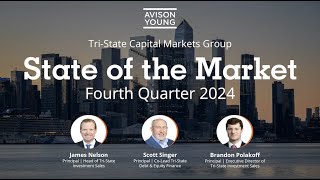
A January 2025 market briefing by Davison Young principals (James Nelson, Brandon Polakoff, Scott Singer) summarizing New York City investment-sales activity in 2024 across multifamily, retail, office, and development. Key findings: ~ $16.5B in NYC sales (70% YoY increase from 2023), Manhattan drove much of the gain (86% YoY), notable pickup in office transactions and institutional/domestic buyer activity, growing conversion and development activity tied to new incentives, and debt markets showing improved liquidity and mixed signals on rates. The presentation is bullish on 2025.
Okay, welcome everyone. I think I'll get started and underway. Happy New Year. I'm James Nelson. I am principal and head of Tri State Investment Sales here at Davison Young. With us we have Scott Singer, who's our principal co lead of Tri State Debt and Equity Finance. Then Brandon Polakoff, our principal executive director of Tri State Investment Sales. Thank you all so much for joining. We had a great meeting this morning with Nate Bliss, who is the chief of staff for the first deputy mayor here in New York City and just excited to hear all the positive things that are happening within the city. Actually learned this morning that we now have a record number of jobs here in New York. We have a record number of businesses and it's also the administration's prediction that this year we will have the most tourism traffic ever here in New York, which is a fantastic thing. We also had several conversations about city Vs. We're going to be getting into that as well. But we're also very bullish about 2025 and so look forward to getting things underway. So I will go ahead and I'm going to share the deck which again we will send to you all after the conclusion of this and we'll dive right in. So first of all, you can see that there was a huge pickup in sales volume in New York City. Again when we track it's across all asset classes. Multifamily retail office development conversions, over $5 million. That's our methodology across New York City with the exception of retail where we track a million five and up. See a lot of the retail condos trading in that space. So for New York City we had almost $16.5 billion. This was a 7% increase from the last quarter. We are still off the 10 year average certainly of $31.8 billion, but a huge uptick from 2023. So if you remember one stat from this presentation, it is that there was a 70% increase in investment sales year over year in New York City. I will say that again, There was a 70% increase in in dollar volume from 23 to 24 across all asset classes in New York City. It's even more pronounced in Manhattan. We're going to get to that shortly. But certainly we've turned a corner. Certainly there's positive momentum here and it is really across the board on where you see this activity is coming from. So as we look at the number of sales again close to 550 sales on the year off the 874 average. But you see increases in almost every single borough. So when you annualize and really look at this year over year change again, you see what happened in New York city, less than 10 billion of sales in 2023. I mean that was certainly a very challenging year. We hadn't seen dollar volume that slow since I think dating back to 2009. But you see that 70% uptick with 16 almost and a half billion dollars in sales. We see Manhattan sales up 86%. So you see how much Manhattan is driving the New York City sales volume. With over $11 billion in sales, the number of transactions was less pronounced. So you have New York city at an 18% increase. And actually Manhattan actually had more uptick in sales year over year at 21%. But the fact that the dollar volume was so much more significant on the increase tells you that what was happening is larger, more significant sales taking place. Many of those in Manhattan, many of those office. So when you look at where is the dollar volume coming from in Manhattan, office has made a huge step up historically. And you look back to 2018 here, office was well above 50% of the dollar volume. So this year that is certainly the case with office coming in with over half the transactions. In fact, the fourth quarter was very significant in that regard. So we're going to be reporting on some very significant asset class sales. So as far as number of sales, clearly it's still multifamily where a lot of the multi mixed use a lot more of that out there. So certainly by a number of sales, multifamily is still the largest portion of that distribution, but certainly healthy activity in retail. Look at the orange band, how much that's increasing in the number of transactions as a percentage of the whole and development also widening. So let's talk about who's selling properties in the city. In Manhattan we have on one hand you might say, okay, well there's been a decline in foreign investment, excuse me, sellers dropping from 38 to 11%. Who is filling the void? Institutions are now selling at a greater clip. So now you have institutions that are selling accounting for almost 30% of the sales. REITs contributing another 11% and then the private sellers at about 41%. When you look at the buyers in the market and here also we saw a decline from foreign sellers, buyers rather who were quick to jump in first in 2020. They were still strong buyers last year. Now we're seeing more of the domestic buyers, specifically the private buyers really stepping up with over 50% of the buyers being private here. And you are starting to see some increase in the institutional acquisitions we're going to talk about a couple of those transactions shortly. REITs also accounting for 3% of the acquisitions, where in 2023 there were virtually no REIT acquisitions. So this is certainly positive in the sense that we have a lot more domestic activity, a lot more institutional activity. All right, so Brandon, why don't you talk about what we're seeing in the multifamily and you might be on.
Yep, I was on mute. Sorry about that. Sure. So I think in terms of dollar volume and number of sales quarter over quarter, it's down 10 and 3% respectively. That's, that's a pretty small margin. So I, I don't think that's something too much to focus on. What was interesting. Yeah, the average price per foot went up and, and the cap rate went up though. I, I, I know we, we try to show us a range here. The reason being is not, not so it could be a fully regulated building, it could be a fully value add fair market building. And those are going to trade on drastic ends of the spectrum. Then there's also, you know, user sales which really can push up the, the dollar per foot for some of these. Call it a 10 unit apartment building in the West Village that's vacant and it would be converted to a townhomes. That's where you could see like a 2,400 foot range or retail. You know, very strong quarter but still not predominant income. So overall I would say more of the same. It's been pretty status quo in terms of what we're seeing in terms of pricing and, and dollar volume and sales. So yeah, that would be my, my general takeaway. It's been pretty status quo. So these were three of the, the top sales. So 540 Fulton Street. That was a 2023 construction. So that traded for 786 a foot. It was a 5.35 cat that has a new 35 year abatement. 7030 building. Sold from, sold by K, sorry two KKR from Janelle 80D cab. Sold by KKR to Atlas. That was at 604 foot, a five and a half cap. That was 2011 construction. The abatement runs through 2036 and that was an 8020 building. So again those are two buildings, you know, low to mid five cast with a lot of Runway on the abatement. 165E66 that was sold to Stonehenge. That is a light value add building. They can do cosmetic renovations to push up the rents. Obviously a great location. So that traded for, I want to say that was 686 a foot. That was a four and a half cap with upside, and it was 22% rent stabilized. So again, I think what's interesting on that is, you know, those, those were selling about 100 basis points lower when rates were lower. So originally looking to exit these deals between, you know, around a 4 cap, now groups are trying to exit these closer to a 5 cap. So. Or at least on the terminal value. So that's probably been the biggest change in, in the institutional space.
All right, thank you, Brandon. That was a great report on New York multifamily. The only negative feedback we're getting is while you continue to feature a picture of a Dallas Cowboy behind you. Got a lot of jets and Giants fans who are posting their thoughts in the chat. But. Okay, so let's talk about what's happening here in development. And interestingly, applications now are just opening up for 45x and 467M. And so these sales are still not necessarily with the benefit of these new incentive programs. It will not surprise you that a lot of these are for condo development. And it's good that I think we're now doing ranges as opposed just to averages. So if you said the average piece of lands were 660 available, you know, like multifamily, there was a huge range. We've got 380 a foot, in some cases up to 970 a foot. So it's a really big range. But we did have six sales. That was about 340, $304 million of value. Okay, so if we go to each of these sales and we'll say that they combine for about 2 1/2 million square feet of buildable, still off the 4 million average, but we'll see what happens once 45 kicks in. Certainly the number of units that are being produced are well below what the city's ambitious plan is. The MoonShot plan was 500,000 new units. You could see that over the past few years, you know, producing, you know, in 23 only 12,000 units, 14,000 in 2024. We certainly do need the incentives and for the market conditions to improve to supply the type of units that we need to get to address this 1.4% vacancy. As far as the sales, we have 655 Madison Avenue for $159.4 million. Xtel buys this from Williams Equity. This was 100 by 109 foot site on the northeast corner of East 60th Street. And we'll see how Gary plans to potentially Assemble some air rights. I think we have this pegged as a rental. I would be surprised if that ultimately was the case at Brandon. I don't know if that was confirmed. I would think with this kind of location and park views I would think that this could definitely be a condo. But I guess we'll wait to see what's what's announced there. We also interestingly XTEL was the buyer here at 655 Madison. They were the seller up here on 3rd Avenue. I think this is the old Pathmark site up on 125th Street. Here they sell to JCS Realty Plan for 543 rental units and it will have a grocer on the ground floor. Last but not least, Continuum Companies buys 2634 E. 35th St. For $66.2 million for the community Church of New York. This site's got split zoning. Developer has plans for 191 foot tall 18 story mixed use condo building with 137 rental units as well as community facility. Okay. Conversions have also been a big driver in the market here. So here at 77 Water street for 95 and a half million dollars Van Barton buys from Sage Realty. Sage actually accounted for 2 of the conversion sales. Sage and I actually just had Jonathan Iger on my podcast if you want to hear their plans. But obviously focused on office and not converting to residential. So they sold 77 water for 95 and a half million dollars to Van Barton. This is a 170 foot high 26 story building. There is over a half a million square feet here. So plans are to convert this to 600 residential units. 767 Third Avenue. $88 million. Quantum Pacific and Nathan Berman team up to buy again from Sage. 40 story building, 286,000ft. And Brandon, if I'm not mistaken, Quantum Pacific, this is an Israeli group that's making their first acquisition here in New York. Correct?
Yeah, they have family but it's a all over. So you know relative to global hold.
Wonderful. And then last we have 143 Franklin at $35.6 million. This is over $1,000 a foot. Beautiful building. Would would assume this is going to go condo with the CNY group. Now I will say with the 467M which we think is a really positive and helpful abatement where you're going to get a 30 year abatement where you're only paying 10% of the property taxes. Otherwise I think that's going to. We're going to certainly see a lot more of these office to residential conversions as a result. We have and we're going to come out with a full office study. But since COVID We've tracked roughly 250 office sales and only 11% of them so far have been converted to residential. Maybe I shouldn't say only. That still seems like a fair amount. Counts for about 7, 8 million square feet. But I think we'll certainly see more of these with the new program. Okay, next we have retail averaging now close to a six and a half cap. Again, look at that range between 3.6 and 9.6% yield is moving up the price per foot. Again, it's a big range, as you can see, from 300 to 333 a foot to $5,400 a foot. So sometimes these averages might not be as instructive. But what's interesting is certainly, and we talked about the increase in institutional appetite. So here you have Blackstone making a splash, buying this portfolio in SoHo from ASB and L3. This clocked in at a 3.6 cap, which is probably one of the tightest cap rates that we've seen in a while. It's in speaking to Blackstone, their belief is that they're going to get to a stabilized yield on cost of 6.5% by raising rents considerably. So there is a value add proposition to this. Meanwhile, Empire State Realty Trust pays $52 million for retail in North Williamsburg from L3 Capital ESRT not just making a splash beyond office in multifamily, but also in retail. And then Here you have 303-03-40 Second street for $48 million. Brandon, this was a consortium of buyers and it is a building. But, but again, you know, the belief there is, is a lot of what's driving this is, is retail. Is that correct?
Yeah, that's correct. Once you, once you back out, the value of the retail, the upstairs is under $100 a foot for the, for the vacant office, but it's entirely vacant upstairs. So really a retail driven play and the office was, was kind of gravy.
Okay, so now we look at office sales, which again are a huge range. And for a while we stopped reporting cap rates because there were so few of them. But you can see the average price per foot again, A huge range from 241 a foot to 1400 is now down to 450 a foot on average. You see cap rates greatly expanding, but again, a billion 5 of office trades doubling quarter over quarter. So that's why, you know, again, when you look at 2024 coming to a year end and how significant these office trades were, very helpful in moving the needle, driving this and a big trend we've experienced that 25% of office sales since COVID have sold to end users. So this was no exception. At 2 Park Avenue, Haddad Brands buys this building from Morgan Stanley, which is pretty remarkable at 850,000 square foot building. And you've got a clothing manufacturer that's going to be buying and using the building that priced out at $419 a foot. Interestingly, we're also seeing some office operator investors who might have seen some challenges in the past and now they have regrouped and they're buying back in. And Savannah is certainly leading the way with some recent transactions. I believe there's another one in contract on 15th street that'll be reported on and probably our next report. But here at 799 Broadway, they buy this for $255 million, $1,444 a foot from Columbia Trust, Cannon Hill. It's a remarkable building. Corner Broadway, 11th Street, 175,000 units. The sale closed at a high 4 cap. It was only 71% occupied at the time of sale. And you know, no surprise, rents I believe in this building have in some cases, you know, gone well into the triple digits. Last but not least, we have 180 to 202 Broome street for $237 million. Here Deutsche bank buys from Taconic. This is an office condominium located on the north side of Broome between Suffolk and Clinton Street. The two properties have a total of 350,000 square feet. There's also three retail condominiums at the property that were conveyed in the sale. If you look at the historical pricing, you can see that definitely there has been some compression on a price per foot. Retail again kind of bouncing around. Office obviously taking the biggest hit previously north of 1,000 a foot in 2019. Now the average office is at 450 a foot. But as you can see, huge ranges going from, you know, sub $200 a foot in some cases in the financial district to in some cases north of 4,000 a foot on Madison Avenue. That was the Bloomberg Philanthropies acquisition last quarter at 980 Madison Avenue. And as far as cap rates, you can see some real expansion here in cap rates. Retail now averaging in the high 6% range. Office eclipsing multifamily, pushing towards a 6% cap and multifamily at a 5 7. But as Brandon mentioned before, there's a huge range based on, you know, location vintage of product 421A regulation but that is the average there. So we're certainly a lot to take in here but very optimistic about the strong sales volume momentum. When you see that 70% uptick year over year for New York City, 86% for Manhattan and the we definitely see that as a signal that both buyers and sellers alike are getting off the sidelines. Scott's going to talk to us very shortly what's going on in the debt markets. But I think that also is a big part of you know, I think again buyers and sellers alike acknowledging kind of the new norm and participating in the market. We are also would like to point out that the return to office in New York City has been very strong. We're currently a top three city, second or third only to Miami and West Palm Beach. We think that a lot of that return to office at 78% compared to 2019 is also not just encouraging because people are back in the office but they're also renting apartments, they're shopping also greatly helping retail. And then lastly going to pay close attention to what city of yes does close to 125 million square feet of office that will now be eligible to convert to residential by virtue of taking the vintage most of these buildings that had to be built before 68 to be eligible for conversion. Bumping that up to 1991 again that's going to add about 125 million square feet eligible for conversion. Of course not all of that will be but it will certainly be helpful in that process. Okay, so with that we will go to the state of the debt and equity markets. Scott?
Yeah, thanks James. Hi everybody. So I, I have a simple message this time I think we can skip right through there and it may be counterintuitive but on the metrics that I look at there are compelling reasons for anyone who is investing now or invested now with maturities coming to to finance now. And obviously that's self serving but I think James, the next slide really that that matters and that I'm focused on. And that's the forward yield curve and this is these upper lines are the treasury rates. The, the, the orange one is the ten year treasury and but both are projected by the traders who bet between short and long term rates. All bets appear to be on the treasury going higher from here. And this is updated as of this is actually updated when Treasuries were a bit lower. So this is a four and a half ten year treasury and we're, we're at 480 today. So it is.
The.
It appears that the index rates for fixed rate borrowers are going straight up by projection for the next 10 years. The black line is the SOFA rate and the Fed is clearly appears to be focused on continuing to cut over time. This is not surprising and it is in line with historical norms for the short term rate. It used to be Libor, now it's SOFR to be in the 200 to 250 basis point range, lower than the Treasury. So for fixed rate borrowers the index appears to be going higher and for floating rate borrowers the index appears to be going lower, which as a floating rate borrower it is possible to take advantage of. The other aspect to pricing obviously is spreads in both fixed and floating rate or for both fixed and floating rate money. Spreads are pretty good. They're not the all time lows, but they're far closer to the all time lows and the all time highs or even to the historical averages for most asset classes. We've seen liquidity come back in a small way, but that's meaningful, very meaningful I think in the office market which has been the most challenged. And with the competition within the floating rate market, the impediment to riding so far down floors are now negotiable. So again our read is that the borrowing rates, waiting on borrowing rates to come down should not be an impediment now either for fixed or floating rate borrowers.
Thank you. Thank you, Scott. Okay, so you can put your questions in the Q and A if you like. And I see we already have some of these, so why don't I start going down the list. Brandon, what is the explanation for the drop in foreign investment?
Drop in foreign investment? Well, I think upcoming foreign investment, one concern that's been raised over the last few weeks by foreign buyers that I'm speaking with with is the strengthening of the US Dollar and how that's impacting certain countries that have invested a lot in the United States over the last, or I guess New York City over the last few years, in particular Japan and Korea. So that's going to be something to keep an eye on as we move forward. And you know, if the US Dollar continues to get stronger, it just makes it harder for them to, to continue paying the same prices.
Okay, yeah. And I would also add, and I think I mentioned, but also see it as a positive that I mean domestic buyers are stepping up. I think when there was kind of a vacuum and a lot of buyers were on the sidelines. A lot of the foreign investors, who are largely cash buyers, saw this as an opportunity to come into the market, take down some really high quality assets. But now you see a lot of the domestic private buyers, institutions that are getting back into the market, they can typically move a lot faster because they're here. And as they become more comfortable with Scott mentioned financing, that'll also bring more buyers back into the fold.
Hey, Jane, I was just going to add, I'm putting in the chat now a link to an article that was in the Wall Street Journal yesterday that I, that I posted and I, I've listened to it four times now and it is a really interesting take on the various factors that cause rates, meaning the index rates, to rise and fall. So it is, it's complicated territory. It's broken down very well in there. So I'd encourage everyone to grab that link.
Okay. Any, any major one or two takeaways from that? Scott, what would you say that the top takeaways from.
Well, I think that it's that combination of inflation, you know, the causes of inflation and the effects of inflation are pushed in both directions. And so it is a difficult balancing act for both the Fed and investors. But as the treasury rates push towards 5%, that is something that tends to pull money out of the stock market into bond investments and then the money flowing into bond investments has a further impact. And so the we, we've said on the, on most of the prior state of the markets and we, we look backwards and the, the current treasury yields are roughly at the historical average. And so it's, you know, we certainly have a certain, we've had a surging stock market now. There have, there's been some pullback and yet we're still at extraordinarily high levels. But there's a lot to this. But when we're sitting at historical normals without a lot of ability or impetus to push the rates back down, that's another place that I'm looking.
Wonderful. Now, I know Todd wants to know about what your favorite fish show is of all time. Scott, I think maybe go back, you guys can speak offline and can you.
Compared to obviously we went to one we went to together.
Yeah, that's what I was going to say. But he's also asking us what investors are assuming for exit caps on office, multi and retail. And I would just say that was very interesting. Again, the Blackstone on that retail acquisition, they're building to a six and a half percent. So do they believe that? I mean Blackstone, they're pretty smart. Do they believe that retail cap rates are going to come within to make that spread? I mean that would have to get back into 5 territory. And unless they're really looking at that for its long term growth. But you know, Scott, maybe question for, for you, I mean when banks are underwriting these deals to say lend on office, I mean what are the, the, the exit caps that they are assuming in their underwriting?
Yeah, I've often been surprised at how relatively aggressive I think investors have been on the exit caps that they'll assume. And you know, often I've heard expectations of an increase of say a quarter point or less per year even in rising rate environments. So from a lender's perspective the focus is more typically on what the exit debt yield is likely to be because with regard to cap rate lenders always have a significant cushion on value on the way in. And so this is a substantial challenge. And the, and, and the liquidity within the, that's growing slowly in the office market is focused on certainly deals where there is, you know, long maturity, that long maturity dates on the leases.
Got it. Mike, we have a question about the foreign investment. If they're not, you know, buying, why are they not selling? I mean my, my observation and Brandon, I don't know if you have a different view, but a lot of these foreign investors, once they come to New York, they tend to stay here. And if even they're going to buy, they're either buying for the long term or they're looking to, you know, keep that money in New York. I, I think it's pretty rare than we see when, when you know, major.
Major depreciation benefits in a lot of these countries. So you know, they hold them for, to offset gains in, in their home countries and then.
That'S been a big driver for the Japanese acquisitions. I know we've talked about this on a previous webinar, but I, I think we've done over a dozen sales to Japanese buyers who are using accelerated depreciation for you know, wood frame multifamily, which seems pretty specific, but it did lead to a lot of activity. But to your point Brandon, you know, once they're doing that they are holding onto these assets to get the benefit.
Yeah. Also there's a question here. With the large population of babies Burns reaching retirement, do you anticipate more near term multifamily sales circuit in New York City? Generally speaking with just like these long time owners, you know, they don't most of them don't have much debt, if any. They have children too. What you often find is unless the market's booming and they're saying, hey, you know, we're going to get peak pricing, it makes sense to sell right now. I can tell you anecdotally there's, there's just not much strong value add product on the market coming from these long term owners. And the reason it's usually driven in a down market, it's retirement. So the family is just saying, hey, we're done. There's a dispute or, you know, a death. Unless those natural occurrences happen, most people aren't really motivated to sell their property. And so really I think the best opportunities are going to come from those natural occurrences and it's just a matter of how many there are in a given year. Sometimes it's a lot, sometimes a little. But yeah, when the market's where it is today, most people want to wait till we get back to, you know, your 2014-2016 levels on pricing.
Brandon, I had a question for you. Don't you think you'd be even more successful if you had a New York sports figure behind you?
Yeah, that's what I was saying before. Yeah, Scott, I know you've got some jets helmets, although I I the, the resale value on those unfortunately seem if we put that on our, it would be falling off the graph at this.
Point at least no one can tell me I'm a front runner.
We have another question on construction materials and costs based on natural disasters. And again we're, you know, send our thoughts out to our friends and certainly our offices in the LA area and then with the east coast hurricanes, I mean, Scott, how much is the insurance piece to this or lack thereof of as you look to finance and I know you definitely you're going to be working on a major assignment on the West Coast. Are lenders pretty cognizant of that? And if so, how are you approaching that?
They are. I mean, obviously LA is on, is unfolding now and will make it dramatically, dramatically worse. I think, you know, for a New York, primarily a New York audience here, I would say not wanting to, you know, dance on tragedy, but I do think that there is an argument for the Northeast that the relative lack, knock on wood, of the types of natural disasters that are hurting other areas, you know, may be another compelling factor in, in pushing investment in the Northeast. We are fortunate to have less storms and less earthquakes and more water and a moderate climate so far. So trying to focus on the good with regard to here that is something that we think about with regard to investment inflows, the insurance premiums and the increases. There are, you know, going to be the next in, you know, these challenges that come in underwriting from time to time. And you know, 0102 it was terrorism insurance and there have been other issues along the way, but it is, but it is going to be a challenge going forward.
Perfect. Scott, another one for you. CMBS appetite. What is that looking like these days? And I know part of your team still down crefse in Miami. I was there yesterday. Yesterday, really great turnout and optimism there. But how much can we.
It's fine. The overall liquidity in the debt market is as high as it's been probably at any time in my career. And the CMES market has served over the last much of the last 18 months. The original function where it was created, this incarnation of it created in the, in the mid-90s when there was a vacuum of capital and that needed to be filled. And I think that in looking at the office loans that have been done through cmbs and the giant SASB loans that have been done that were likely only to be done by CMBS over the last, over that period of time, it was incredibly important to have the CMBS market as part of, as part of the industry. And I think going forward it is not only a lender of last resort, but also very, very competitive and aggressive on most asset classes. So it's, I'm glad they're here. And while there are challenges and certainly some borrowers are very aware of the negative side of CMBS borrowing in particular, I mean the necessity to deal with servicers who are often hard to, hard to reach or sometimes are acting across purposes, having that supply of capital is just absolutely critical in the market.
Right. Great. I think last one here. Any updates on Midtown south rezoning? Oh, actually, sorry, we got some more questions coming in on the chat as well. Midtown south rezoning, the city told us that they're going to certify and begin the Ulert process, which should be about seven months, but it looks like that's in going full speed ahead as opposed to next week. That's going to be very helpful in conjunction with city of yes to unlock a lot of these office buildings for conversion to residential. I think that is Anne Marie, who is asking how long do you think the 201416 pricing might take for mixed use multifamily. You know, Brandon, with. And again it's, I know it's so dependent on is it fair Market is it rent regulated but thinking to 2014, 2016, you know, prior to HSTPA, certainly for regulated units that you used to be able to decontrol, certainly in a much lower interest rate environment. I mean that being said, I mean the rent growth is pretty spectacular here barring that good cause eviction, where again if you're built before 2009 you now cannot raise rents more effectively than 9% with the CPI adjustment over 5%. But Brandon, do you think there's a world where multifamily pricing gets back to 2014, 2016 levels? I gotta imagine it. Rent growth would really have to be the driver to do that, right?
Yeah, I mean there, there are so many variables. I think just go back 50 years and watch the peak and the trough and New York City goes like this. So like will it get there? You believe in New York City and yeah, it'll get there. If you believe in market cycles, it'll get there when it gets there. And how I think is there's just so many variables that it's, it's really tough to determine. But I think yeah, if you have patient capital and you're not looking at an IRR and you're just saying hey, is the market going to go back up from here? If I was a betting man, which I'm not, I would say yes. I just don't know when and how. And I think trying to make that prediction would be really tough right now.
Yeah, I mean we're as, we're looking at these development sites for rental in Manhattan, you know, across the city. Across Manhattan rather. I don't think we've seen one project where the projections are less than a hundred dollars a foot rent. So you know, what does that mean for you know, pre war, you know, fair market that's renting at 50, $60 a foot. If you new construction is north of 100. I mean there seems to be a pretty in some cases a gap there. Now obviously it, you know, some of the smaller, efficient East Village walk up Sprint and I'm sure you've seen north of $100 a foot there as well. But there is, yeah, there is plenty of growth opportunity there as well, so. Well, great. Well we really appreciate you all joining in. Our, our theme for this year is thrive in 2025. So it's, it's really, really looking forward to working with you all and great things ahead. Have a wonderful day. Thank you.









