Strip Malls with Don Tepman
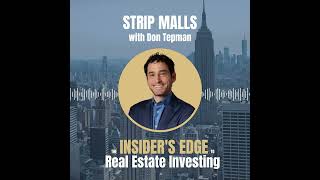
Don Tetman, founder of Town Center Capital, built a $30 million deal flow by becoming "Strip Mall Guy" on social media. He buys Class B/C strip centers, fixes access and tenants, and scales nationally using remote assessment and in-house teams. His $15 million credit line lets him move fast on deals institutional sellers bring him.
Chapters
Welcome.
This is the Insider's Edge to Real Estate Investing with James Nelson, the principal and head of Avison Young's U.S. Investment Sales Group, and his co-host Kim Trohler from his investment sales team. In this program, you'll learn game-changing strategies to outperform the market. James will teach you how to source, execute, and capitalize on the best real estate opportunities in New York and around the world. Now, here are your hosts.
Welcome everyone to episode number 241 of The Insider's Edge to Real Estate Investing. This is your co-host James Nelson, and I'm Kim Troller, also your co-host. And we have a big treat for you all today. Uh, we have with us Don Tetman, who is none other than Strip Mall Guy. And for those of you who have been, uh, living in a cave, maybe you have not, or maybe not on social media, and there, yes, there are some of you still out there, uh, maybe you've not heard of, of Don or, or Strip Mall Guy. But this, this is a really great conversation we're going to have. Don is founder and managing partner of Town Center Capital, but widely known online as Strip Mall Guy. Don shares about how he built his portfolio by focusing on neighborhood strip centers, starting with suburban retail properties and expanding across the U.S.
You'll hear the story behind Strip Mall Guy and the brand and how Don's anonymous social media account became a platform for sharing practical real estate insights. He speaks about the importance of specialization and establishing a competitive advantage for yourself and, and knowing your asset type and market segment better than anyone. And they close all their deals all cash, by the way. I love how he's been able to use social media to build and elevate his personal brand while still being able to be like the main point of contact. He's not hiring anyone to do his outreach or write his content for him. It's all authentic, genuine, and directly from him.
Yeah, no, he has really harnessed the power of social media, but not just to kind of— it's not about him. It's about, again, how can he make better connections? How can he find more deals, more opportunities, make more broker connections? Look, this podcast is an extension of this. I mean, this is a way for him to get his message out, but he's leading with content. And I think that is what's so amazing. And I asked him at some point in the interview, you know, Don, how do you think of all these things? He says, no, I just come up with it. And when I am having these thoughts, I figure, hey, if I'm wrestling with this question, probably someone else is. So I love the transparency that he's willing to share. And it's just, again, he's putting out such tremendous value that there's no doubt that that created a great network here.
100%.
So as always, you can go to JamesNelson.com. That's where you can find the show notes with this episode. You can find out how to connect with Don, although he is very easy to find. And last but not least, at the end, Don speaks about the Real Estate Gala that he puts out. So keep a lookout for that. It's an amazing thing, bringing all these social media influencers offline in person together. It's an incredible event. And again, he does such incredible things for the industry. So with that, we're going to have a brief word from our sponsor and we will get right into our interview with Don Tetman.
Avis and Young's United States Investment Sales platform executes on multifamily, office, retail, development, and specialty asset transactions across top US markets. As experienced leaders in the industry, our integrated national team is here to help you make informed investment decisions, whether advising on your current holdings or identifying new opportunities nationwide. Our one unified platform is built on unparalleled collaboration and connectivity across across 120 full-service offices around the world, giving clients direct access to the deepest pools of capital. We put our clients first, delivering tailor-made strategies to achieve superior results.
Welcome everyone. Thrilled to have with us today Don Tetman, who is founder and managing partner of Town Center Capital and famously known as Strip Mall Guy. Don, thank you so much for joining us today.
Thank you so much. My pleasure. Excited.
Awesome. Really excited to have this conversation. I think for most of our followers, I'd be shocked if they didn't know who you were. They haven't followed what you've done, but I like to actually start with telling the audience about Town Center Capital, your holdings. What does it encompass now? I know there's been exponential growth. We're going to be talking about how that has happened, but maybe just for our audience, talk about what does the portfolio look like today and what is the focus for acquisitions?
For sure. So we started buying properties in 2006 with just, you know, suburban, just your classic Class C, Class B strip mall. And we bought 45 deals over the years. We rebranded to Town Center Capital about 5 years ago because it was called University Avenue Partners in the Bay Area, which everyone knows is in, you know, Palo Alto. But, you know, outside of that, everyone's like, well, is that, are you a school or are you, you know, college, university? And so we, we rebranded and now we're buying deals nationwide. The last fund we bought 12 properties and we're, we're buyers and sellers. We don't really usually hold for more than 3 or 4 years. So right now I think we own 13 of 'em, but you know, have an escrow to buy, escrow to sell. And so I think that the portfolio, I, I would doubt if it ever went above about 20, because again, we're always buying and selling.
So you've, you've spoken publicly about the importance of having a competitive advantage and specialization and yeah, obviously you've been established this brand as Strip Mall Guy. Walk us through the evolution of Strip Mall Guy. I know you were anonymous for like 3 years. Yeah. And, and you finally revealed your identity. So yeah, walk us through that entire process and, and why you decided to stay anonymous at first and then why you kind of came public with it.
Sure.
So I mean, like the whole Strip Mall Guy brand happened by accident. I didn't want it to, didn't expect it to. And so I literally was on an airplane in 2021 and, you know, just over the years I got tired of hearing the TikTok narrative of like, you know, real estate's easy, passive income, taking on a lot of debt, all these things that make you lose money. But every time I would want to post for my Don Tetman account, which has like 9 followers, right? Still, I think on X, I would be scared to hit that post button because I don't know what my investors might think or my employees or tenants. So I just would never do it. And then so one day I'm, you know, I'm on this plane, I'm killing time. I'm like, you know what, let me just put together just an account that's anonymous, not tied to me, and just post, you know, like renewal options, parking ratio, boring things, but, you know, like the right thing after doing, you know, strip mall deals for, for so long. And so I just started posting under, you know, this, this anonymous account and I was going to, you know, basically close it after a day or two. It just started taking off. I thought it was an algorithm problem. I didn't know what the deal was, but it just got, you know, started, started exploding and it got to a point where, you know, I love writing and sharing knowledge, but I didn't know that it can benefit the business at all. I didn't think that it, it, it ever could or would. So I kept posting, but it got to a point where it started getting bigger and I got, I started getting DMs from people that are legitimate folks in the industry, other industries that wanted to connect. So, you know, again, I didn't plan on it, but now it's the operating system of our entire business. And, you know, I was anonymous at first 'cause I didn't know, I didn't wanna rock the boat on my career, you know? And I'm a private person. Yeah. I'm an introvert. I'm like, I like the career I was building. I was raising a bunch of capital from, you know, high-net-worth folks out in Silicon Valley. And I was like, well, I don't want to rock the boat on this. What does it mean to be public? What are my investors going to think? And then, so for the first 2 years, I was weirdly really protective of, you know, my identity. Like a few people knew here and there, but I was like, you know, and then after a while I realized that it could be a deal flow hack and advantage. And then when I finally went public through The Real Deal, our deal flow just starts skyrocketing.
I was going to ask, like, did your social media presence actually improve your deal flow or was it mostly your network? And how has your online presence changed the way that brokers and investors are actually approaching you?
Yeah, so when I was a broker early in my career, right, I knew that if a principal called me from Texas or whatever, Florida, and I was in San Francisco and they wanted me to send them deals, I just knew that I would never do that, right? You send the information on your— but it's like, it's out of sight, out of mind. And it's like, I have my local people that I think of every single day because they call me and reach out. This guy or woman who reaches out once or twice a year, like, sorry, you know, not going to work. So that was my challenge on the principal side. I was insecure about calling a broker out of the area and saying, hey, I'm in San Francisco or, you know, New York now. I know you're in Chicago. Think of me. And it's just like, I know how that's perceived. It's like, it's like, look, like I'm not going to think of you if you call me once a year. I have my local buyers that I hear from every single day or week. And so what social media did is it's creating a situation where we are more top of mind nationwide, right? So it's like, obviously, like there's a strategy to this, right? Where, you know, if brokers are aware of you nationally, the odds of them sending you deals go up obviously a lot. And now we're, rather than emailing them every day or playing golf or whatever, we're in their inbox, if you will, through the social media accounts. And I think we've done $30 million of deals now that I can directly attribute to the social media brand.
Wow.
You know what's amazing about that decision when you decide to flip the switch, you know, go public with this, is it was, it was not ego and hey, everybody look at me. It was, you know, with this kind of almost business decision where, hey, this can actually be an incredible way to create deal flow. And I know even to this point, we talk, you say, hey, well, you know, what do you focus on doing here? You said, I want more brokers to hear about what I'm doing and owners so I can find more opportunities. And so really leveraging the power of social media to actually create deal flow. And so I think that that's a really important thing for our audience to learn about. The other thing I really appreciate, appreciate about what you're doing is the value and the content that you're putting out. And again, I don't know, your mind must be running constantly because I don't even know how you come up with all these ideas. But whether it's, you know, a recent post about, you know, talking about how hiring a property manager can be one of the toughest things out there, or you're strolling along the street on Madison Avenue, it's just kind of whatever's on your mind. So, correct. Do you, do you kind of plan out and think about themes and kind of test them, or is it just kind of stream of consciousness, whatever's on your mind that you want to share?
Sure. I, I mean, it'd be way too hard to sit there and try to create content. It's just, you know, I have a busy job, et cetera. And so what I do is I'm kind of live casting my thoughts. So as my day goes on, if I think something is interesting or I have a question about something, the odds are that many others also think it's, it's interesting or, or have that same question. To your, to your example about the property manager, which that resonated and got 100,000 views, whatever. I mean, it's just like we're struggling right now to find a property manager. It's been, it's been 6 months. We're interviewing. It's a hard role to fill and it's on my mind. So it's like if I have that struggle, I'm sure others do as well. So I, I put it out there and it resonated with many folks around the US and they're like, yeah, it's a hard role to fill. And, and you know, I'm offering $150,000 base plus bonus, et cetera. And, and still for that salary, very few applicants who are qualified. So, I just go about my day. I don't worry about, you know, it's like I never really can run out of thoughts, right? So, so, you know, it just, it's just that what thoughts do I think are interesting? And, and, you know, I pause and just post it. It doesn't take that long. I mean, I think if all of us are just more aware of things that we think about, see, hear, question, and just share it with an audience, that's really all the account is. I'm not saying anything that's crazy ingenious or like, oh my goodness, I, you know, I never thought about that, heard of that. And so. It's just live, you know, live casting my thoughts.
Right. And when you put it out there, I mean, it's not just that 100,000 people see it. Clearly people are engaging with it. So how do you manage, you know, the flow as far as the feedback? I mean, people are probably DMing you constantly and this and that, and a lot of that is great, especially if they're, you know, opportunities that, that people are sending you. But do you have like a social media manager? Are you trying— how do you even keep up with this all?
So every post, every DM has always been only me, every response. Look, I, I don't think outsourcing it works. I mean, you can— I think that you're capped on how big the audience can get. The algorithm is smart and knows if it's, you know, like if it's some third party that's just like here and there checking boxes. Something happened where about a year ago, a gentleman DM'd me who's a well-known figure. He's on television, whatever it is. And he wanted to meet up in New York. And so I said, you know, no problem. I'm not gonna say his name, obviously, here. And so he, you know, responded and went, you know, back and forth. And then 2 weeks later, I coincidentally just saw him on the street in Midtown and said, hey, how's it going? And he just— it freaked him out. I was like, oh, it's Don Strip Mall Guy, we're just DMing. And he had no idea what I was talking about. And I realized in that moment it wasn't him DMing me, right? And so, like, I don't ever want to be that. Like, of course, a lot of DMs that come in don't get seen, don't get responded to, not because I, like, want it— it's just I, I can't manage it all and it's just kind of done randomly. But, like, it's better to have that than be not authentic and having just a third party communicating and commenting and just not being genuine. And I think that that's what makes the account work is just like, you know, I do it and it takes, you know, an hour and a half a day, whatever it is. But it's the most high leverage use of my time by far. I mean, it's deal flow, fundraising, recruiting. It's the center, you know, of our business. But it has to be genuine. It has to be you. Because if you could outsource it, everyone would just do that and become just like a commodity product. It's like some folks do and like they do fine, but like you can't really get to that next level where it's like, wow, that's, that's, that's an amazing account. And it's great if it's some other person doing it.
Yeah, I mean, for, for building a personal brand and also just having deep relationships with people, authenticity is, is huge. So we can definitely understand that. I'd love to hear about how you actually got started in real estate and then what led to ultimately like founding your company in 2006. Like why, why strip malls? Why focus on that sector specifically?
Yeah, so I went to Santa Clara University in Silicon Valley and graduated in '02, which meant that I was in my dorm room during, you know, '99 when everyone had a startup. Including me and friends. And, you know, like, it was a crazy tech wave where everyone had egos because we were raising money from— I mean, it was crazy.
What was your startup?
It's called College Elite. So we would go, just our peers were like Stanford, UCLA, USC, and Texas in school. And we would say, okay, okay, finance major at Stanford, who is our friend from high school, go give me like the top 10, you know, like computer science students. And then like eBay, Schwab, all these companies, rather than hiring interns at job fairs, would come to us and, and, and just like hire from our, our like kind of pre-screened group of like top students in like these 12 colleges, like in Oregon. It was just like amazing. And so that was it. And then, you know, when layoffs started getting announced, that went outta business like overnight, which was good 'cause it was a moment of humility.
Yeah.
Right. And so I went from embarrassingly walking into Google during that time and be like, you know, hot new startup. I looked like I walked into the lobby and said, hire me, I want a job here. That's how amazing I thought I was, which, which I was. It's a true story. And Al Gore was in the lobby randomly. It was a very weird day. But like, you know, and so I was humbled by the crash, which was the best thing that, that could happen. And then '02, I was just, okay, I need a job. And family friend introduced me to his broker and said, hey, meet with this guy. And then I, I met with a gentleman who did, you know, Class B strip center sales and leasing. I didn't know what he was talking about. I didn't understand. But, you know, he had a nice Rolex and made money and me these like check stubs that the guy was doing real well. I said, you know, I don't know what you do, but let me, let me just start and try it. And the first day he's like, here's a binder, you know, cold call these, these owners. And so I just started calling property owners, seeing if they'll sell. But what changed is that I think he had 70 shopping center listings for lease, and I would take those calls. And then sometimes, you know, a nail salon would say, I can't really, you know, like it wouldn't work for our site for like, you know, nail salon. So I go represent them. As a tenant rep broker, which is crazy for like, you know, $1,000 commission. I'd go help them find sites, but through that I got to know how they think. Site selection for mom-and-pop tenant, parking ratios, signage, et cetera. And I started realizing that there's inefficiencies in the strip mall space like crazy. Like 92% of these owners are not institutions. They're just kind of local families, which means that they leave a lot of money on the table. Spaces that are vacant that shouldn't be, rents that are half market rent because that liquor store convinced them that 3 grand is all they can pay. And so yeah, studied the business through leasing and sales. And then in '06, I saw a deal in Fremont, California. It was $1.4 million. The back space was vacant, had no visibility on Fremont Boulevard. And I said, if I create a monument sign for like $10,000, I can create visibility. Your sign here, lease that back space. I was like 600 feet. Got all excited, called everyone I knew. I raised $400,000 from like 12 people. Put $100 grand in for my own money, which is all I had at that point really I'd saved. Got a loan for $1 million. So $400 grand down, $1 million loan, $1.4 million purchase price, bought the thing, put up a monument sign, leased the space, sold it for $1.8 million. So everyone made, you know, $400 grand on $400 grand in like a year and a day. Like maybe this is a business. And you know, at the time I thought it was just a way to, for me to get a listing. I didn't even think that that was a business model, like syndications. I didn't even know what that was. And so I didn't even charge any fees. It was just like, guaranteed commission to sell, you know. And so yeah, that was my first deal. And, and, you know, 45-day deals later, every one of our deals has been a variation of what I just described. You know, find some inefficiency that we can address through our actions, address them, add the value, and sell once you're stabilized.
Yeah, I gotta say, for starters, I'm having a hard time believing that you're an introvert because, I mean, even being in that role and that outreach and having to canvas, I mean, that, that is not an easy job. I mean, plenty of rejection there.
It Doesn't mean that it wasn't a struggle and like, is it still a struggle? Like, you know, like this podcast today, like I'm not like, I'm doing it because it's amazing opportunity obviously with your platform and like, but it's for the, because there's a brokerage audience out there. That's how I earn my living. Finding deals is the hardest thing in real estate by far. And so yeah, I mean, I, we have this annual gala that we'll talk about, like I'm petrified when I know that, you know, the gala is a month away, 2 weeks away, it's tomorrow. I don't sleep the night before. Right. I think to me, an extrovert, I think, gets energy out of being out there, and introvert, it takes energy out of them. And so I've had to learn. I mean, I, I, first time I was at, you know, got invited to Harvard 2 years ago, I could barely speak when I got up there. I was like, what's going on here? You know, but now I've been there 3 times now, and the last time it's like pretty easy. You just get, you know, do it. It's like not a big deal. So it just kind of trial by fire, just forcing myself to canvas back then.
It just, you, you have to So I'd love to talk about the discipline because it is so specific with what you buy and you put it out there, even the depth of the stores. And maybe you could talk a little bit about it. But yeah, when I've brought you ideas, hey Don, I think this is a great idea. You said no, big box, not, not what I do. And yeah, I think, you know, now that you have plenty of investors who are approaching you and again, we can get to, you know, as it graduated beyond private investors, kind of larger checks, but Suddenly, if you have the opportunity to put more equity to work, that could mandate either more deals or larger deals. And yet you've been, and I think it's amazing that you've stayed so disciplined to the specific asset class. So maybe talk about why you've continued to double down again and again on that and haven't kind of expanded, chased larger opportunities. There's all these dark boxes out there. Why have you continued to just stay in your lane, so to speak?
Yeah, so I believe that your knowledge and network compounds, right? So it's like when you focus on one thing, as time goes, you'll get better and better at it. If I shifted to a, you know, a grocery anchor deal or big box, I lose 10 years or 15 years of knowledge because that's an entirely different world, different tenants, different approach. That's more of like a, you know, asset management role than it is really deep value add. I don't know how to lease a big box space, right? Like I know how to lease mom and pop, you know, spaces. We, we very proactive. So it's like staying in your lane is a hack. A lot of people think, you know, who are very smart, they shift every 5 years. I, I've seen folks who are absolutely brilliant. They have just okay careers because every 5 years they're like, I can do this. The grass is always greener. Why don't you graduate to something else? And it's like, you know, if I graduated to grocery anchored, I'd be competing with Kimco, who is very, very, very good at what they do, and Regency, and, you know, other players who have raised hundreds of millions of dollars in China's many, many years of capital. Yeah, yeah. And, and it's like, it's like, so my competitive, you know, advantage goes away. The same thing, you know, all these folks that, that jump into strip malls, like I know how hard it is. It's not that simple. Leasing is hard. And it's like, you know, like, like we're at a weird time right now where things are just really rosy in, in the sector, but it's like folks jump in and they get hurt. And, you know, and I've seen it. And, and, and so I think specializing is really, really important. And, and so, you know, I'm gonna keep doing this for X amount of years. And that's why deal finding is so hard because it is really specific and, you know, everyone wants value add now, et cetera. And so You know, I mean, finding deals is so hard that a lot of the real estate world doesn't try anymore, right? So a lot of folks raise a lot of money, right? And they buy average deals, they buy basics, and investors are totally fine with that. Like, I'm not saying that's a bad strategy. They make more money than I do in many cases, but it's like the formula shifted to, okay, let's just try to buy stabilized deals at scale. And by definition, you're not finding diamonds in the rough. Like, you're not really finding, you know, value-add, but they're not looking for it. And so investors are fine with a lower return when that's their target, right? It's just, it's just not what we do because I can't make money buying average deals by doing, you know, $6 million per deal on average. There's not enough absolute dollars. So like, we need situations where we create deep value and like, think of things outside the box like that first deal. And again, focusing on one thing allows us to do that.
Post-pandemic, there's been a lot of conversation around strip malls and how they're more experiential. I'm curious to hear how the strip mall space has evolved since you first started out in the space to today, especially as it's become more institutionalized.
Yeah, I mean, a lot more buyers now, right? So I don't know if I have a hand in that, jokingly, but like, you know, a lot more attention to the strip mall category. Everyone wants value add now. I think people don't even know what that means a lot of the times. Like, and so, you know, it's, it's, it like, it was a lot easier to buy deals 20 years ago and then 10 years ago. And then in 10 years it'll seem easy to buy deals now. So there's a lot more information out there. It used to be like when I started in '02, like people that had strip malls would be like, yeah, you want to buy my strip mall? Like at a 7 cap, like, here you go. Like it wasn't this like, oh, you know, I know what I have thing. Like, you know, so that's changed. A lot more cold calling of owners now. So we used to buy deals as principals more early in my career, and which is harder to do that. And now the brokers are really on top of, you know, every single owner of every strip mall is getting calls probably regularly. And so, you know, that's changed. And also I think that, you know, one thing that's not as good as, you know, how long it takes to open a store now and how expensive it is versus even 5 years ago has really, really changed because doing a restaurant deal now, mom-and-pop tenants who maybe haven't done one in 5 or 6 years are not realizing that it's $600 grand instead of $200 grand now. And it'll take you a year, like a year and a half to open versus 6 months. So, you know, lots has definitely changed over the last, you know, 24 years that, you know, I've been in this now.
It's really interesting that you bring up the, the access to, to information at such a widespread level because generally and historically that's what's made real estate so efficient or inefficient, right? Is that there's a lack of information. And so if you have sort of like insider knowledge, I know James speaks about this in like the first page of his book, but like that's what kind of gives you that, that edge into actually getting a good deal opportunity. I'd love to drill into your value-add strategy, maybe through a couple deal examples. I read about your, your Camino Collections in Santa Clara.
Yeah.
How you took this 8-unit strip center, fully renovated and repositioned it, put new tenants in, new facade. Please walk us through like what made this a compelling opportunity for you and like what you did here.
Example, because I think a lot of people right now, you know, are, are really focused on value add, value add, value add. That deal is what I mean by value add. And so folks now are like, oh, value add. The liquor store is paying $4,000 a month rent. I'll, you know, like renew them at $5,000. The hair salon's on a gross lease. I'll make a triple net and at least a vacancy. That's not value-add. That's not like that. That's, that's, that doesn't really exist at scale. A value-add deal to me is a big, difficult, pain-in-the-butt deal to do where it's super hands-on. You really have to have knowledge. That deal, we, we, I think renewed, I think, 6 leases, but we did a heavy facade remodel, which took like a year and a half. We spent millions of dollars of equity. You know, we don't finance the construction. We had a space that was difficult to fill. We canvassed, we sent out mailers, recruited tenants. We ended up getting Verizon to move from down the street by doing this creative deal with them. We got a, you know, a learning center to take this elbow space with very little visibility by, you know, figuring out something for them, you know, on the monument sign, TI allowance. Every single renewal was a struggle. And, you know, one of the tenants, right, like the rent in that area is $36 or more very easily. El Camino Real, Santa Clara, hardest, you know, Silicon Valley. And one of the tenants like wouldn't pay more than $12, right? And, and I'm like, look, like I'm not— the rent doesn't go to me. Like it's just like the market makes the rent, not me. And Everyone around you is signing deals at $3,600, whatever it is. And that tenant was very upset with me. Like, I don't make the market rent. And it's like, I'm a fiduciary. I can't legally charge a third of market rent. Like, I mean, who would rationally do that? And so that tenant didn't want to move. And, you know, and it's like, I don't want to push them and like do, but it's like, you know, it took a long time and back and forth and they got in the way of our construction. And so like, Like it was a serious headache deal all the way around. But, you know, we bought, I think, for 4.5, sold it for, I'm guessing, 12-ish or something. I don't know what it was, but it's like, so every deal we do, like there was one that we bought in El Cajon, California a couple of years ago. Right. And that property, it's 2 buildings. And in the middle is this median that goes front to back where cars can't get from one side to the other. I don't think— I mean, it was just like, it was on CREXi, basically, on the market, or whatever it was. And it's like, buyers miss that. And so I'm like, look, like, if you literally create an opening in this strip mall, you've opened it up, customers can get in and out, you've changed the entire product. So like, there, it wasn't like some genius complicated move, but I think most buyers who looked at that were like, oh, like, What a weird center. There's no access. How are tenants going to get in and out? And it's like, oh wait, you know, just, just think about it and just solve the problem. And that was our value unlock. And like, tenants are like, wow, all these new customers come in now who never stopped in. And, you know, those going like across to the hair salon are now coming here to my store and just like doing things like that outside the box. And it's like most people that are just jumping in the business, I don't think would have, you know, like seen that.
How do you do that effectively at a national scale? Because I get that if it's, you know, in your backyard, because the type of hands-on reposition you're talking about, like you need boots on the ground. I mean, I'm sure you can't do that all remotely. So how do you effectively do that across the country? And some of these markets are what, secondary, tertiary markets that you're going into? So like, how do you even get there?
I think that the concept of only do deals in your local area is the biggest blind spot of my career. It is old 1940s thinking of real estate before Google Earth. Okay. Now, like when I started in the business, if someone showed me a deal in Houston and I'm in the Bay Area, like, I don't know, like I have to go there. Like, I don't know anything about it. Now, you know, like you pull up an aerial and immediately have a very good sense of what this is. Beyond that, it's not hard to assess, all right, if a deal pencils or not remotely, very quickly. I think there's been one deal in my whole career where we liked it, and then when I get there, it's not what I thought, only because the elbow was a lot worse. It was one of those V-shaped ones where it's like, okay, you know, doesn't work. But beyond that, you know, you can get a good sense of a property no matter where it is, as long as you can get changed the rent variable and your exit cap rate.
But then how do you actually do the work and the repositioning?
Yeah, I will get there. Yeah. No, I get asked that a lot. That's why I joke. So we do the leasing in-house anywhere in the country. My team was in Tucson last week. 3 people from my team were in Tucson all week. We got 6 tours. We're going to get 2 deals done in a week. Okay. As a broker who worked on 1,200-square-foot spaces when I was in my early 20s, I understand that I'm not going to spend time and money on a space that small for a $3,000 commission. I don't expect the brokers to— the owners of properties underpay the brokers. Like, it just doesn't make any sense beyond them putting up a sign, putting it on Craigslist and waiting. I don't blame them, right? For us, because we are value-add, every space I lease adds $100 grand in value. Overnight, right? So, so we will canvas, we will FedEx by the hundreds a week for great operators to recruit them to our centers. And so if my team spends a week on the ground in the market, they're going to get more done than, than a leasing broker will over a year. And, you know, I say that because I did that role. It's not a knock on brokers. We don't pay them enough on the mom-and-pop centers. Like no one's going to do a bunch of work for $4,000 pre-split. Okay. So I feel like we have an advantage doing it in-house, right? Even remotely, right? Versus a local broker who will, you know, wait and put up a sign. On the construction, it gets a little bit more complicated, but, and you know, you'll be shocked to hear that we GC all our own work. Not because of the fees, it's because we save so much money. When you hire a general contractor, they're going to have their subs that they do business with. You know, here's my stucco person, here's my framer, period. It is what it is. We will go out and get 6 bids for stucco, 6 local bids for painting, for drywall, whatever it is, just through like, you know, other owners in the area, etc. And so, yeah, like it takes a little bit longer. The folks make mistakes. We're out there not as often as we would be if it was local. But like, you know, we've done deals obviously locally. Construction and when it's in Indiana. And like, it's, it's not, you know, you can do it. It's not, it's not that big of a deal. I think being there in person all the time is overrated. You know, we're, we're living that, you know, even Bay Area deals, we have stuff like, you know, an hour away from our office for construction, whatever it is. Like, we're not there all the time or daily or what have you. And even on property management, right? If like, you know, like there's a vendor that handles landscape, there's an HVAC contractor, like, you know, garbage company. We have a camera. If someone runs into the building or something, you know, you call a local, right, a vendor that fixes it. So I think, you know, especially retail, when it's triple net, tenants don't want to call you unless they have to. It's like if there's a roof leak, like you call your roofer. Like even if we were local, if there's a roof leak, I'm not going to go out there and like look at the roof leak. So I do think that that mentality, you know, like Blackstone is not buying deals in only one area.
Yeah.
And Starbucks isn't just all it. So it's like you, you have to be able to do deals nationally. And I think it's just a mental shift. It was the biggest mistake I made in my career was believing that it's like, oh, I got to stay in Santa Clara County or like Alameda County. It was just, it's, it's, it was, it was a mistake, you know, in hindsight.
So because you guys are all market agnostic and it seems like you're, what's, what's really important to you is basis and upside potential for your value-add business plan.
Correct.
Where do the majority of your your best deals typically come from? Is it direct, a broker, a lender? And how do you go about finding these deals and then differentiating yourself as a buyer to give yourself a leg up in the process?
Yeah, so it's brokers. I mean, we're all in on the broker network. That's why I do the whole social media thing. Differentiating. So we are a fund, right? We're not tying up a deal, running around syndicating or you know, getting a loan, we buy every single deal all cash every single time. So it's like every time, every time. So as a broker, I knew if I had two offers, one was at $8 million, one was at $7.8 million, but the $8 million was 45-day due diligence. There's a lender, it's like some person or $200 grand less. But, you know, they can do DD in 21 days. They're going to buy it all cash, close in 30 days. There's no handholding. These people know their craft. You know, I would sell, and sellers also go with the cash person, I think, very often. So, you know, brokers like to hear, you know, every deal we do, you will double end it. There's no broker on our side. You're going to sell it again. We cannot hold legally per our agreements. We're a fund. We have a fund lifecycle. We have to get in and in a few years get out, right? There's no handholding. We move lightning fast. There was a very large institution that sold us a deal. I'm not going to share the name, but it was an 84-page PSA. We turned it around in 4 hours and closed like 3 weeks later, all cash, right? So we give people that surety of close. And so like in the strip mall space for us, one of the biggest issues is because we sell to kind of random locals, a lot of times they don't close. We're, you know, tied up or in escrow. And then I don't know what else is happening with them. Maybe they're tying up other properties. We don't have surety of close. CurbLine has been great now with strip malls. They're providing that for sellers. So it's like we, we give brokers and buyers, you know, the one large fund that actually buys these Class C, B- strip centers.
So, I mean, sorry, James, to cut you off, but you, you started, as you described earlier, your first deal was a single asset syndication, like a million dollars.
Yeah.
So how did you move from the, the syndication model to the, the fund model? What drove that decision?
Sure. So every time you're doing deal by deal, you're scrambling around, you're dealing with getting paperwork signed, getting your investors lined up. A lot of times when that investor that guaranteed you $1 million next deal, no problem, when the deal comes up, they're in Thailand with their family and it's December and they're like, hey, it's not a good timing for me, or they don't have the money. Life changes. And so just like not— I mean, it's so hard to find deals and executing that, worrying about Fundraising as you're doing a deal, you know, puts you at a disadvantage. Also, when you have a fund, we have a line of credit with Citizens Bank, right? That means that within 48 hours I hit a button and, you know, I can get up to, I think, $15 million in cash as I need it. So like, that's secured by our fund documents. When you're deal-by-deal syndicator, you can't do that. And so for me, you can't raise a fund unless you have a track record, I think, for, for anyone. So So for me, once I did my 30th deal, I'm like, you know what? And at this point, LPs are investing in Don, not in a property that I'm pitching them. And it's like, you know, they recognize that I'm doing this every single day. And so like when you're raising a fund, it's a blind fund. Like the LPs don't know what you're buying until you buy them. But it's like the great thing is you have all the money already raised. So it's like, you know, like I think like in politics, fundraising doesn't help your day-to-day business whatsoever. It kind of takes you away from what the goals are. So in having a fund, you kind of get that out of the way. And also it's been a crazy deal flow hack, right? Institutions, I mean, you know, 2 REITs have now sold us deals and them knowing that we're a fund is huge for choosing us, awarding us deals. Because when you're a large institution, when you get into escrow and someone drops a deal, that's expensive for you. That's a lot of employees who are high paid working on this and you wasted everyone's time. So a fund as a deal flow hack is so underrated. And so I didn't even realize that until after we started, because a lot of people bring us deals now that otherwise wouldn't, because they know that, like, you know, all the capital is all there right now, and we can close a deal that's $30 million in 21 days without me running around fundraising. It's great.
I, I'd like to go back to— if brokers are your, your number one source of deals, you have this incredible network where at this point a lot of brokers are coming to you, and then I'm sure you have to kind of sift through all that to kind of find out, but are you proactively going to try to reach out to brokers to expand your network? I'm also curious if, like, if you're leveraging AI, thinking about— because, you know, brokerage also is a really kind of inefficient marketplace. I mean, you got some people who are kind of generalists. I'm sure in these secondary, tertiary markets, someone might do a lease one day, a sale another day. So, like, who are the brokers you're even targeting, and how do you reach out to them and cultivate those relationships? Or are you just waiting for people to kind of find you?
I think that's the best question I've ever been asked because— wow. Yeah, I think about that 25 times a day because, because it's one thing to have a social media presence. How do you translate it into deals, you know, which does happen, but it's like, it's so like, you know, I'm always changing that because the odds of someone finding a deal and bringing it to us when we— when they just are aware of us because of social media are, are not that high. But if I can leverage that and create a meeting, right, where it's okay, now let's do a 20-minute Zoom call. And now, you know, we know each other, we're on email, we're texting. The odds of them bringing me a deal now skyrocketed, right, a lot. So you also, right, there's not really a way to like prioritize the brokers that much because a one-off broker who does leasing that does one deal every 5 years is just as likely a lot of times to have that next value-add deal than, you know, the Dallas team at whatever large brokerage of 6 people. So like I've got my kind of 100 list of brokers that I, you know, I click with and I like them and they work on this product and, you know, I focus on that. But also I'm trying to, to myself be on 8 Zooms a day with the brokers. And then as they send in deals, my team will analyze them. Get back to them, go from there. So right now my biggest priority is like turning like the social media brand into one-on-one, you know, conversations. And, you know, I do it through ICSE. You know, our team emails out a lot. Hey, love to chat with you. I'm posting every week. Yesterday I did a calendary, you know, whatever it's called on LinkedIn. I said, hey, if you're a retail broker anywhere in America, right, sales or leasing, Here's my calendar, here's 15 slots, like, let's talk. And you know, it filled up and it's like every one of that call, you know, those calls can lead to a deal. Like there's also 50,000 retail and sales brokers in America. So it's like, how many can we talk to? So without social media, I don't know how you get an advantage in buying strip centers today. I literally don't know.
So, so maybe, so maybe part of the answer, I, I'm, I'm, you know, I haven't heard much about your team and what everybody else is doing, but I mean, you're answering all or as many of your, you know, DMs as you can. Yeah, but you're also the point person for acquisitions. I mean, I'm sure you have an acquisitions team. I mean, could you have, you know, is it 20 people, 10 people reaching out to other brokers to set up those Zooms as well? Or do you think it really has to be—
No, I mean, they do, but like You know, the brand awareness, like if I reach out and someone's been following me, the odds of them like responding to an email, like versus, you know, whether it's Grant, Maria, James Nelson, Andrew Nelson, whoever on my team, when they reach out, you know, you don't have that competitive advantage where someone's like, oh, I know who they are. So like they're the rate of acceptance of a Zoom, you know, brokers are busy. They're not paid on salary. I get that. I was there and, you know, every minute of your day really, really matters. So it's like. A broker is going to spend 20 minutes of their day talking to a, quote, random buyer who's not even in their market? Most won't. And I don't blame them, right? If it comes from me, they at least, you know, like some of them maybe appreciate, maybe they learn something over the years, you know, but I, I take this really seriously where, you know, if a broker takes their time to get on a call with me, anyone, you know, on my team, that's, that's, you know, we're honored. I don't take it lightly. That's the holy grail for me because, you know, if we can do couple thousand of those a year, we're going to do deals. Like, you know, I don't focus on let's do deals today. That's not really like actionable. It's how many brokers can we talk to today? And then further, we measure success by how many brokers are calling us every single day, just, you know, just because they're thinking of us and now they know us and they're reaching out to us because the vast majority of brokers, of principals in America, like brokers are not calling them every day, like cold calling them, hey, I have a deal for you. It's a, it's hard to get to a point where like that's happening. And so that's our top of funnel, social media to actual connecting to sending us deals to actually doing deals.
What a great way of using social media. I mean, it's amazing that you've been able to scale your, your personal brand and your platform, but you've stayed authentic to who you are and you've maintained that like human touchpoint throughout the whole process. I think that's, that's pretty hard to do to scale while still being like having that one-on-one contact with people.
I have—
we could go on for another hour and this is amazing. And thank you as always for sharing all your, you know, such incredible advice. We only have a couple of minutes left, so we'd love to talk about this big gala.
Oh yeah.
Let us know what— so what is this gala? What was the impetus for it? And we'd love to hear more.
Yeah, I mean, it happened randomly. I mean, I was, you know, on social media, I was anonymous, and I like, 4 years ago, I'm like, you know what, what if we all met in person? All these folks that connect online, why don't we just meet in the room and just see what happens? So I just on a whim just posted, and then Mike, who runs CREXi, agreed to help pay for it. I'm like, holy smokes. And so we, we, we got, we did this event at Soho House, and even though I was anonymous, no one like took pictures, but it was just, it was just so much love in that room, and people were just like hugging each other and connecting, and it felt like the airport, you know, like the arrivals lounge, and And so I'm like, you know, why don't we do this again? And so we kind of upped the ante. We do it every year where it's a celebration of the folks doing great things in real estate, but also leveraging social media like you to grow their business, you know, further. And so we have it now at peak. We've had great guests. Jeff Blau came on stage with me 2 years ago and, you know, he, he, you know, obviously runs Related and, and, and he said that one of the ways that he gets his real estate news in the morning is through Strip Mall Guy account. I was like, you know, holy smokes. Yeah, like Emma Smith wanted to come out last year, and you know, it gets media coverage, and it's become this like hot ticket. I mean, I'm, I'm, I'm not great at how the list is curated because, you know, we have a small team, and you know, we miss a lot of DMs. We try to do the best we can. It's not a profit center for me. We don't make money on it whatsoever. And so, you know, we, we We try to bring folks that use social media, good people, do deals, are interesting, but certainly it's not a perfect process whatsoever. And, you know, that's, that's always a work in progress.
So maybe the final question though, then, is the, you know, a great guest for that, a contributor. What is it that one of our listeners could do right now to kind of contribute to the ecosystem? Like what advice? I mean, you've had this entire interview has been, but just practical kind of get started and how How would you approach social media today if you—
Yeah, it's folks who are, you know, nice, good people who use social media to add value to others. They're not on there selling. They're not on there, you know, they're just focused on making the community better, being positive. Someone like a Bob Knackle, like, you know, that's exactly, you know, who we want. Someone who is trying to help. He is helpful and just, you know, good people that are part of this community who are also doing, you know, things in the real estate world anywhere in the US.
Well, this was amazing, Don. Thank you so much for taking the time, and this has been just such an incredible discussion. So I know our audience is going to get a ton of benefit, and thank you again for everything you do for the community.
I appreciate it a lot. I really, really do.
And thank you. Yes. And thank you all for joining. As always, forward this episode to a friend. If you could not— if you didn't get value out of this, I don't know what to tell you, but the best thing you can do is share this, right? You know, yes, the 5-star reviews, subscribe, you know the drill, but really share this episode, right? So until next week, thank you again for joining.
Thank you for listening to The Insider's Edge to Real Estate Investing. We appreciate your subscribing and sharing with your friends. If you haven't already, please connect with James at James Nelson NYC on LinkedIn, Instagram, and Twitter. Please also visit JamesNelson.com where you can sign up for our monthly newsletter, find the show notes, other episodes, exclusive video series, and other helpful resources so you can gain the insider's edge to real estate investing. Until next week.
This podcast is for educational purposes only and should not be relied upon for investment decisions. The opinions expressed are those of the guests and not their companies. Listeners should not act upon the information without first seeking appropriate advice from an accountant, lawyer, or other professional.









