The Insider's Edge to Real Estate Investing with Marco Santarelli
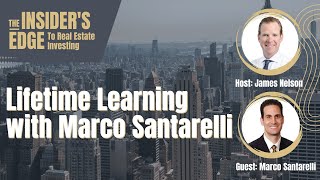
A long-form interview (YouTube) between James Nelson and Marco Santarelli covering Marco's background as an entrepreneur, Broadway producer, and founder of Norada Capital/Real Estate Investments; his mission to help 1 million people achieve financial freedom; education and events (Aspire Tour) to scale financial literacy; mindset (fear, 'ignorance is expensive') and lifelong learning; investment approach favoring cash-flowing residential real estate and a top-down market/neighborhood-first underwriting process; and guidance on passive investing and sponsor due diligence (track record, reputation).
Welcome everyone. Thrilled to have with us today Marco Santarelli, who is a two time Inc. 1000 entrepreneur, investor, author and listen to this. Broadway producer and founder of Nerada Capital Management and Real Estate Investments, the largest nationwide provider of turnkey investment property and also the top rated podcast passive Real Estate investing. You might be hearing me on that, that show in the near future. And last but not least, and Marco, I gotta say I love your mission here. It's to help 1 million people create wealth and passive income and put them on the path to financial free freedom. So we're not talking about hundreds, we're not talking about thousands, we're talking about at least a million. So this is fantastic. Really appreciate everything you're doing for the real estate community and all the incredible content that you put out.
Thank you, James. I appreciate you saying all that and it's an honor to be on your show.
Wonderful. So Marco, if you don't mind, I gotta ask, Broadway producer and I love you have it right in the bio, right up there, front and center. So is there kind of like a real estate story behind that or is that just a passion? I thought that might be a fun thing just to start off with. Sure.
I have a feeling you and I could probably talk for hours and hours with all the things you just listed off and all the things I know about you and what you do. So long story short with the Broadway producing piece, I've always been a big believer in education, always educating yourself and working on your mind and personal growth and development. So for many, many years I've been a member of mastermind groups like the traditional masterminds where you attend and you have like minded people and you grow together and you help each other. I'm sure you know what I'm talking about and probably the majority of your audience understands it as well. So. One of the masterminds I used to belong to, it was called War Room. It doesn't exist anymore. Last year was their last year, but I was at War Room and I was sitting next to somebody and you never know who you're going to meet or who you're sitting next to. But these are all what I'll call movers and shakers. So we're all there to learn about business and development and growing and scaling our businesses and marketing and whatnot. And I got talking to someone who was at the table with me and he fell in love with what I was doing and he said, where have you been my whole life, the last five years? I need someone to help me build my real estate portfolio and hold my hand, et cetera, et cetera. And then the tables were turned, and I asked him, what do you do? And he goes, well, I'm actually a producer on Broadway. And I said, oh, that's interesting. I love theater, live theater. So I started picking his brain, asking him, well, what are you working on? What productions have you been in the past? And. And so things just started to click both ways. We've become very good friends as of today. But he told me about one of the productions he was working on, and I said, hey, you know, I might be interested in co producing that with you. So we stayed in touch, and he got back to me, and I made a small investment, then a larger investment, and then I ultimately became one of the largest investors in that production. And that one production led to two, that led to three, and now I'm co producing, I think nine or ten, including A Beautiful Noise, which is the Neil diamond musical running.
Oh, my gosh. Oh, that's so cool. That's definitely on my list. I gotta. I gotta check that out. The problem is when you live in New York, you end up just taking all these things for granted, even though that theater is literally a couple blocks from my office. So, yeah, I gotta. I gotta make the effort.
You will love it. You will love it. You might tear up once or twice, but it's an incredible production. And then just last week, I was in New York, we had opening night for Harmony. Uh, so that. That's now live. And that's another incredible production. You know, about the comedian Harmonists back from the 1920s, 1930s. You'll love that too. So check it out if you're in the area.
What. What an amazing thing. And Mark, I just, again, because I. I really don't know much about that world, but does your investor mindset. Do you look at these productions through that investor lens, or do you just kind of put this in a separate. Hey, this is a passion project. You know, I see a great play or musical, and I want the world to know about it. So I want to bring it out there. And it's, again, what we would call a passion project. Or are you actually cranking out the numbers and figuring out what your return on investment is going to be?
It's a very interesting question. The answer is D all of the above. And what I mean by that is this. As a real estate guy, primarily, I was always trying to underwrite that deal, if you will, that deal of investing in Broadway from lens of investing in real estate or a Multifamily property, you know, where there's a certain return on investment, there's a timeline and all that stuff, it doesn't work in that world. It's not underwritten that way in the community. So Ken told me an interesting thing. Ken's my friend and my partner. He said, look, Broadway is high risk. It can be high reward, but it's high risk. He said, out of 10 productions, seven are going to lose money. Your first goal is to recoup. And that paradigm didn't work with me as a real estate investor, because as a real estate investor, I want to go into the deal knowing that I'm on solid footing, that I can cash flow right away or in the near term, and that my equity will grow over time because of amortization and appreciation and all those good things. And then I have the tax benefits, et cetera, et cetera. So I'm looking through this lens at these investment opportunities on Broadway, and it just doesn't fit that mold. It's like putting a. A square peg in a round hole. So the first goal when you invest in productions like this, even film, is to recoup your money. That's your first milestones, recoupment. Then anything after that is profit. It's gravy. And that's assuming you get to that point. So out of 10 production, seven typically will fail. Fail in the sense that you won't recoup, two will recoup and then make something. It may not be a double or a triple, but. But it might be a single and you'll make something. And then one out of ten will be like a Hamilton or a Wicked or something like that, where you actually make some really good money and it'll run for years. And so, you know, that's the frame. That's the frame of mind you have to be in when you're looking at these things. So how do you mitigate your risk when it comes to supporting the arts? Because that's what you're really doing. You're writing a check as if you'll never see it again. And you're hoping, which is not a good strategy for investing, but you're hoping that you're going to make money on that. So the only solution there is really is to diversify across multiple productions, knowing that some of them will fail. But. But across all the productions you're invested in, you're diversified, across. You're going to recoup enough from the ones that do succeed, where you're going to make an overall rate of Return.
Wow. You know, it's interesting. The closest thing I could compare to that, I've done some venture capital investing and early stage, and it seems similar, but it's great when you have that passion and you have that real interest in what you're doing. Because even if, look, not that, you know, you'd ever want to lose money, but if you feel that, look, this is a great production that needed to be seen, you have that. So. Well, Mark, I could ask you questions. We could fill up the whole time just Broadway shows, but I want to go back to something that you said right from the. The beginning, which, you know, could be, you know, we hear talking about your why and what you said very early is that you really enjoy sharing and that kind of education, helping other people. Again, it goes all to your. Your mission, which is to empower your. Your I don't stand. Your mission statement is to. To make, you know, yourself, millions and millions of dollars. It's to help other people. So what is your why? How did you kind of come to that point where, okay, I'm really. I'm out there doing this. Obviously, you've already been incredibly successful. You're a top 1000 entrepreneur and Inc. 5000 twice. You know, I assume you don't need to be putting out, you know, a podcast at this point or doing all these things you do. What. What is your why?
Well, at this point, I mean, you get to a point. I've heard someone else say this, so I take no credit for it, but there's a point in time where you've made enough money and you have enough net worth or wealth that you have nothing to really worry about. At least from a financial perspective, you're living comfortably and you're living literally in the top 1% of the entire world population. There's a law of diminishing returns. The incremental gains for every million dollars more in. In net worth you achieve or in income you produce doesn't really have a major impact on your life. So you've got to start thinking about, well, what else can I do that will fulfill me that I can do for humanity to better my family, better my friends, and better people in general? So that came down for me to. And this really came birth. Was birthed over 20 years ago when I started Norada Real Estate Investments, which was really tough, figuratively speaking, hold other people's hands and help them invest in real estate like I was doing. And just to give them all the tools, resources, the knowledge and the properties that they need to do that, so I was already starting down that road helping people build passive income and wealth through real estate. But then, you know, I was increasing the amount of content I was putting out there because I wasn't doing a podcast that long ago podcasts didn't even exist. So it was now putting out content as far as free free education on the blog, on our website, which is tons of content. And then the podcast and going on other people's podcasts. And then, you know, we were literally helping thousands of people. Because of the volume that we do, thousands of people get on the path to financial freedom, at least financial independence, but financial freedom. So that was the give back. And then over the last couple years, and this is more recently, two business partners of mine and I are doing monthly events where we're filling centers with 2,3000 people at a time, educating them in these large venues. The Javits center was one of them just three months ago, you know, not far from you, where you know, we're putting on events. It's called an Aspire Tour or Aspire Event. You know, if you're in the area, you'll see tons of advertising online. But this is where we get people, two, three thousand, five thousand people into an event center or a space where we educate them for a day or two and then from there, you know, we show them other opportunities where they can continue their education, typically financial education. So this is now how we're fast tracking it to reach more people. And then, I mean, I can go on about it, but the last thing I will say, just to kind of zoom out as far out as I can go, I'll call it the last layer of the onion. My partners and I have this nonprofit called Impact Others and The website is impact others.com where we have projects going on around the world where we are helping communities, especially kids with clean, drinkable water, food, daily food education, and the ability to train them to be small solopreneurs, entrepreneurs, so they can now become self sustaining and they can do it on their own where they can make their own money and be able to support their family and you know, buy food and all that kind of stuff. So it gets pretty exciting. This is all the give back because at some point, like I said, you make enough money where you don't need anymore. Now it's just, you know, a game, it's a scorecard, but, but it's fulfilling to help other people achieve whatever goals and success they they need or want or have.
Wow, that's unbelievable. And that makes a lot of Sense. And like you said, it's more than just a scorecard and racking up a financial statement. It's having fulfillment. And it's very clear to me that you have that. So talk a little bit more about your training programs and you get a couple thousand people in a convention center. How are you able to connect with them individually? How do you give them the resources and the roadmap to accomplish what you have?
Well, I'll give you the short answer to that because that kind of goes down a whole, you know, what do they call it, a rabbit hole? Something like that. So, so what we call Aspire, like there's Aspire Tour, Aspire Summit, Aspire Arenas. Those events are not specifically geared towards real estate. There is a, a path that people will get introduced to at some point in time when they start going down that road where they get introduced to real estate based education and training. It doesn't start that way. It starts off with money, understanding money, what it is and how to create wealth. So it's very general in scope at the beginning, but it's all about money movement. How can you create wealth, grow it, protect it. And we talk about, my partner Andrew talks about money movement a lot. How to position your money in ways where you defer taxes or eliminate taxes altogether in, in the wealth that you create. And then ultimately when they get to the mastermind level, we were exposing them to vetted investment opportunities. Those could be real estate related. Some of them are, some of them are not, you know, some of them are just investments, equity investments in, in the existing ventures and startups or businesses. So you know, that's kind of at the end of the train, if you will. But it's all about educating people on money, money movement, how to grow it, protect it and all that kind of stuff. So, so this is again, I'm talking at a 40, 000 foot level here just because it goes down a rabbit hole. But, but that's how we're getting in front of a lot of people. And those people vet themselves, they vet themselves coming into the event because there's a lot of, know, a relatively small cost for a ticket to come. But then as they go through the process, they're exposed to all kinds of interesting concepts and education, mindset, personal development, financial development and all that kind of stuff. So this is just how we reach the masses. But you know, if you kind of zoom back into my small world, if you will, with real estate, you know, for me it's just about putting content out there on the Internet. Through our blog, through the podcast, you know, having conversations with people like you and reaching your audience, you reaching my audience, and us just sharing like shepherds content education to help other people, even if they never talk to you and I, at least we're giving them the tools and, and knowledge that they need to, to start doing something. Get, get, you know, get on the path to financial independence or at least better, you know, one up what they're already doing.
Marco, that is fantastic. And that makes a ton of sense. And I've seen your site and some of the other materials that you put out, and it's a lot of content just putting out a podcast. I know the work and effort that goes into it and again, all the valuable tools that you provide for your students. So you mentioned mindset, and I'd love to talk about that because, and this is interesting, I was, and I speak at a lot of the colleges, master's programs, and last week I was speaking at one of the master's programs and just to try to get an understanding to the audience, asking, okay, how many of you currently own investment property? And about a quarter of the hands go up. And then asking the question, well, how many of you would like to own investment, investment property? Every other hand goes up. I mean, obviously they're there. And so then the question becomes, well, what's stopping you? Why have you not bought something yet? And I said, for anyone brave enough and did get a couple of people to say, and what I have found time and time again is that I believe fear is what holds most people back. And what is that fear of. Yes, it's that financial stress, if you will, that first deal, stepping up, putting your money on your line. On the line. And I do believe it. That fear, right, coupled with someone saying, well, I don't know enough yet. So I'm just, I'm not ready. So. And maybe that's their way of also kind of reasoning that, okay, well, once I know it all, hopefully by then I'll have the money to put it forth. But when you talk about the right mindset, what are the things that you're teaching your students, and how would you address that, that question or that fear that holds a lot of people back?
Fear, in my opinion, comes from the unknown. You know, it's what you don't know, because when you're venturing out, especially if it's a, an uncharted path, you don't know what you're gonna, what you're gonna run into, what pitfalls you might fall into. You know, like, we all feel comfortable in our own, in our own familiar environment. It's like a cocoon. You know, we feel safe. And, you know, the whole thing with, with our brains is that we don't want to put ourselves in jeopardy. It's just, you know, biologically cooked into our, our psyche. And it's been there for hundreds of thousands of years. So, you know, that fear comes from the unknown. When I, when I, when I'm talking in front of live audiences and you know, doing a keynote or whatever it is, you know, one of the first things I ask, and this is one of my first slides, is finish the following sentence. And I have a slide, it says ignorance is. And then there's a blank. And I asked people, well, finish the sentence. Ignorance is what most people say. What do you think they say?
Bliss.
Right? That's what people say. Ignorance is bliss. Now that may be true at times, but in my world, ignorance is expensive because what you don't know, you don't know what you don't know. And those things you don't know are costing you opportunities. They're costing you all kinds of opportunities and abilities to better yourself. So the thing is, there's that saying, the more you learn, the more you earn, the more you grow, the more you know, the more you grow. There's a lot of truth in that. But you know, you have to look at education as being the new currency, if you will. Knowledge is the new currency. See, if you don't educate yourself, you're doomed to follow other people's advice. And you don't know if that advice is good or bad. But that knowledge, educating yourself takes you from being a non investor to an investor, from being a good investor to a great investor. And that knowledge takes you to a place where you can build wealth for yourself and a passive stream of income. So not just for you, for your family, so that way you can get ahead. So if you really think about it, ignorance is expensive because you are missing out on so many opportunities because you just don't recognize it. You don't see it. It might be in your periphery, but you'll never recognize it because it's your reticular activator in your brain is not connected to identifying those opportunities. So fear just comes out of the fact that you just don't know enough. But the solution to that is so simple. Education can be free. Listen to your podcast. Listen to my podcast. Books are 10, 20 bucks on Amazon. You've got a book, you know, the Insider's Edge to Real Estate. Investing. Pick that up and read it. You know, there's a lot of resources out there online, free podcast, YouTube, whatever, where you can educate yourself. So there's really no excuse. And if you get to the point where you feel you know enough, that fear subsides and now you start taking steps forward, contacting the right people, building the right team around you and taking action to actually get ahead. Anyway, that's a long answer to your short question.
No, that, that's fantastic. And I'm writing down, ignorance is expensive. I've got to remember that. I will definitely credit that to you. But just to challenge you on this front though, because look, we know that. And what I love about this business is every day I learn something new. I've been doing this 25 years and I'm constantly. So you could kind of fall into this trap where, okay, well, I'm still learning, there's still more to do. And you know, there's also a school of thought that the only way you really learn how to do this investing is by doing. And so at some point you're going to have to take the leap where it's no longer, you know, the education piece, but it's actually the doing and putting the money on the line. So I guess the follow up question would be is when do you know that you know enough?
Never. Look, you know what, there's a point where you don't need to keep educating yourself, but there's, there's no harm in continuing your education and building on what you know. Again, you know, you can apply the law of diminishing returns. You get to a point where you know enough. You get to a point where you know enough to be dangerous. That's why you need a team around you, the right team. But then you keep building your education, you get to a point where you know enough that you know what to do. And if you found yourself broke again and you know, and transported to another city, you could rebuild your wealth and your income. But you get to a point where you know more than enough that the more you're learn, the more you learn, the smaller the, the, the impact that has on, on what you're achieving. But it doesn't hurt. Like just staying on top of the housing market or staying on top of the economy at a high level doesn't hurt. Knowing what's going on in the neighborhoods that your properties are located doesn't hurt. You know, just understanding what's going on in the world of the Fed and inflation and the cost of living and all that Kind of stuff doesn't hurt, you know, it, if, if nothing else, it's just going to give you more food for thought and maybe more fodder to discuss, you know, at the next social event. But, but yeah, I mean, I'm, I'm a believer in lifelong education. I went on two cruises with Robert Kiyosaki, you know, author of Rich Dad, Poor dad, interesting character, very interesting character. I've seen sides of him that most people don't see. And the one thing I do admire about Robert Kiyosaki is for as successful as he is and for as much that he knows and he's an avid reader, he probably reads a book a week. He will sit at the back of the room with a notepad, regardless of who's speaking on stage, even if they only have 1/1,000th of the success that he has. And he will sit and listen and take notes because he knows that he will learn something from whoever it is on stage or who's speaking in the room that he doesn't know or hasn't heard of before. Maybe he's heard, have. He has heard before, but now it's been reinforced. So, you know, that's a great model to just be a lifelong learner, just like Robert Kiyosaki is.
Love that. So I want to now talk about some of your investment thesis, your approach. We can talk a little bit about active versus passive investing, but one thing I noticed is that you're not, you see a lot of this, you know, out there, get rich quick, you know, flipping homes and, you know, make the big, you know, two, 3x multiples right out of the gate. And that's how you're going to kind of build it up. Whereas, you know, what I've noticed about what you're putting out there is this is really about the long term benefits of real estate ownership and cash flow. And you mentioned the tax advantages as well. So maybe you could expand a little bit on that and then talk about, for the people listening, the decision to be an active investor versus a passive, Maybe some of the pros and cons that you see there or just considerations as people think about how best to get involved.
Yeah, I think that just comes down to, you know, what, what are, what are your, what are your ambitions or goals when it comes to investing? Like when it, when I talk about, when I think about active real estate investing, assuming we're talking about the context of real estate here, as an active investor, it means that you're essentially involved, whether you're the general Contractor, or you're swinging a hammer, buying a distressed property, fixing it up, maybe not by yourself, but with the help of other people. But you're actively involved. And so that means that you're investing your time and probably your money, of course, but you're actively involved. So you need to be part of it or you need to be there or managing it at the very least. For people who have the knowledge to go back to that whole thing about educating yourself, but for the people who have the knowledge to do that and, or the time to do that, that's great. You stand to make larger games gains in a shorter amount of time. You know, often that's in the form of equity. Because if you find a distressed asset, you fix it up. Now you can sell it and receive a capital gain or refinance it and, you know, lock that equity in or maybe even pull that equity out. But, you know, it comes with its fair share of risks. But if you've got the time, energy, desire and knowledge to do that, great, be an active real estate investor. But that's not mutually exclusive. It doesn't mean you have to be an active real estate investor and not a passive real estate investor. The goal is to ultimately be a passive investor as much as possible. So you have that passive income coming in so you can do what you want, when you want, have, you know, the lifestyle that you want and live life on your own terms. You know, for me, given a choice, I'd rather be a passive real estate investor than an active real estate investor. I've done both. I've, you know, fixed and flipped, you know, over 200 houses in the past. And, you know, it's. It's a lot of brain damage, it's a lot of energy. It's stressful that, you know, it's got its pros and cons. You could lose money, not just make money. So. But I'm not trying to, I'm not trying to suggest that it's the wrong thing for a lot of people. They love fixing houses. They love that creativity and that rebuilding. You know, it, it jazzes them up. And, you know, I felt the same way. I love doing renovations. You know, it's fun to see something go from ugly to beautiful, but it's not for everybody. So for me, you know, active real estate investing is really not investing in my books. It's a job, it's a business. You know, you are running a small business and in the end you hope to generate a profit. Or if your strategy is buy, buy ugly, fix it up and keep it well, then you're still, you know, creating a job for yourself, but you're turning a distressed asset into a performing piece of real estate. Now you've got cash flow and you've got the equity, and now it's a passive, predominantly a passive investment. Some people can't start there because they don't have enough cash to be a passive real estate investor. They have to create through sweat equity and whatnot or partners and sweat equity, you know, those real estate assets to create that passive income to be a passive investment. Well, you know, if that's the situation you find yourself in, you don't really have much of a choice. But if you've got the deployable capital and the credit to get started as a passive real estate investor, which is the name of my podcast, interestingly enough, you know, then start there. You know, just build it up. It all depends on what you want, what your expertise is, your capital, you know, available and, you know, and how you want to fast track things.
Yeah, Marco and I certainly talk about that at the beginning of my book, to be honest, to assess not only your strengths, but also risk tolerance and your time. Right. And I really like how you put. When you're an active real estate investor, you have a job. Right. So that's really important, you know, for everyone listening to look at yourself in the mirror and be realistic about, you know, what is your skill set and time that you can devote to this. So, Marco, you bought and sold over 200 homes. You invest passively. Now, talk about, was there a time when you began to build and start looking at larger assets? Maybe talk about multifamily mixed use. What other asset classes have you branched into? Did you ever do that on the active side or was that just more on the passive side?
Wow, that's a big question. I've pretty much touched every single asset class over the years, from real estate to stocks to cannabis to crypto. I've kind of ventured in all of it in the world of real estate. My favorite, and I know you're in commercial and you deal with all kinds of different kind of commercial types of real estate. At least I think I do. But. But that's my understanding. You know, my favorite in the commercial space is residential. You know, for me, anything from a single family home on up to a large apartment complex, you know, from a financial, from a financing perspective, that's considered commercial. But from, you know, where I sit as an investor, it's all residential. I don't care if it's 1, 2 unit 4 unit or 50 unit. But that's my favorite because it's easy to understand everybody needs a place to live, everybody needs a roof over their head. It's easy to understand rents and rental income. The numbers aren't that complicated to run. It's something that most people can wrap their head around and they know when something breaks, it's, it's repaired. Whether it's, you know, a, a sink or a hot water tank or a roof replacement, you know, it's, it's not something that has a huge learning curve. At least I don't think so. But, but that's my favorite space is, is, is real estate as far as, you know, zooming out in the world of, of all possible investments. You know, for me I have really three or four favorites. Businesses like viable businesses that can be scaled. Residential real estate to us a much smaller degree is a certain crypto assets and then high yield promissory notes. That makes up my investment world.
Me personally, I really appreciate you giving that overview. And as I also talk about my book, most investors start off and stick with multifamily for the reasons that you gave. Although if you're doing it on the active side, I mean you could make the case to say, look, even if you have 100 unit apartment building and you have a third party manager, and I think a lot of people say well, I'm not going to be actually collecting the rents. Well look, if you're not asset managing, overseeing that property manager, you know, again I think that when you're doing that and you are the active investor, you do need to certainly oversee that. And when you get into larger apartment buildings, more units, yeah, it does still become a lot of work and I think there are some trade offs and we could talk about kind of risk of having 100 units where if one apartment vacates, there's always going to be someone else who will rent it. It's just a question of what. As opposed to getting maybe a retail piece that has two or three stores where long term leases. But look, if one of them leaves, you could be looking at a third of your rent roll disappearing and then how much time will it take. So again, weighing how much from a management standpoint and also a risk profile, I think you kind of addressed that risk piece to it. But how else do you factor in risk when you're looking at an investment? If you could just talk a little bit about that.
Well, this took me years to figure out. The way I look at it, when it's investing in real Estate is this. And this comes down to like two or three of what I call my 10 rules for successful real estate investing. I like to take a top down approach. So if you can imagine a funnel, you start at the top, most people start at the bottom, which is the property itself. But for me, I start at the top of the funnel, which for me is the metro area, you know, the market. And then, you know, that could be subdivided into sub markets and areas. Like Atlanta, for example, is a massive market made up of many, many cities. And those cities can be broken down into, you know, regions as well. But you got to find a market that, you know, offers two main things. One is stable, a stable job market, or ideally a growing job market. So you want to see job growth. To me, that's a fundamental, you know, it's not a technical factor, it's a fundamental factor. And then the second thing, which is tied to the first thing, but the second thing can stand on its own, and that is population growth. You've got your organic growth, but if you have a strong job market and you know, you have Amazon and Google moving there and other things that are going on, it can bring in thousands of people, which puts upward pressure on the housing market. So, so population growth is a, is a positive thing. You don't want negative population growth is okay very short term, but if it's sustained over years, it becomes a problem. So if you have job growth and population growth, you've got the fundamentals covered and that's the top of the funnel. And, and then as you go down the funnel, you're looking at regions within a metro area. And then ultimately what I'll call neighborhoods and where you want to position yourself is, is in neighborhoods that have strong desirability. It's, it's where a lot of people want to live. You'll always have a large tenant pool to draw from. You have good schools, you have retail, you have retail demand for the housing. You have retail stores and malls and whatnot, and maybe Starbucks and that kind of stuff. You know, you want a solid neighborhood where there's desirability and you can see long term prospects, long term demand for that area. And then ultimately you look at the properties, the deals themselves within that neighborhood, within that market. If you get the neighborhood piece of it right, in my opinion, you've probably licked 70% of your risk in that real estate deal. Real estate's pretty forgiving, you know, if you do it right, it's pretty, you can make mistakes and still come out laughing, you know, years down the road on your real estate deal. Like you can overpay for a piece of real estate today if it's in the right location, the right market, and especially in the right location, like that neighborhood, it's gonna, it's gonna be very, very good for you over time. So real estate can be very forgiving. But, but I put a heavy focus on the neighborhood, that region of where the property's located, and then I look at the properties within that area and then I underwrite those in terms of condition and the numbers like the rent versus the expenses, et cetera, et cetera. So the mistake I've seen a lot of investors make, including myself in the beginning is I get presented this piece of real estate, this, this so called deal and you know, I, I start looking at it too closely and I don't consider its roots, its roots are in the neighborhood, the community. And you can't uproot it, you can't change the neighborhood. So if you love the property, it's newly renovated, or maybe it's new construction, it's newly built, has a warranty, it's a great property, you love it. And even if the numbers make sense and pencils out really, really well, if it's in a crappy neighborhood, you, you know, you're going to have problems going down the road, you know, in terms of tenant turnover, tenant quality, the demographics of that tenant, you know, skip payments, missed payments, extended vacancies, whatever it may be. So this is why to me the top down approach makes the most sense.
Really appreciate your breaking that down and I hope our listeners are taking notes because you give a lot of good information and I, I would add one more thing and because I think a lot of our listeners also look for areas that are up and coming. And so, you know, how do you find, you know, those opportunities and whether it's infrastructure. So it could be a new, you know, subway station or rail yard, rail line that opens up, it could be a new company coming to town, could be a zoning change that all of a sudden facilitates development. So those are the kind of things to think about. But certainly you want to do your work and your point of it can be the greatest asset ever. But if it's in a very challenged area, you could be in for some tough times ahead. So Mark, with that, I'd like to talk about how to go about passive investing because to me and my experience in that front is yes, it's certainly about the real estate and you need to understand what the opportunity, opportunity is, but it's almost more equally, if not more important, of who is the sponsor and who is executing on this. So if you would agree with that statement, what would you say that someone should be looking for in an active investor or a sponsor before considering investing?
Well, I mean, I might be oversimplifying, but it's their track record and their reputation. I mean, those, those two things are very key, very critical. You know, what is their track record? Do they know what they're doing? You know, can you look at, you know, other deals that they've done and how did they turn out? You know, it's not hard to do your due diligence on that and you can certainly talk to investors that are LPs or, you know, part of that deal to see, you know, what their opinion is of it. You know, are they getting paid, are they getting the returns that were originally promised, etc. Etc. So, so that's one factor. And then, you know, the person's reputation, you know, you want to make sure that you're dealing with somebody who's not going to take off, you know, a year from now with the money from, you know, the, the company's coffers. And why not? You know, you know, as time goes on, people build a reputation. It's either good or bad. And that's not too hard to figure out today, you know, with, with all the stuff that's online on the Internet.
So Marco, just to challenge you on that a little bit, because, look, someone can give this incredible track record on their site and, oh, I've closed a hundred deals, whatever it is, and maybe they were the driving force behind that deal. Maybe they just had some small component of it. I mean, maybe in the worst case scenario they didn't and they're just putting things up. Let's assume that's only the 1% of the, you know, 1% situation. But again, if this is a new sponsor and you know, again, you're doing your research online, it looks like they're active, right? But, you know, qualifying. And I like the idea, I think, you know, speaking to the investors. But when you're talking to a sponsor for the first time, you might not know who's investing with them and you might ask them, well, hey, can I speak to some of your investors? And they pass you along to their best friend and they say, oh yeah, he's great, you know, invest with him. But how do you do real due diligence where you feel like you've gotten to the bottom to have the, you know, the certainty that what's being presented is real.
Well, it's a debatable question, a debatable answer. You know, everybody gets started somewhere. Like if you're a syndicator, you're, everybody does their first deal and they don't have a track record and maybe don't really have a reputation other than, you know, they're just their, their personal reputation, not their professional or business reputation. So at some point, you know, you, you're going to bring in investors, fewer investors in the beginning, but you're going to bring in investors that are going off their gut and their, their trust in you and whoever you've put them in touch with. You know, be friends, family, people that maybe have done deals in the past, you know, with a particular syndicator or sponsor. So if that.
There. Oh yeah, now you're still here.
Okay. I saw a bunch of circles flying around. You know, you've got to put together as much as you can to kind of build your case, you know, to build a presentable, trusting profile. So I mean, I can answer this, you know, as the investor or the, the syndicator, if, if it's your, if you're the investor. Asking me from the investor.
No, no, no, this, this is helpful and I, I think that this is, I think a good conversation for our listeners too to just think about in general who you do business with. Right, because it could be a sponsor, it could be finding investors, it could be finding a contractor. Right? So what I have found is that as you develop your sphere of influence, right, and you make connections and we know this is a business about the people that usually, you know, once you find trusted people in your inner circle, I'm sure they will introduce you to other people who, who can verify. So again, I, I think part of this is the more that you're involved in this, the more people you meet and that, that's also where you can get that, that verification. Right? So, and I'm sure it's probably not too dissimilar that what you've done on, on your Broadway investing, where I'm sure maybe the first time it was again, you were at a conference, like minded people, you like what they had to say, got to meet the person in a casual setting, you go do a deal, but after you see how that person's operated on the first deal, obviously it, it went well even if it didn't. Maybe you said, well at least I like the way this person handled this situation and maybe things didn't work out the way they're supposed to, but I'm happy to do it again. I think it's really, this business is so much about building that sphere of influence, building those connections. Because that's what's going to lead you to whether it could be a partner, it could be an investor, it could be anyone who's going to work on your real estate transaction.
Yeah. And just to take that one step further, I mean, I agree with everything you said. Just to take that one step further, I'd rather invest with someone who I put more weight in the person than the deal. You can have a B quality real estate deal or business, but have a rock star person managing it, running it or driving it. You know, an A class person. It's the saying, you know, you're betting on the jockey, not, not the horse. So you're better off having a, a good deal and a great deal manager or, or general partner or whatever it may be than the other way around. Because a someone who's solid, that knows what they're doing, has a good reputation, but has the experience can turn an average deal into a great deal. But if you flip it around, you know, someone could take a great deal and drive it into the ground if they don't know what they're doing.
Yeah, Marco, that, that is a fantastic point. And we've both been doing this a very long time and you know, with love of everything always runs according to the business plan. But we all know that things come up and that's where experience matters and knowing how to handle situations. And so yes, I fully agree. You know, sponsors, when I've invested passively, it's all about the sponsor for me. And one of my latest investments, I invested in an RV park. I couldn't tell you the first thing about the RV business. I mean, look, I understand the offering memo. I can look at the numbers, I can understand the assumptions, see if things look out of whack, but at the end of the day, I don't know the business and the value behind this. So. But I do know the sponsor and I know if the sponsor says, look, this is good, this is vetted, then that that's what I'm really relying on. So, Marco, with only a couple minutes left, I have to ask you. So you're an Inc. 1000 entrepreneurs entrepreneur and a two time recipient also, I think, was it Inc 500 as well? So maybe it seems like you've been rising in the ranks here, but maybe for our audience, talk about how that came to be. I mean, that's an incredible distinction. Are they basically taking all your businesses and kind of looking under umbrella and classifying you in that. But this is maybe talk a little bit about how that happened and how maybe others who are looking to grow their business could aspire to get on that list one day.
Yeah, they look at year over year growth. There's, there's a criteria, it's on their website. You know, you have to be in business for so many years, you have to have a, you know, revenue over certain dollar amount, you know, which is in the millions, etc. Etc. Etc. So if you check all the boxes, you can submit an application, then you send them supporting documentation which is the previous two years, tax returns, and, and then, you know, they look at all that and then they just look at your year over year growth from two years ago, I think, to the current, you know, year of that list. And then, you know, if you qualify, then they put you in the bucket, if you will. And then when the deadline arrives, they take the top 5,000 companies. These are not public companies. They have to be private companies. They take the top 5,000 private companies in America and they rank them in order of, of growth from the previous. I forgot if it was the previous year or the previous two years to that point in time. And Whoever's the top 5,000 goes on that Inc. 5000 list, you know, with Inc. Magazine. And we applied, I think three years in a row. The first year we were 923 or something like that on that list. So that put us in ink 1000. It's, you know, it's, it's just an honor and a distinction to be on that list, period. But, you know, the, the biggest and fastest growing companies end up, you know, creating their own separate list called the Inc. 500, which is what they tend to brand and market, you know, the crap out of.
So, yeah, I think it's fantastic and obviously a testament to what you're doing, but also that good housekeeping seal, if you will. And so just thank you for sharing that. So, Marco, the name of this show and my book is the Insider's Edge to Real Estate Investing. In just a couple words. What would you say your inside edge is to real estate investing?
Me personally?
Yes.
What my insider's edge is to real estate investing.
Wow.
I have more than one answer. I would say at this point it would be kind of two things that go hand in hand. It's what we talked about before, and that is just being a lifelong student, just constantly educating yourself, because that will never hurt you. It can only help you. And then the other thing now, I didn't start this way is to focus on real estate investments that provide strong growth potential. In other words, I'm looking for markets that have strong growth potential. And you know, usually people think about that in terms of appreciation like price gains, which is true, that's what I do want. But that's a function of those fundamentals I talked about before. You know, where are the markets that are experiencing strong population growth and have strong job markets, because that's what's going to sustain that market. But I'm never, ever, ever losing sight of the fact that the property needs to make sense literally from day one. So I am investing for cash flow. I want the cash flow. And maybe I don't get it in year one because it's, let's say it's, it's more expensive new construction of some kind. And this may not apply to multi units, you know, or apartment or syndicated deals like that. This tends to, you know, be more along the lines of single family, duplex, fourplex. But the principles are the same if you're applying them to apartments and multi unit. You want to invest for cash flow. You don't want to lose sight of the fact that you can't feed the beast every single month and put money into it in order to survive long enough where you do have positive cash flow. So don't be a speculator, invest for cash flow. The deal has to pencil out and make sense. But, but, but I do like to focus on markets that show sustained growth that will provide me reasonable, not, you know, unreasonable rates of price appreciation and growth. So you take that and you couple it with, you know, constant ongoing education. That to me is the insider's edge. Call it the secret if you will, but that's the insider's edge.
Well, Marco, thank you. This has been incredible and that was great advice and I love that you are a lifetime learner, but you're also really drilling. You continue to drill down on the fundamentals which are so important for long term success. And so again, just thank you for everything that you were doing for the real estate community, being here today and sharing your knowledge. And before we go, just let everyone know where they can find out about all the great things that you're doing.
Well, a good friend of mine told me to start giving out my Instagram handle instead of websites and email addresses and this and that. So, so I thought, okay, here's the first time I'm going to do this. So the social I use the most and what I'm going to start doing more of next year. As far as educational content is my Instagram handle, which is Marco G. Santarelli. It's my name with my middle initial. So, Marco, the letter G. Santarelli. And that's on Instagram. And of course, my website is just marcosantarelli.com Perfect.
Well, Marco, thank you again for joining. And thank you to all of you listening right now. And and if you enjoyed the show, please go ahead, subscribe if you haven't already, or give a rating. And that's what helps others find this show. And what we're all about is helping you gain the insider's edge to real estate investing so you can gain the advantage and outperform the market. As always. This is your host, James Nelson, until next week. Thank you again.









