The Trinity of Sales: Behind the Scenes of Our Award Winning Deal
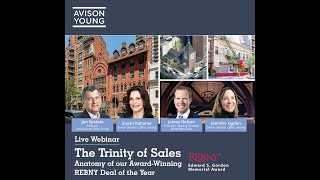
A recorded panel discussion (Oct 2020) describing an award-winning, multi-party real estate transaction handled by Avis and Young involving three NYC nonprofit institutions: Jan Hus (a church), Church of Epiphany, and Weill Cornell. The team coordinated sales and acquisitions so each institution could meet mission and space needs while preserving historic structures. Key innovations included synchronized closings, use/release of escrow deposits to fund subsequent purchases, two-year leaseback/post-possession agreements, landmark-preservation coordination, and creative timing to let proceeds flow between deals. The sale price for Jan Hus was $22.5M (≈$600/ft in cited metric); Epiphany’s site had ~125,000 buildable ft and attracted institutional interest. The deals closed in 2019 and were recognized by REBNY as “Ingenious Deal of the Year.”
Questions this video answers
$22.5 million
Two years
About 125,000 ft²
It.
Welcome everyone. My name is Arthur Moranti and I have the privilege this afternoon to introduce my Avis and Young colleagues. First to my left is James Nelson. We have the opportunity today of being together in our new Avis and Young headquarters office in New York City at 530 Fifth Avenue and joining James and I today are Susan Kahana, Jennifer Ogden and John Epstein, the winners of the most Ingenious Deal of the Year award presented annually by the Real Estate Board of New York. This award is named after Edward S. Gordon, who I had the privilege of working with many years ago and frankly, I should say competing against many years ago. And I will tell you that Ed was one of the most successful historic real estate brokers in the history of New York City. And he was known for his creative genius. This particular award is the most coveted, the most sought after award given by the Real Estate Board each year because frankly, it epitomizes what we real estate brokers do. Create unique value for our clients and produce results. I'm so proud of my Avis and Young colleagues and partners for what they did in serving three nonprofits, two historic churches in helping those churches unlock the value in their real estate assets, which will help fund their respective missions into the future, and one prominent hospital to help that hospital locate an optimal development site for its critical housing needs in the future. Not only was this transaction recognized by the Real Estate Board, but also by Ava Cion at our annual meeting globally and nationally. And it was recognized for its collaboration, which of course drove the success and allowed the creativity and ingenuity to take place. This afternoon. We're going to share with you the details of what happened, which hopefully will inspire each and every one of you to similar accomplishments. James Nelson participated in this transaction with the rest of the team. And James, why don't we begin by your just describing, in your opinion, an overview and what you thought was special about what happened here.
Great, Arthur, thank you so much for that incredible introduction and I'm so happy to be here with you. Although socially distant, but in our new office, in our new headquarters. So excited to be back here in the city. And I know that Jen, Susan and John, who are dialing also from their offices, very excited for our return as well. So look, this was such an incredible transaction, a series of transactions really to be a part of. And you know, I always tell my brother, who's a doctor down at Vanderbilt, he's in infectious disease, he's on the front lines right now. You know, he's truly saving lives. And as real estate Professionals, you know, maybe we're not saving lives per se, but it really is meaningful when you can give back. And certainly the work that we're doing with our not for profit clients. And Arthur, as you mentioned in your lead up, I mean, these are three New York institutions that were all challenged space challenged to find a place that worked in a really difficult neighborhood to find space on the Upper east side. So the fact that we had epiphany and you're going to hear about each one of these transactions and how the dominoes fell into place. But they had all this development potential that they wanted to unlock and find a new home. And for Jan Hus, they did not need the space that they had and to find a new location for their outreach and of course for Weill Cornell to build much needed housing for their medical institution. So it was just so rewarding to be a part of this and know that we were helping these people. Three incredible institutions to be here with us for the next century and centuries to come. And I would just say, lastly, on a personal note, I could not be more thrilled to be part of the Avis and Young team because this transaction really embodies everything that we're about and such a huge reason why I joined this firm. We like to say that we don't have silos. What that means is we are completely client focused. We want to do what's best for the client and bringing in different service lines and that sale brokers, working with leasing, working with finance and project management. You know, we are solving for the client. And you know, this transaction was introduced to me the very first day that I showed up to work at Avis and Young and for Jen Ogden to come over and I could see the excitement. She comes running over and she says, james, we've got a meeting set up this afternoon. You have to join me. We're going to meet with this pastor. She's about to hire another broker to sell the property. But I think we're missing out on something big here. And I'm just so fortunate to be part of this team. And you know, first of all.
And you had nothing else to do there. That's true.
And Jim remembers I lost my wallet on the way up to the. It was a little bit disoriented that day, but it was so amazing to get to know you in that fashion and with Susan and to join forces with John and the rest of our sales team was here. And of course, Arthur, I cannot thank you enough for your leadership. So really such an exciting transaction to be a part of. And we're excited to tell you about how this all unfolded.
Okay, well, hi, I'm Jen Ogden and just wanted to sort of preface this. Although the two sales and two acquisitions on behalf of Epiphany and Janhus closed in 2019, the synergistic transactions came together because of relationships and projects we had cultivated more than a decade before. I know I met Beverly Dempsey, who was the senior pastor at Jan Hus at a Junior League Montclair Newark function in about 2005. Beverly and I went on to volunteer for various league sponsored events and we became friends and part of a women's group that we would, you know, see each other socially and go out for lunch, et cetera. But then in 2009 I decided to re enter the workforce and started in commercial real estate. Beverly at the time was going through the ministry program and in 2014 she actually called me, I was at another firm and she said, I've just taken this new job as senior pastor. I know you're in real estate. I'd love for you to come up and look at my church, see the space. I want to get some some of your advice because I'm thinking of maybe subleasing and doing some shared space options to raise some cash. So I went up, I looked at it, I gave her some advice and some ideas and then fast forward like four years later. I am looking at my Facebook over the weekend and there is Beverly sending me a message. Jen, do you think you could help me sell my church? And I was like, oh my gosh, I can't believe this. I knew that James Nelson had, we just hired him. So I had all the confidence in the world that yes, we could affect this transaction. We would be the best ones to handle this. So reached out to James as he said, we scheduled a meeting that was like 4:30 at the end of the day on your first day. Susan and I and James, we got in the cab, went up, talked about what we were going to say, we met with Beverly and her board and we were hired. We displaced the other broker and she hired not only us to sell her property, but also for Susan and I to look at finding an alternative location. Thank you.
So you've all heard the cliche, real estate is a 24, 7 business. And I'm sure everyone in our audience recognizes the value of long term relationships. Just an interruption there. Sorry, Jen.
That's okay. That's all. Next slide.
So I'll tell you a little bit about the property and it's a Beautiful church building. And Yanhus at the time was only using a very small portion of it. They were using for some of their outreach to the homeless and for senior citizens in the area. On the lower level, it did have a fully built out commercial kitchen. But there was a lot of work that needed to be done with this property. And we were really trying to determine what was the highest and best use. And when we were asking our questions, because the buildings you can see is very striking, our first question was, is this an individual landmark? Is this something that needs to be preserved? And it turns out that landmarks had approached Yanho's about designating the property. So it had not been designated yet, but this was something that we certainly wanted to consider and if all possible, preserve this beautiful structure. And so we thought about the potential users buyers for this property. And we've actually, over the years, we've actually sold a lot of these churches to developers who have converted them to residential condominiums. We did one down for the Methodist church on West 4th Street. There's a couple other examples, but just the way this space was built and you actually walk up to the second floor and you have a very high ceiling and this incredible chapel and meeting room. And then they had offices above. And we just, we thought this would be such a perfect opportunity for an end user. And whether it was another religious organization or whether it was a school, there's a lot of private schools on the Upper east side. We're always looking for space and it can be very challenging. We, we knew that we had a property that was gonna be very desirable. Of course the challenge then was if we were to Janhus was not closing their doors. They wanted to continue their outreach and in fact they were very cognizant of the fact that they had all this real estate value and they basically weren't even using it. The above floors, they were kind of renting out for meeting rooms. But they really wanted to monetize this space and really use it for their mission. And so the idea was to sell and find a new location in the area. And Susan is going to tell you about that search later. But really use these proceeds to advance their mission.
So, hi, my name. Go ahead, James.
Oh, I was just going to introduce you, but please.
Hi, my name is John Epstein, also principal at Davidson Young. Just like Jen, I have work at keeping relationships long term and you never know what happens. As it turns out, I had been working with the church down the street, literally about a block away. The church the epiphany for about 10, 12 years where we were looking for an alternative location for them or to build on site. Back in 2005, we had gone through the process, and ultimately we did not move forward with building something on site with a developer building a tower above. So my persistence kept up and as the years progressed, always kept in touch. Well, when I found out the availability of Yahnhus, immediately thought of the congregation 94th in York, and when running to the rector there and said, I've got a solution for something we've been working on for a long time. And she said, you gotta be kidding me. It's literally down the street. And one of the issues had been for them is they were trying to minimize disruption of their congregation. They had been working on building it over the years, and the only solution really would be within a block, one block, maybe two block radius of their existing church. So when this popped up as an availability, we went to work really quickly trying to assess what would be needed in order to accomplish something like this. Brought it to their vestry for a quick approval of whether or not there would be interest. And of course, it went through with flying colors. That's when we started discussing the transaction with Jen and Susan and James about whether there'd be an opportunity here for Church of Epiphany to acquire the ANU's property. So once we get.
Before you go on, I just want to point out something to our listeners. James mentioned the word silos, and I mentioned the word collaboration. You all should realize that Susan and Jen are office leasing brokers. That is their specialty at Avis and Young, and James and John are capital markets investment sales professionals. So when we mention silos and collaboration, it's that immediate reaction of Jen seeing an opportunity for the firm and without hesitation bringing it down the hall to the investment specialists to help serve her relationship. Sorry for the interrupt.
No, no. And in that spirit, you know, I went forward with the church, got myself engaged to represent them. And then we began some discussions with Jen and Susan and James and that the team representing Janus and then also internally on the Church of Epiphany side, what would it take to get this transaction done? What are the key issues that would have to be addressed and sort of what were the pivotal elements of making a deal occur? So go to the next slide. After being hired, you know, we again, as I said, sat down and found out there were several things that needed to be accomplished to do this transaction. One was that we have to arrange for the sale of the Epiphany site first. So so that the Epiphany Church of Epiphany would have surety that they would have the cash to close on Yahnhus. Meanwhile, Yahnhus want to make sure there would be a deposit put up before they would take any take their property off the market and would want to make sure that the church had the funds necessary to close. So initially we had this conflict of making sure the timing would work and how would we find a buyer that would be appropriate. So we determined that we would cast a very wide net and search for developers and other users who had the capability of not only closing quickly, but who would be willing to put deposit money at risk so that the Church of Epiphany could then use their monies to put a deposit down on Yahnhus, and so that Yanhus could then have funds available if needed to put a deposit down on their property that they would want deposit. So talk about a stack of dominoes that needed to fall in line and on time. This was certainly it. With that said, we went out wide. We found lots of developers who had an interest in the property when we had on the market initially back in 2005, and some other new entrants in addition to that. We went out to users not for profits and found that one in particular, Weill Cornell, again a neighbor in the area who Church of Epiphany, had a long relationship in terms of their ministry, assisting them in their facilities, had an interest in expanding their medical colleges residence for their residents. And the timing was as soon as they could get hold of a piece of property, they would close on it because they knew that the competition between the other medical users in the area was pretty fierce for any sites as large as this, which is about 125,000ft buildable. So quickly we arranged some meetings with Weill Cornell through their broker and put together some meetings and ideas that would work for both sides in order to accomplish the timing goals and the monetary goals needed to close the deal. In addition, the Church of Epiphany was going to require renovation work on Jan Hus in order to move into it, because it really was not really suited for sort of a 21st century congregation and needed to be expanded and adjusted for the uses of the Church of Epiphany's mission and and congregation. So as you can imagine, putting all these pieces together simultaneously became quite the challenge for all of us. And meanwhile, Jan Hus was interested in closing as quickly as it could so it can move on with its own mission. So we got Cornell to agree to allow Church of Epiphany stay in possession for two years on a leaseback. And that sort of was the last sort of underpinning in order to move this forward into what ended up being a phenomenal transaction for three, not for profits, with great missions in the area. And in addition, that could all stay in the Upper east side and continue with their existing congregations, as well as build their community for their hospital.
Perfect. So now I'll talk a little bit about the Yanhu sale. And I just want to say that it was very important that Evison Young did the right job, and we clearly had a fiduciary with both Epiphany as well as Jan Hus. And that meant that when John was running his sales process for his property, he had to go out and cast a very wide net and secure the highest and best price on the best terms. Because, as you mentioned, Epiphany needed that lease back. They needed that post possession so they could have time to renovate their new location. Well, in much the same way, we had to do the same thing for Janos. And we knew very clearly that Epiphany had interest in the property, but we had a process to run, and we needed to make sure that we secured the highest and best price for Jan Hus. So there was, you know, on one hand, a lot of coordination that took place, but there was also, you know, really that understanding that John had his process to run on Epiphany, we had our process to run on Yahnhus, and as it turns out, we did have another church group was interested in Jan Hus. That really helped us cure that price at $22.5 million, which was in the ballpark of almost $600 a foot. And most of the developers were shying away at that level. So the other piece is this landmarks question. And I really have to take my hat off to Kramer, Levin, and especially Dan Ber, the transactional Council on this, as well as the Land Use Council. And this was a little counterintuitive to me. Usually when we represent clients, we just say, look, we're going to sell it as is, and we'll just let the buyer deal with it. But they said, no, this is a situation where we need to reach out to landmarks. We need to let them know what we're doing here. These are institutions that are going to be here for a long time and don't want to make this seem like we're, you know, we're doing something, you know, quickly. And so there was a very healthy dialogue And Landmark suddenly said, look, there would be flexibility, but they want to do preserve this building. And the fact that Epiphany, you know, fully intended to restore this building to its original splendor, really checked a lot of the boxes. And ultimately they did say that they were willing to take that risk and work with Landmarks on the transaction. So, you know, that was a huge piece to this. Just like Epiphany needed post possession, so did Jan Hus, because at this point, and Susan's gonna tell us shortly about her search of finding a new home, but we did not have a new location security, and we knew this was gonna take time. So the fact that John was able to. Well, Cornell Weill was able to give two years of post possession to Epiphany, they could in turn offer Jan Hus a similar amount of time to allow for each church to do the renovation and move on. So the timing on this was so critical because this isn't like a private, you know, investment sale where you sell your profits and then you can either, you know, maybe exchange or maybe cash in. These were churches that really needed that silver platter solution where it wasn't just going to be about making a sale and throwing something quickly together, but really arranging and allowing for this time for them to find a new location and to renovate it.
Okay, well, now for the third part of the Trinity was to find a new location for Jan Haus new church. And we knew right away that to find a building on the Upper east side with a very, you know, a tiny parameter for the location and the operational use of this building was not going to be easy. So I'd like to think that there was a bit of divine intervention in this part of the deal as well. Jen and I put on our sneakers and we walked the blocks, crisscrossing every block on the Upper east side. And originally, Jan Hos was thinking of leasing space in someone else's building, but because of the unique use of the church, they do have an outreach component where they serve the homeless. And the pastor, Beverly Dempsey, was very serious about maintaining this part of the church. And as we looked at leasing situations, a lot of developers, famous ones, were not interested in having such a building in their neighborhood. Obviously a political situation. So we decided that Janhus should buy its own building and not lease, so they would have control over their own use and their property. So we walked the streets, and here we found a very unique opportunity on First Avenue in 91st. That was a double 50 foot building, and it had some unique architectural aspects. To it, there was a full basement that we could use for the outreach with a full kitchen to serve the homeless. There were office floors as well as worship areas. And you can't see because the building is set back on, there's a four story building and on the top there's actually a beautiful residential apartment that will be used for the pastor's personal apartment. So this was not an easy deal to negotiate. There were offers in on the building, but when we brought Sessions and Jan Hus and the pastor over to see the building, everybody fell in love. And we knew we had to negotiate a really good deal so Jan Hus would have enough money in there Downing to pay for this building and its renovations as well as putting some money into the bank after the sale. So Jen and I actually negotiated a rather excellent deal, I must say, reducing the price from an original asking price of 14 million to 26% below the asking price. And it was tense and it was emotional, but in the end this was the perfect outcome for Jan Hus. I think this is a before picture and we hope we'll be able to send you pictures of the finished project once it is all done. And the community so seems to be welcoming the use for this wonderful church of Jan Hus.
Perfect. So. And Susan and Jen again define this building that was such, you know, met all their needs, but also had the right zoning to allow for it. So I know that needle in the haystack. So this deal of the year award again is all about the ingenious aspect. And this is really what I love about this business is that trying to create something new, getting creative and really solving for our clients. And this transaction had elements that I have never seen in my 20 plus year career. We do a lot of work with not for profits. We've worked with a lot of religious organizations. Usually they're on one side of the transaction and we're selling to a private professional investor. So to have three not for profits who all had their own set of boards and hierarchy was. And to make sure that everyone was moving their process along at the same time, I cannot underscore the amount of complexity and the amount of time and patience that we had to exhibit to keep everyone on board. And so I think for us and as the broker, to really work hard to report and to advise, to make sure that all of our clients knew what was going on. Because this is a sophisticated transaction even for a professional real estate investor, you know, for the lay people, you know, to explain what we were doing here was no small Feat. So, you know, that alone, I think the way we were able to get these not for profits to come together was really unusual. But I think the ingenuity and certainly I think allowing for this post possession and again, for the timing for this all to fall into place, we really crafted a transaction that allowed for success. But above and beyond, the one thing that I think that we did, which, which I've only seen done in a private transaction before, is using deposit proceeds from a contract, releasing that out of escrow and allowing that deposit to be used, the purchase of another property, you know, the amount of risk that goes with that. Because once that money is gone, out of escrow. Right. It's been spent. Right. And so to. And I really have to compliment Cornell Weill and their board, who luckily had some great real estate professionals on board to explain to them that we were going to need to use their deposit. Excuse me, Epiphany. Was going to need to use their deposit. Right. To go and purchase Jan Hus's property and then for us to have that contract deposit released again and use that deposit to purchase the new location again. I don't even know how this group came up with this idea because if you only, you know, if deposit was only released once, I think that unto itself would have been certainly something new and unheard of for a. Not for profit, but to do that twice and to kind of recycle that money, if you will, to make two acquisitions, to make everything fall in place, that was the key to the ingenuity of this transaction. And so was really happy that we were a part of that and, you know, the benefits of this transaction again. And Arthur did a great job in the intro and talking about how this is going to build up these institutions, secure their financial success, solve for their space needs, modernize their facilities. This is going to do wonderful things, not only for those organizations, but for New York. So, again, so thrilled to be a part of this. And, you know, we'll see if we have some questions, but I know Arthur has questions for us as well.
No questions, just a comment. Don't forget about what Susan said. Divine intervention helps.
Yes, yes, absolutely. Yeah, it was. And you'll see what Beverly, the pastor of Jan Hus, had to say about this. And, you know, just really, we love partnering with our clients and it's really. And we're going to be releasing and you'll start seeing kind of our new branding and the new essence of Avis and Young. But we truly believe that we are powered by people and it's our people at Avis and Young who allow us to do these things for our clients. But it's really about the people who we ultimately serve. So we really, again, this was a wonderful transaction to be a part of. It's great to get the, you know, the awards and the acknowledgement. But more important than that, this was really a success for our clients.
Yep. We're going to get some questions now.
We can, we'll now if you would like to type in your questions into the Q and A, we can, we'd love to hear your comments, questions about the transaction. In the meantime, you know, I actually, you know, have a couple questions that I think might be, you know, helpful to, you know, kind of further dig into the transaction. But John, how did you know talking about the development potential? Because I know one of the alternatives that we have done before is when a not for profit or any user has air rights. A transaction that we have done in the past is saying, okay, we're going to bring in a developer and they're going to build a new building and they're going to deliver back to you a brand new space at your location. I'm curious, did you ever present that to Epiphany and is that something that you considered? I think that because that's an alternative deal structure which could have worked in this situation. John, are you still on?
I was muted. I apologize. As a matter of fact, we had discussed it and in the case, when I originally represented them in the mid 2000s, that was the case that we went out to the market with. And that time we had several very prominent New York City developers who proposed putting the church on the first several floors with a tower above it. The image that we showed in the slide today, where they would then stay in place and through the years, they really kind of lost the appetite of trying to live through that sort of disruption and the possible costs that could come to runaway budgets and as a result of that, sort of avoided that that sort of concept again. Hence why they made so much sense to renovate the Janus building because it was an existing church, it had had some bones that they needed and was much easier from a timing standpoint to get accomplished. For example, if we could imagine that the time would it take to plan they're building, the developers building, get it financed, it still would not be built to this day. And at this point, they are more or less finished and moving in. So time to market sometimes is also an issue.
Great, great point. And yeah, avoiding that double move because if you have to move out for a new development which could take two, three years and move back in.
Correct. And they still would have the problem. They needed to find a large enough congregational space base for a two year displacement either way.
Absolutely. So I have another question for Susan and Jen, and I'd love to get Arthur's opinion on this as well. So, Jen or Susan, I know that you were originally looking for space for lease for Jan Hos. So what tipped the scale? Why did they decide to end up buying? And then maybe, Arthur, you can maybe talk about some of the pros and cons of leasing versus selling, because I know that is something that many of our clients, including not for Profits, consider.
Well, I'd like to say that because part of the church's use was an outreach center for the homeless. So when we were looking at least space, a lot of the landlords did not want that particular use in their building. You know, there were issues. There's a lot of private schools up there. So besides the financial aspects of investing in a sale, we thought that Yanjuz would have more control over their lives and how they use the space if they own their own building. And that was the case.
And we kept, you know, pressing Beverly on looking at the sort of the economics of a lease versus buy, because also looking at leasing space on the Upper east side, you're not getting the tenant improvement packages that you see in Midtown. So looking at doing some preliminary budgeting, we just said, let's take a hard look. And then her sessions did review that, and then they pivoted completely, saying we buy. So that felt was a much better decision. You know, as Susan said, they have full control over the use. They have the latitude to do the types of work that they want to do. So it was very, very difficult to find a building. You know, we were given like an 8 to 10 block radius. And as Susan said, we did pound the pavement and we did find this building, which was an old soccer shop with a family who had to, you know, was kind of interested in selling, but was really resistant on price. And so we kept in touch with the broker and we knew there were competing bids, but then we walked. We decided that we really were going to say, we're done. And we took a risk. And sure enough, the other buyer disappeared. And so we sort of value engineered the transaction because we knew the endowment that Beverly needed and how much money she needed to sustain the mission going forward. So let's go back. Let's put another offer in on this building on the Upper east side. Where she can afford it. And Beverly said some miracles were sprinkled in, but we were able to procure the building at a 26%, you know, lower cost.
And I should add, also there might be some extra space left, office space in the building. So Jan Hos may be able to get some extra income if we sublease or lease the space to another nonprofit with some synergy. So that kind of sweetened the deal as well.
Yep. I know some good leasing brokers who could help them with that. So, Arthur, you dealt with a lot of companies and not for profits. The decision of whether to own versus lease. What's your experience been?
Well, number one, I want to compliment both Susan and Jen, Susan for her candor because that issue of having the use of the facility going forward clearly restricted the market that the lady were left with selecting from. So but generally speaking, James, there's a real, there's a serious leaning to ownership for nonprofit for two reasons. Number one, the fact that a nonprofit can fix costs knowing the, you know, just amortizing the capitalization cost over the next 30, 40 years and knowing that it's not going to be subject to New York City rent cycles with rents spiking and declining. Number two, as you know, most leases have both real estate tax escalation and operating escalation. The real estate tax escalation the nonprofit can avoid if it owns. Now, you can do a condominium under the New York City statute, but that's a pretty expensive process and it's a process that can take anywhere from six to 18 months to accomplish. So that's a negative. And number two, being able to control our own operating expenses and not being subject to a 2 or 3% annual escalation, operating expenses, a real benefit for nonprofits.
Well said, well said. And I think that's important for us to know for our clients to hear when you're working with the not for profit. I mean, they do have that, that advantage. Also there can be transfer tax savings that they don't pay on an acquisition. So there are certainly a lot of benefits. And of course not having to pay real estate tax is certainly helpful for them. I do see we have a couple of questions. A quick one. Was there any financing involved in this transaction? I'm not aware of any. I'm pretty sure Jan hosts for them. This was an all cash transaction. They obviously, after they bought, if they sold for 22 and a half million and they bought for 11, and even with their renovation costs, they have plenty of money left over for an endowment John, do you know of Cornell Weill or was there any financing from Epiphany Cornell Weill?
There was definitely some financing. I don't know exactly if they ended up doing as a bond financing, which they'll probably do as part of the ultimate construction. And for Epiphany, they just solely use the cash from the sale in order to fund the renovations.
Got it. So just two more quick questions. I see we might not have time to get to all of them, but the other question was if there was any governmental approvals required for these sales. When you have a not for profit and it's their sole asset or a major asset balance sheet, Attorney general approval is required. We did go to the AG for Jan Hus. John, do you remember was.
There was a requirement to go to the Supreme Court to get approval for the sale in addition to all the boards. If you think about it, the Weill Cornell board had to approve it. The diocese of the Episcopal Church had to approve the transaction in addition to the Presbyterian for the Yanu sale. So there was in addition to the government agencies, you also had to have all the religious and board relationships in terms of hospitals sign on to this in addition to, you know, what was complicated transaction because ultimately Cornell would be the beneficiary of the would you say to the fact that the deposit on the Yanhus building, if that fell through with a church of Epiphany Cornell wall would have ended up owning the Yahnhus building.
So.
There was a little leap of faith here as well to make sure that all of these transactions were going to be accomplished as they were laid out. So kudos to all of us and to the people on the other side of each transaction to have the faith to make sure and believe this would all get done. And again, I think that's a credit to our team, a credit to the, you know, the institutions that were there for such a long period of time that everyone knew that no one was going anywhere and that, you know, it was the intent was to make the best of this situation for all Perfect.
I might say that I'm saved by the bell on this last question. But being asked what would these properties sell for today versus when the transaction happened? So, you know, look, the price per buildable on Epiphany was plus or minus 600 a buildable as was what we sold Jan Hus on an existing square footage. You know, look for an end user who needs to acquire a property that exactly meets their needs. You know, these institutions don't think about timing the market I think these were, you know, these were fair values at the time, you know, where they would trade today. There's, you know, you'll hear in our state of the market report shortly. Yes, there's been a 70% decline in sales activity this year compared to the 10 year average. So I'm very glad that we, you know, we're able to close these transactions when, you know, there's plenty of willing buyers out there and to create the market. But I don't think I would venture a guess. Although each buyer and seller were using the proceeds to make another acquisition. So even if they sold for a little less, they'd be buying it a little less. But you'll have to tune into our state of the market if you want to hear more about value. So I think that's it for questions for now. Arthur. I'll turn it back over to you now.
I just wanted to thank you all for participating today. And James wanted to let you all know that we at Avis and Young are working very hard.
At what?
Winning this award again next year. You all better get to work and battle your way through Covid and get things done. Otherwise you're going to have to watch this again next year. Thank you all.
Thank you, everyone.
Thank you.
Thank you.









