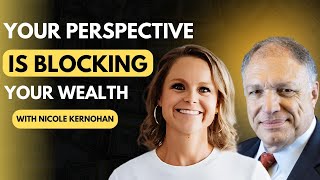
Secure Your Financial Future: Quiet Psychology Moves That Make Your Money Work For You

Psychologist Nicole Kernahan explains how the language you use about money shapes your financial decisions. Gratitude and daily affirmations can rewire your brain toward abundance thinking, while scarcity language limits what you earn and invest.
Questions this video answers
10–20 minutes a day.
30 days.
October 27, 2025.
keepellivated.com/backslash web-undundance-journal (as spoken in the transcript).
Chapters
Ladies and gentlemen, thank you so much for spending a little bit of your time this afternoon with us. We are back with Nicole Kernahan. We are on our question and answer session and we had some fascinating questions. So we're going to turn this back over. As you know, Nicole is an expert on psychology. She's an expert on self talk and, and personal development. She and I have been working together for about three years. She is an amazing lady and has some very, very great, very great insights on how our selft talk and our, our ourself, what we think about affects our income and the way we, way we make money. So I'm going to turn it back over to you. Go with it, Nicole.
Awesome. Thank you so much, Jim for having me. And it really is this how so powerful how our, our thoughts influence like I like what you said, right. Not just your income but it, they influence your actions, they influence what you're willing to invest in and what types of career opportunities or business opportunities you look for. So, so there is such a direct correlation. Awesome. Well, let's just jump in. There's just a few key takeaways we're going to share today and a couple of questions to follow up from what we talked about on Tuesday. So here's one of the key takeaways. And people are often intrigued by your words and how significant of an impact they can have. So I'll read this here. Your language sets your financial ceiling. Words shape identity. Identity drives decisions. Scarcity words reinforce fear and abundant words create confidence. So the words you use are twofold. A, they're a reflection of your current beliefs and identity and how you see yourself. And B, you can use them as a tool to shift your perspective. But I love when I work with clients and I'm sure, Jim, you hear it either in yourself and in others, you can hear in their language what their beliefs around money are, what their beliefs around investing. If they say things like I can't or I don't have enough or I can't afford or money doesn't grow on trees, some of these beliefs came from, from childhood. But just even if they're referring to I'd love to, but I'm not, I'm afraid to take that risk. Right. You can see what their beliefs, their thoughts and beliefs are by the words that they use. I am kind of curious in your experience, Jim, when you, because you worked in the financial industry, like how you've seen words in your own life or in the lives of clients affect their actions.
The, the, the words you Know, you, you touched on it. You said it.
Really.
I, I can't. I don't have enough. I can't have enough. The, Their fear. The fear words. I'm afraid. I don't think that will work. How can that work for me? Instead of the positive impact words like, that's great. I know I can do that. I know that will work. You are, you have great ideas. Those are the type of words I like to. That's the type of languaging I like to hear. But you're correct, hearing those other. Hearing that other languaging is. It's very telling to me when I talk to potential investors about, you know, about what we're doing and how we're doing it. And it gives me some guidance on how to, how to talk to them and, you know, how to maybe assuage their fears, that sort of thing. Back to you.
Awesome. I think it's just really fascinating how much you, how much your words are in. Are a reflection of your beliefs. So if you want to know what you believe about money, about your worth, about your income or investing potential, listen to your own words. Consider. What are your. What are the thoughts you have and what are the things that you're saying? And one of the biggest questions we get is how do you change that? And first of all, first and foremost, you, you have to realize that it's not a fact, it's a belief. A belief is something you believe to be a fact, but it's not. They're. They're not facts. You have to. The first step is awareness. The first step is saying, wait, is that. Is. Are those words, are those the thoughts that I'm having? Actual fact, or are they just passed down or even an experience based on my current awareness? So let's jump to the second key takeaway. They're all connected. You'll see some of these connections here. So we talked on Tuesday about the, the different levels, kind of the different layers to shifting your lens, right? Shifting your. The way you see yourself, the way you see the world, the way you see your opportunities into an abundance lens. And it starts with gratitude, purpose and vision. This is how you rewire your lens. You, you know, and I'm just. Read what it says here. Gratitude calm stress and expands perspective. Purpose and vision anchor your decision. Impossibility, not pressure. I am always amazed every week when we hear from clients. And I know you've seen a lot too, Jim, in people, in their experience of how gratitude shifts their perspective. When you see, when you can shift the way that you see the world and shift the way that you see yourself and shift the way that you see your opportunities. You will take different actions. And gratitude, it's like one of those things, right? It's so easy to do and it seems so simple. It seems like how could practicing gratitude affect my risk tolerance? How could practicing gratitude affect my ability to, you know, take action within with investments or with different money making opportunities? And I want to reassure you and everyone that it does. This is the starting point. All of our, all of the programs that we teach at Elevator, any of the entrepreneurial programs we have, we ask all business owners to go through this first to shift the lens like everyone. It's like the mandatory step to be able to put on those lenses of, of abundance before you start talking about your business and your opportunities and especially before you show up in the world because you're influencing others. Let me have any thoughts to add on that. Jim? Just.
Yeah, I was going to say, you know, the gratitude, the expression of gratitude, the fundamental belief in gratitude and the fact that you live in abundance in an abundant universe gives you so much more, so much stronger impetus for investing. I can't tell you how many times that people I talk to, people who, who believe in, you know, in, in the abundance, in, in the abundance mindset, their approach to investing is so much different from people who believe, believe who live in a lack mentality. You know, the lack mentality promotes such a fear based reaction to investment. When on the other hand, somebody who, who lives in gratitude and, and significant abundance, they are, they approach investment in an entirely different way.
And I want to emphasize what you're sharing is not just their external reality. You could have two people with the same financial ability to make the same level of investment with a different lens. And the way that they see things will affect what they take action on. And therefore like if you think that in five years, in 10 years, in 20 years, they're going to end up in a very different place.
Absolutely. Absolutely.
Albert Einstein and I know you've heard this quote, Jim, but for those listening that Albert Einstein shares that the greatest decision you can make in your life is whether you believe you live in a friendly or a hostile universe. And the way I refer to that is just looking at do you see things from opportunity, abundance and solution and creation or from lack, fear, worry, worst case scenario? So awesome. All right, let's take a step, a stab at takeaway number three. And this is the idea of small daily steps compounding into lasting wealth and lasting happiness and abundance in all areas of life. I refer to this. And through elevator worldwide we refer to this. 10 to 20 minutes a day, listening, reading, writing, speaking. Repetition shifts the cycle. Subconscious, right. That calm confidence, that's where we're, what we're talking about. That shifts your lens to actually make better financial decisions. But I think it's just also wanting to, I really want to emphasize here this idea. You may have heard of it, if any, if anyone's read Atomic Habits. But if a, if a plane changes the trajectory of the nose of their plane by just one degree at takeoff, the accumulation over time means they'll land in a completely different city. It doesn't have to be a major change. It's the small daily habits. The small daily habits of thoughts and the small daily habits of actions. Which makes it easy. Which makes it. It is easy to do, but it's easy not to do. All right, let's jump to the.
Sorry, go ahead, Jim, Let me interject this. Nicole, do you want to touch. You know this I think might be a good time for you to touch on the fact that you know what your subconscious. But the difference between what your subconscious and your conscious hear, see and, and take in. You know, you've talked so many times about the fact that you know the sub. The conscious is the analytical. The subconscious just takes what what. What you give it. It doesn't not know. It does not know right right from wrong, good from bad. Anything else. It is it. It your subconscious absorbs things as you give it to them.
Yes. I love that. Thank you for pointing that out because that is really when we're talking about shifting the lens and looking at things from an abundance perspective. We're not talking about just on a conscious level through conscious effort. We're talking about it on a subconscious level. And this small repetition with emotion is what, is what shifts that. The subconscious controls about 93 to 97% as we've talked about. And your subconscious can't differentiate between what's real or imagined. Right. To your point, Jim, it can't determine if it's good or bad or true or false. It just takes the direction that it's given and accepts it. So the point of this shift and the point of these efforts is not to. To only check to change your conscious thoughts. That is only gonna have a very small impact on your results over your lifetime. The intention is to take those conscious thoughts and deposit them into the subconscious part of you. Because when it's your subconscious mind, it's a feeling and you can feel the difference when you are feeling abundant when you're feeling positive opportunities versus feeling the emotions of fear, worry and doubt. But the interesting right we is when you're a child your subconscious is wide open and that's why we A lot of the perspective we have around money was formed when we were kids. So if we have an abundance lens or a lack lens, most of that was actually created when we were children. So as an adult now we have the opportunity to be intentional with shifting it. Awesome. Go ahead, let's jump on to the next one. So this one is referring to the same thing I was kind of sharing but it's really understanding because we do get this right and I get it like concerned about the amount of time that you have available. I'm time starved. How long does this take? And you know 10 to 20 minutes a day. Is you price Bridget. No, it's someone else. Les Brown, Jim Rohn one of them share right. That you will only be willing to pay the price if you believe in the promise. If you believe that the influencing your subconscious mind and changing your lens to an abundance lens will impact your actual results in your life then you will be more likely to be willing to take 10 to 20 minutes a day. The net time saved over your lifetime by making faster decisions. Successful people make decisions quickly and stick to them. Right. And change them very slow if at all. And reduced worry. How much time is worry taking up in your mind and fear and overanalyzing things. Right. The actual amount of time saved by shifting your lens and being able to feel more confident and make decisions more quickly in your business or in your life. You can't even compare it. But this is where you have to trust in the promise. You have to be willing to put that time in in order to get that long term reward. Awesome. Is this just hypey positive thinking? So you know what? Even when I first got into this industry 10 years ago, this idea of is this too fluffy or woo woo or like how does it really work? In my own personal experience I. I just believed it. So I didn't actually have a lot of the doubts. But I know and I just, I know having worked with lots and lots of people over the past decade that this is a common concern is like is this, does this positive thinking stuff really work? And this is where we have to reference the psychology and the statistics and the hundreds of authors who have come before us to do the research and provide the data to. To actually confirm how your brain works and how it changes. Structured repetition changes your neural pathways. We didn't even know that. Right. Like 10 or 20 years ago, we didn't know that you could change your neural pathways. Like science hadn't come along far enough to know that that was even possible. We now know that it is possible to change your neural pathways, which means you can redirect your patterns of thought. Progressive affirmations is a term that I use and it's essentially to bridge belief gap. So you're not trying. I'm not. We are not trying to suggest that you just go from intense fear around money to overnight just saying money is everywhere and I have no fear at all. Right. Sometimes that jump from lack to abundance is too far for people. So you use a progressive, I call them progressive affirmations. But it's the idea of using words and thoughts to build your belief or to bridge that gap. So you can choose. I'll just give a quick example. But you can say, up until now I have had some fear. I have had some fear around my finances and today I'm choosing to see solutions. Today I am choosing to believe it's possible that things can change. So it's the idea of having a language that you use that progresses your belief. Then the last one just says backed by positive psychology research and client metrics. I already referenced that as well. And the next slide we can share is actually one from Tuesday. But this was. This is what some of the questions we often get right. It is around the what does the research say? Because it's hard to pay the price if you don't know the promise. So I'll just read them quickly. Especially because for those who didn't see it on Tuesday, or even if you did, we just talked about the power of repetition. Gratitude reduces financial stress. In studies, people who practice gratitude reported lower perceived financial pressure and more life satisfaction even before income levels changed. Scarcity narrows focus and drains capacity. Behavioral science research shows that when the mind is focused on not enough time, money or resources, it reduces decision making capacity leading to costly mistakes. You, you can't let that happen. Right. You don't want to be making inaccurate decisions because of your. Your scarcity thinking. When you write down your goals, it makes you approximately 42% more likely to achieve them. And then the last one is affirmations envisioning rewire default neuroplasticity. As I referenced, research shows repeated focus on abundance creates new neural pathways, helping your subconscious align with possibility rather than limitation with. With shifting your mind. It does take time and repetition. Right? Creating a new neural pathway is like paving or like A new walkway in a trail. You gotta cut it down, walk it 100 times until that becomes the smoother pathway.
So it is actually something you have to work towards. Yeah, my experience, I've been, I've been involved in this for many, many years. And it, it's not an instantaneous, instantaneous change, but it does, it does change. It's amazing how what you do, how you, you look back and you say, oh wow, how much you've changed. People generally overestimate what they can do in, you know, in a week or a month and vastly underestimate the change that they can make in a year. So I encourage people, you know, get involved in this, take these steps and download the, the Abundance Journal. Nicole, do you want to talk a little bit about, just a quick blurb about Elevated and, and what Elevated can offer people?
Sure, I will share too. Like that journal. Just a really quick recap that abundance journal keepellivated.com backslash web-undundance-journal. We gotta get a shorter term, shorter version of that. It is a 30 day daily thing. It is intended to follow the process of small daily repetition to rewire your neural pathways. So it is, it is, it is created in a way that it's something you can try and test out at home to go through that. And then I actually put on here like we have our next exponential activation three week programming. It's actually coming up October 27th depending on when you're watching this 2025. It is kind of a preview of what we do right? And what we do at Elevated. It is a daily process for things that you do at home where we suggest we give you what to listen to, we give you what to write, we give you what to read and spend speak. And then we have a weekly coaching group where you get personalized and attention and personalized coaching for what you're working towards. But this three week activation is kind of the first step and Jim, it wasn't the first step when you were here. When you were here, we only went straight into gratis shift. And we do sometimes, we'll have sometimes folks jump straight in to gradish shift. We have found that this activation has really helped people get into the habit of the process and prime their minds to really get the full experience when they go into some of the other modules. We do work a lot with entrepreneurs primarily like I would say 85% of our clients, maybe 90% of our clients are entrepreneurs. Not exclusively and driven to change, driven to grow, driven to have, you know, have big goals but not wanting to do it in the way where they're just forcing and grinding and trying the same thing over and over again. It's moving towards these new, these big goals that you have as an individual or for your business or for your finances in a more in a smoother flowing way. Not like not willing to tolerate force. You're always looking for a new way to shift. So.
But we will put in the show notes how to get that exponential activation three week program. We'll put, put contact information there so everybody, anybody that wants to, to grow, to improve, to, to learn how to, to not just in their, not just in their wealth, not just in their investment, but in any and all areas of their life. This is an amazing program. I, I can't tell you how much I have learned, how much I've grown by doing, by going through it. I encourage everybody to even just give it a look. We'll give it a look. See. So thank you Nicole.
Awesome.
Appreciate your time. You are an amazing talent. We love you. You've got, you know, you're brilliant lady. Look forward to talking to you again soon. Have an absolutely great day. And ladies and gentlemen, thank you so much Ty for, for taking some time to join us this afternoon. If you have any further questions, get in touch with, just get in touch with me. Get in touch with Nicole. We have no problem answering further questions. Thank you and everybody have a great day. Goodbye for now.
Thank you so much Jim. Appreciate you. That's awesome. Bye bye.
More from James






AI for Real Estate Investors: What Smart Capital Builders Know That Others Don't - Live Q&A