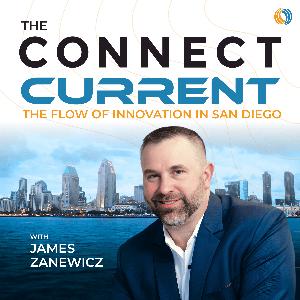
The State of San Diego Innovation According to James Zanewicz
20 Oct 2026 · 24 min
In this episode of The Connect Current, host James R. Zanewicz (CEO of Connect) and producer Austin Robertson take a panoramic look at San Diego’s innovation ecosystem. Zanewicz frames the region as a richly endowed “road network” of talent, universities, defense presence, life‑science clusters, AI, climate and tech assets, but notes the ecosystem has lacked a real‑time guide—like a Waze app—to help founders navigate opportunities and challenges. He provides sector‑by‑sector snapshots: life sciences (top‑three biotech hub, $1.7 B VC in H1 2026, talent gaps at the wet‑lab/computation interface), tech & defense (Shield AI, battlefield 3D‑printing, slow government‑contract pipeline), AI (Qualcomm’s Modular acquisition, low AI adoption among local firms), and climate (Solve Energy IPO, scarcity of large growth checks). Across sectors, he observes that the most successful companies straddle multiple domains, founders are purpose‑driven and want to stay local, yet they often don’t know which resource or contact to approach next. Capital is flowing—$3.6 B VC in 2025 and $3 B in Q1 2026—but is top‑heavy and local venture capital is limited; Connect aims to bridge external and local investors and increase the proportion of Connect‑affiliated funded companies from 13 % to 20 % by 2030. The conversation then shifts to Connect’s evolution from a hands‑on incubator in the 1980s to today’s “connective tissue” that curates, aligns, and stewards the ecosystem through programs like Springboard, Cool Companies, and the AI in Healthcare (AAIH) network. Zanewicz ends with a call‑to‑action: founders should engage Connect early as a guide or “hospital concierge,” investors should view Connect as a trusted filter, and corporates, universities and service providers should plug into the network to keep San Diego’s innovation momentum moving as one.
Chapters
Welcome to The Connect Current, the flow of innovation in San Diego. We bring you the founders, investors, and leaders building the future across life science, tech, climate, defense, AI, and more. This is where San Diego's next chapter takes shape.
Welcome to The Connect Current, the flow of innovation in San Diego. My name's Austin Robertson. I'm the marketing and events coordinator at Connect. I'm stepping in for Trey today. I'm excited to be joining the Connect Current as your producer going forward. Today we're going to be doing something a little bit different. The person who usually asks the questions is going to be answering them today. I'm joined by James Zanewicz, the CEO of Connect and the regular host of the Connect Current. This season, James has sat down with founders, investors, university leaders, and ecosystem builders working across life sciences, defense and dual-use technology, AI, health innovation, and more. Those conversations offer a useful vantage point of where San Diego's innovation economy stands today. This is a great Connect Current conversation because it steps back from any single company and looks at the whole ecosystem. We'll take a quick tour through the sectors Connect works across, from life sciences and tech and defense to AI and climate, talk about capital and where founders still get stuck, and look at how Connect and programs like Springboard, Cool Companies, and AAIH powered by Connect fit into what comes next. So, James, you usually ask the questions, so today we're going to be turning it around. If you had to describe San Diego's innovation ecosystem to someone meeting it for the first time, what would you tell them, and where's the momentum right now? Why does this moment matter?
Well, I think what's really key, Austin, is that San Diego innovation has all the assets. We have, you know, if you want to do kind of a driving analogy, we have the road, we have the destinations, We have the drivers, we have the cars of all different types, but what we haven't had up until this moment is that Waze app or that guide, that pathfinder that shows you the fastest route and reroutes you when the road changes at times. And some of those assets we talk about, if we want to get into what they actually are, we have a depth of talent and research. We have over 100,000 tech and life science and defense and AI, et cetera, workers. We have one of the nation's deepest concentrations of engineers and scientists. We have incredible universities. I mean, UC San Diego alone brought in $1.8 billion—
Wow.
With a B, in researcher words, in FY26, one of its highest totals ever. And that's in a tough grants landscape. Defense is a backbone. The military drives $61.3 billion, again with a B, in economic impact here with their presence. It's about 22% of the regional economy and roughly 1 in 5 local jobs. And they do a lot in innovation as well, which most people don't know. Life science is world class, but you know, under pressure as we all know right now. But we're a top three global biotech hub, about just shy of 65k direct jobs and average salary of $203,000 a year, which is pretty incredible, and about $55 billion in regional impact. Employment dipped down a little bit. Lab vacancies at a cycle high, but there are some positives of that too that we'll that we'll talk about. And one is that you know it's never been a better time to build a life science company in San Diego because while People will talk about the affordability of building companies here when you have that much open space, like rents are discounted. When you have large companies that have reduced workforce, you have incredible talent that does not want to leave San Diego and is here and available fractional and perhaps at a, at a fraction of the price they used to be. So it is an ideal moment to start your company here and get the support of the ecosystem, the resources of Connect, et cetera, et cetera. Um, we have strong but concentrated capital, and most of that is brought in from outside. It's what Connect really focuses on, but through $3.6 billion in venture capital in 2025, and then $3 billion just in Q1 of 2026. Most of that quarter went to a single defense AI deal, which was Shield AI. Life science raised about $1.7 billion in the first half of 2026, matching almost all of 2025. So we're on the upswing. And AI plus life science as a combo took about 92% of this year's dollars. We're seeing more exits. Lilly and Ventix, Qualcomm and Modular, and Solve Energy that went public. So a lot of really interesting things. And our good friends at the Regional EDC call this an incredible inflection point. And I think we agree here at Connect. And the opportunity is that we're spreading momentum beyond a few mega deals to the next 100 group of companies, that good mid-tier. And the success of this depends on how the pieces connect. And there are constraints to name. I mean, we, we do have more expensive energy and water costs, which make large-scale computing expensive here. But you also have great institutions like UCSD working on ways to bring that cost down in a way that make it much more qualitative. And the last little thing I'll throw in is we're not just, we're not just San Diego, we're not just the U.S., we're a binational region. And the Cali-Baja corridor has 850 life science and medtech companies. TJ has 73 medical device plants and about $3.2 billion in annual exports. That's also a way to keep costs down is to headquarter your company here, do some work right across the border and go back and forth. Um, that's, I think it's plenty. I just talked a lot.
Plenty. Awesome. All right. So you've spent this season in conversation with founders, investors, and ecosystem leaders. Looking across those episodes, what patterns or themes keep coming up And what has surprised you the most?
Well, I'm— it's interesting. The one of the key patterns is that, and it should be no surprise, the best companies straddle sectors or verticals. Hyperkelp, which hits ocean and climate, Cov Therapeutics, which is, you know, bio and technology, and then Sesh, which is doing AI in healthcare around cancer. We're seeing a lot more of the what bucket do they fit into? It's hard to describe. Pattern 2 is, is I think that founders rarely say I need another program to go through here in San Diego, but they say I need that guidance, that pathway, that introduction to capital at the right time or to a resource at the right time. I think 3, and one of the reasons we're so excited to have you here is because you are very grounded in purpose, is that our founders are grounded in purpose. They want to stay here. They want to scale here. They don't want to have to partner and move their company out of San Diego. And despite us having had New Orleans-like weather the last week, you know, more and more. Companies, I think people are drawn to San Diego and want to stay. And I guess the surprising thing to finish that off is they don't know who to call next. And that's where those assets, which are so incredible, those places that exist to help people, the accelerators, the incubators, the service providers, the universities, everything that's out there. No one was really helping our founders navigate the richness until this moment. And that's where Connect in the last year has really stepped in.
Mm-hmm.
It's becoming that guide, that Waze for innovation.
Exactly. Great. Yeah. And it's, it's a hard city to leave for sure.
Absolutely. Absolutely.
All right. So now we're going to go ahead and do a quick lightning round through the sectors Connect works across.
Oh, no pressure.
Life sciences, tech and defense, AI and climate. So for each one, we're going to go ahead and cover kind of what's working and what's missing and one company we should be watching. So,
all right,
take it away, James.
All right. Which one you want to hit first?
Let's go ahead and start with life sciences.
All right, let's do it. What's working? We're a top 3 US market. We talked about the number of workers we have, you know, just shy of 65,000, $34 billion in direct output. And just as we mentioned earlier, $1.7 billion in venture funding just in the first half of 2026, nearly matching all of 2025. And so, so what we're missing, it's the predictability of research funding in this space, which generates a lot of what comes out. And that we have incredible talent here, but we do have scarcer talent bridging computation and wet lab biology. But that's where, again, our universities, UCSD, San Diego State University, they're really stepping in to generate the next iteration of the workforce to bridge this gap. What's the one company to watch? Well, I've, I've got a few here. Campfield with their $180 million Series A, Element Biosciences, they had a $175 million series led by Samsung. And then of course, 2 of our faves here because they're there are board chair and our incoming board chair, Crystalis and VetMab, both of which just completed rounds.
Awesome. Solid answers, James. I think you're going to do just fine with the rest of these. Why don't we go ahead and talk about the tech and defense sector?
All right. Well, you can't do this without talking about what's working with Shield AI. You know, $1.5 billion raised at a just shy of $13 billion valuation. Everyone knows Firestorm as well. $82 million raised for battlefield 3D printing, which has so many dual-use applications. And then Martak opening a Defense Innovation Center here. And we have SDSU again about ready to explode on this scene because they're developing a whole innovation platform around defense and dual-use tech. And what Halima Nott and her team over there are doing is incredible. I guess what's missing, that path from startup to government contract is still slow. There's some confusion in the language back and forth, I think. And that's where places like Connect can help with that. pilots, grants, and CRADAs are the bridge there. And Connor Hefner's Navy CRADA for his company Odin actually came through Connect Connections. So we're able to help companies navigate that and figure out where they go. And gosh, one to watch, SeaSats. They have autonomous ocean vessels, which is really interesting. And I think keep your eye on them.
Interesting. Great. Okay, let's move on to the AI sector. What do you see going on in there?
Well, you know, Qualcomm, Can't mention San Diego without Qualcomm, quite honestly, but they acquired Modular for just shy of $4 billion. And AI is increasingly central to drug discovery and genomics, which again is why we're really excited to have the Alliance for AI in Healthcare in UnderConnect. And anyone who's interested in participating in that can hit us up to learn how. What's missing here? Only about 18% of our local firms engage with machine learning or AI-ish type things at all. So adoption is early on that machine learning kind of bent. And so I feel like we can do more and more of that to optimize what we're doing here. Let's see, one to watch, Ribodyne, uh, AI-driven genome sequencing and drug discovery. I'd keep my eye on them.
Great. And, uh, last one, we're almost out of this round.
All right.
What about climate? Let's talk about that for a bit.
So what's working here? I think Solve Energy had their $512 million IPO. General Atomics is doing really, really cool fusion work. And, and then you layer on that, UC San Diego's work with their StartBlue accelerator. There's a whole lot of potential there. And then missing, it's no surprise, it's money. It's large growth checks for climate hardware. They're scarce right now. It's just, it's an interesting cycle for this space where it's harder and harder for them to find investment. But then you want to watch Hyperkelp, go back and listen to their episode. Really, really cool stuff. Or Aquaporo, they do atmospheric water type work in a $5 million seed round, which was really incredible to watch. And I think, you know, that's it. That's all I got.
Well, that's all I had as far as verticals here, but those were some great answers. Thank you, James. I think there's a theme kind of developing here, and that's some of these, some of the most interesting companies that are coming out of this region sit at the intersection of these sectors like AI and biotech or defense and climate. So what does San Diego do well when those worlds come together, and where do founders working across them most often get stuck?
I think what they do well is when you look at our history, we have that genomics heritage that was developed here in many ways, and it gives AI the structured biological data it needs. Because AI is great, but if it doesn't have data, it's like any database, you know, it's as good as what you put in it. And we have incredible information to put into it. We have also defense customers next to ocean science, wireless expertise behind health tech. It's the crossover stuff. And some examples there are are Fabric8Labs, CSATS that we talked about, Ribodyne that we talked about. And there's a lot of the crossover stuff. And I think San Diego melds disciplines and new disciplines better than anywhere else. And I think that does lead to where founders get stuck sometimes, though, as we talked about, you know, sometimes our companies don't fit into an investor's one thesis or one program's box. So they, they can risk getting passed between silos without proper introductions. to folks who can figure out who actually understands that straddle moment. And that's where Connect can come in and where Marshall, Kiana, Petra, the team really strive to help those founders find the right funders at the right moments. And I think this is where we can almost look at Connect and what we're doing for the ecosystem. In addition to the driving, you could also have a hospital analogy. We have specialists in verticals really diving deeper, but we have that one shared patient record that Connect has as part of our brain and part of our data. So we can kind of pull people in and maybe pull a couple specialists together to, to cure that company and make them successful.
And love that metaphor.
And it's a little Grey's Anatomy action there. Maybe that's what we should do. We should figure out, do I get to be McDreamy or McSeany then? I don't know.
I think we'll, we'll table that.
Oh, ouch. And I think, you know, what could help here? A little more honesty like Austin just gave me. The Connect team, you know, and by team at Connect, we mean staff and board. It takes us all together to drive the ecosystem. And together we can be that known trusted guide, that hospital concierge, however you want to look at it, and give that introduction to the right people at the right time.
Awesome. Great. So let's talk about capital next. San Diego produces these world-class science and engineering companies, but they also need capital. So how healthy is the investment picture right now and what would it take for more San Diego companies to get funded and funded here?
More and more money. It's always about the money, right? I know. Yeah. Everyone's like, oh, well, tell me more. All right, I'll try and dig in a little more. Um, we're healthier than we have been, but we're top heavy. We have a few deals that were more than half the year's total so far, although we're starting to catch up a bit. But below the mega deals, the rounds in Q1 and 15 of them were in that $10 million to $50 million range. So you have things up near the billion and things that are smaller. We do have those exits that are back in vogue. We talked about some of those before. Lilly and Ventec, Qualcomm and Modular, ResMed and Noctrex. And we do have local funds. Yeah, we have less resident venture capital here than most places. Yeah, we're a top 10 for investment, but we're— I think we're out of the top 20 for resident venture capital. But our local funds are raising again. We have Blueprint Equity, Carmel Capital, and Social Leverage all raising rounds of varying amounts from just shy of $100 million up to $350 or so million. And that, that helps us prepare for what it's going to take for those people to deploy capital. And it means our companies have to be readier. They have to be prescreened and vetted for deal flow so investors don't have to waste their time searching here like they do in other ecosystems. And we need to activate our local investors to co-invest with outside people because it's easier for them to understand when they have someone on the ground and kind of have someone who can visit the company and report back. And so that's why those partnerships of outside capital and local trusted capital work so well. And then the one stat I always like to tout is that, you know, 13% of our companies in San Diego that raise capital are Connect companies in some way. And our team, as you know, Austin, has a goal, an audacious goal. By 2030, we're going to raise that to 20%. Yes,
we do.
And maybe more. 20% is our baseline.
Exactly. Fantastic. So now let's go ahead and talk about Connect's role. So Connect has been part of San Diego's innovation story for 40 years. What does it mean today for Connect to be the connective tissue rather than the center of every initiative? And looking at the founders coming through Springboard, Cool Companies, and AIH, what do they need that the ecosystem isn't giving them yet?
Well, I mean, it's interesting that you talk about the evolution and what does it mean to be connective tissue rather than the initiatives themselves. And we still have some initiatives that are needed, like our Cool Companies, as you mentioned. But we used to, you know, in 1985, we were the only place to find for help. And we would, you know, companies would come in and we'd give them that, that Hey, here's your homework for this quarter. Come back, get it graded, you know, do your business plan, file your IP, all the things that universities, accelerators, incubators do now that Connect doesn't do anymore. We're always leaping to fill the gap we see. And one of the things that was my favorite just from this week, and I shared it with the team, is we had a founder register for Founders Forum who had just founded it. And he said, I have seen Connect evolve for 20-plus years, and it's been 41 for us. So he's been with us for half our time. And he says, a new butterfly emerges every few years. And I think, you know, it was one of the most profound things and that this is one of those moments. And in many ways, the current Connect staff and the team of the staff and board together are refounding Connect and this newest iteration of Connect, this newest butterfly, monarch, whatever we are. We're the trusted guide or that Waze for San Diego innovation. We don't own the road or the cars, but we help the founders and investors find the fastest route to each other. Or reroute them when conditions change. And again, we're not, not a drawbridge or a gate that you have to go through, but we're there when you need us. If you look at our history, 41 years, 4,000 companies helped, it's always no equity, no fees, no cost to those companies. Our values really guide how we do it, and I think they always have. But we're fortunate to, as a team, have, have cemented these recently where innovation, we pioneer what's next. Alignment, we move as one, which doesn't always have to mean we agree, but we Come together and move in a direction with the community. And then stewardship, that we view San Diego and our obligation to San Diego as sacred, and we earn trust through what we strengthen. Again, focusing on relationships and not transactions, curation, not closed doors. And we're looking ahead in decades, not quarters. And it's the same players on the same map in San Diego. But I think the difference is the connect is different and that we're in that middle helping everything get around. And I think when we talk about AI in healthcare, again, the AAIH powered by Connect brings just shy of 12,000 engagements, followers on LinkedIn and AI healthcare community into the network in general. But it is now hubbed in San Diego, and that's just amazing.
That's incredible. Well,
did I answer your whole question? I don't know. I just rambled.
You know, I think you did.
Okay.
And then some. So it's more than I could have asked for. James, thank you. We'll go ahead and bring us to the end of the show. But before we close, what would you ask of everyone listening, whether they are founders, investors, corporate partners, or institutions? Since you usually get to ask this one, it's only fair to end with it. James, what drives your innovative flow?
Oh, I have— I don't know if I've gotten to answer this one or not, but I'll have to come up with a cute answer. So founders, use Connect as, as your guide, as your pathfinder, however you want to say it, your hospital concierge, whatever your analogy is. Come to us before you're ready, not after. You know, don't wait until you need the emergency room. Come to us when you start to feel that pain so we can help you out early.
Exactly.
Or even before pain, when we can anticipate your needs down the line and, you know, pre-diagnose. Investors, let us be your trusted filter. We can help you invest locally. We can help you meet local investors to do things with. For our corporates, universities, service providers, they are honestly what makes San Diego companies so investable and keep them here. So plug in with us, layer that network. And I'd say again, you're thinking back to, and I love this, Austin, you came up with kind of the compass as part of the guide thing for us. And think of Connect as a compass. Tell us where you're trying to go and we'll help you navigate there. We'll be that needle that will try and help you show the truest north. And we're guides, not gatekeepers. You don't have to always come to us, but we're here when you need us. And again, that, that callback to our values, I think is so important. I just want people to understand that When we think of innovation, we're asking what can we do differently at every moment? When we think of alignment, we ask how can we move together? When we think of stewardship, we're asking are we leaving something better for those who come next? And whether that's the companies of the future, the investors of the future, the future students in the academics, the future employees at service providers or other accelerators, or, you know, quite honestly, the future team at Connect. We want to leave something more for them to build from because Connect is San Diego's ultimate long play. It was 41 years ago. It is now. And when Connect wins, San Diego wins. And I guess we're down to the innovative flow now, which I kept trying to put off. What's yours first? I want to ask you yours first. It's your first time on the podcast.
That's a great question. I wasn't prepared for it. I know my head. My innovative flow. It's a great question. And honestly, I think A lot of it comes from the love I have for this that I found for this city in San Diego. And I think you see it in everything. And, you know, it's when you're going around to the beach and it's happy hour and it's spending time with the friends and it's the weather, it's everything about this makes me just want to build here and help others build here and create their innovation here in San Diego. I think this is a beautiful place and the more we can do to help other people build and create and live here, I think that that's a, it's a great calling.
I love that. I love that our listeners now got to know you and it bought me enough time to come up with my creative answer. But I think, you know, it's personal for me. I mean, whether it was, you know, I grew up in Louisville, Kentucky. I've bounced all over. I've, I've lived in Los Angeles and in D.C. and Urbana-Champaign, Illinois, and New Orleans, Louisville again at one point, and then San Diego. And I think the, the thread that drives me everywhere I go and what drives my innovative flow is, is helping people find their people. It's one of the reasons I think why Misty Kane and Jonah Peak and I have become such good friends is all 3 of us are passionate about that. And it's not about— it's not about what we get from it. It's what other people do and taking joy in that. And that's what turns my crank and, you know, why it's my why, I guess, in many ways. And I have nothing else to say on that.
Great. I love that. That was a great answer. All right. So, James, thank you. It was a lot of fun to get to turn the tables, get to join the podcast here. And this was a great reminder that San Diego's Innovation's strength comes from how its sectors, institutions, and people connect with one another. Or as we like to say at Connect, it's where innovation moves as one. Your view across the region helps founders, investors, and partners see where the momentum is and where they can plug in. We appreciate you joining us on the other side of the mic. And for the listeners, thank you for listening to The Connect Current. As always, we will have more information on James Zanewicz, Connect, Springboard, cool companies, AAIH powered by CONNECT, and UC San Diego Park and Market in our show notes.
Thanks for listening to The CONNECT Current. If you want to learn more about CONNECT and explore resources across San Diego's innovation ecosystem, follow us on LinkedIn or visit connect.org. We'll see you next time on The CONNECT Current, where San Diego's innovation story keeps moving forward.
This podcast was edited and produced by Resonate Recordings.
More from James
How Founders Can Connect with SDSU’s Research and Innovation Engine featuring Hala Madanat
Episode 156: Answering YOUR Questions Part 2 – Founding and Building a Biotech Startup Company
Episode 155: Answering YOUR Questions Part 1 – Biotech Career Advice and Professional Development
Accelerating Innovation Through AI, Non-Dilutive Capital, and Smarter Pathways to Market featuring Rupak Doshi
Episode 154: How to Build Trust and Navigate Culture in the Global Biotech Business