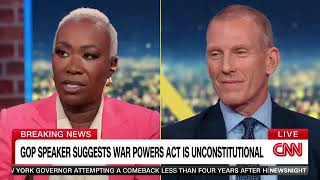
In this segment of CNN’s NewsNight, host Abby Phillip moderates a heated panel featuring Joy Reid, House Speaker Mike Johnson, and foreign‑policy analyst Jamie Metzl. The discussion opens with President Trump’s recent airstrikes on Iran, his public taunts toward Congresswoman Alexandria Ocasio‑Cortez, and the resulting calls for impeachment. The panel debates the constitutional status of the War Powers Act, with Johnson arguing it is itself unconstitutional and others asserting that the Constitution requires Congress to declare war while the president serves as commander‑in‑chief. Joy Reid invokes Eisenhower’s warning about the military‑industrial complex and argues that the American public is exhausted by endless, often unilateral, interventions. Metzl counters by emphasizing the post‑World War II era of unprecedented peace and prosperity that, in his view, rests on sustained U.S. global leadership. He notes that despite flawed interventions, America’s diplomatic position after the Iran strikes is stronger, potentially enabling a new nuclear‑inspection deal with Iran and broader regional agreements. The conversation weaves historical references (Hamilton, Eisenhower, Wilson), critiques of past administrations’ use of “self‑defense” justifications, and divergent visions for how the United States should wield its power—either through continued military action or renewed diplomatic engagement.
Chapters
Back to our breaking news. The ceasefire between Israel and Iran appears to be holding for now while President Trump spends his night in the Netherlands for the NATO summit, just hours after announcing that deal. But he spent his morning taking shots at Congresswoman Alexandria Ocasio-Cortez as calls for his impeachment over striking Iran grow louder over on Capitol Hill. Today, Trump dared AOC and her Democratic friends to impeach him again. Going full-on Clint Eastwood, saying, "Make my day." AOC hit back, accusing the president of illegally bombing Iran and dragging the U.S. into war. As we were discussing in the break, this idea that the president never goes to Congress, frankly, to authorize strikes or authorize war has no— No president.
—span.
Virtually no president. But let me just play, actually— No one. This is House Speaker Mike Johnson, who is arguing that the congressional power here, the War Powers Act, actually, that's the part that's unconstitutional.
Many respected constitutional experts argue that the War Powers Act is itself unconstitutional. I'm persuaded by that argument. They think it's a violation of the Article II powers of the commander-in-chief.
I think that's right. He is the—
he is the speaker of the House, the legislative branch.
I think the way— I think the way it was supposed to play out by the Founding Fathers was Congress determines if there's going to be a war, and then the president as the commander-in-chief, then he takes— he or she takes over.
So you think Mike Johnson is wrong about it?
So I think, I think that's what Alexander Hamilton and the Founding Fathers— what Alexander Hamilton wrote in the Federalist Papers, that unlike a king who could, who could declare war on his own, the president of the United States can't do that. Congress has to do that. But the way we've got— and I do believe George W. Bush did go to Congress regarding Afghanistan. But the way they get around it, President Clinton and many others, is when President Clinton went to Haiti, is like, look, I'm not starting a war. I'm just going in to fix a couple of things. It's a little bit of self-defense. It's in the national best interest. And here it's so minimal. It's just like, we went and we bombed. That's it. We're done.
It might be right now. But I think therein lies the rub, is that when you start something— I've said this every night this week— you start dropping bombs, you don't know that it's going to end with those bombs. And you begin with the—
with the debate of that depends on what the definition of war is, OK? And so, OK, but listen. I think that's part of the reason why Congress has such low approval ratings, because it depends on what team is in charge and what they say. And in our lifetime, there's been at least a dozen military actions by Democrat and Republican presidents where they don't go to Congress. And if you're a Republican and there's a Republican president, then it's A-OK. If you're a Democrat and it's a Democratic president, then It's A-okay. If it's the opposite, then you— so then you come off looking inconsistent and like a hypocrite partisan. But I do— but let me also say this. I think it is insane and ridiculous that the president of the United States, in the middle of this international incident, in the middle of this war, as he is negotiating a ceasefire en route to a NATO meeting from Air Force One, is waging a war of words and tweets against a Democrat congresswoman from New York who's not even in a leadership position. So, I mean, dude, how can we possibly have any confidence in this child with a Twitter feed who can't even control his impulses? Well, they're both children.
Yeah, but one of them is president of the United States. The other one is not.
Abby, you talked about the fact that the majority of the American people are opposed to this. And I think I am among them and I speak for them in some ways because I think that There used to be a saying that the United States should no longer be the world's policeman. And, you know, Dwight David Eisenhower, at his low moment, hired the Dulles brothers—not a fan. But at his high moment, at the end of his presidency, he warned about the military-industrial complex, that there would be endless wars because there was endless profit to be made. We have had military action after action after action and have not declared war against another country we've bombed since World War II. And yet the American people are becoming exhausted by this idea that at any president's whim, we are bombing this country, and then we're bombing that country. We're gonna fix a little thing here in Haiti. We're gonna tweak a little thing there. We're gonna pick governments for countries that didn't ask us to do it. We're gonna remove and depose and change governments and do regime change. It's— the American people are exhausted of this. There is so much more that we could do with the precious funds the American people, the taxpayers, give to the government. How about helping to make people's lives more affordable? How about making people's lives better? And stop with the endless wars.
Donald Trump ran on that. And he is— now in a way walking away from it in part.
So did Woodrow Wilson. No, no, no, Joy is right that President Eisenhower warned against the military-industrial complex. President Eisenhower also believed in the essential role of American leadership. That was why he was president, because of his leadership in World War II when America had to step in to save the world. So America has this role. You may not like it. But we have lived since 1945 in the greatest time of peace, prosperity, and wealth creation and innovation in all of human history, thanks in large part to American leadership. There are many, many frustrations that many people like myself have. We have had all kinds of interventions that have been ill-advised and downright wrong. But America does have this role. If you want to say we want to live in this democratic world that you're kind of imagining, That is a much more dangerous—
Can I ask you a question? I assume you're in favor of the Iraq War. I was not. How do we make— I was not. Oh, okay, all right. We keep on going in and making the decision in our arrogance as to what governments, people should have, what they should do. But bottom line—
Sometimes there are bad decisions and sometimes there are worse decisions.
And you are saying that you feel that there is a strong moral case for us using our leadership in the world to simply bomb countries that have not attacked us. Not countries. And that when we do that, it's justified. In 1979, you're taking us back to 1979. No, no, no, they never stopped. The bottom line is— The bottom line is, Iran was without an Iran nuclear agreement since the Obama administration. Wow. And you cannot—
agreement, they were funding all these proxies that were, that were attacking, killing us.
Okay, you think, you think a piece of paper is going to stop fanatical mullahs who want to murder Americans? To stop that, a piece of paper?
The bottom line is Iran would not be led by fanatical mullahs had the United States not imposed the Shah of Iran upon them. The United States intervention—
Can I just ask you, or maybe make a point? Donald Trump, 13, 14 days ago, wanted a deal with Iran. He wanted a piece of paper, because I think he understands— he did the Abraham Accords. He understands the power of making a deal. So I don't know that the idea of a deal with Iran is just a piece of paper. Trump wants it. He would prefer that because it's less messy than dropping bombs, which he knows is unpopular.
Well, let's go back to what Chuck Schumer said a good deal would be back when he opposed Obama's silly deal.
Yeah, you know what I'm talking about.
Hang on, hang on, though. He's— he's— Chuck Schumer said we needed a deal where Americans could inspect Iranian facilities at any time with no notice, as often as possible. That's the kind of deal Donald Trump wants. How do you—
but how do you get there but for diplomacy? That's my point. You have to get to the table. And so at the end of the day, the bombs are a delay, but it does not resolve the problem. I think it has been clear that he's—
right now America is in a stronger diplomatic position now across the board than we were last week. And so if— I mean, right now we did drop these bombs and the world's greatest nuclear— America is in a stronger position. Diplomacy is advanced. The possibility of an agreement with Saudi Arabia is increased. This so far, I mean, I'm a Democrat. There are all kinds of things where I critique vocally President Trump, but so far this is a pretty big win for the United States and for, certainly for the Democratic countries.
All right, we got to leave it there for that conversation. Jamie Metzl, thank you very much. It's always interesting at this table when people from different parties actually agree with each other. But breaking news tonight, a Democratic socialist is leading Andrew Cuomo in the New York City mayoral primary in a race that could very well be a sign of where the Democratic Party is heading. Another special guest is going to join us in our fifth seat.